Who certifies the past, who pays to keep it, and who collects
Opening: Liverpool
Liverpool’s grandest stone was paid for by trade, a trade which began with people. Across the eighteenth century Liverpool overtook Bristol and London to become Britain’s leading slaving port. Some 5,000 voyages left the Mersey, and by the end of the century Liverpool ships made up more than two-fifths of all European slaving voyages. Around 1.5 million Africans were carried in them. In the last decade before abolition in 1807, four in every five British slaving voyages sailed from here.
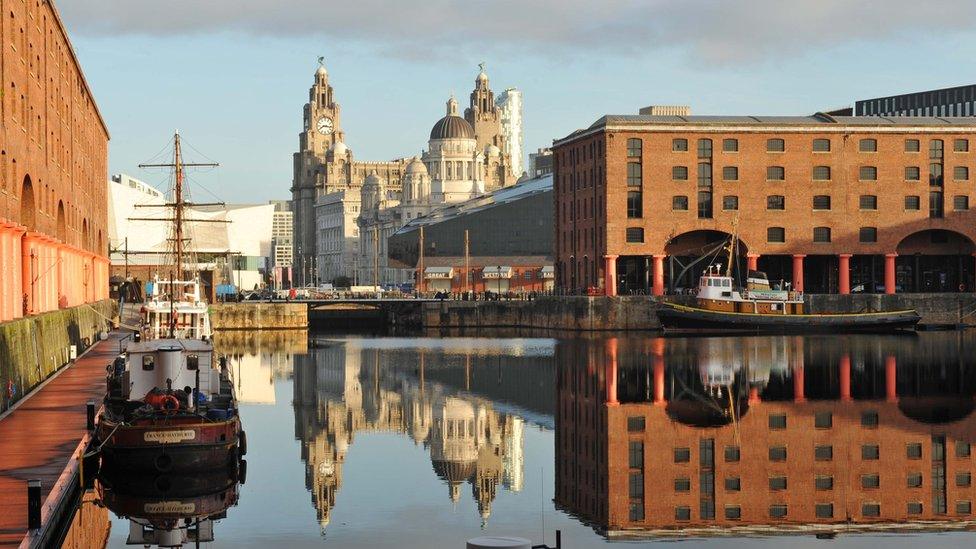
Most of what the city now shows off came after abolition, but not after slavery. Jesse Hartley’s Albert Dock opened in 1846. The Three Graces at the Pier Head, the Port of Liverpool Building, the Royal Liver Building and the Cunard Building, went up between 1907 and 1917. They were built on cotton, sugar, tobacco and emigrants; the cotton was grown by enslaved people in the American South until 1865, shipped through Liverpool to the mills of Lancashire. The stone is Victorian and Edwardian. The money behind it is older, and the city waited until 2007 to tell that part of the story in the International Slavery Museum. When the Albert Dock was first reborn as a heritage attraction, as David Harvey noted, its story left out the slave trade, and it took protests to put it back.
The city’s two cathedrals are not old at all, yet both are protected heritage. Giles Gilbert Scott’s Anglican cathedral looks medieval. It was begun in 1904 and finished in 1978. The Catholic Metropolitan Cathedral went up in under five years, from 1962 to 1967, Frederick Gibberd’s concrete tent pitched on the crypt of Lutyens’s unbuilt giant. It was upgraded to Grade I in 2025. Heritage is not a matter of age. It is a matter of decision.
In 2004 UNESCO made the biggest decision of all. It inscribed “Liverpool – Maritime Mercantile City” on the World Heritage List: the docks, the Pier Head, the commercial quarter around William Brown Street. The original case rested on Liverpool’s place in world history, its trade, its migrations, the slave trade itself. Not long afterwards, as the planner Ian Wray has pointed out, the statement of what made Liverpool special was rewritten, without public consultation, to stress buildings, architecture and views. Liverpool’s history became Liverpool’s collective symbolic capital.
That rewrite set the trap. Peel Holdings’ Liverpool Waters scheme for the derelict northern docks put the city on the In Danger list in 2012. Then came Everton’s stadium at Bramley-Moore Dock. In July 2021 UNESCO deleted Liverpool from the list, only the third site ever removed, citing the irreversible loss of the very things it had certified.
Liverpool chose one rent over another, and did it in the open. The government said it disagreed with UNESCO. Local voices asked why an empty dock was worth more than a football ground. The city weighed the global brand against the development, and the development won. That is the argument of this essay in a single city: heritage is a rent, rents compete, and someone always decides which one counts.
Step 1: Heritage is made, not found
History asks what happened. Heritage asks what the past can do for us now. David Lowenthal drew that line in The Heritage Crusade and the Spoils of History (1996). Heritage, in his account, is not bad history. It is a different activity, one that uses the past to claim identity, belonging and ownership. Seen that way, two questions follow at once: who is doing the using, and who is getting paid.
The past, left alone, is a public good. Nobody owns the sight of a spire or the story of a dock, and one person’s enjoyment takes nothing from anyone else’s. Designation changes that. It draws a line round a building, a street or a landscape, gives it a name and a grade, and turns shared value into a scarce, certified asset. Scarce, certified assets earn rent.
Valuing the past is ancient; certifying it is modern. Rome revered Greece, collecting, copying and looting its sculpture. Renaissance humanists and popes hunted for antiquity; around 1519 Raphael wrote to Pope Leo X protesting that Rome’s ruins were being burnt for lime. The Enlightenment catalogued the past and the Romantics fell in love with its ruins. None of them drew a boundary round a building and gave it a grade. Veneration is old. The certificate is new.
Certification was invented by privileged Europeans. The Grand Tour was the aristocratic prototype: the past as something to collect, with Canaletto painting Venice for English buyers and crates of antiquities shipped home to country houses. Thomas Cook brought a version of it to the middle classes from the 1840s. France built the state machinery first. The Revolution smashed churches, the Abbé Grégoire coined the word vandalisme in 1794 to condemn it. By the 1830s Prosper Mérimée was inspector-general of historic monuments, with Viollet-le-Duc restoring buildings to an ideal of how they ought to have looked. England answered with campaigners rather than ministers. Ruskin and Morris attacked restoration as a kind of forgery, Morris founded the Society for the Protection of Ancient Buildings in 1877, and the Ancient Monuments Protection Act followed five years later. Postwar listing came in 1947, UNESCO’s World Heritage Convention in 1972. In 1983 the National Heritage Act created English Heritage. As Lowenthal noted, the Act’s authors deliberately left “heritage” undefined, leaving the heritage to define itself. A category with no fixed edge can be stretched to cover whatever someone wants certified.
Even the words give the game away. The French call it patrimoine, what is handed down from the father. “Heritage” shares the same root idea of inheritance. And inheritance has heirs and titles.
There is no single certifier, and each creates value in its own way. UNESCO’s listing is mostly brand: in English planning law it is a consideration, not a bar. Listing by Historic England restricts what an individual owner may do. Conservation areas restrict whole streets, which tends to protect everyone’s value at once. The National Trust and English Heritage both own sites and vouch for them, a different relationship altogether. France’s Malraux law of 1962 went further than any of these, zoning historic districts and handing tax breaks to the private owners who restored them.
Nature is no exception. UNESCO lists natural sites under the same convention as cathedrals. In Britain, national parks date from 1949 and Areas of Outstanding Natural Beauty, now rebranded National Landscapes, cover the Cotswolds and much else. The Lake District won World Heritage status in 2017 not as wilderness but as a cultural landscape, shaped by sheep farming and the Romantic poets. The mechanism is the same whether the asset is stone or fell.
Step 2: Designation locks in value more than it creates it
Two groups create heritage value, and they are rarely the same people. The first built the thing: the wool merchants, weavers, masons and dockers, long gone and collecting nothing. The second re-valued it. They arrive when an old district is cheap and unloved, buy, restore and campaign, and turn a run-down terrace into a period gem. In 1964 the sociologist Ruth Glass watched this happening in London and coined a word for it: gentrification.
The evidence from England suggests designation follows the second group rather than leading it. LSE research for English Heritage covered more than a million house sales between 1995 and 2010, across more than 8,000 conservation areas. Homes inside sold for about 23% more on average, and for about 9% more once location and type of property were taken into account. But the premium grew over time, and the formal act of designation made no significant difference to prices inside an area. Neighbours just outside the boundary gained up to 4%, fading to nothing within about 500 metres.
The homeowners ask for it. A later paper by Gabriel Ahlfeldt and colleagues, pointedly titled “Game of Zones”, treats designation as a process that serves local owners. A conservation area removes uncertainty about what the neighbours might build, at the cost of limits on what you can do to your own house. The authors found that as local taste for historic character rises, which is to say as an area gentrifies, designation becomes more likely. The certificate arrives when the incomers want their gains protected.
Designation is less a lever than a lock. It does not so much create value as guarantee it, and the guarantee goes to whoever already holds the deeds. Those who rent, or who might have moved in later at the old price, get the view and the period features, but not the gain.
UNESCO’s effect is more contested, and that is telling in itself. A 2024 study of Italian towns found that World Heritage listing raised incomes and property prices in urban areas. A study of Old Rauma in Finland found a positive effect too small to be statistically meaningful. In Tel Aviv’s White City, researchers measured the other side of the ledger: what owners lose when they can no longer knock down and rebuild. Whether the label lifts prices depends on what else a place has going for it. What it reliably does is change who may do what with the land.
Harvey explains where the rent goes. In “The Art of Rent” (2002), David Harvey argues that monopoly rent arises in two ways. In the first, someone controls a resource of special quality and sells access to it: the hotel with the view of the Pier Head, the tour round the cathedral close, the short let in the old town. In the second, the resource itself is traded: the Georgian house sold on the strength of its certified stone, the estate bought as a store of value. Heritage produces both, and in both cases the rent flows to whoever owns the land or controls the access.
Harvey saw that uniqueness has to be vouched for, but he looked at wine, not buildings. Claims of special quality, he argued, are an effect of discourse as much as of the thing itself, and French wine shores up its claims with terroir, tradition and the appellation contrôlée. Heritage designation is the same device applied to stone, streets and landscapes. The certificate turns a contested claim of uniqueness into an official one, and an official claim is far easier to charge rent on.
France makes the mechanism explicit. The Malraux law of 1962 did more than protect historic districts. It paid private owners to restore them. The scheme still runs: a tax reduction of up to 30% on restoration works of up to €400,000 over four years, marketed openly to high-income investors. The Marais in Paris, among the first districts protected, is still the standard international example of heritage designation followed by gentrification.
Step 3: The costs fall on the public
The certificate is cheap to issue and expensive to keep. Behind every listing stands a chain of public bodies: UNESCO, the culture department (DCMS), Historic England, the local conservation officer, and a ring of charities between the state and the owner. That chain has been thinning for fifteen years. DCMS grant-in-aid has fallen by about 18% in real terms since 2010, and local authority spending on services for the historic environment has fallen by 47% since 2009/10. The listings stay on the books. The people who look after them are fewer every year.
The tax system subsidises private heritage owners. Under conditional exemption, heritage land, buildings and objects pass on death free of inheritance tax, provided the owner keeps them up and allows reasonable public access. Around 300 owners have such arrangements, at a cost to the Treasury put at about £40m a year. That figure comes from Historic Houses, the owners’ own association, and the access required is often a few weeks a year.
The lottery fills the gap, and the lottery is regressive. The National Lottery Heritage Fund takes in around £350m a year from lottery players and plans to hand out £3.6bn over the decade to 2033. That income has held up while tax-funded budgets have fallen. But poorer households spend a larger share of their income on lottery tickets than richer ones. Theos found the payouts mildly progressive and the overall effect regressive, and in a 2018 Lords debate Lord Kerr called the lottery the most regressive tax in the United Kingdom. As the state steps back, a growing share of the bill is met through a levy that falls hardest on those least able to pay.
Watch how people move through a cathedral. Some come in a group behind a guide. Some do a brisk circuit of the monuments and dedications, light a candle, take a few photos and finish at the altar. Nothing wrong with any of that. And then there are the others, taking their time, guidebook in hand, reading the brasses and the memorial tablets, people like the human in this writing partnership. The building, the signage, the guidebook and the repair programme are all arranged to satisfy that second kind of visitor.
The public pays to keep it that way. England’s Anglican cathedrals alone receive more than eleven million visits a year, yet the bill for the stone does not fall on the visitors. Between 2014 and 2018 the government’s £40m First World War Centenary Cathedral Repairs Fund made 146 awards to 57 Anglican and Catholic cathedrals. It was justified as commemoration, so that the buildings would be fit to host the centenary services. Commemoration is a harder thing to argue with than taste.
Who decided? We can name him. The repairs fund’s expert panel was chaired by Sir Paul Ruddock, co-founder of the hedge fund Lansdowne Partners, chairman of the V&A from 2007 to 2015, a serious collector of medieval art, and one of the most generous donors in the British arts and heritage world. His name, or his family’s, is on galleries at the V&A and the British Museum, among them the Sutton Hoo gallery at Bloomsbury.
By every account he cares, and the money is real. Ruddock’s commitment to medieval art is long-standing and serious, a collector’s passion rather than a vanity project. The money behind it comes from somewhere specific: the success of Lansdowne Partners.
That is the twist. Hedge funds are often cast as the purest rent-seekers in modern finance, earning their returns from positioning in markets rather than from making anything. Here part of that accumulation flows back into heritage: galleries free to enter, cathedral roofs kept watertight, a benefit open to everyone who walks through the door. Rent taken in one market is recycled as a public good in another.
The recycling carries a price, even if the price is only a name. The donor’s taste gets an institutional home. The donor’s name goes on the wall. And because gifts to charity attract tax relief, part of every large donation is money the Treasury has chosen not to collect. Whether that is a fair exchange, or a good one, when compared to funding by tax or lottery, we leave open.
And the philanthropy of finance matters more every year. As public budgets for culture tighten, galleries, repairs and acquisitions lean ever harder on private money, and Britain’s biggest givers are more and more likely to have made their fortunes in finance. Whoever funds heritage increasingly shapes what heritage is.
Residents pay in kind. Congestion, rising rents and displacement fall on the people who live in a heritage place, not on the people who own its assets or run its visitor trade. Nobody sends them an invoice. They pay by leaving.
So the ledger reads like this. The rent flows to owners, landlords and the visitor trade. The costs fall on taxpayers, on lottery players and on residents, and the share carried by the taxpayer at large is shrinking. Private philanthropy, much of it made in finance, fills some of the gap and gets its name on the wall. The certificate itself costs almost nothing to issue.
Step 4: Success eats the asset
Monopoly rent depends on uniqueness, and selling uniqueness wears it away. This is the first contradiction Harvey identifies in “The Art of Rent”. The more marketable a place becomes, the less unique it is, because the marketing itself tends to destroy the unique qualities. Whoever collects the rent has every reason to take it now and little reason to keep the asset whole, because the cost of the wear lands on someone else.
Venice is the contradiction carried almost to its end. In 1975 the historic centre had about 104,000 residents. It now has fewer than 48,000, and on an average day around 40,000 visitors. In 2024 it became the first major destination to charge day-trippers to come in, and on the days the €5 fee applied, visitor numbers went up. The fee has since doubled for late bookers and spread to more days. A city that charges admission is well on the way to becoming an attraction rather than a city. Harvey tells of a student who preferred Disney World to Europe, because there all the countries were so much closer together. The more Europe redesigns itself to Disney standards, he argued, the less unique and special it becomes. Las Vegas already has its own Venice, canals and gondolas included, and the real one is learning to manage its visitors like a theme park.
Barcelona built its symbolic capital, then started paying for it. Harvey used Barcelona as his own example: Catalan history, Gaudí and the 1992 Olympics, followed by the chain stores, the traffic and the first signs of what he called Disneyfication. Rents in the city have risen by about 68% in ten years. In 2024 the mayor announced that none of Barcelona’s 10,101 tourist-flat licences would be renewed when they expire in November 2028, an attempt to claw homes back from the visitor trade.
The Lake District shows that nature is curated too, and contested. It won World Heritage status in 2017 as a cultural landscape, after bids in 1986 and 1989 were deferred, on the same boundary as the national park drawn in 1951. The listing rests on sheep farming, which angered rewilding campaigners who argue it preserves an overgrazed landscape. Meanwhile about a quarter of the Park’s homes have no permanent resident, and at the cheaper end of the market a house costs more than 13 times local earnings, against about 9 times across England. The certificate celebrates a working landscape whose workers can less and less afford to live in it.
The pattern is the same at every scale. The rent is collected faster than the asset can be maintained, the people who made the place drift out, and the public is left with the cost of the wear.
All which it inherit, shall dissolve. The Human League called their deadpan list of wants “The Things That Dreams Are Made Of”, and the phrase goes back to Prospero, watching his own pageant melt into air: “The cloud-capp’d towers, the gorgeous palaces, / The solemn temples, the great globe itself, / Yea, all which it inherit, shall dissolve.” Heritage sells the towers and the temples as permanent. The rent it earns is what dissolves them.
Step 5: Deciding what counts as heritage is political
At the international scale, a listing can stand in for a claim to sovereignty. The Old City of Jerusalem and its Walls was inscribed in 1981 at Jordan’s request, and it still appears on the list as a site “proposed by Jordan”, with no state named as its owner, because ownership is the question nobody can settle. It has been on the In Danger list since 1982. UNESCO’s own papers record that no benchmark for taking it off has been set, “due to the political context”. Here the certificate protects an argument as much as a city.
Only three sites have ever been removed, and in each case the state chose to give the label up. Oman’s Arabian Oryx Sanctuary went in 2007, after the government cut the protected area by 90% once oil was found. Dresden went in 2009 over a four-lane bridge across the Elbe valley. Liverpool went in 2021. War-damaged sites in Syria, Iraq, Libya and Afghanistan go onto the In Danger list and stay there. Removal happens only when an owner decides another rent is worth more than UNESCO’s, and says so.
At home, “what is worth keeping” quietly becomes “whose past is worth keeping”. Spitalfields, a mile from the Bank of England, shows how. Huguenot silk weavers built its Georgian streets in the eighteenth century. The Jewish East End followed in the nineteenth, and the Bangladeshi community in the twentieth.
One building carries every layer, though the official record favours one. At the corner of Brick Lane and Fournier Street stands a chapel built for Huguenots in 1743–4. It became a Methodist chapel in 1819, a synagogue in 1897 and a mosque in 1976. It is listed Grade II*, and the official reasons for listing are its mid-eighteenth-century chapel design and its rarity as a surviving Huguenot chapel. The synagogue and the mosque appear as conversions. On the pediment is a sundial dated 1743, carved with Horace’s motto Umbra sumus: we are but shadow.
The revaluers arrived in 1977. By then 90 of Spitalfields’ 230 important old buildings had been demolished in twenty years, many to make way for the market and the creeping edge of the City. A group of young architectural historians, Mark Girouard, Colin Amery and Dan Cruickshank among them, founded the Spitalfields Trust. They squatted two condemned weavers’ houses in Elder Street for seven weeks, staged a sit-in at British Land’s offices, and with John Betjeman’s support forced the developer to sell. The Trust bought its first houses cheaply. Houses like them now change hands for millions, and many of the buyers work in the City the Trust was holding back.
The layer that was restored is the layer that was priced. The Georgian Huguenot fabric was listed, protected and sold. The Bangladeshi presence was branded rather than protected: the ward is called Spitalfields and Banglatown, the curry houses are a tourist draw, and the 1978 murder of Altab Ali is remembered in a park that bears his name, not on the heritage list.
Then finance rented the image. In 2001 a new independent agency stockbroker, Execution Limited, decided that its challenger status would be enhanced by setting up in the Truman Brewery, complete with table football and dress-down every day, just a mile down the road from the City firms it was taking on. Finance capitalised the image. Ten years later the firm was gone, sold to Atlantic Equities, a London broker specialising in US shares, which in 2023 was folded into Redburn, the research challenger already owned by that venerable scion of the banking world, Rothschild & Co. They are back in the heart of the City, at New Court on St Swithin’s Lane.
Taste decides, and taste has a class. The cathedral fund and the Spitalfields squatters make the same point from opposite ends. A panel of connoisseurs decides which roofs get public money. A group of architectural historians decides which street is worth sleeping in a roofless house for. Both acted from real knowledge and real love, and both turned their own taste into the nation’s protected stock. Bourdieu would call it distinction. The protection then paid out to whoever held the deeds.
Heritage is a rent on the past. The public creates it and pays to maintain it, and private owners collect the money. Whoever decides what counts as heritage decides who gets the rent. Liverpool, at least, made that choice in the open.


Leave a Reply