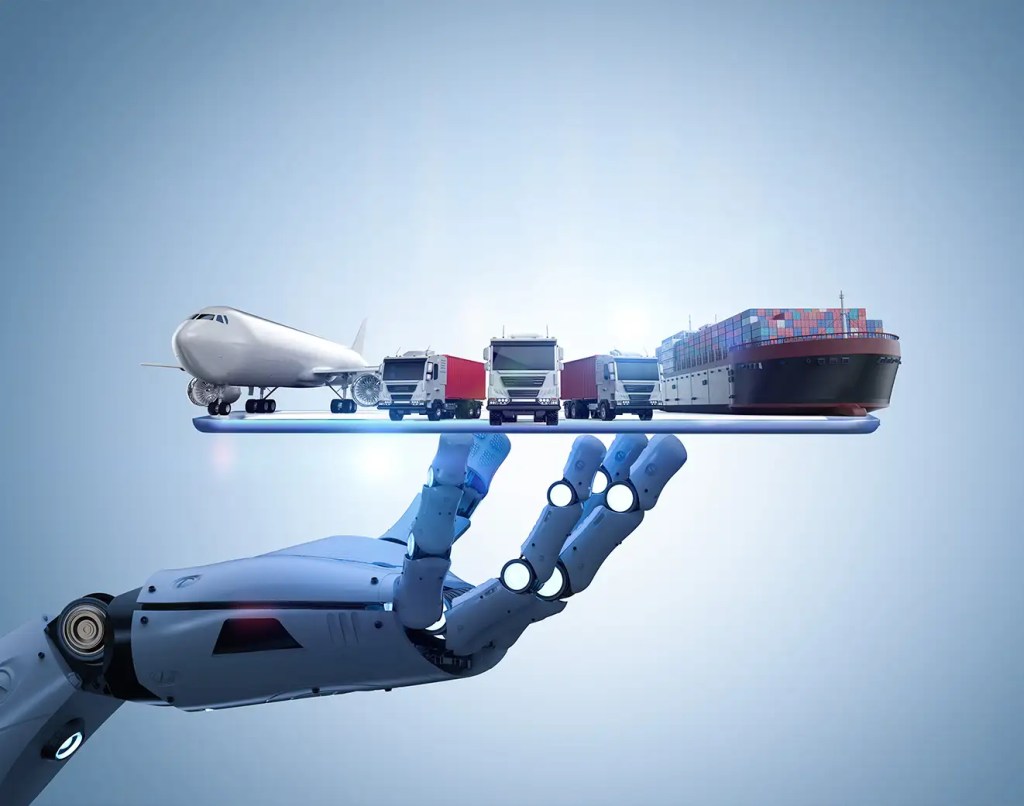
The price of the situated hand: how AI and robots might rewrite logistics
This essay argues from mechanism and public evidence. We have no inside experience of warehouses, haulage or rail. Much of the evidence is American and some of it comes from the firms themselves; each source is graded in the text, and where we offer explanations for the data they are explanations, not established drivers. Outcomes cannot yet be known. If you know this world from the inside and something here is wrong, tell us and we will correct it. The essay was researched and drafted with an AI; the methodology note at the end says how.
Too late for Halloween
This essay was meant for Halloween and has turned up more than a week late, still unable to choose a costume. The vampire is Marx’s and too well worn. Ghosts are for things already dead. Zombies are closer. In the end it came dressed as two things at once: a robot that hasn’t been born, and a worker who has been declared dead but keeps clocking in. Neither turns out to be a monster. Both are cards in someone else’s hand. Don’t take fright, we will explain.
1. Sacked before they are hired
Amazon: a way to sack employees before they are hired. In October 2025 the New York Times reported on internal Amazon documents setting out how the company’s robotics team planned to double the volume of goods it sells by 2033 while keeping its US workforce flat. Automation would let it avoid hiring more than 600,000 people it would otherwise need, and around 160,000 by 2027 alone, saving roughly 30 cents on each item picked, packed and delivered. The long-term aim was to automate three-quarters of operations. The documents reportedly also advised staff to talk about “advanced technology” rather than automation. Grade: strong journalism, reporting a firm’s own forecast. It is evidence of intent, not of outcome.
The workers being replaced do not exist yet, which is why nothing shows. There are no redundancies to report, no closed sites, no picket lines. The documents speak of hires avoided, not jobs cut. Amazon said they were incomplete and did not reflect its overall hiring strategy, and pointed to the 250,000 seasonal workers it was taking on for Christmas. Both things can be true. A firm can hire a quarter of a million people for December while planning not to need the next six hundred thousand. This is the first of our two costumes: an unborn robot, replacing unborn workers.
The robots that do exist are already close to outnumbering the people. Amazon put its millionth robot to work in June 2025, in a warehouse in Japan. Its operations workforce is estimated at around 1.2 million. The company says packages handled per employee rose from about 175 to about 3,870 in a decade. Grade: firm claims carried by trade and technology press, weak to middling; the headcount comparison is an industry estimate.
What this shows / what it doesn’t. It shows the largest operator in the sector planning around workers it will never hire. It doesn’t show that the plan will be met. A forecast written inside a firm that wants the forecast to be true is the unborn robot on paper.
2. The brain went first
In logistics the thinking was automated long before anyone called it AI. Routing, scheduling, slotting stock, setting the pace: these went to warehouse management systems and handheld scanners twenty years ago. The scanner is Taylor’s stopwatch made portable. It tells the picker where to walk, what to pick and how long she has to do it. She is living labour, alienated, moving at dead labour’s rhythm.
Marx came early to the warehouse party. Machines are dead labour. Capital was the vampire which fed on the labour that remained. Dead labour is past work frozen into things: the scanner, the conveyor, the software, each the product of someone’s labour years ago, now owned by the firm. Living labour is the work being done today by people who can be paid more or less, and who can stop. Capital, in Marx’s best-known image, is dead labour that lives only by sucking on living labour, and lives the more, the more it sucks. In a modern warehouse the image is less a metaphor than a floor plan. The dead labour sets the route, the rate and the target; the living labour supplies the legs and the hands.
The unborn robot is the dead labour from the future. It scares the living before it exists. Marx’s vampire had to be built before it could feed. The robot in Amazon’s planning documents feeds on promise. Its effect on hiring, wages and bargaining starts the day it is announced, years before it is switched on, and whether or not it ever is. That makes the worker who is still needed something stranger than living labour: a job already written off in the forecasts, still done every shift. The undead. That is the second costume.
What is left is the hand in clutter. Reaching into a bin of mixed items and pulling out the right one is easy for a person and very hard for a machine. Hans Moravec spotted the pattern in the 1980s: what humans find hard, computers find easy, and the reverse. Amazon’s own engineers describe picking in clutter as the unsolved problem. Its newest arm, Vulcan, which has a sense of touch, can handle about three-quarters of the items at the site where it is being tested. The last quarter is the situated hand. Grade: firm claims via trade press, weak to middling.
The machine got the brain; the worker kept the backache. This inverts what happened to lawyers, which we have described elsewhere (https://athomehefeelslikeatourist.blog/2026/11/06/the-collapse-who-answers-for-the-machine/), where the human kept the judgement and lost the drudgery. In a warehouse the judgement went first and the drudgery that won’t automate stayed with the person.
What this shows / what it doesn’t. It shows a specific, named technical gap at the point of the hand. It doesn’t show how fast that gap is closing; three-quarters at one test site is a snapshot, not a trend.
3. The robot that was born and died
Ocado built the most automated grocery warehouses in the world, and its biggest American customer has started switching them off. In 2018 the US grocer Kroger agreed with Ocado to build twenty robotic fulfilment centres. Eight were built. In November 2025 Kroger said it would close three of them, in Maryland, Wisconsin and Florida, and took charges of around $2.6 billion. Order volumes had not been enough to earn a return on the high fixed costs. Ocado’s shares fell by about 16% on the day. Kroger agreed a compensation payment for the early closures. Grade: company announcements via financial press, strong on the facts.
The robots lost to people with cars. Kroger’s chief executive said that in most places it made more sense to fill delivery orders from stores, because stores are closer to customers and so delivery is quicker and cheaper. Alongside the closures Kroger expanded deals with Instacart, DoorDash and Uber Eats. At Kroger the robots were made redundant. The humans kept their jobs, at gig rates, in their own cars.
The reasons are not as clear cut as they look. Online grocery growth slowed after the pandemic. Kroger was rethinking strategy under new leadership. American suburbs sprawl in a way British cities do not, and Ocado’s UK business runs in denser markets. Kroger kept five of its Ocado sites, and said automated centres still do better in dense areas with strong demand. The volume explanation is the one the evidence supports best, but it is not the only one.
What this shows / what it doesn’t. It shows a fully built robot system losing to people on cost. It doesn’t show that this generalises: one partner, one market, several overlapping causes.
4. Robots love repetition
Robots love repetition. They don’t like surprises. Neither do humans, but they hate repetition even more. The economics of automation favours big and predictable volumes pushed through minimal points. The economics for humans favours variable and unpredictable one-offs spread across a myriad of points.
Technology enables but doesn’t define this. Amazon succeeds because it pools volume at scale and drives down price. Kroger discovered with its Ocado sites that it was cheaper to pay people peanuts to wander around a store making up the baskets. Not enough volume to justify the technological cost.
AI, and its friend the robot, can compress time, but the situated hand is still needed to handle space. Logistics, ultimately, is the optimisation of stuff across time and space. Marx, when he wasn’t breathing life or death into labour, unsurprisingly got there first. In the Grundrisse he explained the annihilation of space by time. As capital expands, it tries to remove spatial barriers to exchange by creating faster communications and transport, so the time spent travelling between places is reduced. Logistics, in a nutshell. Though probably not the textbook definition to trot out when going for a job with Amazon. David Harvey, the Marxist geographer, has expanded this further with his concept of time–space compression. Capital can change how humans experience space and time, making them feel closer together, through technologies of communication and travel that reduce the “turnover time of capital”, helping speed up global production and exchange. For us, AI and its friend the robot can compress time, but the situated hand is still required to handle space. Some of the time.
5. Back in the cab to sit there
Long-haul driving was the job the robot was always about to take. Self-driving lorries have been five years away for the best part of fifteen years, and several well-funded firms gave up waiting. In 2023 alone Embark shut down, TuSimple wound down its American business and Waymo, Google’s sister company, shelved its trucking arm to concentrate on robotaxis. On 1 May 2025 Aurora Innovation, the leader in the field, launched what it called the first commercial driverless trucking service on public roads, hauling freight between Dallas and Houston with no one behind the wheel. Grade: trade press, middling; the “first” claim is Aurora’s.
Three weeks later a human was back in the driver’s seat, not to drive but to sit there. The truck maker, Paccar, asked for it, citing prototype parts in its vehicles. Aurora said the observer would not touch the controls. Paccar’s chief executive later told analysts that having a driver in the seat “seems like the smartest idea”. A short seller’s report had questioned Aurora’s claims a few days before the reversal (weak source, named as such). Whatever the reason, the human went back in to carry the risk, not to do the work.
The robot chose its own terrain. By Aurora’s own account, fog, rain and high winds kept its fleet off the road about 40% of the time in 2025, until a software update in early 2026. Its second route, Fort Worth to El Paso, was chosen partly because it is long, flat and often featureless. The motorway is the job as an operations researcher draws it: a line between two depots. The yard, the reversing bay, the roadworks and the city streets are the job as it is actually done, and those stayed with people.
Fourteen months late, the observer got out. In July 2026 Aurora launched a second-generation fleet, built on International trucks with cheaper hardware, running with no one aboard across ten routes in the American Sun Belt. It had logged about 440,000 driverless miles by the end of June. Its build partner is aiming for 1,000 trucks a year, and one customer has signed a non-binding agreement for 500. The target for the end of 2026 is around 200 driverless trucks: a significant step for the firm, a rounding error against the American trucking workforce. Grade: Aurora statements and trade press, weak to middling.
The money was never what kept the driver. In 2025 an American heavy truck cost $2.34 a mile to run, of which the driver’s wages and benefits were $1.03, about 44%. Drivers’ wages rose more slowly than inflation for the second year running. Grade: the American Transportation Research Institute, an industry research body, middling; US data. With the driver at nearly half the cost, the incentive to automate is enormous. It took weather, a manufacturer’s caution and fourteen months of safety cases to get the human out of a cab on a flat Texas motorway.
In Britain the backstop is already written into law. The Automated Vehicles Act 2024 makes an “authorised self-driving entity”, usually the manufacturer or software developer, legally responsible for how a self-driving vehicle drives. The person in the seat, the “user-in-charge”, is immune while the self-driving feature is engaged, but must take back control when the vehicle asks. Much of the Act depends on secondary legislation still to come. Grade: statute, strong. The stopgap human now has a legal definition.
What this shows / what it doesn’t. It shows the expiry date slipping, then arriving, on the easiest terrain available. It doesn’t show whether driverless trucks will spread beyond Sun Belt motorways, or what happens in the yard, the city and the rain.
6. The hand is best raised at the chokepoint
The situated hand is best raised at the chokepoint. Consider the train drivers on the London Underground. In 2022 and 2023 Mick Lynch, general secretary of the RMT, was either a demon wreaking economic havoc or an eloquent and much missed defender of the working class intent on defending passenger safety, depending on your point of view. He and the rail unions could bring London to a standstill. On the Tube itself most drivers belong to ASLEF, around four in five of them. The fact that they could do this reflected their bargaining power. The Victoria line has run with automatic train operation since the late 1960s. The DLR was built driverless in 1987, though it still has staff on board. So on parts of the network the technology has been there for half a century. Yet drivers still sit in the cab and are paid around £64,000. Why? Answerability. A driver is a chokepoint in a network that can’t be routed around, with a safety licence attached. A lorry missing its exit in the rain risks a load. A train carries a thousand passengers. This is potential human tragedy.
The human who can prevent tragedy should command a premium for her labour. A chokepoint makes that premium visible. Organised labour is best placed to realise it. In contrast, if the risks of failure are trivial, the task is dispersed, the labour is fragmented and unorganised, is purportedly self-employed and is easily replaced, then pricing power evaporates.
Where workers held a chokepoint, they won. In August 2022 about 1,900 dockers at Felixstowe, Britain’s largest container port, struck for the first time in thirty years. They settled in December on 7% plus £500 for 2022 and 8.5% plus £1,000 for 2023. Grade: union and port statements, middling, consistent with each other. During the lorry driver shortage of autumn 2021, government statistics show 89% of haulage firms that raised drivers’ pay in the last quarter of the year did so to keep the drivers they had. Grade: Department for Transport official statistics, strong. Scarcity did what organisation does: it made the hand hard to replace.
Where workers were dispersed, they lost, narrowly. In July 2024 workers at Amazon’s Coventry warehouse voted on whether the GMB union should be recognised. 49.5% of about 2,600 voters said yes; the bid fell 28 votes short. The union alleged that Amazon had recruited hundreds of extra workers to make the threshold harder to reach; Amazon denied it. Under UK rules the union cannot reapply for the same workers for three years. Grade: wire reports, strong on the result; the allegation is an allegation.
The robot does not have to arrive to win the hand. Marx noted in the machinery chapter of Capital that machines were brought in partly as a weapon against strikes. The cheapest version of that weapon is one you only have to announce. A workforce told that its jobs have an expiry date bargains under that date whether or not it ever comes. This is how the undead are paid: like a job that is already over. Nothing here shows that the threat of automation decided the Coventry vote. It shows the conditions in which a threat would work.
What this shows / what it doesn’t. It shows the price of the remaining human rising where the task sits at a chokepoint, carries real risk and is organised, and falling where it is spread out and fragmented. It doesn’t show cause and effect between automation threats and bargaining outcomes; that is posited, not proven.
7. Follow the money
The saving goes to whoever already holds the volume. Amazon’s internal figure was about 30 cents per item. Applied across the volume Amazon handles, that is the kind of number that moves a share price. Kroger, without the volume, could not make its robots pay and handed part of its delivery work to the gig platforms instead. The fix was available to anyone with the money to build it. It only paid for the firm that already had the throughput. The saving stops where competition stops, and pools where market power sits. We have seen this elsewhere when it comes to AI.
Markets pay for the robot before it exists. In the nine months to September 2026 Aurora took $6 million in revenue and lost $727 million. Its revenue covers less than one per cent of its losses. In October it cut its forecast for the year from $14–16 million to about $9 million, because its truck production was running six weeks behind plan. The same shareholder letter sets out an aim of more than 30,000 trucks on the road by the end of 2030. Grade: company filings with the US Securities and Exchange Commission, strong. In early November 2026 the stock market valued Aurora at about $8.9 billion, roughly a thousand times the revenue it expects this year. The firm is valued on the trucks it will run, not the ones it runs now: the unborn robot, with a share price. Ocado spent years valued on the warehouses it would build for partners, and lost a sixth of its market value in an afternoon when one partner stopped believing. That is capital sustained by the promise rather than the yield: zombie capital, kept walking by the story about the robots. When the story stops being believed, the robot dies before it is born. Embark, closing in 2023, said the capital markets had turned their backs on companies without revenue. Grade: company results via trade press, middling.
Somebody still has to buy the parcels. If the saving goes to the firm and the hiring curve goes flat, the wages that would have bought the goods in the boxes are not paid. A warehouse network that doubles its sales with a flat workforce is betting that someone else’s workers will be the customers. The dead, the undead and zombies don’t make great consumers.
What this shows / what it doesn’t. It shows the saving concentrating where volume is already concentrated, and valuations running ahead of operations. It doesn’t show what happens to aggregate demand; that is the argument, not the evidence.
8. Erosion and migration
Erosion here is a door that doesn’t open. Warehousing has been one of the main routes into work for people without qualifications, especially in former industrial areas. Employment in UK warehousing has grown by around 40% since 2011, against 14% for the economy as a whole (figures from a study for the UK Warehousing Association, weak to middling). The Office for National Statistics has mapped the growth into a “golden logistics triangle” across the Midlands, the East of England and Yorkshire. If the hiring curve flattens, nobody is sacked. The next intake simply never arrives. The robot doesn’t take your job. It takes the one your nephew would have had.
Migration runs in three directions: up to the vendor, sideways onto a stand-in, and down onto the worker. Up: legal responsibility for how a vehicle drives moves to whoever built the system, in Britain the authorised self-driving entity, in Texas Aurora, which owns, operates and insures its own trucks. Sideways: for fourteen months the risk of something going wrong sat with an observer in the driver’s seat who was not allowed to drive. Down: employment risk lands on the gig courier, the person who beat Kroger’s robots, who supplies the car, the fuel and the insurance, and is paid by the drop.
What this shows / what it doesn’t. It shows where the costs of the fix are landing. It doesn’t show the scale of lost entry-level hiring in the UK; that would need regional employment data over several years, which does not yet exist for the period that matters.
9. Bluff, call or raise
Capital is running ahead of reality. At Amazon it may yet catch up. At Kroger it fell over. On a flat Texas motorway the bluff turned out not to be a bluff. The reasons are not as clear cut as they look, but the pattern is consistent: the fix pays where volume is pooled and the terrain is predictable, and fails where the work is scattered across a myriad of points. Which reality capital meets depends on who already holds the volume.
Capital doesn’t need the technological fix to work. It only needs the threat to be credible. Labour can call the bluff, but only while it still has a hand in the game.
Methodology note
This entry was scoped and drafted in collaboration with an AI (Claude, made by Anthropic). The arguments in sections 4 and 6 and the conclusion were written by me; the AI drafted around them, searched for and checked the evidence, and pushed back where the argument was loose or the facts did not hold. Every factual claim was checked against at least one published source; sources are graded in the text as strong (official statistics, statute, court and regulator material, reported company results), middling (trade press, industry bodies) or weak (firm claims, consultancy and vendor material, short-seller reports). US data is labelled as US. Where the text offers reasons for what the data shows, they are explanations offered for testing, not established causes.
Theory: Marx, Grundrisse (the annihilation of space by time) and Capital Vol. 1, chapter 15 (machinery); David Harvey, The Condition of Postmodernity (1989) on time–space compression; Hans Moravec, Mind Children (1988).


Leave a Reply