Railway Kings, the Surveillance Economy, and Who the AI Machine Will Carry
Chapter 4: The Owners Who Cannot Be Sacked
Previously. Chapters 1 to 3 began with George Hudson, the Railway King, whose mania ruined thousands of investors and left the country its railways, and with a riddle about a man who rents his supercomputer to a rival to keep his social network afloat. They then took apart the machine underneath: platforms that give their product away and sell forecasts of our behaviour, whose power comes from network effects rather than the quality of the forecasts, and who earn rent, a toll at a bridge the public largely paid for. Their grip depends on one thing: what it costs a user to leave.
Follow one platform through its owners and you will see the problem in a single story. In 2022 Twitter was a company listed on the stock market, answerable, at least in theory, to thousands of shareholders who could vote on its board. It was obliged to publish detailed accounts every three months for anyone to read. That October Elon Musk bought it for $44 billion and took it private. “Private” here doesn’t mean secret. A private American company still pays tax, still files basic paperwork with the state it is registered in, and still shows its figures to its lenders. What it no longer has to do is publish its accounts to the world, answer questions from public shareholders, or hold votes open to anyone who owns a share. The owner and his lenders see the numbers; the public sees what the owner chooses to show it. Musk renamed the company X. In March 2025 he folded it into his artificial intelligence company, xAI, which was also private. In February 2026 his rocket company, SpaceX, bought xAI, and X went with it into a division now called SpaceXAI. In June 2026 SpaceX floated on the stock market in the largest share sale in history. The platform that left the stock market in 2022 came back to it four years later, inside a rocket company, with one change: this time the public could buy the shares, but control stayed where it had been.
At each step of that journey, the same man sat on both sides of the table. When one private company he controlled bought another private company he controlled, he effectively set both prices. One corporate lawyer called the SpaceX and xAI combination a “fiduciary stress test”. Company directors have a “fiduciary” duty, a legal obligation to act in the interests of the company and all its shareholders, not their own. When the controlling shareholder is on both sides of a deal, that duty is under maximum strain: who is protecting the other investors when the man setting the price for the buyer is also setting it for the seller? The law’s usual answer is an independent committee of directors, or a separate vote by the minority shareholders. In a group of private companies all controlled by the same person, those protections are thin, and the other investors largely learn the terms after they have been agreed.
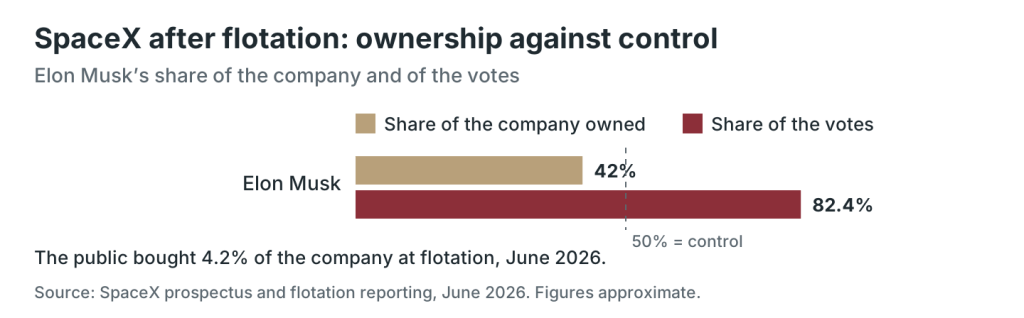
When SpaceX came to the stock market, the numbers showed exactly who had kept what. The company sold 555,555,555 shares at $135 each, raising about $75 billion. Those shares were just 4.2 per cent of the company. Musk kept roughly 42 per cent of the equity and, through shares carrying ten votes each, 82.4 per cent of the votes. SpaceX is officially a “controlled company” under stock exchange rules, which means it doesn’t need a majority of independent directors on its board. The public, knowingly or unknowingly, bought a sliver of a company in which one man controls more than four-fifths of every vote.
How this was allowed? The answer is not a villain. Nobody had to break a rule. At every stage, a crowd of professionals was paid for the deal to happen: investment banks earning fees on the loans and the flotation, lawyers on the structures, the stock exchange on the listing, the firms that compile stock-market indices on including the new share, analysts on covering it. Nobody in the chain was paid to say no.
Anyone who has sold a house will recognise the method. The estate agent flatters you with a high valuation to win your business, because without the instruction there is no commission. Then, once the house is on the market, he talks you down in stages, depending on how keen you are to sell and how many people come to look. What every seller really hopes for is the buyer who falls in love with the place and pays over the odds. An investment bank floating a company does much the same job, with one difference: the seller is usually far more sophisticated than you are, and everyone involved wants the highest price the buyers can be persuaded to pay.
The SpaceX flotation followed the method closely, and it made sure of its buyers. Around 30 per cent of the shares were set aside for private individuals, about three times the usual share for a large flotation. The public float was kept tiny, so that even modest demand would push the price up. Nasdaq rewrote the rules of its flagship index to let the shares in after just fifteen days of trading, relaxing its float rules to do it; SpaceX had reportedly made early inclusion a condition of listing there. S&P Global, which runs the S&P 500, refused to follow. Every fund tracking the Nasdaq-100, and every pension invested in one, would have to buy whatever the price. The veteran investor Jeremy Grantham called it the craziest flotation in the history of man. On the first day of trading the price rose 19 per cent, and within days it reached about $225. By early August it had fallen to about $105. By mid-October it was trading around $150, above the $135 flotation price, but anyone who bought at the top of that first week was nursing a loss of more than a third. Meanwhile, on 6 August, just after the company’s first earnings report, about 911 million insider shares became free to sell, more than the entire public float, in the first of several staggered releases. The buyers least able to judge the price were invited in at the top, with the index funds as guaranteed support underneath, and the insiders’ supply arrived later. None of that is illegal. All of it is in the prospectus.
And what the public bought loses money. SpaceX has real revenues, around $23 billion over the past year, most of it from Starlink. It also made a loss. Yet the stock market values it at around $2 trillion, more than all but a handful of companies on earth, and roughly twenty times the sales analysts expect it to make in 2027, which assumes those sales will more than quadruple in a year. A company that loses money, valued as though it will soon earn a fortune, controlled by one man, with the public holding a twentieth of it.
The professionals paid to value it are guessing, and their guesses have risen by almost half in three months. In June, analysts’ forecasts for SpaceX’s 2027 revenue averaged about $70 billion. By mid-September the average was about $100 billion. Much of the upgrade followed the company’s second-quarter results, in which its AI division’s revenue came mainly from renting spare computing capacity to rivals, chiefly Anthropic, on contracts that can be ended at three months’ notice. Among the analysts covering the stock, price targets run from about $100 to $800. That isn’t a range of estimates; it’s a range of beliefs. And many of the analysts work for the banks that were paid to float it. They are nominally independent, but the right beliefs tend to precede the right bonuses.
To repeat: these are forecasts of sales, not profits. SpaceX is valued as a multiple of its revenue because it has no profits to value it on. The profits are forecast too, arriving next year and rising to tens of billions the year after. That is the hockey stick every analyst of a technology stock has drawn at some point in their career: a line that runs flat along the bottom of the chart, then turns sharply upwards just after the date by which anyone will be checking.
There is an old name for what the public is buying, and it helps explain why nobody asks too many questions. SpaceX is a real business. It launches most of the world’s rockets and its Starlink satellites have millions of paying customers. The part that is harder to pin down is the price. The share price is a claim on profits many years away, justified by stories about data centres in orbit and colonies on Mars. Marx called this kind of thing “fictitious capital”: paper claims on future value that may or may not ever exist. David Harvey built much of The Limits to Capital (1982) around it, showing how financial markets come to depend on those claims continuing to rise. The word “fictitious” doesn’t mean fraudulent. It means that what is being traded is a promise, and everyone involved is paid to keep believing it.
The problem the modern company was built on
The founding problem of the modern company is that the people who own it aren’t the people who run it. In 1932 two Americans, the lawyer Adolf Berle and the economist Gardiner Means, published The Modern Corporation and Private Property. They pointed out that the great American companies were now owned by tens of thousands of small shareholders, none of whom could watch the managers, and that the managers were therefore free to run the firm largely for themselves. Owners without control; controllers without ownership. Almost everything written about the governance of companies since has been an attempt to deal with that problem.
From the 1970s, finance believed it had found the answer: make the managers think like owners, and let outsiders sack the ones who don’t. In 1976 two economists, Michael Jensen and William Meckling, set out what became known as agency theory. Managers are the shareholders’ agents, and agents will slack unless their interests are tied to their employers’. So pay them in shares and share options, and they will care about what shareholders care about. Behind that sat a second discipline, which the American law professor Henry Manne had named “the market for corporate control” in 1965. If a company is badly run, its share price falls, an outside buyer can purchase it cheaply, sack the board and run it properly. The takeover was the owners’ ultimate weapon.
It worked, in a way, and anyone who worked in the City of London from the 1980s onwards watched it work. The hostile bid, the corporate raider, the private equity firm buying an underperforming company with borrowed money: all of it rested on this idea. For forty years it was the official justification for the whole system. Whatever else you said about shareholder capitalism, the owners could get rid of a bad boss.
The cure produced a disease of its own: bosses paid in shares learned to think like traders rather than owners. When a large part of a chief executive’s pay depends on the share price over the next three or four years, the rational thing to do is whatever lifts it soonest. Buy back the company’s own shares. Cut costs that won’t be missed until after you’ve gone. Hit the quarterly number. The American economist William Lazonick showed in a much-cited Harvard Business Review essay, “Profits Without Prosperity” (2014), that the largest American companies had spent most of a decade’s profits buying back their own shares and paying dividends, leaving little for investment in the business itself. Andy Haldane, later chief economist at the Bank of England, produced evidence that financial markets systematically undervalue the long term. Neither man is a radical, which is why their evidence carries weight.
Sacking a bad boss changes less than it should, because the next one believes the same things. Boards hire from a pool of people trained in the same business schools, paid on the same measures and judged by the same analysts and fund managers. The replacement makes the same moves for the same reasons. Bad bosses also have a surprising habit of popping up again elsewhere. The problem isn’t the individual in the chair. It is the arrangement that chooses who sits there and pays them to behave in a particular way.
Two kinds of share
The platform founders solved the takeover problem in the simplest possible way: they made sure nobody could ever take them over. They did it by issuing two kinds of share. The founders’ shares typically carry ten votes each. The public’s carry one, or even none at all. The founders can own a small fraction of the company and still control every decision.
Think of it as buying a house with friends. You put up an eighth of the money. Your friends put up the rest. But the deeds say you take every decision about the house, for ever, and nobody can outvote you. You can knock down walls, redecorate, or turn the garden into a car park. Your friends can sell their shares in the house to someone else, and that is the only choice they have. Your friends may still be prepared to put up with this though hoping the demand for car parks increases and the value goes up.
The big platforms were built this way, and they told investors so from the start. When Google floated in 2004, its founders, Larry Page and Sergey Brin, wrote to prospective investors that Google “is not a conventional company”, and that they did not intend it to become one. They kept voting control through a separate class of shares. Mark Zuckerberg owns a minority of Meta’s shares and controls a majority of its votes. When Snap, the company behind Snapchat, floated in 2017, it went further and sold the public shares with no votes at all. SpaceX is the latest in the line.
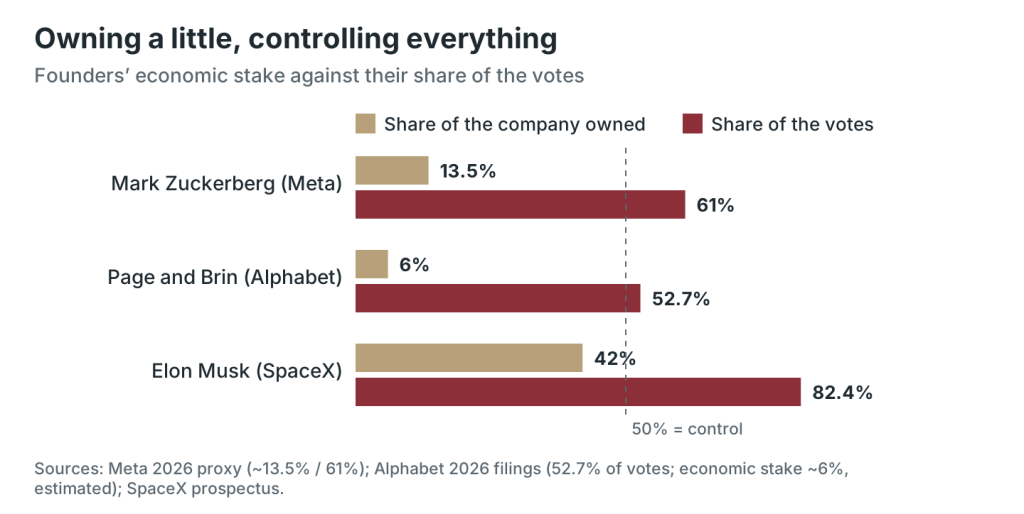
The consequence is that the weapon finance spent forty years building has been switched off. Nobody can buy control of these companies, because control isn’t for sale. These companies still have boards of directors, with committees and independent members and annual meetings, and all of it looks like normal corporate governance. But when one shareholder holds the majority of the votes, he appoints the board, and the board effectively serves at his pleasure. The directors can advise; they can’t overrule. The share price can fall, investors can complain, and nothing happens. The clearest example is Meta’s move into the “metaverse”, the virtual world Zuckerberg decided was the future. The division responsible lost tens of billions of dollars over several years. Shareholders grumbled loudly. Nothing happened, because nothing could. That isn’t a failure of character. It is what the arrangement was designed to allow.
The ordinary shareholders still get a vote, and the results show how little it counts for. At Meta’s annual meeting in May 2026, a proposal to do away with the two classes of share won about 1.3 billion votes and lost with about 3.65 billion against. Meta doesn’t publish how each class of share voted; a separate proposal asking it to was voted down at the same meeting. But Zuckerberg’s ten-vote shares account for most of the votes against, and the arithmetic leaves little doubt that most of the ordinary shareholders who voted wanted the change. It failed anyway, as it has every year.
The founders have a defence, and here it is at its strongest. They argue that control protects long-term bets from impatient investors. A company answerable to the stock market every quarter would never have funded Google’s more speculative projects, or kept pouring money into ideas that took a decade to pay. There is something in this, and after reading Lazonick and Haldane it is hard to argue that the stock market is a patient judge.
But the defence can’t have it both ways. These are people who praise markets as the right judge of almost everything: schools, hospitals, public broadcasters, other people’s companies. At their own flotation, they arrange never to be judged by one. Their better defenders reply that they accept the judgement of their customers, just not the judgement of short-term shareholders. That reply works only if customers can take their business elsewhere easily. As we will see, the whole platform economy is built on making that as hard as possible. So the defence fails on its own terms.
The founders also like to believe they earned their position, and the evidence says they were at least as much in the right place at the right time. For every Zuckerberg there are thousands of founders who worked as hard, took the same risks and failed. We study the ones who won, and read their success as genius. Statisticians call this survivorship bias. Add to this the point Mariana Mazzucato made about the iPhone: much of the underlying technology was paid for by the public. The founders assembled publicly funded parts at a lucky moment, and then arranged to be answerable to nobody. Timing and inheritance explain more than the legend admits.
The debate is live, and it has a leading critic. Lucian Bebchuk, a professor of law at Harvard, argued with Kobi Kastiel in “The Untenable Case for Perpetual Dual-Class Stock” (2017) that whatever the merits of founder control at the moment of flotation, the case weakens every year the founder stays on. Their proposed remedy is modest: a sunset clause, under which the special voting rights expire after a fixed number of years unless ordinary shareholders vote to keep them. Few companies have adopted it.
If the founders can’t be sacked, the obvious next question is who allowed them to set things up this way. The answer runs through stock exchanges competing for business, American states competing for company registrations, and a crowd of shareholders with very different reasons for not making a fuss. That crowd, and where its money goes, is the next chapter.
And of course, in all of this, no-one really minds whilst the share price is going up. Which, of course, in the case of the concentrators, it ha. In spades. The problems start when the tide turns. Remember the railways.
Chapter 5: Who Really Owns It
Previously. Elon Musk took Twitter private, folded it into xAI and then into SpaceX, and brought it back to the stock market in the largest flotation in history, with the public holding 4.2 per cent of the company and Musk 82.4 per cent of the votes. Two classes of share have switched off the takeover, finance’s old weapon against bad bosses, and the founders’ defence of the arrangement fails on its own terms.
Why the rules allow it
The rules that should prevent this are largely written by, or for, the businesses they govern. Stock exchanges were once member-owned clubs. Today most are profit-making companies, and they compete with one another for listings, because listings are revenue. When a large technology company wants to float on its own terms, an exchange that refuses loses the business to one that won’t.
London has demonstrated this. In 2024 Britain’s financial regulator rewrote the listing rules to make it much easier for companies with enhanced voting rights to float in London, in the hope of winning back technology companies that had been choosing New York. It was presented as competitiveness. It can equally be described as a race to see which exchange will ask for less. And it hasn’t worked. More companies have left the London Stock Exchange than joined it in every year since 2022. In 2024 alone, 88 companies delisted or moved their main listing away from London, the largest outflow since the financial crisis, and the exodus has continued since then. The rules may be laxer, but the pool of money to invest is thinner: British pension funds, which once held around half their assets in British shares, now hold about 4 per cent. Companies aren’t queuing to join the London market. They are being bought out of it.
American states compete in the same way. SpaceX moved its legal registration from Delaware to Texas in 2024, after a Delaware court struck down Musk’s pay package at Tesla, and Texas has since changed its company law to make it harder for minority shareholders to challenge controlling owners. Jurisdictions, like exchanges, compete to be the place that objects least.
The index providers and the rating agencies have their own interests in the answer. Firms such as MSCI, S&P Dow Jones and FTSE Russell compile the indices that trillions of pounds of pension and savings money automatically follows. They earn their money licensing those indices to fund managers, so they gain from more listings, more trading and bigger markets. Their policies on dual-class shares have gone back and forth, tightening after Snap’s no-vote flotation and loosening again a few years later. The credit rating agencies, meanwhile, are paid by the companies whose debt they rate. None of this is secret. It is simply how the system is built. The American economist George Stigler would have called it regulatory capture. Much of it was never captured, because it was never independent to begin with.
Who the shareholders are
“The shareholders” is a crowd, not a person, and the crowd has different objectives and horizons. There are pension funds and insurance companies, investing money that will one day pay for people’s retirements. There are index funds, which buy a slice of every company in an index and hold it without making judgements. There are active fund managers who pick shares, on average badly: over ten years or more, most fail to do better than the index they are measured against. There are hedge funds that trade rapidly and decisively, private equity firms that buy whole companies, family offices managing the fortunes of single dynasties, sovereign wealth funds investing the savings of entire states, and retail investors with an app on their phone. Before its merger into SpaceX, xAI’s investors included American venture capital firms, Nvidia, Fidelity, BlackRock and star-linked investors from Qatar, the United Arab Emirates and Saudi Arabia.
The biggest single shareholders in almost every large platform are the same three fund managers. BlackRock, Vanguard and State Street appear near the top of the shareholder register of almost every large listed company in America, because that is where index funds park their money. If your pension tracks the stock market, you own a sliver of the company that tracks you. You have no say over it in either role.
Economists have started asking whether this common ownership weakens competition, and the argument is fierce. In a study of American airlines published in 2018, José Azar, Martin Schmalz and Isabel Tecu found that on routes where the same big funds owned all the competing airlines, fares were higher. Their explanation was simple. If the same few investors own every airline, none of those investors gains from a price war between them. Other economists dispute both the data and the mechanism, while antitrust scholars such as Einer Elhauge at Harvard want regulators to act on it. Put in everyday terms: if the same few people owned every shop on your high street, why would they want the shops competing on price? It is an open question, and we present it as one.
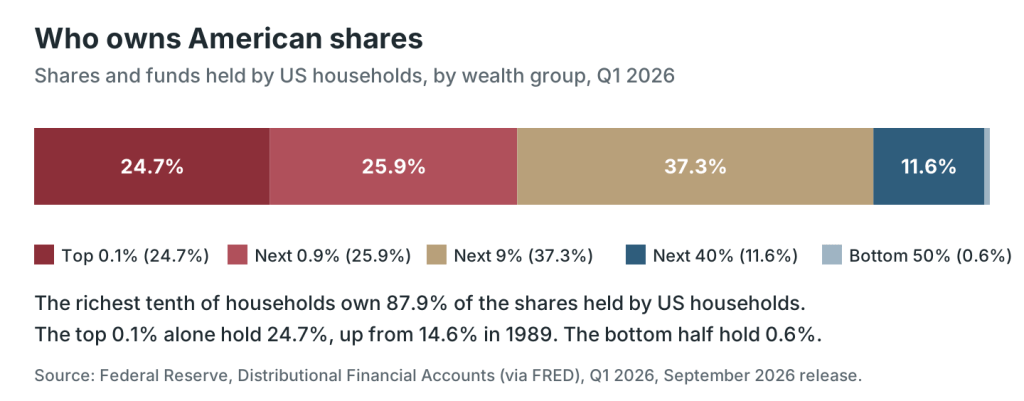
The comforting story is that we all own these companies through our pensions; the truer one is that wealth mostly owns wealth. In the United States, the richest tenth of households own the great majority of all shares, by the Federal Reserve’s own figures nearly nine-tenths. When share prices rise, the gains flow overwhelmingly to people who already hold most of the shares, who then have more money to buy more assets. That isn’t a conspiracy or a fraud. It is a loop that feeds itself. Thomas Piketty built his argument in Capital in the Twenty-First Century (2013) on the long-run version of the same loop: when the return on wealth outruns the growth of the economy, those who own wealth pull steadily further ahead.
Brett Christophers gives this ownership picture its sharpest British reading. He is a British economic geographer who works at Uppsala University in Sweden, writing in the tradition of David Harvey. In Rentier Capitalism (2020) he argues that the British economy now earns much of its money from owning and controlling assets rather than from producing things. In Our Lives in Their Portfolios (2023) he follows the asset managers as they buy up the physical fabric of daily life: housing, roads, pipes, power. It is Mazzucato’s tollbooth again, with the ownership structure drawn in.
The owners who pass the parcel
A growing share of British business isn’t owned through the stock market at all, but by private equity. A private equity firm raises a fund from big investors: pension funds, insurers, sovereign wealth funds, university endowments. The fund has a fixed life, usually about ten years, and the firm charges fees for managing it, traditionally 2 per cent of the money every year plus a fifth of the profits. The firm uses the fund to buy companies, but it pays for most of each purchase with borrowed money, and the debt is loaded on to the company being bought, not on to the fund. The company then has to pay the interest on its own takeover.
The clock is always running, because the fund has to hand the money back. A private equity owner typically plans to sell within three to seven years. In that time it looks for ways to raise the company’s value or extract cash from it: cutting costs, selling the buildings the company owns and renting them back, pushing back at regulations or borrowing more money against the company to pay the owners a special dividend. Then it sells, increasingly to another private equity firm, which borrows again to buy it and starts the clock again. The industry calls this a “secondary buyout”. In Britain it has become one of the main ways private equity firms sell. It is pass the parcel, and each time the music stops the company carries a little more debt and a little less operating capability.
The scale in Britain is remarkable. McKinsey estimates that Britain attracted $1.8 trillion of private equity investment in fifteen years. Of the 197 companies taken off the London Stock Exchange by private buyers between 2016 and 2023, 127 were bought by private equity firms, and only two have since returned to the stock market.
The scare stories are familiar, even if the names have faded. Southern Cross, once Britain’s biggest care-home operator, sold its homes and rented them back; when the rents became unaffordable in 2011, it collapsed and tens of thousands of elderly residents faced losing their homes. Debenhams was bought by private equity in 2003, had its property sold, was floated again three years later carrying far more debt, and never recovered; it collapsed in 2019. Today two of Britain’s four big supermarkets, Morrisons and Asda, are private-equity-owned with heavy debts, and the competition regulator’s investigation into vets found that the family practice has largely been swallowed by a handful of chains, several owned by private equity. If you have wondered why the vet’s bill has risen so fast, this is part of the answer.
Private equity is the last piece of the ownership picture, and it matters for what comes next. Borrowed money, fixed horizons, fees on the way in and out, and a buyer always waiting to take the parcel: the same habits are now visible in the money pouring into artificial intelligence. Capitalism keeps finding new merry-go-rounds to keep the plates spinning, or rather, repainting old ones. Private equity firms have even bought life insurers, whose policyholders’ savings are then lent back into private equity and private credit. The snake eats its own tail.
Where the money goes round in circles
At the frontier of artificial intelligence, a lot of the money moving between companies is going round in a loop. Chipmakers invest in the laboratories building AI. The laboratories spend the money on the chipmakers’ chips. The chipmakers report booming sales, the laboratories report growing investment, and everyone’s valuation rises. Nvidia, the leading maker of AI chips, has invested in several of the laboratories that are also among its biggest customers, and in 2025 it announced plans to invest up to $100 billion in OpenAI, which buys its chips, a plan later scaled back to a stake of around $30 billion.
Put another way: I lend you a tenner, you buy my sandwich with it, and we both tell our investors that sandwich demand is booming. The snake again, this time eating a sandwich and risking indigestion. None of this is illegal or invisible, and nobody is being accused of fraud. But the question of how much of the AI boom’s revenue is real outside demand, and how much is investment money coming back round, is one serious analysts are now asking, and it runs through the chapters ahead.
This is not a new trick, and the history is not reassuring. Economists and accountants call it vendor financing: the seller lends the buyer the money to buy the seller’s product. In the telecoms boom of the late 1990s, equipment makers such as Lucent and Nortel lent billions to young telephone and internet companies so they could buy Lucent and Nortel equipment. The sales looked spectacular until the customers went bust, the loans went bad, and both companies’ shares collapsed. Enron went further, booking trades with friendly counterparties that went out and came straight back, making revenue appear from nowhere. And the railways got there first. In the 1860s the great railway contractors, Samuel Morton Peto among them, took payment for building lines in the shares and bonds of the companies they were building for, and financed themselves by borrowing against that paper. When the London bank Overend, Gurney collapsed in 1866, the contractors’ paper was part of the wreckage, and Peto was ruined. Every generation finds this idea new.
The loop has a cousin that runs through the accounts rather than the sales. In the first three months of 2026 Alphabet reported record profits of $62.6 billion. About $28.7 billion of that came not from search or cloud computing but from revaluing its stakes in private companies, primarily Anthropic. Amazon booked $16.8 billion of pre-tax gains on its Anthropic investment in the same quarter, around two-fifths of its pre-tax income. Both companies also sell Anthropic the computing power it runs on, and neither had sold a single share. The snake has learned to eat its own tail and book the meal as profit.
Trying to write different rules from inside
Some of the AI companies have tried to build different arrangements into their own structures. OpenAI began in 2015 as a non-profit research laboratory. After years of restructuring, it is now a profit-making company that remains, formally, under the control of a non-profit foundation. Anthropic is a “public benefit corporation”, legally allowed to weigh a stated public purpose alongside profit, with an independent trust empowered to choose some of its board. Whether these structures bind anyone when serious money is at stake is the question, and OpenAI’s own restructuring battles are the best evidence either way. The machine helping to write this is made by Anthropic, so read this paragraph accordingly. The human half of the partnership is not expecting an invitation to join Anthropic’s board.
The point isn’t that the insiders have fixed anything. It is that people inside these companies, many of them sincere, have tried to change the rules they work under, which shows the rules can be changed. The arrangements are contested from inside as well as outside.
The last discipline left
Put the pieces together and the picture is stark. The founders control their companies without owning most of them. The takeover, finance’s weapon of last resort, has been disarmed. The ordinary shareholders are spread across index funds that won’t act, pension funds that can’t and hedge funds who aren’t motivated to care. The rules are written largely by businesses that profit from the listings they govern. Every check that was supposed to discipline these companies from above has been removed or never existed.
That leaves one discipline, and it doesn’t belong to the owners or the regulators. It belongs to the person holding the mobile phone. If the founders can’t be sacked and the shareholders won’t act, the only thing left that can hurt these companies is their users walking away. What that costs the user, and how much the owners can squeeze before she goes, is the next thing to understand.
Chapter 6: The Squeeze
Previously. The rules that should restrain the platform owners are largely written by businesses that profit from them. The shareholders are a crowd with little reason to act, and some of the money in the AI boom is going round in circles. With the owners beyond reach, the only discipline left belongs to the user, and her one power is to leave.
Almost everyone has watched a service they relied on get slowly worse, and that experience is where this starts. Search for something on Google today and the first things you see are adverts dressed up as results. Search on Amazon and the first page is increasingly made up of products whose sellers have paid to be there. Book an Uber and compare the fare with what the same journey cost a decade ago. For years Uber sold rides below cost, paid for with billions of dollars of investors’ money, and passengers loved it. Local minicab firms couldn’t compete, and many closed. Then the prices went up. Or take something we have already come across: the Tesco Clubcard, launched as a thank-you for loyalty, now works as a price of admission. Shoppers without one pay more for the same tin of beans.
None of this needs theory to recognise, but theory explains why it happens every time. It isn’t a run of bad luck, or a string of greedy executives. It is a pattern with a logic, and once you have seen the logic, you see it everywhere.
Services that got worse: what they offered at first, and what they offer now
| Service | At first | Now |
|---|---|---|
| Google search | Plain results, with adverts clearly marked down the side | Adverts at the top, styled to look like results, and summaries that keep you on Google |
| Amazon | The cheapest and best-reviewed products near the top | Top results increasingly paid placements, often worse value than those further down |
| Uber | Rides below cost, paid for with investors’ money | Higher fares, once the subsidy ended and many local rivals had closed |
| Facebook feed | Your friends’ posts, in the order they were posted | Posts chosen to keep you scrolling, adverts in between, and businesses paying to reach their own followers |
| Supermarket loyalty cards | Points, as a thank-you for shopping | Member prices: shoppers without the card pay more for the same goods |
Sell more, or charge more
At its simplest, a business can make more money in two ways: sell more, or charge more for each sale. Which it chooses depends on its costs, and on what its customers will put up with, and an everyday example makes the choice clear. Think of a baker. His ovens, his shop and his rent cost the same whether he sells ten loaves or a thousand. Those are his fixed costs. The flour, the yeast and the electricity for each loaf are his variable costs, and they rise with every loaf he bakes. At first, the baker wants to sell as many loaves as he can, because every loaf helps pay for the ovens and the rent. Once those are covered, the calculation changes. Now, putting up the price of each loaf by 10p is almost pure profit, while selling more loaves still means buying more flour. Economists call these the marginal cost and the marginal revenue: what one more loaf costs to make, and what one more loaf brings in.
Anyone who has analysed businesses for a living knows the rule that follows: if you have the power to do it, raising prices is usually better for profits than chasing more sales. A business facing real competition can’t do much of it, because its customers will go elsewhere. A business with market power can. That is why monopolies charge more whenever they can get away with it, and why the whole of competition law was invented to stop them.
The power to raise prices comes from somewhere, and there are only a few places it can come from. At one end of the scale sit commodities: crude oil, bulk chemicals, basic memory chips, wheat. One barrel of oil is much like another, so no seller can charge more than the going rate, and the price is set by supply and demand across the whole market. Commodity producers live with booms and busts they can’t control. The makers of memory chips, for example, swing between fat years when supply is short and brutal years when everyone has built too many factories at once.
At the other end sit the businesses with premium prices, and they get there in one of three ways. The first is brand: Coca-Cola is sugared water, but people pay more for it than for the supermarket’s own cola, because of what the name means to them. The second is scarcity: when demand outruns supply, whoever holds the supply sets the price, at least until more supply arrives. The third is control of the market itself: a monopoly, or a cartel of producers agreeing not to compete. OPEC turned oil from a commodity into a premium product in 1973 by agreeing to restrict supply, and the price quadrupled.
The platforms found a fourth way, and it isn’t the one they advertise. Their premium doesn’t come from the quality of the service or the strength of the brand. It comes from stickiness: the cost of leaving. So their pricing power only arrives after the volume phase has done its work and the users are locked in. Without the lock-in, a platform is just another supplier of a commodity service, in this case attention, competing on price.
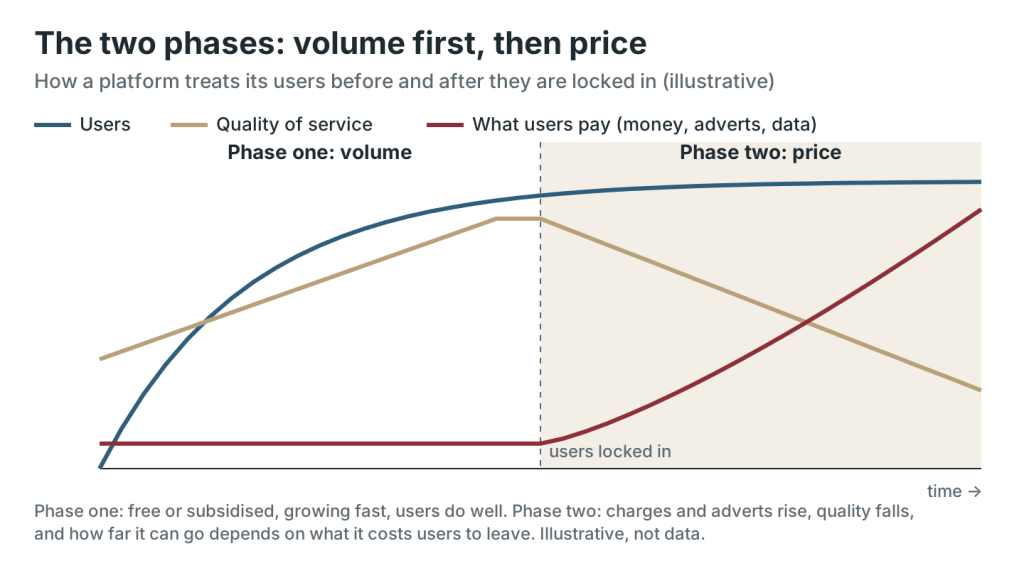
The platforms follow the baker’s logic, but in two distinct phases, and the order is what matters. In the first phase, they chase volume. An extra user costs them almost nothing, as the software and servers already exist, and every extra user makes the network more valuable to everyone else. So they give the service away, subsidise it, make it as good and as cheap as possible, and grow as fast as they can. Customers do very well out of this phase. It is why so much of the digital economy has felt like a gift.
In the second phase, they switch from volume to price. Once the users are locked in, because their friends, their photographs, their audience and their habits are all in one place, the platform starts charging, one way or another. Not always in cash. It shows more adverts. It sells the top of the search results. It raises the fees it charges the sellers and businesses that depend on it, who pass the cost on to you. It creates paid tiers and makes the free version worse. The returns that justified all those years of investors’ money come from this second phase. The first phase is the bait. The second is the catch.
The man who named it
Cory Doctorow gave the second phase its name, and the word itself tells you how widely the experience is shared. Doctorow is a Canadian-British science fiction novelist and a campaigner for digital rights, for many years associated with the Electronic Frontier Foundation, the American group that fights for privacy and freedom online. Around 2022 and 2023 he coined the word “enshittification” for the process by which platforms decay. The American Dialect Society made it its word of the year for 2023, and Australia’s Macquarie Dictionary did the same the following year. His book Enshittification followed in 2025. Unlike the academics we have met so far, Doctorow writes as a campaigner, and that shows in both the bluntness of the word and the practicality of his remedies.
His description of the process has three stages, and it adds something to the two phases. First, the platform is good to its users, to attract them. Second, once the users are locked in, the platform turns on them to serve its business customers: the advertisers, the sellers, the publishers. It sells those businesses access to the users cheaply. Third, once the businesses are locked in too, the platform turns on them as well, squeezing both sides to hand the value to its shareholders. Then, in Doctorow’s account, the platform declines, as everyone who can leave does.
A simple example shows how the stages feel from the inside. A social network starts by showing you what your friends post, in order, with few adverts. Then it starts showing you posts chosen to keep you scrolling, with adverts in between, and sells those adverts cheaply to businesses. Then it starts charging those businesses to reach even the people who chose to follow them, so that a local café with ten thousand followers has to pay for its posts to be seen by more than a handful. Finally, your feed is mostly paid content and posts from people you don’t know. Everyone involved is worse off, except the shareholders, for a while. Even they have to judge when to get out, which means finding a buyer: what the markets call a “greater fool”, someone willing to pay more on the belief that there will always be someone else willing to pay more still.
Doctorow’s most useful idea is his explanation of why this happens now, when it didn’t used to. He argues that four forces once held companies back from squeezing too hard. The first was competition: if you treated your customers badly, a rival would take them. The second was regulation: the state would step in. The third was what he calls self-help: users could modify their own tools, install software to block adverts, or use programs that let them move their data elsewhere. The fourth was the bargaining power of the technology workers themselves, skilled people in short supply who could refuse to build things they found shameful. His argument is that all four were weakened together, through mergers that removed competitors, regulators that looked away, laws that made it illegal to tamper with the platforms’ software, and waves of lay-offs that taught tech workers their place.
If that is the explanation, the remedy follows from it, and the remedy is hopeful. What was weakened can be rebuilt. Competition can be restored by breaking up or blocking mergers. Regulation can be enforced. Users can be given the legal right to take their data and their connections elsewhere. Workers can organise, though in the United States, where most employees can be dismissed without any reason being given, it takes real courage, and the penalties for sacking the organisers are small enough to be treated as a cost of doing business. None of these requires anyone to become a better person. All of them change the arrangements.
Leave, or complain
To understand how far a platform can squeeze, we need Albert Hirschman, and a short book he wrote in 1970. Hirschman is the one figure in this chapter no longer alive, and his life earns him his place. He was born in Berlin in 1915 and left Germany when the Nazis came to power. He fought for the Republic in the Spanish Civil War. In 1940, in Marseille, he worked with the American journalist Varian Fry on the secret operation that smuggled some of Europe’s most wanted artists and intellectuals out of Vichy France and away from the Gestapo; Marc Chagall and Hannah Arendt were among those the operation got out. He went on to serve in the American army, work on the Marshall Plan, advise the government of Colombia, and become one of the most original economists of the century. Exit, Voice, and Loyalty is short, elegant, and still read in business schools and political science departments alike.
The book grew out of a railway, which will please anyone who has followed the story so far. Hirschman was puzzled by the Nigerian state railway, whose service in the 1960s was poor and stayed poor, even though it faced competition from lorries on the roads alongside it. The conventional economist’s answer is that competition should have forced the railway to improve. Hirschman saw something else. The customers who cared most about quality, the ones most likely to complain loudly and push for better service, were the ones who switched to the lorries first. With its most demanding customers gone, the railway faced less pressure, not more. It could settle into being bad.
His framework is simple, and everyone has used it without knowing. When you are unhappy with something, a café, a school, a political party, a company, you have two options. You can stop going: that is “exit”. Or you can complain, and try to change things from inside: that is “voice”. Which you choose depends on how easy it is to leave and how likely you think it is that complaining will work. “Loyalty” is what keeps you complaining rather than leaving: the attachment that makes you want to fix the place rather than abandon it. A healthy organisation needs some of both. Exit tells it that something is wrong. Voice tells it what.
The platforms have arranged the worst possible combination: exit made expensive, and voice abolished. Try to complain to a platform. There is no telephone number to call and no one to write to, only a help page that loops back on itself and a form that disappears into silence. Voice has been designed out. At the same time, leaving has been made as costly as possible. The user is left with neither option in any meaningful form. That single observation explains more about how the digital economy treats its users than any volume of theory.
Hirschman also noticed something about monopolies that fits the platforms uncomfortably well. A monopolist can be quite happy to see its most demanding customers leave. The awkward ones, the vocal ones, the ones who write letters and organise campaigns, depart; the quiet ones stay, and are easier to squeeze. He called this the “lazy monopoly”. When a platform’s most prominent critics announce that they are leaving, the platform may lose less than they think.
Some businesses go a step further and push out the customers they can’t profit from. British bookmakers for example. Anyone who wins consistently finds their account restricted to tiny stakes, or closed altogether. Betfair, the betting exchange where the customers do all the work of setting the odds, introduced a “premium charge” in 2008 aimed squarely at its most successful customers. The ideal customer is not the skilled one. Or the mug. It costs to recruit them and they leave too quickly nursing their losses. It is the one who sticks around and loses steadily. The data that tells a bookmaker who is winning is the same data that tells a platform who can be squeezed.
What leaving costs
The cost of leaving a platform has four parts, and each can be seen from the user’s side. First, your people are there. Your family group, your old school friends, the neighbours you only speak to online. Second, your history is there: years of photographs, messages, posts and conversations. Third, for anyone who makes a living online, your audience is there: the followers built up over years, who pay the rent. Happily not a problem for the writers here. No audience. No rent. Fourth, the habit is there. The app is on your home screen, your thumb knows where it is, and the alternative means learning something new. The price of leaving isn’t the subscription. It is everything you would leave behind.
The height of that price decides how far the owner can squeeze. If leaving is cheap, the platform has to keep treating its users well, because they will go the moment it doesn’t. If leaving is expensive, the platform can squeeze hard and for a long time before anyone moves. Every one of the platforms’ business decisions, from which features to build to which data to hold on to, can be read as an attempt to raise the cost of leaving.
Britain already has proof that a single rule can make leaving cheap: you can keep your mobile number when you change network. It sounds trivial. Before number portability, switching networks meant telling everyone you knew your new number, reprinting business cards, and missing calls from people who hadn’t heard. Most people stayed put rather than face it. Once the rules allowed you to take your number with you, and the regulator made the process quicker and simpler, the networks had to compete harder to keep their customers. Nobody had to be persuaded to be nicer. One rule changed the cost of leaving, and behaviour changed with it.
The same principle can be applied to the platforms, and in places it already is. Some of the newer social networks are built on open standards, called protocols, designed so that you can move from one service to another and take your followers with you, the way you take your phone number from one network to another. The European Union’s Digital Markets Act pushes the biggest platforms in the same direction, requiring them to open up in ways that let users and businesses connect with rivals. The Victorians called it a standard gauge.
The dilemma
Put the pieces together and the choice every owner of a platform faces becomes clear. The profits that justify the valuation come from the second phase, the squeeze. But the squeeze has a limit, and the limit is set by the cost of leaving. Squeeze too early, before users are properly locked in, or squeeze too hard, and they walk out. Squeeze too little and the profits never arrive, the valuation can’t be justified, and the investors who paid for all those years of free service want to know where their money went.
That is the concentrator’s dilemma: when to switch from volume to price, and how hard to squeeze. Every concentrator faces it, because every concentrator’s returns depend on it. Where the cost of leaving is high, the owner can squeeze hard and for a long time. Where it is low, the squeeze causes a walkout. What follows is a series of cases of the same dilemma: an owner who squeezed too hard where leaving was cheap; a state that settled the dilemma by making leaving impossible; and a new industry facing it from the start, with little lock-in, real costs on every use, and a bill that has to be paid by someone.
The next chapter begins with that new industry, because it is where the dilemma is sharpest. Artificial intelligence has everything the platforms had, except the one thing that made their second phase possible. Its costs are real on every use, its users can switch almost for free, and competitors are driving the price down rather than letting it rise. Its owners face the dilemma without the lock-in that would let them resolve it. So they have begun to look for help from the one institution that can build a wall the market won’t: the state.
Next: Chapter 7, When the Market Won’t Build the Wall.
Methodology note: this piece was written collaboratively between a human and an AI — the human providing the instincts, provocations, editorial judgement and voice; the AI providing research synthesis, intellectual scaffolding and drafting. Full method at athomehefeelslikeatourist.blog. The AI co-writer is Claude, made by Anthropic, which appears in this story as the company renting Elon Musk’s Colossus supercomputer. The human author has no financial relationship with Anthropic beyond a subscription.


Leave a Reply