Railway Kings, the Surveillance Economy, and Who the AI Machine Will Carry
Chapter 7: When the Market Won’t Build the Wall
Previously. Platform owners make their money in two phases: volume first, giving the service away until users are locked in, then price, squeezing them for as much as the cost of leaving allows. That is the concentrator’s dilemma: when to switch, and how hard to squeeze. The founders can’t be sacked and the shareholders won’t act, so the only limit left is the user’s ability to walk away.
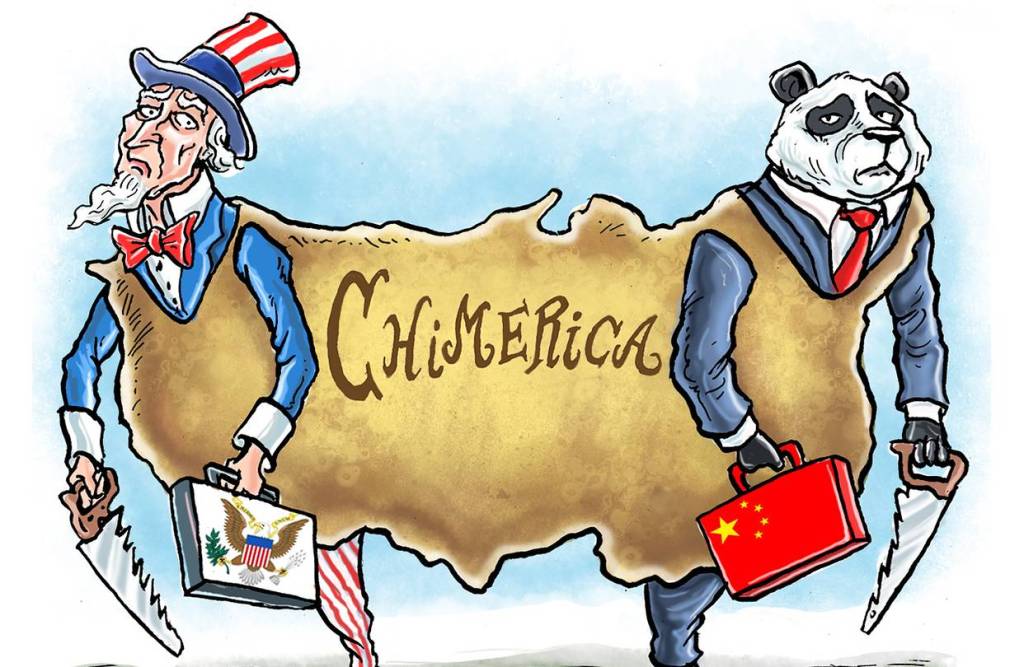
The clearest picture of where power sits in the new economy was laid out on a dinner table. When Xi Jinping made his state visit to Washington last month, the guest list for the banquet read like a register of the companies we have been describing. Jeff Bezos of Amazon. Sundar Pichai of Google. Sam Altman of OpenAI. Elon Musk. The heads of Nvidia and Microsoft. Two empires at the top of the table, and the concentrators along its sides.
The words spoken around that visit tell you what each side wanted. On the morning of the talks, Donald Trump posted that “super intelligence” would be a big topic, and that he wanted to leave it “exactly where it is”, adding: “our guardrail is the DOJ”. Two days earlier, at the United Nations, he had said that America rejected any attempt to build a “globalist scheme” around artificial intelligence. Xi, for his part, said that AI must always remain “under human control”. What came out of the talks was a dialogue: the two governments would exchange views on the risks and benefits of superintelligence, with the next meeting due by November, and the Americans proposed a mechanism for notifying each other of AI incidents that threatened national security. Jamieson Greer, the American trade representative, compared it to the red telephone that linked the Kremlin and the White House during the Cold War.
The executives were not all saying the same thing, and the differences matter. Sam Altman argued that rival countries have sometimes come together for the common good when faced with a powerful new technology, and that this should be one of those times. The heads of OpenAI and Anthropic have both said publicly that the race needs to slow down. Trump has called fears about AI a “hoax” that only China is happy about. Mark Zuckerberg, meanwhile, has argued that the AI laboratories have no need to coordinate on safety at all.
They wired a telephone for one kind of emergency, and nobody discussed the other. The emergency the red phone is meant for is a machine escaping human control: a rogue system, an accident, a weapon. The emergency no one at that table raised is quieter and more likely: the machine working exactly as sold, and the economy that is supposed to pay for it failing to hold up. What follows takes both halves of that problem in turn. The first half asks why the owners of AI have started looking to the state for protection. The second asks who, in the end, pays the bill.
Who wants what: business model and public position on regulation. Positions as stated publicly; they shift.
| Company | How it makes money from AI | What it says about rules |
|---|---|---|
| OpenAI | Closed models, sold by subscription and to businesses; backed by Microsoft | Asked the US Senate in 2023 for a licensing agency for powerful models; Altman argues rival countries should coordinate |
| Anthropic | Closed models, sold mainly to businesses; backed by Amazon and Google | Backs transparency and safety-testing laws and tight chip export controls; its chief executive’s five risks are discussed in this chapter |
| Meta | Gave its Llama models away free, to protect its advertising business; its newest model, Muse Spark (April 2026), is closed, with open versions promised | Zuckerberg says the laboratories have no need to coordinate on safety |
| Nvidia | Sells the chips to everyone | Argues against export curbs; agreed to give Washington a 15–25 per cent cut of some China chip sales in return for licences |
| xAI (SpaceX) | Closed models, and computing power rented to a rival | Musk signed the 2023 letter calling for a pause in AI development, then built one of the largest supercomputers in the world |
| DeepSeek, Alibaba (China) | Open models, free to download | Beijing says AI must stay “under human control” and calls for a global body to govern it |
The moat that isn’t there
Investors have a word for what every concentrator needs; moat. A moat is whatever stops competitors getting at your profits. Warren Buffett, the most famous investor alive, popularised the term: a great business is a castle with a wide moat around it. For the platforms in the earlier chapters, the moat was the cost of leaving. Your friends were on the network, your photographs were in the cloud, your audience followed you there. Rivals could build a better castle, but they couldn’t get your people across the water.
Artificial intelligence has almost no moat of that kind, for three reasons. First, it costs real money every time it is used. Adding a user to a social network costs almost nothing; answering a question with an AI model takes computing power, specialised chips and electricity, every single time. The more successful the product, the bigger the bill. Second, switching is almost free. Moving from one AI assistant to another takes seconds, and your friends aren’t “on” one in the way they are on WhatsApp. (The biggest risk may indeed be that the AI assistant becomes your friend). There is no network effect to hold you. Third, competition is driving the price down, not up. Free “open” models, which anyone can download and run, and cheap models from Chinese laboratories keep undercutting the leaders. The price of any given level of capability has fallen steeply, year after year, even as the newest models still command a premium.
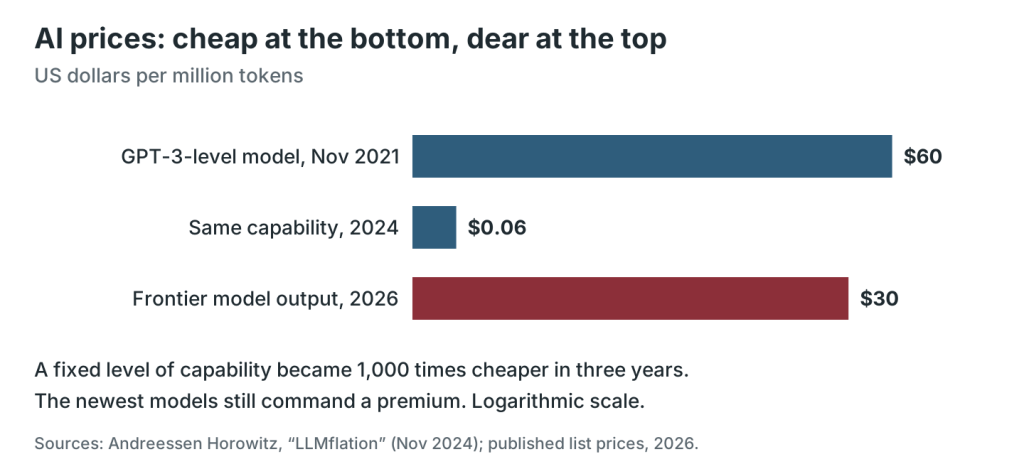
Without lock-in, AI is heading towards commodity pricing. Its output is already sold by the unit, as “tokens” priced by the million, much as electricity is sold by the kilowatt-hour. The companies know that, and they are trying every route to a premium at once. Start with brand: ChatGPT has become for many people what Hoover once was for vacuum cleaners, the name of the whole category. Then scarcity: Nvidia, which makes most of the chips the industry depends on, earns extraordinary margins today because demand far exceeds supply, and every memory-chip maker in history can tell you how long that lasts. The memory makers were reminded on 13 October, when a Chinese rival, CXMT, showed progress on a cheaper design for the memory that data centres need. Samsung fell more than 7 per cent in a day and SK Hynix around 10. SpaceX, which has been talking up its own chipmaking plans, fell 4 per cent with them. Musk’s response, on X, was that China scales up manufacturing faster than anyone, and that memory was a low-margin commodity until about three years ago. A premium built on scarcity lasts exactly as long as the scarcity. Or lock-in: the assistants that remember you, the agents built into office systems. And then there is the last route, control of the market, the one no company can build on its own. For that, they need the state.
The insiders said so first. In 2023 a memo written by a Google engineer leaked, under the title “We Have No Moat, And Neither Does OpenAI”. It argued that free, open models were catching up with the expensive ones faster than anyone had expected. On 27 January 2025 the market reached the same conclusion in a single day. A week earlier a little-known Chinese laboratory, DeepSeek, had released a model that performed close to the American leaders at a fraction of the cost, and Nvidia lost around $590 billion of its stock-market value in one day, the largest single-day loss for any company in history. For a day everyone stopped believing. It didn’t last long.
Watch where the companies are now trying to dig a moat, because it tells you they know they lack one. AI assistants that remember your preferences and your past conversations. Tools built into the office software your employer already uses. “Agents” embedded in companies’ own systems, doing work that would be painful to move elsewhere. Each is an attempt to raise the cost of leaving by design. Some of it is useful. All of it is also a moat under construction.
The writers here are not immune. The human half of this partnership chose the machine half partly on the reputation of its maker, which he had no way of checking, and partly on search results telling him it was the best tool for long-form writing, which he had no way of checking either. The machine now remembers every conversation the two of them have had about this project. Trying a rival would mean starting again from nothing. The value, for now, is excellent. It is also a moat, and he is standing in it. The industry has begun offering tools to bring your history across from a competitor. Watch whether it ever becomes as easy to take it out again.
Asking to be regulated
When a business can’t build a moat in the market, the next place to look is the state. In May 2023 Sam Altman told a committee of the American Senate that the government should create a new agency to license the most powerful AI models. It was widely reported as a remarkable act of corporate responsibility, a company asking to be regulated. Read it another way. A licence is a barrier. It costs the company that already has one nothing, and it costs every newcomer a great deal.
The hard version of this argument comes, perhaps surprisingly, from the right. George Stigler was a leading figure of the Chicago School, the group of free-market economists around Milton Friedman, and won the Nobel Prize in 1982. In “The Theory of Economic Regulation” (1971) he argued that regulation is usually acquired by the industry being regulated and designed mainly for its benefit. The everyday example is professional licensing: rules that stop unqualified people practising, and that also, conveniently, keep the number of practitioners low and their fees high. Stigler wasn’t a radical. He was a free-marketeer warning that the state is more often the industry’s servant than its master.
A gentler version of the same argument explains something Stigler’s doesn’t: why sincere people and self-interested people end up backing the same rules. The American economist Bruce Yandle called it “Baptists and bootleggers”. He noticed that in parts of the American South, laws banning the sale of alcohol on Sundays were supported by two groups. The Baptists supported them because they sincerely believed drinking was wrong. The bootleggers, who sold alcohol illegally, supported them because a law closing the legal shops on Sunday was excellent for business. Neither group needed to share the other’s motives. The coalition worked anyway.
Applied to AI, the picture is uncomfortable but fair. There are people inside and outside the AI companies who sincerely fear what the technology could do, and whose concern is serious. There are companies that would benefit from rules that make it expensive for newcomers to compete. They can support the same regulations for entirely different reasons, and the result will serve the bootleggers as well as the Baptists. No one has to be a villain. The arrangement turns sincerity into protection all by itself. It is the principle of arrangements rather than people, at the level of policy. The framework applies to every company in the industry, including the one that makes the machine co-writing this.
Even the bootleggers disagree about which law they want, and their disagreement follows their business models. A company whose business is selling access to its own closed, expensive models gains from rules that raise the cost of competing. A company like Meta, which made its name in AI by giving its models away free to protect its advertising business, gains from no rules at all. Even Meta has started to hedge: its newest model, Muse Spark, released in April, is closed, with open versions promised later. That is why Altman speaks of coordination and Zuckerberg says none is needed. Same dilemma, different position in it, different plea.
An aside, or rather more than an aside: another contradiction, and a foundational one. The eagle-eyed reader who has clocked the methodology note at the end of each part will know that this piece was written in collaboration with Anthropic’s AI model, Claude. As if it wasn’t obvious anyway from the detail, length and tone. Which means that much of the explanation here comes from the product of one of the companies whose political economy we are exploring. Which raises the question of what that company thinks about the issues we are analysing. We can’t know for sure. But we can listen to what it says.
Anthropic’s chief executive, Dario Amodei, has set out both the promise and the danger at length. In his October 2024 essay Machines of Loving Grace he described the benefits he saw coming from AI. In January 2026, in The Adolescence of Technology, he set out the five risks as he saw them, and he has repeated the warning at every opportunity since. In essence they are:
- AI that slips out of control
- AI that helps someone build a bioweapon
- AI that lets a state watch and control everyone
- Economic disruption: his warning that half of entry-level white-collar jobs could go, with wealth piling up with whoever owns the chips and data centres
- Knock-on effects that destabilise the world
He and his company have argued vigorously for transparency and safety testing; for the economic risk, his remedy is to share out the proceeds afterwards. He calls for “a more robust tax policy”, which “could be targeted against AI companies in particular”, and says that those at the forefront of AI’s economic boom “should be willing to give away both their wealth and their power”. The hollowing-out of demand, which we see as a foundational contradiction not yet properly appreciated, is to be fixed by redistribution. We would argue for a settlement built on predistribution: shaping the market so that wages and ownership are fairer before tax, rather than taxing and handing back afterwards.
So he wants a moat built on regulation, which brings us back to the Baptists and the bootleggers. It might make him rich. But it also serves the wider purpose of protecting the American labs from Chinese competition, and the Western democracies from states that may choose to use AI to undermine them. Motives may not be the point. It might read as what’s good for him is good for us. The regulatory moat protects us from AI spinning out of control, or from undemocratic states misusing it. But it concentrates the wealth AI creates at an unprecedented scale, with as yet no arrangement to share it.
Of course, all of that rests on two assumptions. First, that the Western democracies he wishes to defend are exactly that: democracies. Not exactly a given right now. Second, that every AI lab and its owners, now and in the future, are as philosophically engaged as Amodei. A moat protects whoever ends up inside it, including owners who have never written an essay in their lives. So we come back to the contradiction: who pays for the risk that AI presents?
The moat moves abroad
The American government has refused to regulate AI at home, but it is guarding the gates abroad. Trump’s “our guardrail is the DOJ” and his rejection of any “globalist scheme” mean no licensing regime and no domestic rulebook. At the same time, Washington restricts the export of advanced AI chips to China, and accuses Chinese laboratories of “distillation”, training their own models on the outputs of American ones. Those two issues remained the main points of friction at the talks. The government that won’t inspect the factory will guard its gates. The moat has moved from domestic regulation to geopolitics.
The state is also becoming a partner in the business rather than its referee. In 2025 the American government took a stake of roughly a tenth in Intel, the struggling American chipmaker. The same year, Nvidia and AMD agreed to pay Washington a share of their revenue from selling certain chips to China, in exchange for export licences. “I said, I think you should pay us 10% of your company,” Trump explained of Intel. On the chip deal, he said he had wanted 20 per cent and that Jensen Huang, Nvidia’s chief executive, had talked him down to 15. No American company had ever before paid a share of its revenue for an export licence. In other words, the state isn’t disciplining the rent. It is taking a cut of it.
China has become the word that opens every door. Any proposed constraint on the American AI companies can be described as a gift to Beijing. Any protection for them can be described as national security. Nick Srnicek, met in the third chapter, argues in Silicon Empires that AI competition has become a struggle between state-backed empires, and the dinner table bore him out. The railway companies of the 1840s didn’t need to dine with the government. Many of their directors sat in Parliament. The modern concentrators are invited to the banquet instead.
The moat, though, is only half the problem. The other half is the bill: what all of this costs, who is lending the money, and who is supposed to pay it back. That is the next chapter.
Chapter 8: The Bill
Previously. At a state banquet in Washington the owners of artificial intelligence sat down with the leaders of America and China, who agreed a hotline for AI emergencies. AI has almost no lock-in: it costs money on every use, users switch in seconds, and prices are falling. So its owners have turned to the state for a moat, and the state has obliged by guarding the borders rather than regulating at home.
The bill
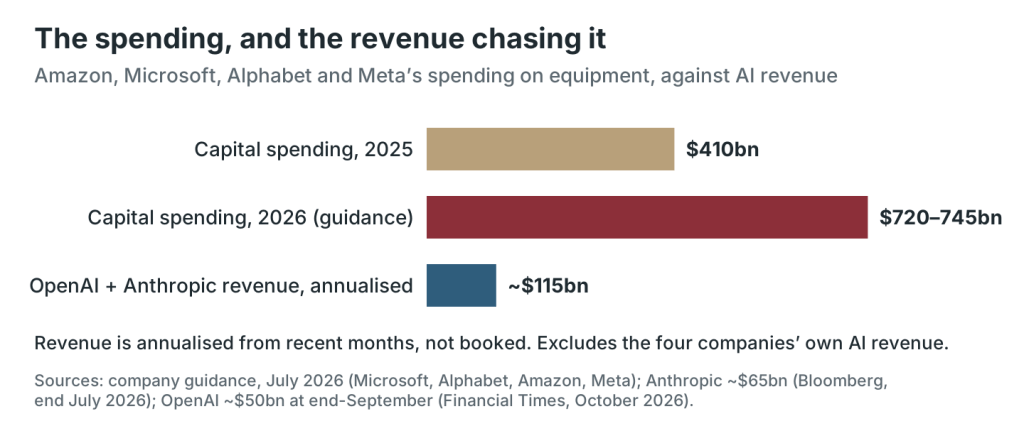
The second half of the problem starts with a sum that doesn’t add up. The largest American technology companies are expected to spend somewhere between $720 billion and $745 billion this year alone, on their own guidance, on data centres, chips and the power to run them. That is more than the entire annual economic output of most countries, spent in a single year by a handful of firms. The revenue coming back from artificial intelligence is growing fast, but it is a fraction of that.
The bet isn’t only American; it is now in almost every stock market on earth. The seven American giants make up roughly a third of the S&P 500, the index most of the world’s pension and savings money tracks. TSMC, the Taiwanese company that manufactures most of the world’s advanced chips, accounts for more than 40 per cent of Taiwan’s main stock index. Samsung and SK Hynix, the Korean memory-chip makers, have made up around half of South Korea’s. In the Netherlands, ASML, which makes the machines that make the chips, is around 15 per cent of the main Amsterdam index. In Germany, Siemens and Siemens Energy ride the demand for power equipment to feed the data centres. Even Ireland’s list of largest companies is now dominated by American firms registered in Dublin for tax, several of them selling the picks and shovels: Seagate, whose storage drives fill the data centres and whose shares have multiplied several times over in a year, and Eaton, which sells them their electrical gear. One fund manager put the danger neatly: investors who think they are spreading their risk by buying American technology shares and Asian markets together may be unknowingly doubling down on the same AI trade. If the cake doesn’t rise, it isn’t only American pensions that go hungry.
A Silicon Valley investor put the question simply in 2024, and it has not been answered since. David Cahn, a partner at Sequoia Capital, one of the most successful venture capital firms in history, wrote a short essay called “AI’s $600B Question”. His method was the one any analyst would use. Add up what is being spent on chips and data centres. Work out how much revenue would be needed to earn a normal return on that spending. Compare it with the revenue actually coming in. The gap was around $600 billion, and it has grown since. The laboratories’ own revenues are growing faster than almost any companies’ in history. Anthropic’s annualised revenue went from around $9 billion at the end of 2025 to around $65 billion by the end of July. OpenAI’s is around $50 billion on the Financial Times’s count, although its investors had been quoting $70 billion, because the two companies measure differently. Most of it comes from where the bull case said it would: businesses, paying for software that does work people used to do. The positive surprises are real. So is the bill. On their own figures the two laboratories together bring in about a sixth of what the four biggest American technology companies will spend on equipment this year. The gap is closing from one side and widening from the other.
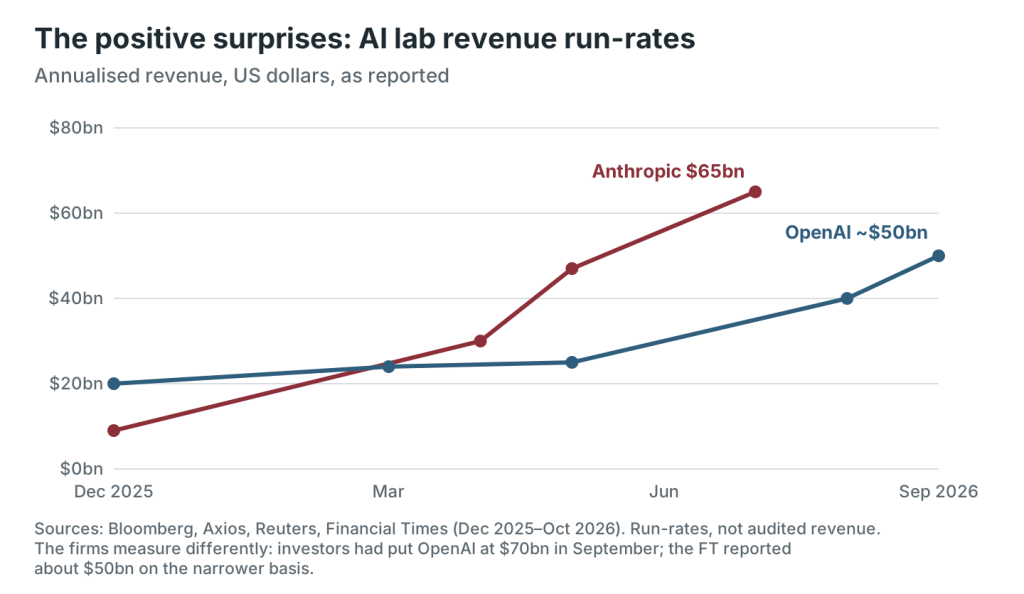
Some of the revenue that does exist is money going round in a loop. The chipmakers investing in the laboratories that buy their chips, the tenner that pays for the sandwich: that loop matters most here, because it inflates exactly the revenue figures that are supposed to justify the spending. The railway companies of the 1840s had their own version. Some of them paid dividends to their shareholders out of the money newer shareholders had just put in.
The stock market’s own valuations look calmer than the story suggests, and that is the trap. On FactSet’s figures the S&P 500 as a whole trades at about 19 times the profits analysts expect over the next year, exactly its ten-year average. That looks reassuring until you see why: the expected profits have risen as fast as the prices, and the technology companies are expected to report earnings up around 65 per cent on a year earlier for the latest quarter. But those earnings are the capital spending of a handful of customers. Anyone who has analysed a cyclical industry knows the pattern: the shares look cheapest when profits are at their peak, just before the customers stop ordering. The expensive part of the bet sits elsewhere, in the private laboratories and new flotations valued on forecasts of revenue, and in the assumption that this year’s orders are the new normal. Nobody knows yet whether the revenue will arrive in time: not the companies, not the analysts, and not us.
Mainstream talk about “markets” and “valuation” is mostly about shares. Stocks and shares. Risers and fallers. Market caps. Tickers on screens. Debt, when it features at all, means government debt: Treasury yields, gilt prices, bank lending rates. Public market debt, the bonds and commercial paper that companies issue, rarely gets a look in. Private market debt sits at the fringes of polite conversation. Which is unfortunate, since private debt, and the way it is packaged up and pulled forward, is the likely culprit when most bubbles burst.
We have been here before, twice. In 2008 the leverage that brought down the banks sat largely in vehicles off their balance sheets, which nobody was watching until they failed. In the railway mania, the danger sat in the calls on partly paid shares: liabilities that looked like nothing on the day of purchase and arrived in full after the price had turned.
The AI build-out is being financed the same way. In 2025 Meta paid for its giant Hyperion data centre in Louisiana through a joint venture with the private-credit firm Blue Owl, the largest private-credit deal ever done: Blue Owl’s funds own 80 per cent, Meta 20, and the vehicle sold $27.3 billion of bonds, structured so that most of the debt sits outside Meta’s own accounts. Oracle borrowed heavily to build data centres for its AI customers, and the cost of insuring its debt against default rose sharply late in the year. Musk’s xAI financed much of its Memphis supercomputer with borrowed money. And private credit, lending by investment funds rather than banks, lightly regulated and lightly disclosed, has become one of the main sources of money for data centres.
Without the transparency of public markets, this funding is opaque and elusive. Once again it may be that commentators, participants and regulators have their eyes on the wrong ball. We shall see. So, presumably, shall Oracle.
The assets being bought also wear out fast, and that exposes a weakness in how profits are counted. When a company buys a machine, it doesn’t subtract the whole cost from that year’s profits. It spreads the cost over the years the machine is expected to be useful, a charge accountants call depreciation. A server bought for £6 million and expected to last six years costs £1 million a year in the accounts. Expected to last three years, it costs £2 million a year, and profits look £1 million lower.
The company chooses how long its machines are expected to last, and the auditors generally go along with it. Since 2020 the largest technology companies have lengthened the assumed life of their servers, from three or four years to five and a half or six. Every extension made reported profits look better. Yet the chips at the heart of AI data centres are overtaken by a new generation roughly every year, and in 2025 Amazon went the other way, shortening the assumed life of some of its servers from six years to five because of the pace of change in AI, in the same quarter that Meta lengthened its own. Same chips, opposite conclusions. Nvidia’s own chief executive supplied the verdict: once the next generation shipped, he said, “you couldn’t give Hoppers away”. Critics, the American investor Michael Burry among them, argue that the others are assuming their machines will last longer than they will, which flatters today’s profits at the expense of tomorrow’s. Burry puts the understatement of depreciation across the industry at $176 billion over 2026 to 2028.
For an industry spending this much on equipment, “profit” can have very little to do with cash. A company can report healthy profits while spending far more cash than it brings in, because most of its spending is spread thinly across future years. Investors have a habit of making the problem worse. They often value companies on a measure called EBITDA: earnings before interest, tax, depreciation and amortisation. It leaves out exactly the costs that matter most in an industry built on borrowed money and machines that wear out. Charlie Munger, Warren Buffett’s late partner, suggested that whenever you see the word EBITDA, you substitute “bullshit earnings”. Buffett himself asked whether managements thought the tooth fairy paid for capital spending. The railway companies of the nineteenth century blurred the line between capital and income so thoroughly that Parliament eventually had to prescribe how they kept their books.
And when the bubble bursts, less will be left behind than last time. Railway track, once laid, lasted a century; the lines built in the mania were still carrying trains long after the speculators were ruined. The buildings, the grid connections, the power supply and the skills of this boom will survive. Most of the chips will not.
The machines also need feeding, and the free food is running out. Large AI models are trained on enormous quantities of human writing, much of it collected from the open internet without asking. Researchers at Epoch AI have estimated the usable stock of human-written public text at around 300 trillion words and fragments of words, and expect it to be used up sometime between 2026 and 2032, most likely around 2028. Elon Musk put it more bluntly in January 2025: “the cumulative sum of human knowledge has been exhausted in AI training.” The fallback, training new models on text produced by older ones, has a known problem: a 2024 study in Nature showed that models trained repeatedly on machine-made text degrade, losing the rare and unusual in favour of a bland average. One researcher named it “Habsburg AI”, after the royal family ruined by generations of marrying cousins. Inbreeding, in other words.
So the free data is becoming a cost, and access is starting to require good behaviour. News publishers and platforms have begun charging for it. Reddit licenses its users’ posts to Google; News Corp signed a deal with OpenAI reported at $250 million over five years. Internet infrastructure companies now block AI crawlers by default unless they pay. And the courts have started pricing what was taken: in 2025 Anthropic agreed to pay $1.5 billion to settle a lawsuit brought by authors whose books had been copied from pirate libraries. The same case revealed that the company had also bought millions of secondhand printed books, cut off their spines and scanned them. It has been a good time to own a secondhand bookshop, as well as to be an electrician wiring data centres. It is another cost the price will one day have to cover.
Small publishers have noticed the collection happening in their own figures. Many writers online have watched their readership drift away from the places where their readers live and towards the places where data centres sit. The visitor figures of the blog you are reading now come overwhelmingly from the United States and China, with a scattering from Hong Kong and Israel, which suggests an indifferent audience more interested in collecting the words than reading them. An essay about extraction is itself being extracted. The irony is not lost on either author.
There is another bill, and it appears in nobody’s accounts. Data centres run on electricity and are cooled with water. The International Energy Agency estimates they used about 1.5 per cent of the world’s electricity in 2024 and expects that to roughly double by the end of the decade, with AI the main driver. In parts of the United States, the cost of securing enough power for new data centres has already begun to show up in ordinary households’ electricity bills. Communities near new sites argue over water rights in places already short of it. And the rush for power has revived plans for gas plants that the climate commitments of a few years ago had written off: for Meta’s Hyperion data centre alone, the local utility is building ten gas-fired power stations, adding more than 30 per cent to Louisiana’s entire grid capacity. By 2030, on the IEA’s figures, America will use more electricity for data centres than for making aluminium, steel, cement, chemicals and every other energy-intensive product combined.
The IEA’s own comparison is instructive, and it cuts both ways. Data centres will account for only around a tenth of the growth in world electricity demand to 2030, less than air conditioning or electric vehicles. But electric cars replace emissions elsewhere; air conditioning keeps people alive in heatwaves; both are spread across millions of households, and both are regulated, argued over and taxed. Data centres’ demand is concentrated in a few places, captured by a few companies, and so far answerable to almost no one.
The industry’s answer is that data centres will generate their own power, “behind the meter”, and leave the public grid alone. It is less of an answer than it sounds. The on-site power is mostly gas turbines, with their emissions; the sites still connect to the grid for back-up, so the public network has to be built out regardless; and some operators haven’t waited for permission. Musk’s Colossus in Memphis ran 35 gas turbines on site against a permit for 15, and campaigners called it the city’s largest industrial source of smog-forming pollution, in a mostly Black neighbourhood already short of clean air. That is the site the maker of the machine co-writing these words now rents. Water has no such escape route. Cooling a data centre evaporates water whichever way the electricity arrives, and gas plants need cooling water too. You can build your own power station. You can’t build your own river.
It is the oldest trick in the book: keep the revenue, and leave the cost to the commons. The platforms took attention without paying for it; the laboratories took writing without paying for it until the courts intervened; the data centres take power and water whose full cost falls on everyone else. Economists call these externalities. They are not an accident of the technology. They are how the arrangement makes its numbers work.
The enterprise bet
The industry’s answer to the question of who will pay is: businesses, out of their wage bills. Consumers paying a few pounds a month for an AI assistant will never cover spending on this scale. So the pitch has moved to companies. Sell them software that does the work of employees, and price it as a share of the salaries it replaces. Suppose a piece of software can do the work of a £40,000 clerk. Charge the employer £15,000 for it, and both sides are better off: the employer saves £25,000, the AI company earns £15,000. That is the case at its strongest, and it should be taken seriously.
The evidence on whether AI really does this is mixed, and two living economists mark out the argument. Erik Brynjolfsson, at Stanford, led a much-cited study of AI assistance in a customer-service call centre, and found that workers’ productivity rose by around 14 per cent, most of all among the least experienced staff. AI, on that evidence, can be a ladder: it helps the new starter work like a veteran. But Brynjolfsson himself warned, in an essay called “The Turing Trap” (2022), that building AI to imitate and replace people rather than to extend what they can do would concentrate wealth and power in very few hands.
Daron Acemoglu, who shared the Nobel Prize in economics in 2024, is more sceptical about the gains. In “The Simple Macroeconomics of AI” (2024), he estimated that the boost to the whole economy’s productivity over the coming decade would be modest, far below the claims of the enthusiasts. With his colleague Pascual Restrepo he had already named a kind of technology that is all too familiar, and with Simon Johnson, in Power and Progress (2023), he made it famous: “so-so automation”. It replaces workers without making anything much better or cheaper. The perfect example is the supermarket self-checkout. It reduced the number of staff, passed the work of scanning and bagging to the customer, and made the shop barely more productive. Anyone who has argued with a self-checkout about an unexpected item in the bagging area understands the concept at once. There is also history here. In 1987 the Nobel-winning economist Robert Solow remarked that you could see the computer age everywhere except in the productivity statistics. Brynjolfsson himself wrote the classic paper on this “productivity paradox” in 1993. The gains did eventually arrive, briefly, in the late 1990s, and then faded again. Information technology has a long record of transforming how work looks while barely changing how much it produces.
The strongest reply to all this naysaying is history. Every wave of machinery has been accused of destroying work, and every time new work appeared. David Autor and colleagues at MIT found that around six in ten American jobs in 2018 were in occupations that didn’t exist in 1940. Believing there is a fixed amount of work to go round is what economists call the lump of labour fallacy. But the question was never only whether there would be work. It was what the work would pay. Over the past forty years the new work has come in at the top and the bottom, and the middle has hollowed out; two LSE economists called it the split between “lousy and lovely jobs”. The share of national income going to wages has fallen across the rich world, and Autor’s own later research traced much of that fall to industries dominated by a few superstar firms. Meanwhile the richest save a growing share of what they earn, because there are only so many pies a person can eat, and those savings have been lent back to everyone else as debt. The former central banker Raghuram Rajan had a phrase for what governments did instead of raising wages: let them eat credit. The work came back. The spending power, increasingly, had to be borrowed.
Where the saving goes
Even if the enterprise bet works, the AI companies may not be the ones who collect. Go back to the £40,000 clerk. The AI company wants to charge £15,000 for the software that replaces him. But the market for AI is competitive: open models, Chinese laboratories, and customers who can switch in seconds. So the price of the software is driven down, towards the cost of providing it. Most of the £25,000 saving, and more, goes to the employer that buys the software, and to its shareholders, not to the company that sold it. The valuations of the AI companies fail at the first hurdle: the gains leak away to their customers.
Then comes the bigger problem, which economists call the fallacy of composition. What makes sense for one firm doesn’t make sense for all firms together. One company replacing its clerks with software cuts its costs. Every company replacing its clerks cuts the incomes of all those clerks, and those incomes are what buy every company’s products. In a country like Britain or the United States, spending by households makes up roughly two-thirds of the whole economy, and most household spending comes from wages. Each firm that fills its price gap by cutting its wage bill is emptying another firm’s till.
A Polish economist worked out the logic of this almost a century ago. Michał Kalecki reached many of the conclusions later credited to John Maynard Keynes, and published them first, in Polish, in 1933. One of his insights can be put in a sentence: workers spend what they earn, and the profits of businesses as a whole depend on that spending, together with what businesses invest, what the government borrows and spends, and what the country sells abroad. Take away the wages, and the profits the valuations assume have nowhere to come from. Unless something else fills the gap: more borrowing (already stretched), more government spending (paid for by taxes on the very wages that are disappearing), or more exports (and not every country can sell more abroad than it buys at the same time).
Whichever way the mix is spread around the tin, there may not be enough in it for the cake to rise. That is the second half of the problem, and it is the one nobody at the dinner raised. The AI companies can’t find the price in the market, so they look to the state for a moat. And even if they get one, the price they hope to charge is a share of the wages their product removes, from an economy that needs those wages to buy anything at all. Marie Antoinette almost certainly never said “let them eat cake”; the line appears in Rousseau, attributed to an unnamed princess, before she had even arrived in France. It stuck to her because it captured something true about rulers who couldn’t see where their subjects’ bread was supposed to come from. This time there may not be enough cake either. That didn’t end well.
Back to the table
Around that dinner table sat the firms creating this problem and the only two institutions big enough to solve it. A shortfall in spending across a whole economy can’t be fixed by any single company. It can only be addressed by states: through taxes, public investment, what they own, and the incomes they guarantee. The two most powerful states on earth had the problem in the room, and chose to leave it “exactly where it is”. They agreed on a telephone for the wrong emergency.
Two days before the banquet, at the United Nations, the British prime minister had promised to put AI at the heart of his country’s G20 presidency next year and to broker shared global standards. A middle power offering the negotiation the two empires then declined; whether anyone follows is another matter.
One of those two states has already settled the concentrator’s dilemma in its own way. It didn’t ask the market for a moat, or the concentrators for restraint. It removed the possibility of leaving altogether.
Chapter 9: The Country That Abolished the Exit
Previously. The AI build-out is costing more than $700 billion this year, financed increasingly off balance sheet, on machines that wear out fast, with the bill for power and water left to the commons. The industry’s answer to who pays is businesses, out of their wage bills. But if every firm cuts wages, the spending that buys everything else disappears, and the cake doesn’t rise.
Everything so far has turned on one freedom: the user can leave. In the West, however costly the platforms make it, leaving remains possible, and that possibility sets the limit on how hard any owner can squeeze. There is one great economy where that freedom has been removed by design. What happens there shows what the exit is really for, and what happens when a state rather than a company becomes the concentrator. It also shows that the contradiction doesn’t go away when you change who holds the power. It moves.
The miracle, first
Before any criticism, the scale of what China achieved has to be stated clearly, because it is unmatched in history. In 1978 Deng Xiaoping began opening the Chinese economy after the ruin of the Mao years. In 1980 a small town on the border with Hong Kong, Shenzhen, was made a “special economic zone” where foreign investment and private enterprise were allowed to experiment; it is now a city of well over ten million people. China joined the World Trade Organization in 2001. For three decades its economy grew at close to ten per cent a year, and on the World Bank’s measures around 800 million people escaped extreme poverty. No transformation in human history has lifted so many people so far so fast.
How China managed it is still argued over, and two living economists give the argument its shape. Isabella Weber, at the University of Massachusetts Amherst, showed in How China Escaped Shock Therapy (2021) that China rejected the advice that wrecked Russia in the 1990s: free all prices overnight and let the market sort it out. Instead it freed prices gradually, keeping the state’s grip on the essentials while markets grew up around them. Yuen Yuen Ang, at Johns Hopkins University, argues in How China Escaped the Poverty Trap (2016) and China’s Gilded Age (2020) that Beijing gave local officials freedom to experiment and a share of the rewards, and that a particular kind of corruption, “access money” paid for favours and permits, oiled growth as well as draining it. One sees careful sequencing; the other a gilded bargain. Both show the miracle was an arrangement, not a mystery.
The Great Firewall as industrial policy
The Great Firewall is usually described as censorship, and it is. It was also the most successful protection of an infant industry in the digital age. From the late 1990s China built a system, officially called the Golden Shield, to filter and block the internet at its borders. Facebook and Twitter were blocked in 2009. Google pulled its search engine out of mainland China in 2010. In their absence, Chinese companies grew into giants with a captive market of a billion users: Baidu in search, Alibaba in shopping, Tencent in messaging and games.
Follow the money behind those giants and it leads somewhere unexpected. For years Tencent was China’s most valuable listed company. This August it was overtaken by CXMT, a Chinese memory-chip maker listed in Shanghai less than three weeks earlier, on the strength of the AI boom. Memory chips are the textbook commodity, the product whose prices swing from feast to famine with every cycle, and for now the most valuable company in the world’s second-largest economy makes one at a scarcity price. It is the same CXMT whose cheaper design knocked the Korean memory makers in October. Scarcity prices invite exactly that. Tencent’s own largest shareholder isn’t Chinese at all. It is Prosus, listed in Amsterdam and controlled by Naspers, a South African company that began as a Cape Town newspaper publisher and made an early bet on Tencent in 2001. Naspers is Africa’s largest company, and it controls itself through a separate class of shares carrying a thousand votes each. The Chinese internet, owned in part by an Afrikaans newspaper group, controlled through two-tier shares: the bet is everywhere, and so are the arrangements.
Put simply: a tariff keeps out foreign goods so that local makers can grow; the Firewall kept out foreign platforms so that local ones could. There is nothing uniquely Chinese about the method. The United States built its industries in the nineteenth century behind high tariffs, following Alexander Hamilton’s argument that young industries need protecting until they can stand on their own; the German economist Friedrich List made the same case for Germany. South Korea did it after the war. China applied the oldest tool of development to the newest economy, and it worked.
The West built a firewall of its own, around a single app. TikTok, owned by the Chinese company ByteDance, became the one Chinese platform to conquer Western teenagers. Washington’s answer was a law forcing its sale. In January 2026 a new joint venture took over TikTok’s American operations: Oracle, the private equity firm Silver Lake and MGX, an Abu Dhabi investment fund, each hold 15 per cent, and ByteDance keeps 19.9 per cent, just under the 20 per cent threshold the law allowed. ByteDance still owns the algorithm, licensing it to the new company, which retrains a copy on American users’ data. The platform was not closed. It was transferred to American and Gulf concentrators, with the original owner keeping a slice and the recipe.
The same company runs two different arrangements for two sets of children. In China, ByteDance’s domestic version, Douyin, has a youth mode that limits under-14s to 40 minutes a day and shuts them out overnight. The version the rest of the world’s teenagers used had no such limits until regulators and courts started forcing them. Beijing governs its own concentrator’s product for its own children. What it exported was the unregulated version.
When leaving is impossible
In China, the concentrator’s dilemma doesn’t arise, because there is nowhere to go. The dominant app, WeChat, combines messaging, payments, identity, public services, travel bookings and much else. During the Covid pandemic it also carried the health code that decided whether you could enter a shop, board a train or leave your building. Imagine your bank, your phone, your doctor’s appointments, your train tickets and all your friends on a single app, with no competitor, which the state can read. That is the exit reduced to zero. The owner never has to worry about a walkout, because leaving the app means leaving society.
Hirschman, who gave us exit and voice, wrote one of his best essays on exactly this situation. In 1993 he published “Exit, Voice, and the Fate of the German Democratic Republic”, looking back at the fall of East Germany. His usual view had been that exit and voice were alternatives: people either leave or complain. East Germany in 1989 showed him something else. As thousands of East Germans fled west through Hungary, those who stayed found their courage and took to the streets of Leipzig. Exit and voice reinforced each other, and together they brought the regime down. Where the exit is sealed, voice loses its most powerful ally.
Nepal showed the same thing happening in reverse, and very recently. In September 2025 the Nepalese government banned most of the major social media platforms. Young Nepalis, the generation that lives on those platforms, took to the streets within days. Dozens were killed, the parliament building was set alight, and the prime minister resigned. The interim prime minister who replaced him was chosen partly through an online poll on Discord, a chat platform. A state tried to close the exit, and voice erupted in its place. China has managed what Nepal could not, because it built the walls before a generation grew up outside them.
Surveillance, with the state as owner
China’s “social credit system” is not the single national score, ranking every citizen, of Western legend. Researchers such as Jeremy Daum, who runs the translation and research site China Law Translate, have shown that the reality is fragmented: credit ratings for companies’ compliance with regulations, local pilot schemes of varying ambition, and court blacklists of people who have failed to obey court judgements, usually over unpaid debts. The distinction matters. Criticising a myth makes the real problem easier to dismiss.
The real problem is serious enough without exaggeration. The court blacklists have been used to stop millions of people buying tickets for planes and high-speed trains, which gives the railway a grim new role as an instrument of discipline. In 2022, depositors from several rural banks in Henan province, whose savings had been frozen, tried to travel to the provincial capital to protest. They found that their Covid health codes had turned red, which barred them from travelling or entering public places. The app built to protect public health was turned against protest. And in Xinjiang, Human Rights Watch in 2019 took apart the police app used by the region’s “Integrated Joint Operations Platform” and documented a system of mass surveillance covering an entire population, the extreme end of what this technology allows when there is neither exit nor voice. The German journalist Kai Strittmatter’s We Have Been Harmonised (2019) is the readable general account.
The comparison with the West is clean. Surveillance capitalism watches you in order to sell you something. China’s version watches you mainly in order to govern you, and its platforms serve the state as well as the advertisers. The same machinery, answering to a different master. That is the whole point of calling it an arrangement.
None of this means ordinary Chinese people are simply victims. Surveys by Harvard researchers found satisfaction with the central government rising steadily for more than a decade before the pandemic. Most people have seen their lives improve beyond anything their grandparents could have imagined. The super-apps are extraordinarily convenient, the streets are safe, the trains run on time. Many know perfectly well what the state can see, and judge the bargain acceptable, or not one to fight. That is not so different from the Western shopper who knows the loyalty card is watching and swipes it anyway for the discount. Surveillance in both systems rests less on force than on a trade most people accept most of the time.
Where people can’t leave or protest, they find quieter ways to refuse. Millions use VPNs to climb over the Great Firewall. In 2021 young Chinese coined tang ping, “lying flat”: opting out of the relentless competition for jobs, homes and status, doing the minimum. Hirschman would have recognised it as a third option alongside exit and voice: withdrawal. You stay, you stay silent, and you stop trying.
The state squeezes its own concentrators
Between 2020 and 2022 Beijing did to its technology giants what no Western government has dared. In October 2020 Jack Ma, the founder of Alibaba and the most famous businessman in China, gave a speech in Shanghai criticising the financial regulators. Days later, the flotation of his financial company, Ant Group, which was set to be the largest share sale in history, was halted. In 2021 Alibaba was fined around $2.8 billion for abusing its market dominance. Didi, China’s version of Uber, floated in New York against Beijing’s wishes; within days regulators ordered its app removed from Chinese app stores, and within a year it had left the American market. The private tutoring industry, a vast business, was effectively banned from making profits overnight. Children’s online gaming was limited to three hours a week. All of it was carried out under the banner of “common prosperity”.
The Western concentrator worries that his users will leave the party; the Chinese concentrator worries that the Party will arrive. For a while, the second worry proved far more effective than the first. The richest men in the country were humbled in public, and several of them disappeared from view for months.
Then the state discovered it had a concentrator’s dilemma of its own. Squeeze private technology too hard, and investment, invention and talent go elsewhere. Foreign investors pulled their money out. Entrepreneurs and skilled professionals emigrated in such numbers that young Chinese coined a slang term for it: runxue, “the philosophy of running”. Growth slowed. By February 2025 Xi Jinping was holding a symposium with the country’s private entrepreneurs, with Jack Ma back in the front row and the founder of DeepSeek, the AI laboratory that had just shocked Silicon Valley, in the room. The state had overreached, faced an exit of a different kind, and eased off.
That symmetry is the most important thing China teaches us. Remove the users’ exit, and the dilemma reappears as the exit of capital and talent. The contradiction wasn’t resolved. It was moved.
The cost of the miracle
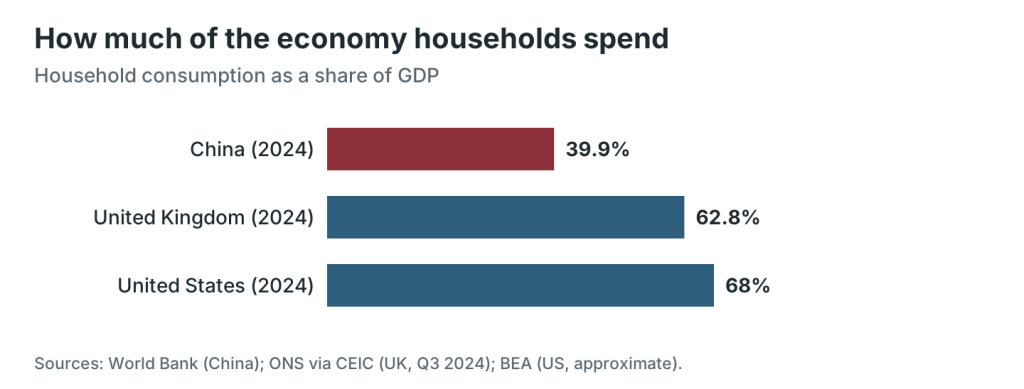
China has the same problem the AI bill threatens to create in the West, from the opposite direction: its households spend too little. Household consumption makes up around two-fifths of China’s economy, against around two-thirds in the United States and Britain. China’s growth was built on investment and exports, while households saved heavily and wages lagged behind the economy. The property sector, where most families kept their wealth, has been in crisis since Evergrande, the country’s most indebted developer, defaulted in 2021; a Hong Kong court ordered it to be wound up in 2024. Local governments carry enormous debts. Youth unemployment rose so high in 2023, above one in five, that the statistics bureau stopped publishing the figure for several months and then changed the way it was measured.
Chinese households save so much because the state leaves them to insure themselves. Pensions are small, especially for rural and migrant workers. Families pay a large share of medical costs out of their own pockets. The hukou system of household registration, a relic of the planned economy, limits migrant workers’ access to schools, healthcare and housing in the cities where they actually work. The population is ageing fast, and there is almost no social care. Saving isn’t a cultural quirk. It is insurance against a state that won’t provide it.
The remedy is well known and only cautiously applied. Michael Pettis, a former Wall Street trader who now teaches finance at Peking University, argued with the journalist Matthew Klein in Trade Wars Are Class Wars (2020) that China’s suppressed household incomes create a surplus of goods its own people can’t afford to buy, which then has to be sold abroad. The economists’ prescription, from Pettis and many others, is simple: build a welfare state, raise household incomes, and spending will follow. Beijing has begun, cautiously: a national childcare subsidy in 2025, and a pledge in its latest five-year plan to raise household consumption. But the steps are small against the size of the problem, because doing it properly would shift income and power from the state and its industrial sector to ordinary households. Like Washington, Beijing could address its spending problem, and chooses to push it into the future, because the cure would redistribute power.
So China has taken the one route out of a spending shortfall that not everyone can take: selling abroad. Its trade surplus is now enormous, and the electric cars, solar panels and steel it exports at low prices are the frontline of every trade dispute. China’s answer to its own contradiction is to export it to everyone else.
And the money from those exports goes back into dollars, which ties the two great economies into a single arrangement. China’s surpluses are recycled into American financial assets, directly and through its state banks. Brad Setser, an economist at the Council on Foreign Relations in New York, has argued that much of China’s real holding of dollars sits outside the official figures, in the accounts of those state banks. In 2003 three economists described the arrangement as “Bretton Woods II”: Asian exporters pile up dollars, which funds American borrowing, which lets Americans keep buying Asian goods. Put another way, the shopkeeper lends the customer the money to keep shopping: the snake, at the scale of two empires. Each economy’s spending problem props up the other’s. America consumes on credit; China saves, and lends it the credit. Neither fixes the underlying shortfall. Together, they postpone it.
What China wants next
Beijing’s stated direction is technology-led growth, with artificial intelligence at the centre. The official slogan, introduced by Xi in 2023, is “new quality productive forces”. An “AI+” policy aims to push AI into every sector of the economy. The drive for self-reliance in chips, including Huawei’s own AI processors, is the answer to American export controls. And Xi’s talk of AI “under human control”, along with his calls for a global body to govern it, is the diplomatic face of the same ambition.
Artificial intelligence does the thinking; robots do the handling, and there China is further ahead still. China has been the world’s largest market for industrial robots since 2013, and installs about half of all the industrial robots in the world each year. In the newer race for humanoid robots, machines built to work in spaces designed for people, Chinese firms accounted for more than 80 per cent of the 16,000 installed worldwide in 2025. There is a limit the enthusiasts tend to skip. As one tutor likes to put it, AI can’t cook a stew. What is easy for people, picking things up, moving through a cluttered kitchen, is fiendishly hard for machines, and the reverse is also true. Robots also bring back everything software escaped: real materials, real factories, real costs for every unit made.
The most striking part of the strategy is to give AI away. DeepSeek, Alibaba’s Qwen models and others have been released as “open weights”: anyone can download them and run them on their own computers, free. That undercuts the Western AI companies’ hopes of ever reaching the second phase, the price phase, because it is hard to charge a premium when a capable rival is free.
It looks like generosity, and it is strategy, the strategy Meta made famous. The technology industry has a phrase for it: “commoditise your complement”. Make the thing next to your business free, and the value flows to the part you own. Meta gave its models away to protect its advertising empire, and still promises open versions even now that its newest model is closed. China gives its models away because its strengths lie elsewhere, in manufacturing, hardware, robotics, batteries and energy, and free intelligence makes all of those more valuable. Mark Zuckerberg and Beijing have run the same play for different masters.
Business theory explains who ends up with the gains when the invention itself is free. In 1986 the American economist David Teece argued that when an innovation is easy to copy, the profits go not to the inventor but to whoever owns the “complementary assets” needed to use it: the factories, the distribution, the customers, the capital. Think of a published recipe. The recipe is free, so the money goes to whoever owns the restaurant. When AI models are free, the gains go to whoever owns the computing power, the data, the customers and the balance sheet to put them to work.
The stock markets worked this out long ago, and have already priced it in. The companies that make the “picks and shovels” of the AI boom have been revalued as though they will collect the gains whoever wins the race between the models: Nvidia in America, TSMC in Taiwan, ASML in the Netherlands, SK Hynix and Samsung in South Korea, and Tokyo Electron and Advantest in Japan. The obvious winners are already priced as winners, and their returns still depend on the same demand the automation erodes. The railway contractors did well out of the mania, too, until they didn’t.
Open weights also look like a gift to workers, and they are the opposite. A model’s weights are human work in condensed form: the writing, code and reasoning of millions of people, compressed into numbers. Releasing them free looks like returning a commons to the public. But the people best placed to use a free machine are those who already own everything else it needs, and they use it to employ fewer people. Marx called the machinery of a factory “dead labour”, the work of past workers frozen into equipment. Here is dead labour, given away free, to replace living labour.
There is one more irony in China’s gift. The country that abolished the exit for its own citizens now supplies the West with its cheapest exit from its own concentrators. A Western company escaping the prices of an American AI laboratory can leave on a Chinese-built model. But exit from the concentrator is not exit from the contradiction. The user escapes the rent. The worker still loses the wage.
Could China turn a lead in technology into dominance of the world’s money? If the world came to run on Chinese batteries, solar panels, electric cars, robots and AI, and Beijing insisted on being paid in its own currency, countries would need yuan to buy the things they depend on, much as the need for dollars to buy oil helped make the dollar the world’s currency. Some of the plumbing already exists. But a currency only becomes the world’s reserve if foreigners can get their money in and out freely. That would mean opening China’s capital account, which would also mean letting ordinary Chinese savers move their money abroad, and given the thin safety net and the property crash, many would. The Party’s whole model rests on keeping the exits sealed. China’s technology could only become monetary power if Beijing gave up the control that produced it. The dilemma follows the concentrator all the way up to the level of an empire.
The verdict
China shows that the contradiction doesn’t disappear when the state takes over. It relocates. In the West, the concentrators capture the state, and the contradiction shows up as rents and a shortfall in spending. In China, the state captured the concentrators, and the contradiction shows up as repression, the flight of capital and talent, and a shortfall in spending of its own, exported to the rest of the world as cheap goods. Neither is a solution. Both are ways of postponing one.
China also built a railway network the Victorians would have envied, the opposite way. In little more than fifteen years it laid the largest high-speed rail network in the world, longer than the rest of the world’s put together, by state direction and on state debt. Hudson’s mania built a network privately and left the investors ruined; Beijing’s built one publicly and left the state railway carrying debts measured in trillions of yuan. Two ways of building a network, arriving at similar places: the track laid, and the bill still to settle.
The one freedom China abolished is still available in the West. Users can leave. The next question is what happens when they do. For that, there is no better case than the platform that one man bought, squeezed, and watched its users walk out of.
Next: Chapter 10, The Man Who Squeezed Too Hard.
Methodology note: this piece was written collaboratively between a human and an AI — the human providing the instincts, provocations, editorial judgement and voice; the AI providing research synthesis, intellectual scaffolding and drafting. Full method at athomehefeelslikeatourist.blog. The AI co-writer is Claude, made by Anthropic, which appears in this story as the company renting Elon Musk’s Colossus supercomputer. The human author has no financial relationship with Anthropic beyond a subscription.


Leave a Reply