Railway Kings, the Surveillance Economy, and Who the AI Machine Will Carry
Chapter 1. The Railway King
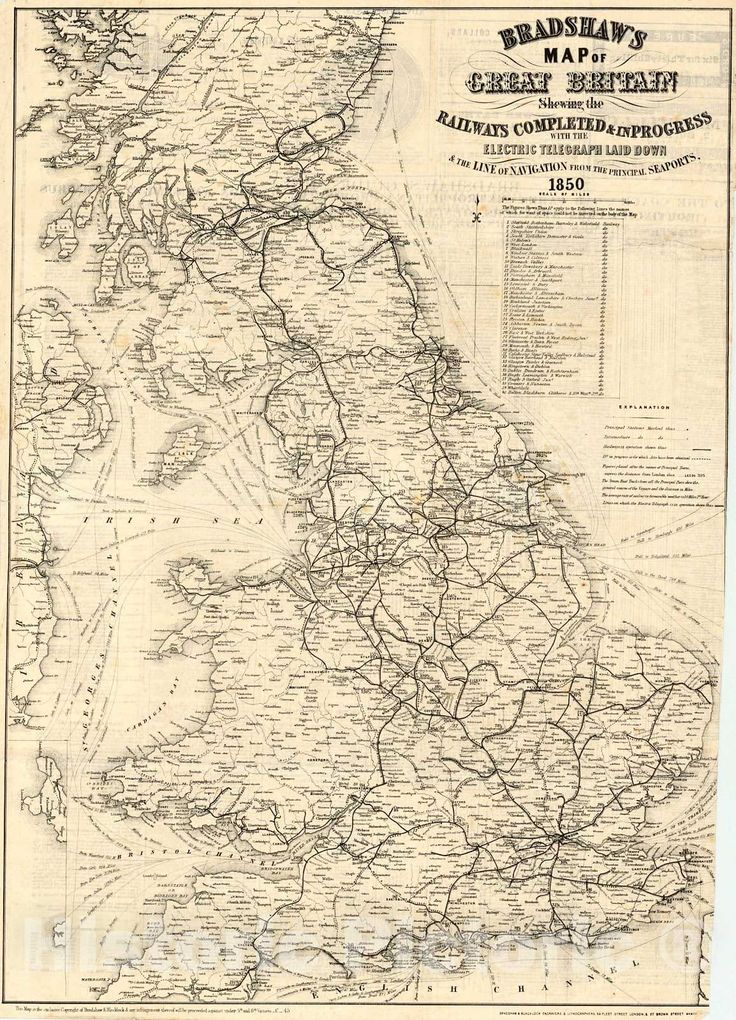
A warning: everything below that happened this week in the world of AI will have been overtaken by events next week. In the autumn of 1845 a Londoner could buy a dozen newspapers devoted entirely to railways, most of them living off advertisements for lines that would never be built, and all of them out of date by breakfast. The difference is that they didn’t know how it ended. We do, roughly. What we don’t yet know is what gets built from the wreckage, and that is the subject of what follows.
It follows in thirteen chapters, in four parts, in the manner of the Victorians. Dickens published Dombey and Son the same way, in monthly numbers, each one wrapped in the Dombey Advertiser: pages of advertisements bound in with the story, so that the novel and the business of paying for it arrived together. The railway mania runs through the plot. This serial comes without an advertiser, which, given what the next twelve chapters are about, seems only fair.
Mind you this may come more quickly than Dickens. This world is changing fast. And Dickens didn’t have the advantage of AI’s dizzying drafting pace. On the other hand he did have the distinct advantage of an audience hanging on his every word.
In 1845 the most talked-about man in England was a former draper from York. George Hudson had been born in 1800 to a farming family in the Yorkshire village of Howsham, apprenticed to a draper, and married into the business. In 1827 a great-uncle left him £30,000, a fortune then, and Hudson went looking for something to do with it. He found the railways. By 1845 he had been Lord Mayor of York (he would be again), was newly elected Member of Parliament for Sunderland, and chaired a string of railway companies that together controlled more than a quarter of the lines in England. Society hostesses competed for his attentions. Dukes asked his advice about their shares. The clergyman and wit Sydney Smith is said to have given him the name that stuck: the Railway King.
Hudson’s genius was to see that a railway line is more valuable when it joins other lines. A short line between two towns carries only the traffic between those towns. Join it to the next line, and the next, and a passenger can travel from Bristol to Newcastle on a single ticket, and every line in the chain carries more traffic than it did alone. So Hudson bought, merged and joined. In 1844 he combined three struggling companies around Derby into the Midland Railway, one of the first great railway amalgamations, and went on adding lines until he controlled routes from the Midlands to the Scottish border. The more he joined, the more valuable each piece became, and the harder it became for anyone to compete with him.
The railways had already made a discovery that nobody had planned. When the Liverpool and Manchester Railway opened in 1830, the first line in the world to run entirely on steam with regular timetables, it was built to carry cotton and coal between the port and the mills. The opening day was remembered for the death of William Huskisson, the Member of Parliament for Liverpool, who stepped into the path of Stephenson’s Rocket. Within weeks the company was remembered for something else. People wanted to ride. Passenger traffic turned out to be far larger and far more profitable than anyone had forecast. The railway had been built to move goods; it discovered that its by-product, people moving about, was the real business.
Railways needed Parliament, and Parliament was full of railwaymen. No company could build a line without its own Act of Parliament, because it needed the legal power to buy land from owners who didn’t want to sell. So every new railway went through committee rooms at Westminster, where the promoters argued their case and rivals argued against it. Many of the men judging those cases were themselves directors or shareholders of railway companies; by the height of the boom, well over a hundred Members of Parliament had railway interests. Hudson didn’t have to lobby Parliament. He sat in it.
The mania
By 1845 the whole country was buying. New railway schemes were announced by the hundred, each with a prospectus promising handsome returns. The newspapers filled with their advertisements; a whole crop of specialist railway papers sprang up to carry them, living on the prospectuses of the very schemes they reported on. Clerks, widows, clergymen and shopkeepers subscribed for shares. Punch drew the Railway Juggernaut crushing the crowds who worshipped it. In 1846 alone Parliament passed some 270 railway Acts, authorising around 9,500 miles of new line, more than the whole network then in existence.
Buying a share was easy; paying for it came later. Railway shares were usually sold “partly paid”. The buyer put down a small deposit, and the company called for the rest in instalments as construction went on. In a rising market nobody minded; you could sell the partly paid share at a profit before the next call came. When the market turned, the calls kept coming. Thousands of small investors found they owed money on shares now valued at less than what they still had to pay. The mania had sold the future, and the future sent invoices.
The rules made while the cement was wet
In the middle of the frenzy, Parliament decided that the railways had to carry everyone. In 1844 William Gladstone, then President of the Board of Trade, carried the Railway Regulation Act. It required every railway company to run at least one train each way along its lines on every weekday, stopping at every station, averaging no less than twelve miles an hour including stops, with passengers seated in covered carriages, for a fare of no more than a penny a mile. They became known as Parliamentary trains. Until then, the poorest travellers had often been carried in open wagons, in the rain, if they were carried at all. The law put them on the network.
The same Act gave the state the right to buy the railways back. For any line authorised after 1844, the government could purchase it after twenty-one years, at a price set by a formula in the Act. The option was never used. But it was written into law, in the year Hudson was building the Midland: the recognition that a network this important might one day need to belong to the public. At the height of laissez-faire capitalism the state was primed and ready to step in.
Then Parliament settled the war of the gauges. Isambard Kingdom Brunel had built the Great Western Railway to a broad gauge, seven feet between the rails, which he argued was faster and smoother. Almost everyone else had followed George Stephenson’s narrower gauge of four feet eight and a half inches. Where the two systems met, at Gloucester, every passenger had to change trains and every item of freight had to be unloaded by hand from one wagon to another, amid scenes of chaos the newspapers enjoyed describing. A Royal Commission reported in 1846, and the Gauge Act of that year required new passenger lines to be built to the standard gauge. Brunel’s broad gauge lingered on the Great Western for decades, but its fate was sealed. The network would be one network, and a wagon could run on anyone’s track.
The fall
The crash came in 1847, and the reckoning in 1849. Railway shares collapsed in the financial crisis of autumn 1847, and the calls on partly paid shares ruined many of the small investors who had bought at the top. Hudson’s companies struggled on. Then, in 1849, the shareholders of several of them set up committees of inquiry to crawl through the accounts. What they found ended his reign. Hudson had paid dividends to existing shareholders out of the capital raised from new ones, making the companies look far more profitable than they were. He had sold land and shares between his own companies at prices that suited him. The Railway King resigned his chairmanships one after another. He clung to his seat in Parliament, which protected him from arrest for debt, until he lost it in 1859; he then lived much of the rest of his life abroad, in reduced circumstances, and died in London in 1871.
The shareholders of the mania could, in the end, reach the king. They had lost fortunes. But they had the power to demand the books, examine them, and remove the man who had cooked them, and they used it.
What the crash left behind
The investors lost their money; the country kept the railways. The lines built in the mania were not torn up when their promoters were ruined. They went on carrying passengers and freight for generations, and the prosperity of the mid-Victorian decades ran on them. Money lost by the people who invested it built something that lasted for everyone else.
The people living through it felt the ruin and the deliverance at once. Charles Dickens, in Dombey and Son (1846–48), watched the cutting for the London and Birmingham Railway tear through the Camden neighbourhood he called Staggs’s Gardens, reducing it to mud and rubble, and then, a few years later in the novel, found the same place rebuilt, busy and prosperous. William Wordsworth, in 1844, wrote a sonnet of protest against a proposed line into the Lake District: “Is then no nook of English ground secure / From rash assault?” John Ruskin, a generation later, mourned a Derbyshire valley buried under a viaduct, so that “every fool in Buxton can be at Bakewell in half-an-hour”. The railway destroyed and delivered, both at once, and the same people often said so in the same breath.
Hold that story. Fast forward to 2026, and a riddle to ponder.
A riddle
A man builds one of the largest supercomputers in the world, to power his own artificial intelligence. His AI can’t find enough paying customers to keep the machine busy. So he rents the whole thing to a rival, on a contract either side can end within three months. The rent now keeps afloat the division of his company that houses a social network he once paid tens of billions of dollars to buy, and which he could not make pay.
One detail the reader is entitled to know at once: the rival paying the rent makes the machine that helped write these words. That isn’t a confession. It is part of the evidence.
Who is the man, what is the machine, and how did it come to this? If you can’t already guess by the time we get there, the answer will seem obvious. Getting there though requires thoroughly understanding a machine of a different kind: one most of us use every day, and almost none of us see.
Chapter 2: You Are Not the Product
Previously. In 1845 George Hudson, the Railway King, rode a speculative mania that ruined thousands of investors and left the country its railways. In the middle of the frenzy Parliament decided the new network had to carry everyone. Then, in 2026, a riddle: a man who built one of the world’s largest supercomputers now rents it to a rival to keep his social network afloat. To answer it, we need to understand a machine most of us use every day and almost none of us see.
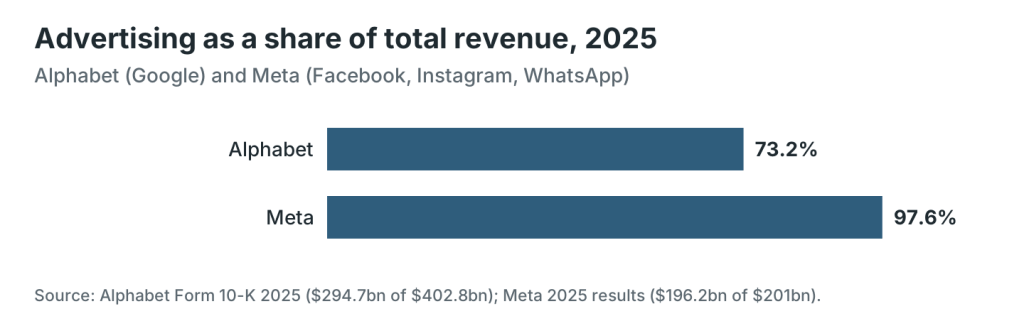
The biggest companies of our time give away their main product. That is the first clue. Google search costs nothing. Neither does Facebook, or Instagram, or WhatsApp, or YouTube. Yet the companies behind them are among the most valuable, at least in financial terms, ever built. Alphabet, Google’s parent, gets roughly three-quarters of its income from advertising. For Meta, which owns Facebook, Instagram and WhatsApp, the figure is close to all of it. Something is being sold, at great scale, to someone. It isn’t being sold to you.
Advertising paid for free things long before the internet, so start with something familiar. Think of the free newspapers handed out at Tube stations. The reader paid nothing, and advertisers paid to reach thousands of commuters on their way to work. The paper didn’t know which commuter was which. It knew roughly who travelled when, and it sold that to the advertisers. Everyone understood the deal. The Evening Standard’s free daily edition didn’t survive the smartphone, which rather proves the point.
The platforms made one change to that deal, and it changed everything. They know which commuter. They know what she looked at yesterday, where she was at lunchtime, what she almost bought and then didn’t, who she talks to, and what she is likely to do next. An advertiser paying a platform isn’t really buying space on a page. It is buying a better chance that a particular person will do a particular thing. The old saying “if it’s free, you’re the product” is close, but not quite right. You are the raw material. The product is a forecast of your behaviour.
The sale happens in the time it takes a page to load. When you open a web page or an app, a description of you (your location, your device, what you have been reading, the categories the industry has sorted you into) is sent to an advertising exchange. Hundreds of bidders receive it, decide in a fraction of a second how much you are likely to spend, and bid. The winner’s advert appears before the page has finished loading. You never see the auction, and the losing bidders keep the information anyway. The Irish Council for Civil Liberties estimated in 2022 that the average European’s data is broadcast this way 376 times a day, and the average American’s 747 times, and that Google alone allowed more than 4,600 companies to receive such data about people in the United States, some of them in Russia and China. The Council called it the biggest data breach ever recorded. It is a stock exchange, trading in you.
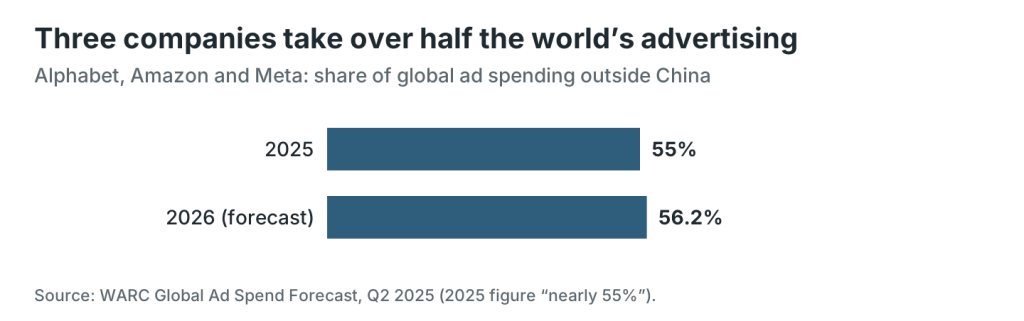
Is this anything new? Academics and commentators who study this don’t agree. There are two running arguments. The first asks whether what we’re describing is a new and rogue form of capitalism or ordinary capitalism working on a new raw material. The second asks whether it is capitalism at all, or something closer to the feudal system of lords and serfs. Both arguments are live, and the people making them are still writing, still disagreeing, and still revising their positions. On the first we side with the view that this is ordinary capitalism. On the second we side with the view that it is capitalism earning rent. Both terms get explained over this chapter and the next. For now, it is enough to know that there is a fight going on, and that we have chosen sides.
The woman who described it
Shoshana Zuboff gave the machine its most influential description, and she has been watching it for forty years. The phrase “surveillance capitalism” was used first by others, but it was her 2019 book that made it the standard term and her definition the one everyone argues with. She is professor emerita at Harvard Business School, where she was among the first women to gain tenure. Her first major book, In the Age of the Smart Machine (1988), studied what computers were doing to work in offices and factories, long before most people owned one. The Age of Surveillance Capitalism (2019) gave the whole subject its vocabulary. She has since argued for something few economists or politicians will say out loud: that markets trading in predictions of human behaviour should be banned outright.
Her first idea is “behavioural surplus”: the data taken beyond what the service needs. A map app needs to know where you want to go in order to give you directions. That is the service. It also records when you left home, how fast you walked, where you paused, which shop window held your attention, and how often you make the trip. None of that is needed to get you there. That extra is the surplus, and the surplus is where the money is. The directions are the bait. The surplus is the catch.
Her second idea is that once you can predict behaviour, the profitable next step is to shape it. A forecast is valuable. A forecast you can make come true is far more valuable. Zuboff calls this “economies of action”, and she calls the power it creates “instrumentarian”. This isn’t Big Brother watching you in order to punish you. It is a quiet hand at your back, moving you along without your noticing.
Her best example is a children’s game. In 2016 Pokémon Go sent millions of people out into the streets, following their phones to catch cartoon creatures hidden in the real world. Some of the places the creatures appeared were paid for. Restaurants and shops could sponsor locations and have the creatures show up at their doors, and the players followed. They thought they were playing a game. They were being walked into shops.
Zuboff dates the discovery to a particular moment, and the moment matters. In her account, Google stumbled on the value of the surplus after the dot-com crash of 2000–01, when investors who had lost fortunes demanded that the company start making real money. Search was a fine service but a poor business. The trail of data people left behind while searching turned out to be the business. Remember that the model was born out of the wreckage of a crash. We will come back to it.
The grocer who got there first
Six years before Google’s discovery, a British supermarket was already doing it. Tesco trialled its Clubcard in a handful of stores in 1994, working with a small London data firm called dunnhumby, founded five years earlier by the husband-and-wife team Edwina Dunn and Clive Humby. When the trial results reached the Tesco board, the chairman, Ian MacLaurin, is said to have remarked that the company now knew more about its customers after three months than he had learned in thirty years. The card went national in February 1995. The same year, Tesco overtook Sainsbury’s to become the country’s largest grocer.
The card was sold to shoppers as a thank-you for loyalty; to Tesco it was a record of how the country lived. Every swipe at the till tied a basket of shopping to a person, a household and a postcode. Tesco used it to decide what to stock, where to open stores, and what to charge. At the company’s headquarters in Cheshunt in the mid-1990s, Terry Leahy, then marketing director and the card’s champion, was explaining its value to investors. Most people in those rooms saw a clever marketing tool that would win customers from Sainsbury’s. It did. What almost nobody could see was that it was an early model of an economy.
The data became a product in its own right, sold to people who were not shopping at all. Tesco took control of dunnhumby in stages, and the firm went on to do the same work for supermarkets around the world, including Kroger in the United States. Today it sells what the industry calls “retail media”: access to Tesco’s customers, sold to the brands on Tesco’s shelves. Clive Humby is credited with the phrase that became the slogan of the whole era: data is the new oil.
The Americans had pieces of this earlier. The supermarket barcode arrived in 1974; the first item ever scanned was a packet of Wrigley’s chewing gum in Ohio. By 1979 an American firm was linking the television adverts particular households saw to what those households then bought. Frequent-flyer schemes and till-printed coupons followed in the 1980s. None of this came from Silicon Valley. It came from grocers, airlines and market researchers doing ordinary business. The platforms didn’t invent a new kind of capitalism. They industrialised an old habit.
What the critics say, and what the evidence says
Zuboff’s critics say she believes the companies’ own sales pitch. They have a point. Cory Doctorow, the campaigner and novelist who gave the platforms’ decline its name, argues that their power to change what we think is oversold, and that their real power is the old-fashioned kind: monopoly. Tim Hwang, a former Google policy lead, went further in Subprime Attention Crisis (2020), arguing that much online advertising works far less well than advertisers are told, and that the whole market resembles the mortgage bubble before 2008: bundled, traded and priced in ways so opaque that buyers can’t see what they are getting.
Anyone who sat in the meetings where companies were pitched on the value of their customers’ data will recognise the pattern. The executives furthest from the data were the most excited by it. The technical and marketing staff closest to it were the most sceptical. The buyers least able to judge the product paid the most for the promise.
The industry has tested this on itself, and the results were awkward. In a well-known experiment, economists at eBay switched off its paid search advertising in some parts of the United States and compared sales there with everywhere else. Sales barely changed. Most of those customers would have arrived anyway. eBay had been paying Google for sales it was already making. John Wanamaker, the American department-store owner, is supposed to have said, around the turn of the twentieth century, that half his advertising was wasted and he didn’t know which half. The platforms sell precision. The evidence suggests the waste is still there, only now with better graphs.
If the critics are right, the platforms don’t need their predictions to work. They need advertisers to believe they work. The rent depends on belief, and belief, as anyone who has worked in markets knows, can be withdrawn much faster than it was given.
If the forecasts are oversold, a harder question follows: why does so much of the money end up with so few companies? The answer has less to do with how well the forecasts work than with how networks grow. And the critics of the critics have their own views about what to call the result.
Chapter 3: Rent, Not Feudalism
Previously. The platforms give their main product away and sell something else: forecasts of what we will do, traded in auctions that run every time a page loads. A British grocer was doing a version of it before Google was. The critics argue the forecasts work far less well than advertisers are told, and that the platforms need only that advertisers believe they do.
Why it ends up in so few hands
Zuboff describes the machine; Nick Srnicek explains why only a few companies end up owning it. Srnicek is a senior lecturer in the digital economy at King’s College London. He first came to attention as co-author of Inventing the Future (2015), an argument from the left for embracing automation rather than fighting it, which makes him an unusual witness: sympathetic to the technology, sceptical of its owners. His short book Platform Capitalism (2016) is the one to hand a sceptical friend, and his latest, Silicon Empires (2025), carries the same analysis into artificial intelligence, where we will meet him again.
His central mechanism is the network effect: a platform becomes more valuable as more people use it. You are on WhatsApp because your family is on WhatsApp. It may not be the best messaging app in the world, but that doesn’t matter; leaving would mean leaving them. The idea isn’t new. A telephone is useless if nobody else has one, and a railway line is more valuable once it connects to other lines. What network effects decide is that one platform will win each category, not which one. Friendster and MySpace had the social network first and lost it to Facebook. Timing, chance and a few design choices picked the winner. After that, the network effect locked it in.
The digital version has one feature the older networks lacked: each extra user costs almost nothing. Laying a new railway line to reach new passengers cost a fortune. Adding a new user to a platform costs close to nothing once the software and the servers exist. The heavy costs come first, in building the thing. After they are covered, almost all the revenue from each additional user is profit. That is why these companies could grow so fast and earn so much, and why investors will pay almost anything for growth. Remember this feature too. Artificial intelligence reverses it, bringing back railway-scale building costs and real costs on every use, and that reversal sits at the centre of the chapters to come.
Srnicek’s second mechanism is cross-subsidy: one side gets the service free and the other side pays for it. Users pay nothing, and advertisers pay for access to those users. Every free user makes the network bigger, which makes access to it more valuable to the paying side. The free side grows the asset; the paying side is charged for it. That is how giving the product away becomes one of the most profitable business models ever devised.
The critic who criticises the critics
Evgeny Morozov is the sharpest critic in this field, and he is as hard on the other critics as he is on the companies. Born in Belarus in 1984, he made his name with The Net Delusion (2011), which took apart the fashionable belief that the internet would spread democracy by itself. To Save Everything, Click Here (2013) followed, naming “solutionism”: Silicon Valley’s habit of treating every social problem as an engineering fault waiting for an app. He is less a technology writer than a political economist of technology, and he makes uncomfortable company for everyone involved.
His case against Zuboff is that she mistakes capitalism doing its normal job for capitalism going wrong. In a long review in the American magazine The Baffler in 2019, titled “Capitalism’s New Clothes”, he argued that Zuboff treats the platforms as rogue actors who betrayed an older and better capitalism, and that her remedy, underneath, is a return to it. For Morozov there was no betrayal. Taking something that used to sit outside the market and turning it into something bought and sold is what capitalism has always done, first to land, then to labour, and now to attention and personal data. The Clubcard story supports him: the model was being run by a grocer in Hertfordshire before anyone in California had thought of it.
The difference between them is easy to picture. Zuboff describes a break-in: intruders have forced their way into our private lives. Morozov says nobody broke in. The landlord had a key all along; it was written into the lease, and he has simply started using it more. If Zuboff is right, you call the police. If Morozov is right, there is no crime to report, and the only remedy is to rewrite the lease. Readers of David Harvey will recognise the pattern: something that was held in common, in this case the ordinary texture of our daily lives, is fenced off and turned into private property. We take Morozov’s side, which is why our argument is about arrangements rather than villains. The people running these companies are mostly doing what the lease allows. Change the lease and you change what they do.
Morozov then turns on the critics coming from the other direction. A school of thought led by the French economist Cédric Durand and the former Greek finance minister Yanis Varoufakis argues that what we have now isn’t capitalism at all. In Varoufakis’s Technofeudalism (2023) we have become “cloud serfs”, working unpaid on digital estates and paying “cloud rent” to the lords who own them. It is a vivid picture and a popular one. In a long essay in the New Left Review in 2022, “Critique of Techno-Feudal Reason”, Morozov argued that the feudal comparison is a rhetorical flourish that lets capitalism off the hook: if the problem is a return to feudalism, then capitalism becomes the thing to defend. We take his side here too, for a reason that will become clear shortly.
Morozov also has a positive story, and it shows that other arrangements have been tried. His podcast series The Santiago Boys (2023) tells the story of Cybersyn, a network built in Salvador Allende’s Chile between 1971 and 1973 to help run the economy in real time, with telex machines feeding factory data to an operations room in Santiago that looked like a set from Star Trek. Its designer was a British management consultant, Stafford Beer. The obvious objection is that this was Soviet-style central planning with better furniture, and the objection is wrong. Beer designed the system against top-down control: decisions were meant to stay as close to the factory floor as possible, with workers involved in running it. When a strike in October 1972 threatened to paralyse the country, the network helped the government keep supplies moving. The coup of 1973 ended it. The lesson is simple: the technology of data and prediction has been built before under completely different ownership, for completely different ends.
Rent, not feudalism
Mariana Mazzucato gives us the most precise word for what the platforms earn: rent. She founded the Institute for Innovation and Public Purpose at University College London. Her book The Entrepreneurial State (2013) showed that the key technologies inside the iPhone (the internet, GPS, the touchscreen, voice recognition) all came out of publicly funded research, largely American and largely military. The Value of Everything (2018) drew a line between creating value and extracting it. With the technologist Tim O’Reilly and the economist Ilan Strauss, she has since developed the idea of “algorithmic attention rents”: platforms using their control over what you see to charge a toll on everyone who wants to be seen.
“Rent” needs explaining, because economists mean something different from your landlord. To an economist, rent is income that comes from controlling access to something, not from making it. The clearest picture is a tollbooth on a bridge someone else built. The toll-keeper made nothing; he stands at the only way across. A great deal of what the platforms earn is income of this kind. They built the tollbooth, and in many cases the public paid for the bridge.
Mazzucato’s team found the tollbooth on Amazon. Search Amazon for something ordinary, a dog bed or a phone charger, and look at what comes up first. The top results are increasingly paid placements rather than the best or cheapest products. Their research found that these promoted results are often worse value than what sits further down. The shopper pays a little more. The seller pays Amazon to be seen. Amazon collects from both, for managing a queue it controls. Nothing new was made. Access was charged for.
| The toll | Who pays it | What for | Who ends up paying |
|---|---|---|---|
| Amazon marketplace fees and advertising | Independent sellers, who make up most of Amazon’s sales | A referral fee on each sale (15 per cent in most categories), delivery fees, and advertising to appear near the top of search. Together they can take around half of a seller’s revenue | Shoppers, through prices set to cover the fees |
| App store commissions (Apple and Google) | App developers | Up to 30 per cent of digital sales and subscriptions sold through the store (15 per cent for small developers and longer-running subscriptions) | Users, through the price of apps and subscriptions |
| Paid placement in search results | Any business that wants to be found | Paying per click to appear above the unpaid results, often including searches for the business’s own name | Customers, through the cost of advertising built into prices |
| Supermarket retail media | The brands on the shelves | Adverts and promotions targeted using loyalty-card data, sold by the supermarket | Shoppers, through the price of the goods |
Four platform tolls. Sources: Amazon and Apple published fee schedules; Marketplace Pulse (2023) for the combined Amazon estimate.
The public paying for the bridge is the detail to hold on to. If the technology underneath the platforms was paid for by taxpayers, and the income from it is collected privately, then that is not a law of nature. It is an arrangement, one that was made and could be made differently. The railway companies of the nineteenth century needed Acts of Parliament to cross private land. The platforms needed decades of public research to exist at all. In both cases the public put in something essential, and the question of what it gets back is open.
The people who make the attention
The machine also runs on labour. A whole economy of creators, influencers, streamers and posters produces what the platforms sell: the content that holds your attention long enough for the adverts to reach you. The creators carry the risk. They put in the hours, pay for their own equipment and absorb the collapse when an algorithm changes and their audience disappears overnight. The platform decides who is seen, sets the terms, and takes its cut. It is the tollbooth again, with the people passing through it doing the work that brings the traffic.
Why the serf could not leave
The feudal comparison fails at one point. A medieval serf was bound to the land. He could not leave his lord’s estate for a better offer; the law and the lord’s men made sure of it. The user of a platform can leave. She can delete the app, close the account, walk away. Nothing but inconvenience stops her.
But leaving has a price, and the platform economy is built on how high that price is. Leave WhatsApp and you lose the family group. Leave Facebook and you lose fifteen years of photographs and the people you only know through it. Leave YouTube as a creator and you lose the audience that helps pay your rent. Even the loyalty card has a version of it: a Tesco shopper without a Clubcard now pays more for the same tin of beans. The price of leaving isn’t the subscription. It is everything you would have to leave behind, or pay extra to do without. We will call that price the exit cost. Who owns these companies, and why so little can be done to make them answer to anyone, comes next. After that, why the exit cost is the one thing left that decides how far they can squeeze.
Next: Chapter 4. The Owners Who Cannot Be Sacked
Methodology note: this piece was written collaboratively between a human and an AI — the human providing the instincts, provocations, editorial judgement and voice; the AI providing research synthesis, intellectual scaffolding and drafting. Full method at athomehefeelslikeatourist.blog. The AI co-writer is Claude, made by Anthropic, which appears in this story as the company renting Elon Musk’s Colossus supercomputer. The human author has no financial relationship with Anthropic beyond a subscription.


Leave a Reply