Five centuries of African extraction: a gate facing outwards, and the countries within
Methodology note: this piece was written collaboratively between a human and an AI — the human providing the instincts, provocations, editorial judgement and voice; the AI providing research synthesis, intellectual scaffolding and drafting. Full method at athomehefeelslikeatourist.blog.
In 2002 the historian Frederick Cooper published a short, difficult book about Africa since 1940, and in it he offered two words that have outlasted almost everything else written on the subject that decade: the gatekeeper state. He meant something specific and, on reflection, obvious. Colonial rule in Africa was never really an attempt to govern the interior. It was an attempt to govern the gate — the port, the customs house, the railhead, the point where whatever the interior produced left the continent and whatever the continent needed arrived. Everything behind that gate could remain, in administrative terms, largely unknown. Everything at the gate had to be counted, taxed, and controlled.
Cooper himself was careful about how much weight the phrase could bear, writing that it was intended more to provoke discussion than to be learned. That is the right spirit in which to take it up here: not as a theory that explains everything, but as a question to put to five centuries of evidence — who has stood at the gate, on what terms, and what has that meant for everyone standing behind it.
What was actually at the gate
Before there is a Scramble for Africa to describe, there is a pattern to name. The first European trading posts on the West African coast were not administrative headquarters; they were warehouses. Gold moved through them from the interior kingdoms of the Sahel. Ivory moved through them from forests further south. From the sixteenth century onward, so did people, in numbers that eventually ran into the millions, sold into the Atlantic slave trade through fortified posts — Elmina, Gorée, Cape Coast Castle — that were built to hold captives as much as to hold goods. By the nineteenth century, as the legal slave trade wound down under British pressure, the cargo changed without the mechanism changing at all: palm oil from the Niger Delta, prized in Britain as an industrial lubricant and for making soap and candles, became the region’s dominant export almost overnight, moving through the same coastal points the slave trade had used. Later still it would be rubber, cotton, gum arabic, cocoa, copper, gold again, diamonds, oil, cobalt.
The common feature across four centuries of changing exports is not what was taken. It is the geography. None of this required control of the interior. It required control of a handful of points where the interior’s output crossed into someone else’s ships. A trading post is cheap to build and cheap to hold — a fort, a garrison, a treaty with whichever local ruler controls access to the coast — against the alternative of actually administering the territory behind it, which is expensive, slow, and largely unnecessary if the goal is simply to make sure nothing valuable leaves without paying its toll. This is the logic Cooper later gave a name to. It did not begin with the Scramble for Africa in the 1880s. It was already centuries old by then. The Scramble did not invent the gate. It intensified it, formalised it, and — for the first time — put competing European claims to the same gates into direct and occasionally violent conflict with one another.
The Scramble for Africa as maintenance, not invention
Competition and conflict. What the Scramble for Africa did add, from the Berlin Conference of 1884-85 onward, was competition sharp enough to force each European power to formalise its claim on the gates it already held, and to stake new ones before a rival got there first. The way in which the powers went about holding the same gate tells us something important about what they were trying to do.
Britain had spent a century perfecting informal empire through trading companies and one-sided treaties. It kept that habit even as formal rule spread. Chiefs and existing rulers stayed in place under indirect rule. The colonial administration itself stayed thin on the ground. Real power concentrated at the coast and the railhead, not the village.
Germany arrived late to the continent and was anxious to prove its colonies profitable. Its colonial administration was markedly more brutal in its labour discipline than Britain’s. The 1904-08 genocide of the Herero and Nama in German South West Africa is the extreme case. But coerced cash-crop labour and punitive taxation ran across German East Africa and Cameroon too.
Belgium’s King Leopold II did not even bother with the pretence of governing on behalf of anyone but himself. His personal fiefdom, the Congo Free State, ran a rubber-extraction regime built on hostage-taking and mutilation, with a death toll credibly estimated in the millions. International outrage eventually forced the Belgian state to take the territory off him in 1908. It remains a rare case of a colonial power being shamed into annexing a colony in order to stop a worse abuse.
Portugal ran a fourth model again. It had invented the “positions not territory” trading-post approach on this same coast centuries earlier, at Ceuta in 1415 and Elmina in 1482, and in first contact with Kongo the following year. Now it reversed course and pursued full territorial control in Angola and Mozambique. The change was driven less by strategy than by the need to hold onto something after losing Brazil, its far larger colony, to independence in 1822.
Four powers, four different registers of the same underlying instinct. Control the gate. Extract what passes through it. Spend as little as possible on everything behind it. A further thought, which we will return to when the subject turns to who holds the gate today: colonial administration at every level depended on local intermediaries — chiefs, headmen, traders — who administered the system in exchange for a share of its proceeds, and who were not merely its victims but, in places, its beneficiaries too.
What was actually taken, and by whom
In order to illustrate the mechanism of extraction, we will look at three companies that still exist, in some form, today.
The Royal Niger Company began in 1879 as the United African Company, took its final name in 1886 when it received a royal charter to administer the Niger Delta’s palm-oil trade, and for two decades effectively governed what would become colonial Nigeria on Britain’s behalf — negotiating treaties with local rulers, several of them later shown to have misrepresented what was actually being signed, and enforcing a trading monopoly that squeezed out African merchants like Jaja of Opobo who had grown wealthy on the same palm-oil trade before the Company arrived. In 1899 the British government revoked the charter and bought the Company’s territorial holdings outright for £865,000 — the founding transaction, in effect, of colonial Nigeria. The Company itself did not disappear. It carried on trading as the Niger Company, merged into the United Africa Company in 1929, came under Unilever’s control the same decade, and remained a Unilever subsidiary until it was fully absorbed into the parent company in 1987. Unilever still operates in Nigeria today.
Union Minière du Haut Katanga was founded in 1906 to exploit the copper, cobalt, and — eventually — uranium of Congo’s Katanga province, and grew rich enough to become, by some measures, the single most profitable colonial enterprise in Africa; its uranium, extracted from the Shinkolobwe mine, was the ore used in the Manhattan Project. Mobutu Sese Seko’s government nationalised its Congolese operations in 1966-68, folding them into the new state company Gécamines. But Union Minière’s Belgian corporate shell survived the nationalisation, retreated into specialty metals and materials processing, merged with several sister companies in 1989, and in 2001 renamed itself Umicore — a company still listed on the Euronext Brussels exchange today, and now a significant player in refining cobalt and other battery materials for the global electric-vehicle supply chain.
De Beers is the third case, and it is unresolved as this is being written. Cecil Rhodes built the company into a near-total monopoly over southern African diamond production from the 1880s onward, and for most of the twentieth century it ran the industry’s price through the Central Selling Organisation — a London operation on Charterhouse Street that held ten sales a year, offered sealed boxes of rough diamonds to a small list of approved buyers at prices De Beers itself set, and at its peak controlled somewhere between eighty and ninety per cent of the world’s rough-diamond supply. De Beers eventually came under the control of Anglo American, the mining conglomerate Ernest Oppenheimer founded in Johannesburg in 1917, and the Oppenheimer family ran both companies for three generations. As of 2026, Anglo American — which still holds an eighty-five per cent stake — is partway through selling De Beers off entirely. Its value has been written down by $6.8 billion over three years, undercut not by softening demand for diamonds but by a technology that makes De Beers’s own weapon obsolete. Lab-grown diamonds, chemically identical to mined ones, have collapsed in price as manufacturing has scaled: a 1-carat lab-grown stone now retails for $750-1,500 against $4,000-6,000 for the natural equivalent, and lab-grown diamonds went from 5.2 per cent of American engagement ring purchases in 2019 to 45 per cent by 2024. De Beers tried to get ahead of this itself, launching a lab-grown brand called Lightbox in 2018, and shut it down again in 2025 when the strategy failed to hold, retreating back to defending the natural market instead. A century of manufactured scarcity, run from a room in London, is being undone by a laboratory that can manufacture the opposite of scarcity on demand. Botswana, which already holds fifteen per cent of the company and hosts its most valuable mines, has said it wants to become the majority owner. Angola has said it wants a significant stake too. No deal has closed yet. Whether the century-old diamond gate actually changes hands to African states, or ends up with a different set of foreign owners instead, is a live question rather than a settled one, and we will come back to it at the end.
One more fact belongs alongside these three, because it complicates the picture rather than simplifying it. Africa’s largest single publicly listed company by market value, as of 2026, is not a bank or a telecoms operator but AngloGold Ashanti — itself spun out of Anglo American, merged in 2004 with Ghana’s own Ashanti Goldfields, dual-listed on the Johannesburg and New York exchanges. In 2020 it sold its last remaining South African mining assets and left the country where the whole Anglo American group began. And the exchange it is listed on tells its own story about where African capital actually sits: of the roughly two trillion dollars of value spread across Africa’s seventeen stock exchanges, some three-quarters of it — around $1.5 trillion — sits on the Johannesburg Stock Exchange alone. “African capital markets,” to a striking degree, means one exchange, in one country, still carrying the weight of the same mining capital we have been tracing since the Scramble.
The gate was never one gate
Colonial Africa was never a single uniform mechanism, applied the same way everywhere, with the same results.
We confine ourselves here to sub-Saharan Africa. North Africa’s experience — Ottoman suzerainty giving way to French rule in the Maghreb, Egypt’s own distinct trajectory under British occupation — followed a different enough logic, rooted in a different regional history, that folding it into the same argument would blur more than it would clarify.
Within sub-Saharan Africa, the choice of colonial administrator mattered more than a single “colonialism” label suggests. British indirect rule worked, however imperfectly, through existing chiefs and political structures, leaving something recognisable behind at independence for a new state to inherit or contest. French rule leaned harder toward direct administration and cultural assimilation, and did more damage to precolonial political structures in the process — one estimate finds French colonisation dissolved roughly twice as many precolonial polities as British rule did across comparable territory. A state inheriting a British-administered gate and a state inheriting a French-administered one were not inheriting the same thing.
The border itself was drawn twice, not once. The Scramble’s 1884-85 partition set the first map. A second redrawing followed the First World War, when Germany’s African colonies — Togo, Cameroon, German East Africa, German South West Africa — were stripped from it entirely and handed out as League of Nations mandates: Tanganyika to Britain, most of Cameroon and Togo to France, Rwanda-Urundi to Belgium, South West Africa to South Africa. Some states, as a result, inherited not one layer of external gatekeeping but two.
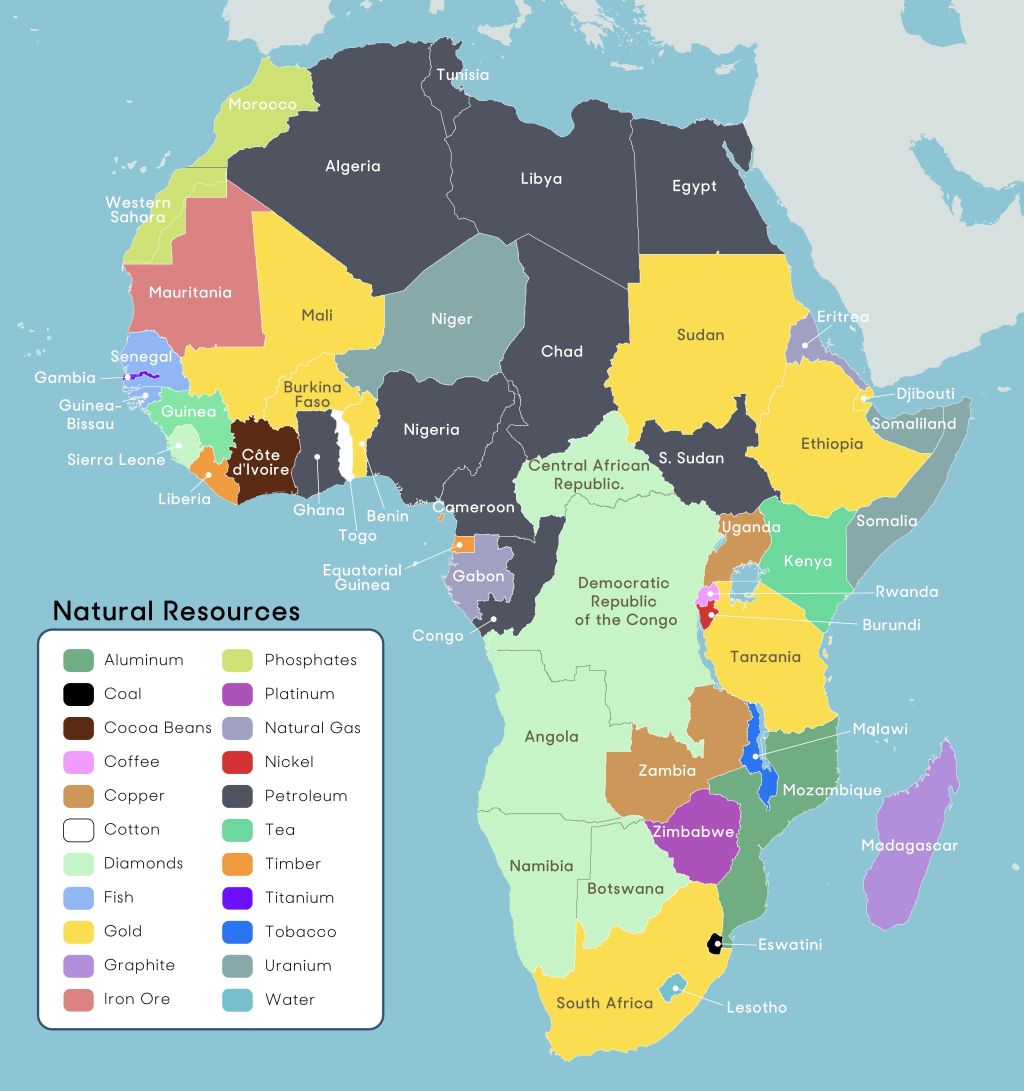
Look at a map of Africa and the evidence of how this was actually done is sitting in plain sight. Long, ruler-straight lines run for hundreds of miles across Namibia, Chad, Libya, and a dozen borders besides — the kind of border only a mapmaker with a straightedge in a European drawing room could produce, cutting across rivers, ethnic and linguistic groups, and existing kingdoms with no interest in what was actually on the ground at the point the line crossed it. Most of the world’s borders follow a river, a mountain range, a coastline, something that was already there. Much of Africa’s border was decided before the people drawing it had ever set foot on the continent, and the straightness of the line is the artefact of that absence, still visible from orbit a century and a half later.
And even the underlying model has real exceptions. South Africa’s settler population came to stay rather than to extract and leave, which produced an entirely different, and in its own way far more brutal, political trajectory than the gatekeeper model elsewhere on the continent. Zimbabwe has more recently been used by scholars to challenge the assumption that gatekeeping is always elite-led and mechanically inherited from the colonial moment. On the ground, the picture is messier than the clean version of the theory suggests. Cooper’s own book, to its credit, notes the variation across the cases it covers even where the two-word phrase it is best known for makes the pattern sound more uniform than it was.
Independence tried to take the gate back
Cooper’s thesis is sometimes read as saying independence changed the staff at the gate without changing the gate itself. That is too passive a version of what actually happened in the 1960s and 1970s. Newly independent African governments did not simply inherit the gate and leave it running. Several of them tried, seriously and at real cost, to take it apart.
Mobutu Sese Seko’s government passed the Bakajika Law in 1966, asserting Congolese state ownership over all land and mineral rights that colonial-era concessions had granted to foreign companies. Union Minière’s Congolese assets were nationalised outright the following two years and folded into the new state company, Gécamines. Zambia and the DRC formed CIPEC, a producer cartel for copper exporters explicitly modelled on OPEC, aiming to do for copper what the oil-producing states were about to do for oil. Tanzania went further still, banning the export of unprocessed raw materials altogether until it could build the capacity to process them domestically.
For a few years, this worked. Congolese state revenue nearly tripled between 1967 and 1970. Copper production rose across the newly assertive bloc. The momentum culminated in 1974, when the United Nations General Assembly adopted the Declaration on the Establishment of a New International Economic Order, formally endorsing the principle that states held permanent sovereignty over their own natural resources. For a brief moment, the nationalisation wave looked like the future rather than a passing experiment.
Then it broke, and broke fast, for reasons mostly beyond any single African government’s control. The copper price collapsed in 1974, falling from around $1.40 a pound to $0.53 within a year. Oil import costs had already quadrupled between 1973 and 1977 following the OPEC oil shock, hitting oil-importing African states hard regardless of what they exported. US interest rates then spiked sharply just as loan repayments on the previous decade’s borrowing came due. Government revenue collapsed at the exact moment debt service costs rose. Twenty-five African countries went through a combined 105 debt reschedulings between 1980 and 1988 alone.
With African governments locked out of ordinary capital markets by the debt crisis, the IMF and the World Bank became, for practical purposes, the only lenders still willing to extend credit. Structural adjustment lending came with conditions attached, and one condition recurred across country after country: privatisation of the state resource companies the previous generation had fought to establish. The World Bank’s own 1992 Strategy for African Mining stated the position plainly, recommending that existing state mining companies “should be privatized at the earliest opportunity.” Gécamines itself, the state company born from Mobutu’s 1966 nationalisation, was privatised under exactly this pressure in the DRC’s 2002 mining code.
This is the real answer to a question that can look, from a distance, like a simple failure of will or capacity: African states did not lose the gate through passivity or a simple lack of capital. They took the gate, held it for a decade, lost it to an external price shock and a debt crisis largely not of their own making, and then found that the only capital still available to them came at the specific price of giving the gate back. It is also the origin of the pattern we keep returning to under a different name — capital moves outward from wherever it actually sits, whether that capital is a nineteenth-century concession, an IMF loan, or, as the next section turns to, a twenty-first-century infrastructure deal, and whoever administers the gate on the ground keeps only a fraction of what passes through it.
Nigeria’s oil sector shows the same underlying logic in miniature, and it is still running today. Nigeria exports roughly $40 billion of crude oil a year. For decades it had almost no domestic refining capacity of its own, and so also had to import back the refined petroleum products made from its own crude, historically spending between $8 billion and $15 billion a year doing so — exporting the raw material and re-importing the converted one at a markup, with the value-adding step happening somewhere else entirely. Only very recently, with the opening of the Dangote refinery, has that specific arrangement begun to change: financed overwhelmingly by domestic industrial profit and African capital rather than foreign debt or foreign equity terms.
China arrives: same position, different terms
By the time China became a significant lender to African governments in the 2000s, it was not entering a level field. It was stepping into a market where the IMF and World Bank had spent two decades using loan conditionality to move state resource ownership back into foreign private hands generally. China simply became a second bidder for the same structural position, financing infrastructure directly rather than requiring privatisation as the price of a loan.
The Democratic Republic of Congo’s Sicomines agreement, first signed in 2008 and renegotiated in 2024, is the clearest worked example of how the new arrangement actually functions. Chinese state-backed companies committed roughly $3 billion, later renegotiated to $7 billion, to build roads, hospitals, and other infrastructure across the DRC. In return they received mining rights to ten million tonnes of copper and 600,000 tonnes of cobalt over 25 years, a resource package one American think tank estimated to be worth in the region of $93 billion. Mining revenue repays the infrastructure debt before any dividend is paid to the DRC government. Nearly all of the cobalt produced, regardless of who owns the specific mine it comes from, is refined in China rather than in Congo, meaning the value-adding step already traced through Union Minière’s history happens outside the country once again. The Congolese government itself understood exactly what this meant: in 2017 it ordered Sicomines to stop exporting unprocessed copper and cobalt concentrate, specifically to try to force more of the processing to happen domestically.
The comparison with the IMF and World Bank lending is instructive. Chinese capital does not demand privatisation as its price. It carries its own strings instead — take-or-pay revenue guarantees, mining agreements structured so debt service comes before any state return. Different terms, the same underlying position: an external lender, an internal resource, and a repayment structure engineered to make sure the money flows back out before it flows anywhere else.
China is not the only capital source running this model. Gulf capital, chiefly the UAE’s DP World, has been building an almost identical port-and-chokepoint position through long concessions rather than debt. DP World has held Mozambique’s Maputo port since 2006 and Senegal’s Dakar terminal since 2008, both years before China’s comparable African projects, and by 2026 operates or is building ports in roughly a dozen African countries. Britain’s own development-finance arm, the CDC, partnered directly with DP World in 2021 on ports in Egypt, Senegal, and Somaliland, a deal its then Foreign Secretary framed explicitly as countering Chinese influence. Britain, the historical gatekeeper of much of this same coastline, has thus re-entered a number of these ports today through a different vehicle. Three capital structures now compete for the same position. The IMF and World Bank offer conditional lending, priced in privatisation. China offers debt-financed infrastructure, priced in guaranteed resource flows and revenue-first repayment. The Gulf states offer sovereign concession ownership, priced in decades of direct control over the trade route itself, with no debt at all.
The story people believe, and the one the record shows
China’s own account of its role in Africa rests on a claim that needs testing. China claims it arrived clean: never a colonial power on the continent, never the hegemonic military-industrial United States, and — implicitly — never a party to the conflicts that tore several newly independent states apart.
The first two hold up. The third does not survive scrutiny. China was a genuine, active participant in Africa’s Cold War-era liberation struggles, not a bystander. It trained and armed the PAIGC in Guinea-Bissau from 1960. It backed Angola’s MPLA in the early years of that country’s independence movement, then switched to arming MPLA’s rivals, the FNLA and UNITA, once Sino-Soviet rivalry made supporting a Soviet-aligned movement politically unpalatable in Beijing. That switch fed directly into the brutal, decades-long Angolan civil war that followed independence, since Chinese-backed UNITA kept fighting long after 1975. China supported FRELIMO in Mozambique and ZANU in Zimbabwe on similar terms. The Tanzania-Zambia Railway, built between 1970 and 1975 to give landlocked Zambia’s copper a route to the coast that bypassed apartheid South Africa and Rhodesia, was the flagship civilian expression of the same solidarity diplomacy.
China’s own preferred narrative is a principled, non-interventionist partner, distinct from every other outside power that has touched the continent. On the specific question of Cold War proxy involvement, that story does not match the record. China got the invitation from movements that sought it out. It was not a neutral guest once it arrived.
The two eras were driven by different things, and the distinction matters. The Cold War interventions were ideological, run through the Sino-Soviet rivalry rather than through any commercial calculation. China backed and abandoned factions according to which movement’s politics suited Beijing’s own dispute with Moscow, not according to what any of them could offer in return. Today’s presence is economic, plain and simple, run through mining rights, port concessions, and loan agreements rather than through any stated political solidarity. The method has stayed remarkably constant across a complete change in motive: arrive at the invitation of a local actor, occupy a position no one else currently holds, extend influence through the position rather than through territorial claim.
A more recent case shows the same gap between narrative and record playing out over infrastructure rather than arms. Djibouti nationalised DP World’s Doraleh Container Terminal in 2018, framing the move publicly as a defence of national sovereignty against an exploitative foreign concession — a narrative still repeated domestically today. The legal record underneath it is considerably less flattering to that story. DP World has won the large majority of roughly seven international arbitration rulings brought since 2018, including findings that the original 2018 seizure was itself unlawful, with unpaid damages awards now standing at around $685 million. The dispute is not even a simple story of Gulf capital against Chinese capital. China Merchants Port Holdings, a Chinese state-owned company, holds 23.5 per cent of Djibouti’s own state port company, while Djibouti simultaneously hosts China’s first overseas military base, opened in 2017. Gulf and Chinese capital sit on opposite sides of one dispute in one tiny, strategically vital country, and the government’s own account of who won does not match the tribunals’ rulings.
Trying to write the terms in first
None of this has left African governments entirely without leverage, and the most recent evidence is that some of them are learning to use what they have before the capital arrives rather than negotiating for scraps after it has already been spent.
The DRC’s own conduct since 2017 traces this shift directly. Its export ban on unprocessed cobalt concentrate that year was followed by a full renegotiation of the Sicomines agreement in 2024, and then by an independent audit of the deal in 2026 — a government testing, revising, and checking its own arrangement with its largest external financier in ways the 1960s nationalisation generation, negotiating against a single available lender, never had the room to do. Zambia has introduced local-procurement quotas requiring foreign mining operators to source between 20 and 40 per cent of inputs domestically. At least thirteen African countries have introduced mineral export restrictions of one kind or another since 2023. The African Union adopted a Continental Critical Minerals Value Addition Framework in February 2026, an explicit continental-level attempt to coordinate bargaining power that no single small state could exercise alone.
The formulation gaining currency among some African policymakers is that the continent is not resource-poor, it is negotiation-poor — and the evidence above suggests governments are beginning to act on that distinction rather than simply repeating it. This is not a triumphant turn. Whether writing better terms into a deal changes the underlying position, or simply produces a better-negotiated version of the same dependency, is not yet answerable. But it is a different starting point from the one African governments held in the depths of the 1980s debt crisis, when the IMF and World Bank really were the only lenders left in the room.
What moves around the gate, not through it
There is a second kind of leverage running through the same period, and it belongs to millions of individual people rather than to any government, mining company, or trade negotiator.
Africa received roughly $96 billion in remittances in 2024, a figure that now exceeds foreign direct investment and official development aid combined. Egypt and Nigeria take the largest absolute shares. But it is the smaller economies where the number becomes structurally decisive: remittances run to around a fifth of GDP in the Gambia and in Lesotho, and above fifteen per cent in Comoros, South Sudan, Liberia, and Somalia. Zimbabwe’s remittances, $2.45 billion by the central bank’s own count and closer to $3.5 billion on the African Development Bank’s broader estimate, sit further down the list by dollar value but tell the sharper story. Zimbabwe’s informal economy as a whole is estimated at 76.1 per cent of GDP, meaning three-quarters of everything actually happening economically in the country moves through channels no state gate has ever taxed, counted, or controlled.
Lesotho’s relationship with South African mining is the oldest version of this pattern on the continent, a near-permanent labour-export arrangement that has sent remittances back across the border for generations. The newest version runs through London care homes and NHS wards, staffed disproportionately by Zimbabwean and Nigerian workers, sending money home by exactly the same informal channel. Notice what direction that money moves in. For four centuries, we have traced value leaving Africa through a gate someone else controlled. Remittances run the other way, from the former metropole back to the household, through a channel neither government has ever managed to gate at all.
Same mechanism, five centuries, new landlords
The argument, stripped back to its bones, is short. From the first coastal trading posts through the Scramble for Africa, through independence and its brief nationalisation wave, through the debt crisis and the World Bank’s conditional loans, through China’s infrastructure-for-minerals deals and the Gulf states’ port concessions, the mechanism has stayed remarkably stable. Control the gate. Let the interior remain someone else’s problem. Extract what passes through, and make sure the return flows back to wherever the capital came from. What has changed, repeatedly, is only the landlord’s name and the specific instrument in their hand — a royal charter, a colonial administration, an IMF loan, a mining concession, a port lease.
Ngozi Okonjo-Iweala, the WTO’s Director-General and the first African to hold the post, told the UN Security Council in July 2026 that surging global demand for critical minerals is “a once-in-a-lifetime chance” for resource-rich countries, provided they move to local processing, strengthen the rule of law around their contracts, and negotiate collectively rather than one country at a time. Nigeria’s Solid Minerals Minister, Dele Alake, made almost the same case at the African Development Bank’s Abidjan forum the same month, calling for what he termed “total economic freedom” through value addition rather than raw export. The AfDB’s own president framed the underlying paradox in a single sentence: Africa holds roughly thirty per cent of the world’s critical mineral deposits, and none of it has yet translated into commensurate economic gains for the continent that holds them.
Carlos Lopes, formerly head of the UN Economic Commission for Africa and now an African Union high representative, offers the necessary caution against reading any of this as settled. His 2026 warning makes its argument in a single, pointed distinction: a government seizing a stake in its own minerals is not automatically the same thing as the country’s people gaining sovereignty over them. A government taking a direct equity stake in a mine, or writing tougher export terms into a licence, does not by itself guarantee the proceeds reach anyone beyond the political elite who negotiated the deal. The same instrument that could deliver genuine sovereignty could just as easily relocate capture from a foreign boardroom to a domestic one, leaving the underlying pattern intact under a national flag instead of a foreign one.
And the old bargain is still being struck in real time, even as this debate happens. In February 2025, with M23 rebels occupying Goma and Bukavu and displacing millions of civilians, DRC’s President Tshisekedi offered the Trump administration access to Congo’s critical minerals in exchange for American security support. The resulting Washington Accords, signed that December, gave the United States facilitated long-term access to DRC mineral concessions, including priority rights over deposits not yet licensed to anyone else. Congo’s obligations were specific: preferential fiscal terms, regulatory changes favouring American firms. Washington’s security commitments were vague, and within months the American follow-through was already in question. It is the same shape as every bargain traced in this piece, struck again, with a new partner, while the continent’s own most senior economic voices make the case for something different in parallel.
De Beers remains, as this is written, the plainest open question of all. Anglo American is still selling. Botswana and Angola still want to buy. No deal has closed. Whether African states actually holding the equity in the company that once ran the colonial diamond cartel changes anything about how the world prices a diamond, or simply moves the same commodity-pricing and market-power problem into new hands, is not a question anyone can answer yet. It sits alongside the quieter fact of the remittance economy running underneath it all — the money moving from a London care home back to a household in Harare, through a channel no gatekeeper, colonial or otherwise, has ever worked out how to tax. Two pictures of where control actually sits today, at the same moment: one still being negotiated between governments, companies, and continents, the other already happening, unnoticed, a wage transfer at a time.


Leave a Reply