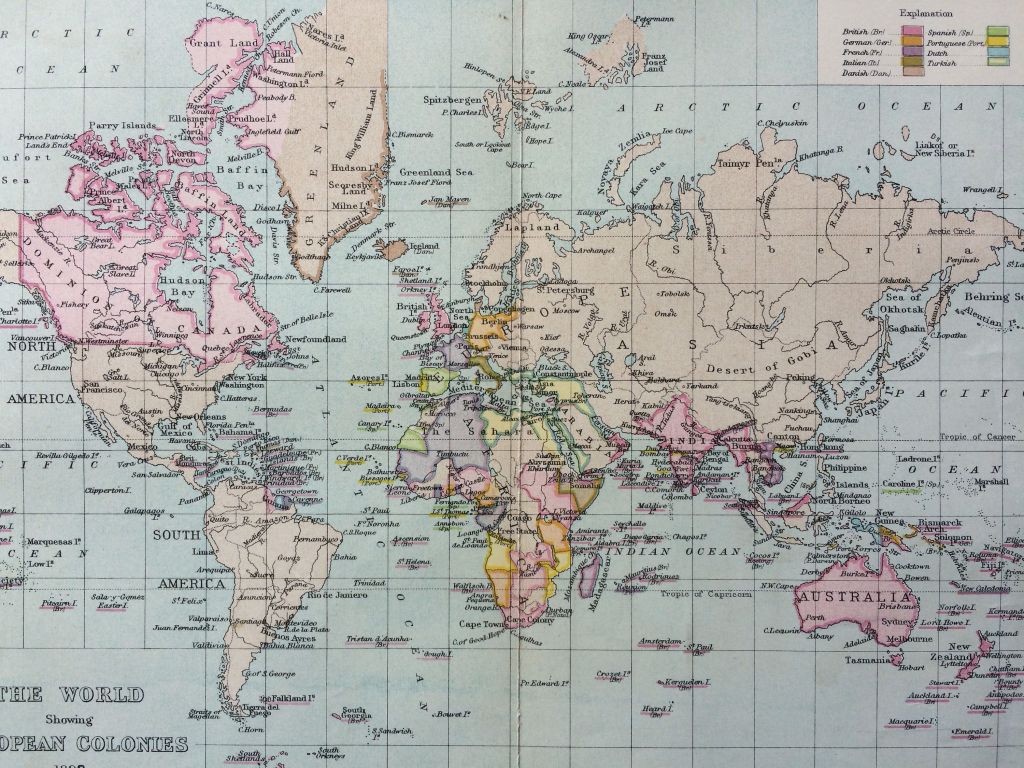
This is the second of two framing pieces on European colonial empire, and it starts where the first one stopped.
Part One ended on a company. Part Two begins on the same company, doing something a company shouldn’t be able to do. At Plassey in 1757, the East India Company — a trading corporation, chartered to buy and sell, not to rule — defeated a sovereign and installed one of its own choosing. Portugal, Spain, and the Dutch had all, in their different ways, leaned on trade-through-position rather than conquest, because conquest usually wasn’t available. At Plassey, for the first time, it was. The question this piece exists to answer isn’t why empire started. We’ve done that. It’s why, having started, one version of it didn’t stop — and changed almost beyond recognition on the way.
This still isn’t a chronicle, and the boundary matters more here than it did last time. We won’t be retelling the scramble for Africa battle by battle, or cataloguing every war between the powers — the long run of eighteenth-century conflicts between Britain, France, and Spain sits deliberately outside this piece, background noise to a mechanism rather than the mechanism itself. Nor is this an inventory of what empire cost the people living under it; that ledger is real, and it belongs to the pieces this frame will hand off to rather than to the frame itself. What we’re tracking is the same thing as before: a small number of moves, repeated at a much larger scale, over a much longer time.
Three moves, this time, rather than four countries. Finance capital, having built up at home faster than domestic investment could absorb it, went looking for outlets abroad — the bondholder replacing the conquistador as the era’s characteristic figure. Where that search met resistance, informal economic dominance — trade treaties, debt, a gunboat within reach — was tried first and formal conquest reached for only when informal dominance stopped being enough; the scramble for Africa is that toggle flipping, almost in real time, in front of witnesses. And what colonial administration left behind, once the flags came down, turned out to outlive the empire that built it — the office surviving the purpose it was built for, which is where gatekeeper states come from and where this frame eventually stops.
The same map as before, repointed. Money now means finance capital, sterling, bonds, direct investment rather than bullion and monopoly. Land means lines drawn at a conference table in Berlin, not forts or tribute systems. Labour means indentured migration and a colonial civil service, filling much of the gap abolition left — a system historians still argue over, closer to contract in law and closer to bondage in practice for many who lived it — rather than the one encomienda once did. Religion’s cover story gets a new name — the civilising mission — while doing precisely the same work. And home politics, this time, isn’t a light touch at the end of the paragraph. Jingoism, parliamentary debate, the press, inter-imperial rivalry: these aren’t colour here, they’re mechanism, in a way they mostly weren’t for Portugal or Spain.
And there’s only one throughline this time, not four. Britain carries this frame the way no single country carried Part One — not because the others don’t matter (Germany’s African colonies, France’s own scramble, Belgium’s Congo will all earn their moments as contrast) but because it’s Britain’s version of this machine that runs longest, reaches furthest, and leaves the residue the rest of this series keeps finding itself standing on.
Motor One — Finance Capital’s Search for Outlets
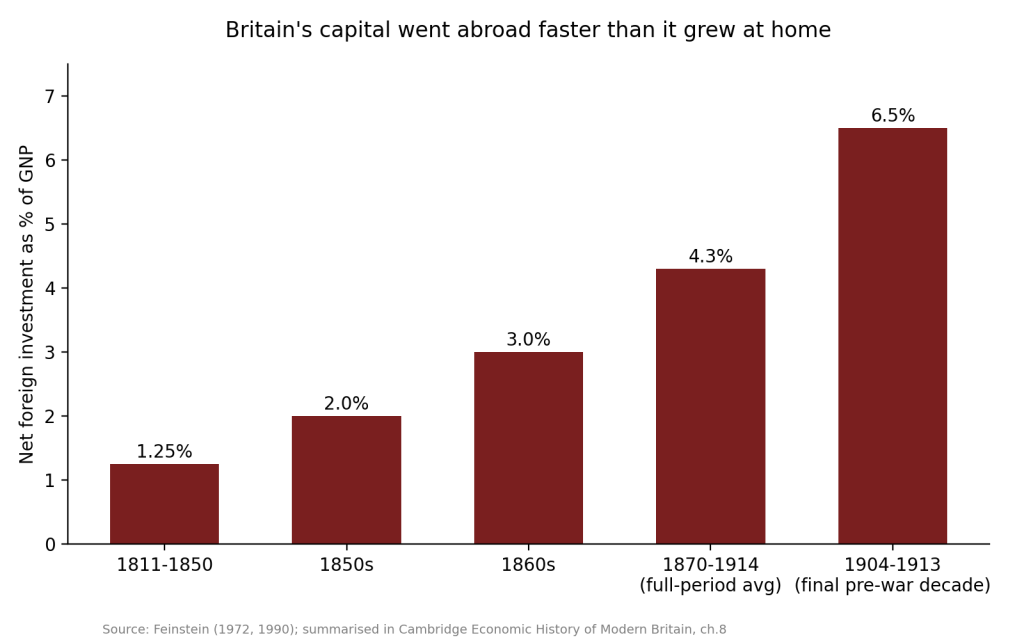
By the mid-nineteenth century, Britain had a problem money doesn’t usually have: too much of it, with nowhere productive left to go. Industrial profit had built up faster than domestic investment could absorb — the railways, canals, and factories at home were already funded, often over-funded, and capital kept arriving anyway looking for a return. In the decade ahead of WW1 something close to half of everything Britain saved that year left the country rather than getting built into a British factory, railway, or house. This is the specific mechanism JA Hobson identified at the time and Lenin later sharpened into a theory of imperialism itself: not a vague restlessness of capitalism in general, but a concrete, dateable surplus of investable money outrunning the domestic opportunities to invest it. It’s the natural theoretical partner to the spatial fix this project has already used elsewhere — capital, unable to expand where it is, has to find somewhere new to go. The bondholder becomes this era’s characteristic figure the way the conquistador was Spain’s: not someone claiming land or labour directly, but someone claiming a country’s future income, in the form of a loan it hasn’t yet earned the means to repay.
Where this capital went, it mostly didn’t need to conquer anything, and there’s a real argument for why. Historians Gallagher and Robinson called this the “imperialism of free trade” — the idea that formal territorial empire, flags and governors and administered provinces, was usually a last resort, reached for only once informal economic dominance stopped being sufficient on its own. Informal dominance meant trade treaties, government debt, and the implicit backing of a navy that could, if it had to, be sent — control without the cost or complication of actually ruling. Latin America is the case that proves the rule almost too neatly: newly independent from Spain and Portugal, short of its own capital, the new republics borrowed heavily from London to build railways, ports, and utilities. Argentina above all — by the 1920s its economy ran so thoroughly on British capital, British-built infrastructure, and British export markets that historians have simply taken to calling the relationship an informal empire in its own right. No flag was ever raised over Buenos Aires. Under Gallagher and Robinson’s logic, it never needed to be: informal control was already doing everything formal control would have done, at a fraction of the cost and none of the political liability.
China shows the same mechanism with the coercion made visible rather than hidden behind a loan agreement.Where Latin America mostly received money, China received the same commercial demands backed, when refused, by force. The Opium Wars weren’t fought to seize Chinese territory — they were fought to keep a trade open that the Chinese state had tried to shut down, and the treaty ports that followed granted British merchants extraterritorial rights inside Chinese soil without any formal claim on the country around them. This is the same “imperialism of free trade” logic as Argentina, just running through gunboats rather than through a bond prospectus — informal dominance wasn’t the gentle version of empire and formal conquest the harsh one. It was the same mechanism, calibrated to however much resistance it actually met, exactly as Gallagher and Robinson’s argument predicts.
Money itself changed what it was fictionalising, and the change matters as much as anything happening on the ground. Spain’s fiction, in Part One, had been bullion — treating extracted silver as wealth itself, a physical substance you could put on a ship and count on arrival. Britain’s fiction here is credit: sterling, the London bond market, the City of London functioning as a clearing house for capital that never needed to physically move to do its work at all. That’s a more abstract fiction than anything in the first frame, and a considerably more durable one, because a bond doesn’t need a mine or a plantation standing behind it to have value. It only needs a government somewhere willing to sign, and a market somewhere willing to believe the signature is good.
And at home, this version of empire was popular in a way formal conquest rarely managed to be. Informal dominance cost no soldiers’ lives that made the newspapers, raised no uncomfortable parliamentary questions about the right to administer foreign peoples, and produced steady, unglamorous returns for a British investing class — increasingly not just aristocratic landowners but a widening professional and commercial elite — with every reason to keep the arrangement exactly as it was. For decades this was empire that didn’t look like empire, didn’t cost what empire usually costs, and didn’t ask the public to think of itself as an imperial people at all. That quiet acceptability is precisely why it lasted as long as it did before anyone felt the need to formalise it.
But the whole arrangement only worked where three specific conditions held, and the piece needs to end here because the next one explains what happens when they don’t. Informal dominance depended on a local government stable enough to honour its debts, weak enough not to renegotiate them on its own terms, and open enough not to close its ports or nationalise its railways. Argentina held all three for the better part of a century. Where any one of them broke down — a bond went unpaid, a market shut its doors, a rival power moved first — the same capital that had been perfectly content to stay informal started asking for something firmer. That’s not a different motor. It’s this one, reaching the end of what it can do alone.
Motor Two — The Formal/Informal Toggle
Motor One ended on a hinge: informal dominance held only while three conditions did, and this motor is what happens once they stop. By the 1880s, several of those conditions were breaking down simultaneously across Africa — rival European capital competing for the same markets, local authorities less willing or able to guarantee the debts and access British capital needed, and, increasingly, other powers arriving first with exactly the same intentions. Gallagher and Robinson’s “informal where possible, formal where necessary” logic didn’t change. What changed was how much of Africa still counted as “where necessary.”
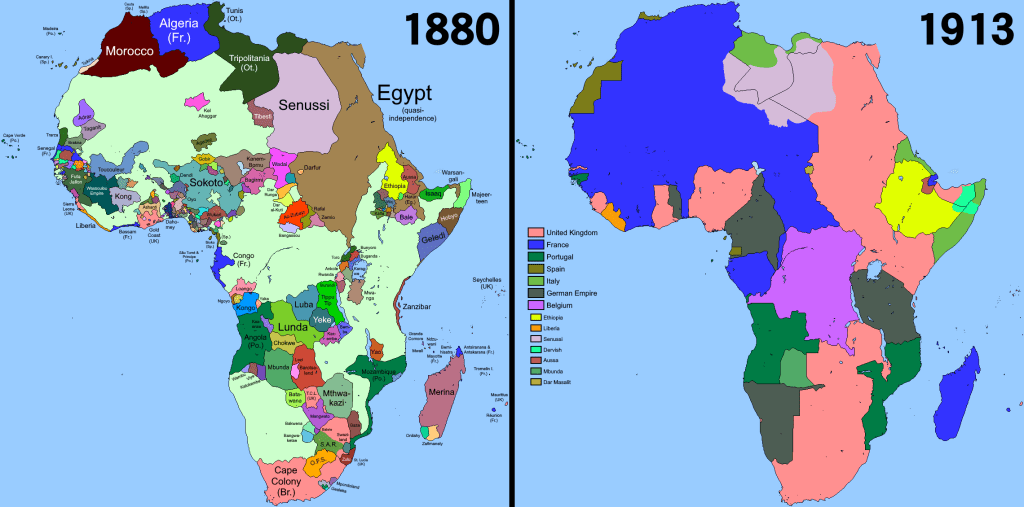
The Scramble is usually told as a story of ambition. It reads more clearly as a story of a mechanism running out of its cheaper option. Between roughly 1880 and 1900, European claims on African territory went from a handful of coastal footholds — barely different in kind from Portugal’s positions four centuries earlier — to something close to the entire continent, formally divided among a half-dozen powers who had, for the most part, never set foot in most of what they were claiming. The trigger wasn’t a single event so much as several powers simultaneously realising that whoever formalised first locked out whoever formalised second, which made the toggle from informal to formal self-accelerating in a way it had never needed to be in Latin America, where Britain had effectively no serious rival.
The instrument for this transition, at first, was a familiar one wearing new clothes. Chartered companies — Cecil Rhodes’s British South Africa Company, the Royal Niger Company — were revived almost exactly as the VOC and the EIC had once operated, licensed to administer territory, raise force, and extract resource on the crown’s behalf without the crown itself having to commit troops or treasury. It was, again, privatised sovereignty, the same institutional trick the Dutch had introduced two centuries earlier, deployed now because it let formal claims be staked cheaply before anyone had worked out whether the territory was worth the cost of actually governing it directly.
Land, in this motor, stopped even pretending to follow anything on the ground. The Berlin Conference of 1884–85 divided African territory among the European powers using lines of latitude and longitude, river courses, and straight rulers on a map drawn in a room in Germany that no African ruler was invited to enter. Where Part One’s land-fictions had at least engaged with what was actually there — Portugal’s chokepoints, Spain’s captured tribute network, the Dutch buying land from people who didn’t share the concept — Berlin’s lines represented nothing except the relative negotiating strength of the powers doing the dividing. Ethnic groups, trading networks, and existing political structures were split or merged with no reference to any of it, an administrative convenience whose costs would fall due generations later.
Not every version of this formal turn looked like Britain’s, and the contrast is worth holding onto rather than smoothing over. King Leopold II’s Congo Free State, claimed as Leopold’s personal property rather than Belgium’s colony, ran on forced labour and mutilation quotas to extract rubber at a human cost that shocked even other colonial powers into public protest — a reminder that “formal empire” wasn’t one policy but a spectrum, and that Britain’s own preference for indirect rule and chartered-company intermediaries, whatever its faults, sat some distance from the Congo’s naked brutality. The difference mattered to the people living under each, even where the underlying logic — extraction dressed as governance — was the same.
And at home, this was the one moment in the whole story where empire briefly did become genuinely popular in the loud, visible way it’s often assumed to have always been. The scramble coincided with mass-circulation newspapers, a newly literate public, and jingoism as an actual word coined for the occasion — Mafeking Night in 1900 saw crowds fill London’s streets in a way no bond issue for an Argentine railway ever had. The Fashoda incident of 1898, where British and French forces nearly came to blows over a mud fort in Sudan, showed how close the “partnership” between rival empires running the same toggle could come to breaking into war between them rather than just against the territories they were dividing. Civilising mission rhetoric — Kipling’s white man’s burden, published in 1899 — did the legitimising work here that religion did for Spain, differently dressed but identically positioned: never the actual mechanism, always its cover story.
By the time the scramble was substantially complete, the question had quietly changed from whether to claim territory to what claiming it actually obliged you to do with it. Someone had to administer the lines drawn at Berlin, staff the offices, collect the taxes, keep the peace, however that peace was defined. That’s not a new motor. It’s this one, having finished its expansion, discovering it now has to run something.
Motor Three — Administrative Residue
Motor Two ended with formal empire having finished its expansion and discovering it now had to run something. That’s a different problem to conquest, and Britain solved it cheaply, the same instinct that had preferred informal dominance to formal rule in the first place: rather than staff every colony with British administrators from top to bottom, rule mostly through existing structures, existing elites, existing hierarchies, redirected rather than replaced. Indirect rule wasn’t principle. It was the same cost-minimising logic Motor One’s bondholders had followed, applied to governance instead of finance.
The institutional actor here is the colonial civil service, and its most complete version tells you what it was actually for. The Indian Civil Service — a few hundred, later a few thousand, British administrators governing a subcontinent of hundreds of millions, selected by competitive examination and trained specifically to keep taxation, law, and export flowing with minimal friction. It wasn’t designed to develop the territories it ran. It was designed to keep the pipes clear.
And what got built to serve that purpose is precisely what got left behind. Railways ran from resource to port, not between population centres that might have wanted to trade with each other. Legal systems enforced contracts and property rights useful to extraction, not much else. Education produced enough of a local clerical class to staff the lower rungs of the same administration, not a broader civic capacity. None of this was a side effect of empire. It was empire’s actual infrastructure, and infrastructure doesn’t disappear just because the people who built it go home.
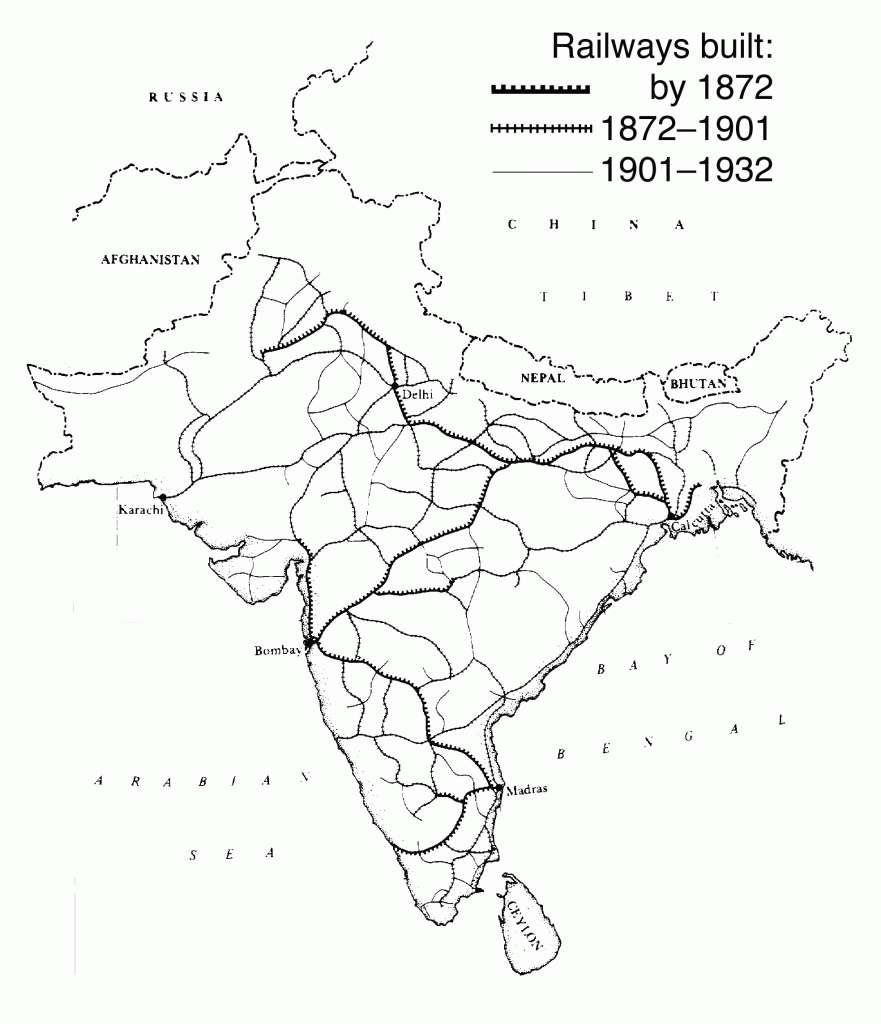
Historian Frederick Cooper gave this pattern its sharpest name: the gatekeeper state. A government whose entire practical function is controlling the point where the domestic economy meets the world outside it — the export licence, the import tariff, the currency conversion — rather than developing anything happening behind that gate. Cooper’s own account of the colonial mindset behind this is worth quoting directly, because it names the blindness so precisely: European rulers, he writes, viewed African polities “with remarkable myopia toward the political economy that they had helped to create,” seeing tribes under timeless chiefs where they should have seen governance structures already shaped, for generations, by regional and global commerce. The gate wasn’t a colonial invention exactly. It was a colonial infrastructure, handed on.
Because that’s the mechanism that survives 1960s decolonization almost entirely intact. Independence changed the flag over the gate and, in most cases, the person standing at it. It rarely changed the gate itself — the boundaries drawn at Berlin without reference to any existing polity, the export-oriented infrastructure, the concentration of state capacity at the border rather than in the interior. A new government inheriting a gatekeeper state inherits an institution built to extract and control access, and discovers that controlling the gate is now the most direct route to power and revenue available to it — which is a structural incentive toward exactly the kind of narrow, extractive, often authoritarian governance that gets blamed, ever after, on some vague notion of African instability rather than on the specific infrastructure a departing empire actually left running.
This is also where the numbers fight belongs, and it belongs here rather than being resolved here. A 1999 Accra commission called for $777 trillion in reparations and unconditional debt cancellation; other accounts argue empire cost Britain money rather than made it, and a genuine, contested statistic about global poverty reduction since the 1980s gets deployed by free-market advocates as evidence the system Britain built eventually worked. This motor doesn’t enter or referee that argument — it explains why the argument is even shaped the way it is: both sides are describing the same gatekeeper infrastructure, one counting what it extracted, the other counting what came after it stopped being colonial and started being merely inherited.
Two pieces, one argument: pressure produces invention, and invention outlives its own justification. What follows — the cases, the cultures, the places this argument turns out to explain — is the rest of the project.
Two pieces, one argument, told from one side of it. We said at the start that this was a choice, and it’s worth restating now the choice is complete: everything here has run through European pressure, European invention, European bookkeeping, because that’s the lens the project set out with, not because the other side of every encounter in these two pieces was passive, or silent, or without its own reasons. It wasn’t. Aztec statecraft, Mughal military and fiscal power, African polities already embedded in regional and global commerce long before a single European ship arrived — each of these shaped what could be extracted and how, and a fuller account would let them argue back rather than simply absorb what happened to them. Nor is the story here the only defensible political economy of it: there’s a real case that frontiers forced London’s hand more often than the City did, and a real case that coal and land explain more than capital and credit ever could. We’re not hedging by saying this. We’re pointing at it, because most of what comes next in this project lives exactly there — in the accounts these two pieces didn’t have room to tell.


Leave a Reply