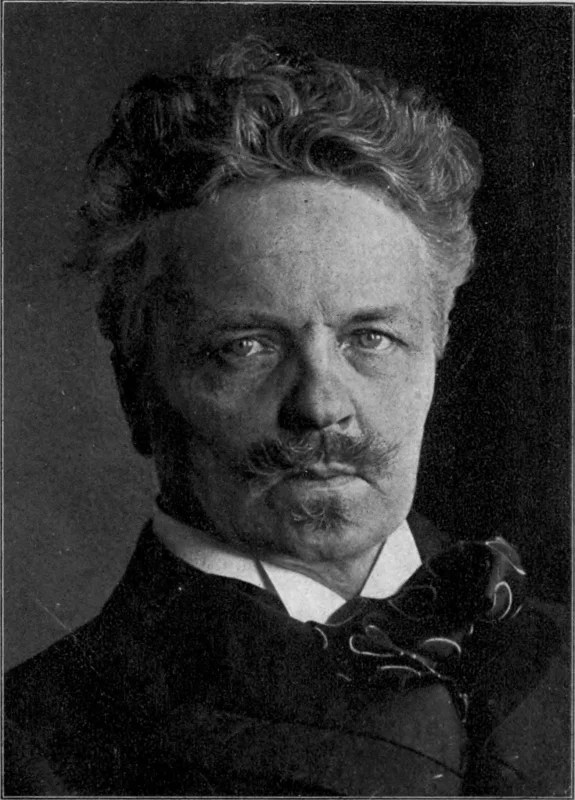
In November 1911 the Swedish Academy received August Strindberg’s Nobel nomination too late to consider it. The following year it passed him over again, and the country’s ordinary readers did something about it themselves. A public subscription was raised to honour him anyway — money collected from people who had no vote on the prize, in protest at an institution that did. He died a few months later, in 1912, having never been crowned by the body meant to crown Swedish writers. The Nobel Prize in Literature has only ever been the Swedish Academy’s own decision to make; there was no foreign committee to blame, no external verdict to appeal to. It was the country’s own establishment that wouldn’t have him, and the country’s own public that decided otherwise.
A century later the establishment changed its mind entirely, and now performs the reversal as ritual. Strindberg is staged at the National Theatre as canon, taught in schools, marked on his birthday — the writer the Academy once wouldn’t touch is now the one the same kind of institution reveres without visible discomfort. He’s not alone in that company: Selma Lagerlöf and Astrid Lindgren are, if anything, more beloved, and Ingmar Bergman rivals him for the stature Sweden exports to the world. But theirs is a warmer kind of reverence — nothing in the fondness for Lindgren has to look away from anything. Strindberg’s doesn’t have that luxury, and gets performed anyway. As a playwright specifically, nothing in Swedish theatre approaches him; what’s unusual is that the reverence for him carries a flinch that the reverence for the others doesn’t.
That flinch is the subject of this essay. Because the plays that earned him this position are, among other things, studies in the “woman question” — kvinnofrågan, the era’s own term for the Scandinavian debate over women’s rights, education, and marriage — answered from the losing side. Feminism, in Strindberg’s telling, is a symptom of degeneration rather than a demand worth taking seriously; the women in his plays are diagnosed more often than they’re understood. A country that built its modern identity on having settled that argument keeps performing, as its highest cultural achievement, a writer for whom it was never settled at all. What follows is an attempt to take that contradiction seriously rather than resolve it too quickly in either direction — not a case for cancelling him, and not a case for letting him off either.
The Man as Symbol
Strindberg’s radicalism and his misogyny came from the same instinct, aimed in different directions. In 1884 he published Giftas — Getting Married — a collection of stories on marriage that mocked the hypocrisies of bourgeois and religious respectability so directly that the Swedish state prosecuted him for blasphemy over a passage on the Eucharist. He was acquitted, returned to Stockholm to a hero’s welcome, and was crowned with a laurel wreath on stage the same night. That’s the shape his public life kept taking: attack the establishment’s pieties, get punished for it, get vindicated by the public over the institution’s head. It’s the same pattern that produced the 1912 subscription after the Academy snubbed him — a writer whose instinct was always to unmask respectable façades, cheered on by people who recognised the unmasking as being done in their interest.
Siri von Essen wasn’t primarily an artist to Strindberg — she was, first, a woman who had already built a life against the constraints he’d spend his career diagnosing in others. A Finnish-Swedish noblewoman, she left her first marriage to a baron in part because both her father and her husband had blocked her from the acting career she’d wanted since childhood; when she divorced him, the social double standard fell entirely on her — he’d committed adultery, and she was still the one blamed for the marriage’s collapse. Strindberg, unlike either of them, encouraged her onto the stage. She debuted at Stockholm’s Royal Dramatic Theatre in 1877, built a fifteen-year acting career, and in 1889 originated the title role of Miss Julie itself, directing and starring at the experimental theatre she and Strindberg ran together in Copenhagen. After their divorce in 1891 she kept working — moved to Finland, taught acting, and had her own students. She’s not incidental to this essay as a footnote-wife; she’s the person whose real professional agency sat directly alongside the man who was, in the same years, writing that women’s ambitions were symptoms of degeneration.
The trouble is the unmasking didn’t stay pointed in one direction. The first volume of Getting Married was, if anything, sympathetic to women — some of its marriages are drawn as genuinely egalitarian. The second volume, published two years later once his own marriage to Siri von Essen was disintegrating, tips into open misogyny: its preface blames women for religious persecution, war, and most of history’s other calamities. That’s not two separate Strindbergs, an early feminist-adjacent one and a later reactionary one — it’s the same rhetorical weapon, unmasking hypocrisy, turned from class and religious respectability onto women once his own domestic life gave him a target close enough to aim at. He also came to suspect, without much evidence, that Swedish feminists and even the Queen herself were behind his prosecution — persecution-as-conspiracy is part of the pattern too, not just the misogyny in isolation. It’s not only gender the reverence has learned not to look at too closely. Strindberg’s writing on Jews is as inconsistent as everything else about him — an essay idealising Jewish rootlessness as a kind of intellectual superiority, alongside private letters reading Jewish “persecution” as a conspiracy against him — and it wasn’t a minority position for the period, which is a kind of pass the misogyny doesn’t get, since a hostility to women’s emancipation was very much a live, contested fight rather than ambient prejudice. Both flaws sit inside the same canonisation, whitewashed with roughly the same thoroughness.
None of this was the work of a man with one trick. Alongside more than seventy plays, he wrote The Red Room — usually credited as the first modern Swedish novel, a satire of Stockholm’s institutions that made him famous before Miss Julie existed — plus essays, scientific speculation, and, from the early 1890s on, painting and photography he mostly pursued in private during periods of personal crisis. That work went largely unseen for decades; Tate Modern didn’t stage a UK retrospective until 2005, by which point his seascapes — done fast, with a palette knife, chasing chance and randomness on the canvas — were being read as a genuine precursor to Surrealism and Expressionism, work included in Paris’s 1959 Sources of the Twentieth Century show alongside artists who came a generation later. The polymath range matters for the contradiction, not as trivia: a man that restlessly inventive across form was applying the same restless, unmasking intelligence to gender that he applied to class and to religion, and it produced insight in two directions and cruelty in the third.
Almost none of that range travelled. What gets performed outside Sweden is a handful of plays — Miss Julie, The Father, Dance of Death, Creditors occasionally A Dream Play — because a two-hander or three-hander about a collapsing marriage or a class collision translates as universal once you strip out the Stockholm specifics. The Red Room‘s satire, the scientific essays, the paintings, the other plays: these stay Swedish because they’re arguments with a particular society at a particular moment, and arguments don’t export the way psychological drama does. The consequence is that the international Strindberg is a partial figure by construction — audiences abroad inherit the marriage-warfare and the diagnosis-of-women without the populist, establishment-baiting context that made him a folk hero at home in the first place. Sweden gets the whole contradiction. Everyone else gets the least palatable, most exportable half of it.
The Plays
The four “major” plays are the ones where the class-and-gender argument was written in the clearest terms, and where enough of the world still watches to make the argument worth having in public rather than in a seminar room. A fifth, A Dream Play, earns its place differently — it’s less directly on-topic for class and gender than the others, but it’s still performed, still adapted, and it’s the clearest showcase of Strindberg’s other great instinct: the pull toward symbol and dream-logic over naturalist argument.
The Father (1887) is the marriage as a zero-sum contest for authority, staged as a psychological siege. A captain’s rational, scientific worldview — his claim to paternal authority — is dismantled from the inside by his wife Laura, who plants doubt about whether their daughter is even his, and lets that doubt do the rest of the work. It’s naturalism as warfare: no external villain, just two people using whatever leverage their roles give them until one side breaks. The “duel of the sexes” reading is the obvious one; the class reading underneath it — an aristocratic, rationalist-authority model losing to a more adaptive, domestic pragmatism — is the one this essay keeps coming back to.
Miss Julie (1888) is a countess and her father’s valet colliding across a bedroom and a class boundary in a single Midsummer’s Eve, and the play refuses to say cleanly which collapse — sexual, social, financial — is actually driving the tragedy. The kitchen they’re trapped in for the night is itself a kind of argument: a servant’s space that briefly, dangerously, becomes the site where the house’s real hierarchy gets tested rather than simply performed. It’s the play that travelled furthest and hardest, precisely because it won’t let a reader settle on a single register — sex, money, and class all doing damage at once, none of them alone enough to explain the ending.
Creditors (1889), written in a few days after Miss Julie was banned by Copenhagen’s censors and Strindberg suddenly needed a play for a cast he’d already assembled, turns out to be the most explicitly economic of the four almost by accident. A struggling artist, his novelist wife, and her first husband circle each other for ninety minutes using the vocabulary of debt throughout — who owes whom for a career made, a marriage entered, an identity formed. Strindberg wasn’t reaching for a political-economy metaphor here; he reached for the most obvious way three people harm each other, and it happened to be accounting.
The Dance of Death (1900), written well after the naturalist period had technically ended, returns to The Father‘s marriage-as-siege but stripped of any remaining ambiguity about whether love is present underneath the warfare — it mostly isn’t. A couple trapped on an isolated island in a former prison spend decades in mutual contempt, each still there because leaving costs more than staying. It’s the bleakest of the four, and the most direct ancestor of Albee’s Who’s Afraid of Virginia Woolf? — proof the marriage-as-battlefield template didn’t stay in 1900.
A Dream Play (1902) breaks the pattern rather than extending it — written after the Inferno crisis, in a register closer to religious vision than marital autopsy. A young woman descends to Earth to find out whether human suffering is as bad as it’s said to be, and discovers it is; characters dissolve into each other, doors recur, geography stops obeying its own rules. It’s here mostly as evidence that Strindberg’s other instinct — symbol over argument, dream over diagnosis — is real and significant, not a detour from the main case. What draws directors and adaptors back to it, and what happens to a text this dream-logical when someone else rewrites it, is worth its own moment later, in the durability section.
One of other plays serves as example of why the domestic reputation runs so deep. Master Olof (1872), his first major play, was rejected by the National Theatre and not staged for eighteen years — now considered the first modern Swedish drama, another instance of the establishment catching up to him decades late. That’s the pattern from the bio section again, this time inside the work itself rather than around it: rejected first, canonised eventually, and the gap between the two is where the reverence has to do its quiet work of not looking too closely.
Systems of Value
Strindberg’s own preface to Miss Julie is where the naturalism argument has to start, because it’s a manifesto before it’s an introduction. He wrote it as an explicit attack on the well-made play, on fixed and consistent “character,” on the whole convention that people are coherent moral agents making free choices — instead he offers people as bundles of heredity, milieu, and circumstance colliding without a script. Form is doing the arguing here as much as content is: naturalism isn’t a neutral style he happened to write in, it’s the ideological claim that social position and inheritance determine people more than will does, staged decades before that claim had a name in drama. Strindberg’s naturalism isn’t quite Zola’s — the detailed documentary accumulation of fact Zola’s method demanded is largely absent from these plays, which lean on psychological intensity rather than sociological record. The naturalism argument that follows is closer to Strindberg’s own polemical self-description than to the strict technical category scholars reserve the word for.
Miss Julie stages that claim as a genuine collision rather than a foregone conclusion, and the play keeps refusing to let either side simply win. Julie has rank; Jean has will, cunning, and a working knowledge of how the aristocracy actually operates, which he’s clearly studied harder than she has. Jean is introduced polishing the Count’s boots — an image of servitude the play returns to right at the end, when the boots are the one thing left that can silently reassert whose house this is. Christine, the cook Jean is nominally engaged to, sits outside the whole contest as a kind of ballast — devout, plain-spoken, competent at her actual job in a way neither Julie nor Jean can claim to be at theirs, and entirely unmoved by the class performance both of them are caught up in. She’s the play’s only character who wants what she has rather than what someone else has, which makes her a quiet rebuke to both of them long before she becomes the one who actually stops the plan.
Midway through, Julie reveals her mother’s backstory: a commoner who married the Count only under protest, ran the estate on an experiment in gender equality — men doing women’s work, women doing men’s — until the whole operation collapsed into ruin, the house burned down after the insurance had lapsed, and the money to rebuild it turned out to have come from the mother’s lover. It’s Strindberg’s own convoluted construction, not a fact about the world, but a telling one: the play roots Julie’s “unnatural” upbringing directly in a household experiment that also happens to be an economic catastrophe, gender ideology and financial collapse fused into a single causal story. Jean, by contrast, has spent years converting proximity to wealth into an actual master plan — a hotel abroad, savings, a costed-out escape, and, not incidentally, a life in which he’s finally the one in charge. It doesn’t survive contact with reality for long. When Julie tries to fold Christine into the fantasy — invites her to come too, to share the hotel, to make the plan a functioning household rather than an elopement — Christine’s flat refusal, and her calm instruction to the stable hands not to release the horses, is what actually kills it. The mastery in Jean’s plan was always more aspiration than fact; the first person outside his and Julie’s private drama to test it ends it.
What breaks the balance after that isn’t the sex, and it isn’t the class gap alone — it’s the small, offstage ring of the Count’s bell near the end, summoning Jean back to servant posture instantly, no argument required. Real authority in this world doesn’t need to enter the room to win. Julie, left with nothing else, exits with Jean’s razor. The greenfinch he’d killed earlier — her one dependent, sentimental attachment, destroyed at her own order so they could supposedly flee together — has already told you where this was going; it’s about as subtle as a fire alarm, and Strindberg clearly meant it that way.
Dance of Death runs the same fight on different ground, but the ground itself doesn’t quite hold still. Edgar’s status is rank rather than birth — a captain, not an aristocrat — and Part I stages that as real financial precarity: threats over money, an insecure pension, a marriage fought partly through the household accounts. Part II, written a few months later after Strindberg had absorbed how the first play landed, quietly changes the terms — Edgar turns up wealthy, confident, capable of financial manoeuvres that ruin Alice’s cousin Curt outright, with no explanation offered for how a man desperately poor in Part I became well-to-do in Part II. But that ground doesn’t quite hold still — Strindberg lets Edgar perform a kind of class ascent the play never accounts for, which makes rank in this world look less like a fixed condition and more like a status that can simply be asserted if the writer needs it to be. That instability is arguably the more interesting fact than either version of Edgar on its own — fear of losing status and the performance of having it turn out to be much the same activity. For what it’s worth, the two parts are rarely staged together; Part I carries the reputation and gets revived on its own far more often, so most audiences never see the inconsistency at all.
Alice was an actress before the marriage, a career she gave up for it, which sharpens rather than softens the cruelty on both sides — she’s not a woman without her own former claim to a public self, she’s one who traded it for this. And the play is careful not to call what’s left between her and Edgar love; it’s something closer to attachment, entrapment mistaken for intimacy because neither of them has anywhere else to stand. That ambivalence is what the ending insists on — not a resolution, not a rescue, just Edgar and Alice sitting down, after everything, to a hand of cards, the marriage surviving the way a habit survives rather than the way a bond survives.
Creditors turns the same fight into a triangle, and the triangle is also a double entry in the ledger sense — it isn’t closed. Gustav isn’t a stranger settling an abstract score; he’s Tekla’s first husband, publicly humiliated when she left him for Adolf and then lampooned in her own novel as an idiot, mocked by his students for seven years over it. Adolf himself is hopelessly naive and dependent, worn down across the play by Gustav’s psychological campaign until he starts showing symptoms close to epilepsy under the pressure — what Gustav extracts from him is a psychic debt that’s explicitly sexual as well as reputational. At the close Gustav offers Tekla one last night together, before they “forget” each other for good, which only really works as an ending if there’s still something live enough between them to need extinguishing. That’s the same sexual current running under Miss Julie’s class collision, present here as unfinished business rather than a single night’s transgression. Dance of Death is the counter-case worth naming precisely because the current has gone out of it — Edgar and Alice’s war isn’t fuelled by desire at all, it survives on habit and mutual entrapment once desire has already burned off, which is arguably a bleaker diagnosis than either of the other two plays offers.
The Father runs the class-and-gender argument through law rather than through birth or debt, and the law turns out to be doing real financial work underneath the psychological warfare. The Captain, recovering from a near-fatal illness earlier in the marriage, once overheard Laura being told by a lawyer that she’d inherit nothing from him without a child — which gives the paternity doubt that destroys him a very concrete motive sitting underneath the theatrical one, whether or not the play wants you to notice it. The argument that actually opens the play isn’t about sex at all: the Captain wants their daughter Bertha trained as a teacher, a route to her own income and independence; Laura wants her kept home as a decorative artist, dependent the way she is. The Captain’s own defence of his authority makes the economics explicit rather than implied — his claim is that a woman sells her legal and financial rights the moment she marries, and that this sale is what gives him his say. Laura’s entire campaign against him is, among other things, a demonstration of how thin that legal authority actually is once someone with nothing to lose decides to test it.
It might look like play’s plotting is closer to Ibsen’s method than the rest of this group. The leading scholarly view actually argues the opposite on formal grounds, that The Father lacks Ibsen’s signature technique of a present crisis unearthing a buried past. What’s certain is that the play was written as a direct polemical response to A Doll’s House, and Strindberg’s own essay from the same period discusses exactly the manipulation technique Laura uses, in direct conversation with Ibsen’s method even if the structure itself resists the comparison. A different register from Miss Julie’s aristocracy-and-service or Creditors’ intellectual credit — here the currency is inheritance law and a daughter’s future income, and the marriage war is fought almost entirely on that ground.
Four plays, four different economies, one recurring undertow. Aristocratic servitude, military-rank precarity, professional-intellectual credit, inheritance law — the terrain changes each time, but the women don’t fare better on any of it. Julie is left with nothing but a razor and an exit the play won’t follow her through, for reasons it frames as partly her mother’s fault; Alice stays trapped in a marriage she can’t afford to leave; Tekla’s success is treated, structurally, as something she owes rather than something she earned; Laura wins the only way the law leaves open to her, and the play still calls it monstrous. Strindberg’s naturalism keeps proving the same point about systems of value collapsing under pressure — and keeps landing, every time, slightly harder on the women inside them than the logic of the collision strictly requires.
Scholarship
We believe at least eighteen substantial biographies exist, several running to two or four volumes; there’s a standing International Strindberg Conference, held every few years since the 1970s; and a 2022 collection alone, Strindberg and the Western Canon, gathers contemporary scholars specifically interrogating how he was built into a canon in the first place — his sources, his self-fashioning, his reception abroad. A writer doesn’t accumulate that much institutional attention by accident or purely on merit; the volume of scholarship is itself a form of the reverence.
David Gedin, a working Strindberg scholar, writing in 2022, argued that the process of turning Strindberg into Sweden’s National Playwright required selectively not looking at several things at once, under a chapter title that doesn’t hedge: “Strindberg Whitewashed — Antisemitism, Misogyny, Persecution and Canonisation.” So this essay’s central claim isn’t just a provocative, amateurish outsider’s reading — it’s close to scholarly consensus, at least among the specialists working the material most closely.
On the misogyny specifically, the same collection carries a chapter titled plainly “Strindberg and Misogyny in Theatre,” and the wider scholarship splits in a genuinely useful way rather than converging on one verdict. Toril Moi’s adopts a harder approach, treating Strindberg and Ibsen together, refusing to let either off easily but also refusing to flatten either into a simple thesis. In Katharine Rogers’s older typology of literary misogyny (sexual guilt, reaction against idealisation, control-anxiety) Strindberg doesn’t sit cleanly in any one of her categories — his hostility keeps shifting shape depending on which marriage, which decade, which crisis produced it, which is itself a finding rather than a gap in the framework.
On class and naturalism, the scholarship is more settled. Readings of Miss Julie through class conflict and the shadows of Marxist analysis are a well-worn academic path rather than a novel move — critics have long read the play as staging the moment identity starts running through economic power rather than inherited rank, the same collision this essay has built its Miss Julie section around.
Where the scholarship pushes back hardest is against exactly the flattening move this essay has also tried to avoid. Anna Stenport’s “white elephant” framing — gender as the thing Strindberg scholarship has historically found hardest to sit with, next to Ibsen’s more “well-tempered” and rewarded handling of the same questions — is less an accusation than an explanation of the canonisation gap itself. And it’s remembering the caution that tMis Julie resists schematic readings better than most productions allow it to: Julie has rank, Jean has will and cunning, and the power keeps inverting rather than settling into a simple story of aristocratic decline. Scholars who’ve spent the most time with the text tend to be the ones most resistant to turning it into a thesis statement.
Coda
Canonisation is never innocent. It is always a choice about what to look at and what to let go blurry. Sweden chose Strindberg the playwright and Strindberg the founder of modern drama. It did not choose to look hard at the misogyny, or the antisemitism, or the marriages. Neither does most of the world that inherited only the exported plays.
So not whether Strindberg deserves the plinth. Whether we understand what got left off it.
Flattening him into a villain is easy. Flattening him into a genius we let off for it is easier still, and more common. Holding the contradiction — the class insight and the misogyny, the populist hero and the reactionary, the man Sweden crowned and the man it also built — is harder. But it is accurate.
Creatives at Work
The clearest evidence that creatives are wrestling with this rather than simply reviving it is how often the plays get retranslated rather than just re-staged. Caryl Churchill wrote her own version of A Dream Play rather than using an existing translation; Howard Brenton did the same for Miss Julie; David Greig for Creditors; Polly Stenham adapted Miss Julie again, differently, only a few years after Brenton’s version existed. That volume of fresh adaptation, all clustered around the same handful of plays, isn’t archival tidiness — a writer doesn’t spend months inside Strindberg’s language unless something in it still needs settling, and different writers keep arriving at different settlements.
The first real choice every adaptor and director faces is period or present, and it’s never a neutral one. Keep Miss Julie in its 1888 kitchen and the class collision reads as historically specific — real servants, real aristocracy, a social order the audience can hold at arm’s length. Move it into the present, as more than one production has, and the class markers have to be reinvented rather than simply inherited, which forces the production to decide what a modern equivalent of “countess and valet” actually is — and therefore what, if anything, has genuinely changed. Neither choice is more faithful than the other; each one answers a different question the play is asking.
Recasting across other axes of power does something bolder still — it tests whether Strindberg’s structure survives being moved onto ground he never wrote for. A South African Mies Julie, staged in the shadow of apartheid rather than Swedish class hierarchy, keeps the servant-and-mistress collision but reloads it with land, race, and colonial history instead. A version of Creditors recast as a gay marriage keeps the triangle’s psychological warfare but strips out the built-in gender assumptions Strindberg wrote the manipulation to exploit, and asks whether the same cruelty still works without them. Both are a kind of experiment: if the scaffolding holds under a completely different weight, that’s a claim about how structural the original collision really was, independent of the specific prejudice Strindberg happened to be writing from.
The symbols themselves are a genuine adaptor’s problem, not just the plot. The Count’s boots, sitting in the kitchen through the whole play as a silent reminder of an authority that never has to appear — that one travels, because servitude-by-object is legible almost anywhere. The greenfinch is nearly as portable. But some of the texture is stubbornly local: the birch branches decorating the kitchen, the folk custom of unmarried girls sleeping with midsummer flowers to dream of a husband, the church reading on the beheading of John the Baptist that Christine references on her way to Mass — these carry meaning a Swedish audience absorbed without noticing and an international one mostly just misses, program note or not.
The challenge for actors is no less significant. Well before the seduction, Julie and Jean each describe a private dream — Julie’s is a fall, wanting down off a high pillar and then further, into the earth itself; Jean’s is a climb, straining up a smooth tree trunk toward light and a bird’s nest of golden eggs he can’t quite reach. That’s the whole class trajectory of the play stated in miniature before anything happens between them: her drawn downward, him straining up. The Como hotel fantasy comes later, after the two dreams and after the seduction, and its flatness is the point rather than a failure of imagination — where the earlier dreams were mythic and private, the hotel is logistical and shared, a plan with a currency and a location, and the comedown from myth to itinerary is what makes its later collapse feel so bleak. There is no gain in trying to make the hotel plan sound like a viable scheme; it plays truer as exactly what it is, two people trading a shared, mundane fantasy because the private, poetic ones already told the audience where each of them was really heading.
Place does real work too, and differently from play to play. Miss Julie’s kitchen sits inside a rural estate near enough to Stockholm that Strindberg could be geographically precise about it; Dance of Death goes further out — an actual former prison on an isolated island, cut off from town, from society, from anyone who might intervene. Both plays use distance from the metropolitan centre as part of the pressure: these are places where the normal social checks have thinned out, which is exactly what lets both collisions happen. Ibsen’s interiors, by contrast, tend to be recognisably bourgeois drawing rooms that could sit in most European capitals without much strain — which makes them more portable, but also less dependent on where they are. Strindberg’s geography is doing structural work Ibsen’s mostly isn’t, which makes relocating Strindberg convincingly a harder problem than relocating Ibsen, whatever the two share thematically.
Time is the same kind of problem, sharpened. Midsummer’s Eve in Scandinavian tradition was understood as an interstice — a night when the usual social lines loosened, which is precisely why Julie can command a servant to dance with her and why the barn dance can carry on past midnight without immediately scandalising anyone. That’s not just colour: strip out the specific licence of the date and Julie’s transgression needs a different engine to explain why tonight, of all nights, the boundary gives. A modern-dress production can update the clothes; it’s much harder to update the cultural permission the calendar itself was granting.
And language is where the class war is actually being fought, which translation keeps flattening — and it’s a harder problem than usual, because Swedish and English aren’t just different vocabularies, they’re different systems. Swedish restructures around the verb’s position in a sentence rather than word order alone, and compresses meaning into single fused compound words where English spreads it across several. More specifically for this play: nineteenth-century Swedish ran on an elaborate system of titles and third-person address rather than a direct “you,” a whole grammar of where you stood with someone built into how you spoke to them — a system so socially loaded it took a deliberate national reform in 1967 to dismantle it. English’s flat, universal “you” has no equivalent for that distinction, which means something real is lost before a translator even gets to the specific class performance in the dialogue itself — Jean drops French phrases into conversation with Julie, a register he’s built rather than inherited, and the moment he’s alone with Christine again, the performance drops. That code-switching is the mechanism of his class ambition made audible, not just narratively described, and it’s a second, compounding loss on top of the address-system one. Most English translations render the class gap through vocabulary and syntax alone, which tends to read as naturalistic informality rather than the deliberate, high-stakes performance it’s meant to be — a modern vernacular Jean can end up sounding merely casual, when Strindberg wrote him as a man working, constantly, to sound like something he isn’t.
And then there’s the harder, quieter choice every director and actor has to make regardless of period or casting: how much sympathy to extend. Strindberg’s own preface argues for people as bundles of circumstance rather than heroes or villains, which means Jean can be played as a calculating opportunist or as a man doing the only kind of climbing available to him; Julie as a spoiled aristocrat or as someone genuinely damaged by an upbringing not of her making; the Captain in The Father as a monster or as a man cored out by a legal system that never had to justify itself to him. The play won’t decide this for anyone. Every production is a specific, committed answer to a question Strindberg deliberately left open — which is its own kind of wrestling, done silently, in a rehearsal room, long before an audience ever sees the result.
This is also where the modern version of art-versus-artist belongs. The cases arriving now don’t get that grace period — the controversy usually reaches the audience before the work does, which is why so few of them get the decades Strindberg was given to become unmovable.
What the Plays Still Say
Every play here makes the same underlying claim: value is never simply given, it has to be extracted from somewhere, and the extraction has a mechanism. Miss Julie’s household runs on a fabricated inheritance economy — a fire, a lapsed insurance policy, a secret loan — before it runs on romance. The Father turns on actual inheritance law, a wife’s rights contingent on producing an heir. Creditors literalises the whole argument: love, marriage, and reputation, priced and owed like any other debt. Strindberg wasn’t writing political economy on purpose. He was writing psychological horror, and kept discovering the horror needed an economic engine to run on.
Naturalism itself is the sharper lesson, and it cuts two ways. Strindberg’s preface argues that people are products of heredity and circumstance rather than free agents making choices — that’s not a neutral aesthetic position, it’s a claim about how much responsibility any individual carries for the system they’re born into. Taken seriously, it explains why Jean can’t simply choose his way out of servitude, or why Julie’s mother’s household experiment collapses under material pressure regardless of its ideals. Taken carelessly, the same logic becomes an excuse — determinism as alibi, structure as a reason nobody’s implicated. Structure explains. It doesn’t absolve.
And the household itself, not just the individuals in it, is where the real damage keeps landing. Miss Julie’s mother runs her household experiment and the estate burns down. Laura’s only route to security in The Father is through a child, and she takes it. Alice in Dance of Death gave up a stage career for a marriage that offers no safety, just a different kind of danger, indoors, permanent, with no one watching. None of that is incidental to the plays’ cruelty — it is the plays’ cruelty, diagnosed a century before the vocabulary existed to name what was actually happening, and diagnosed by a man who pointed the blame at the women rather than the structure that put them there.
A country can revere a writer and still refuse to look at him properly, and it turns out that’s not a contradiction. It’s how reverence usually works. Sweden kept the plays and let the man go blurry. This essay has tried to keep both in focus at once, the class insight and the misogyny, the populist hero and the reactionary, without letting either one cancel the other out.
That’s what makes him worth the trouble a century on. Not because he resolved anything. Because he wrote the contradiction down so precisely that it’s still legible — in a kitchen, on Midsummer’s Eve, in a language of debt and inheritance and boots left by a door — long after the man who wrote it stopped being anyone we might want to defend.


Leave a Reply