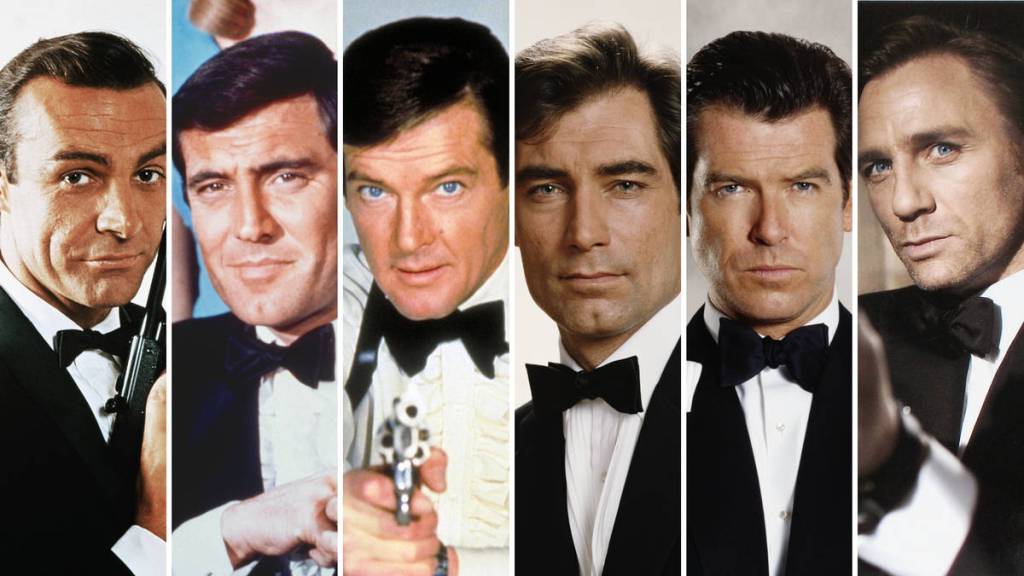
Part Three: Six Men, One Licence
Competing Performances
Ranking Bonds is itself a minor cultural genre with a fairly stable consensus. Nearly every published list — magazine retrospectives, critic polls, fan forum arguments — puts Connery and Craig at or near the top in some order, Moore reliably third, Brosnan fourth or fifth depending on the poll, and Dalton and Lazenby fighting over the bottom two places, though both have enjoyed real critical rehabilitation in the years since their tenures ended. Connery, in particular, sits at or near the top of almost every version of this list as the “authentic” originator against whom everyone else is measured.
However let’s now imagine a family that has watched these films enough times to have opinions that no longer feel like opinions, just facts they’ve settled between themselves — a smartarse, his well-read and long-suffering spouse, an educated and educator son, a highly principled daughter who somehow exempts Bond from her own principles, another daughter who is a natural comic, and a daughter-in-law who has been railroaded into the viewing conspiracy. Their order runs: Moore, Craig, Brosnan, Connery, Dalton, Lazenby. That’s not a minor variation on the standard list. It inverts its central assumption, putting the two performers most willing to let the seams show — one through comedy, one through visible strain — at numbers one and two, and relegating Connery, the man nearly every other list treats as the unreconstructed, authentic standard, down to fourth. That’s the household’s verdict on which register of masculinity is actually bearable to live with on a loop, and the gap between this order and the consensus is the argument this piece is going to make, not a curiosity sitting outside it.
There’s a useful piece of apparatus for explaining why, borrowed from the sociologist R.W. Connell. He argued that masculinity isn’t one fixed thing at any given moment but a hierarchy of competing performances — several versions in circulation simultaneously, one culturally dominant and rewarded, others marginalised or subordinated, the hierarchy itself shifting across decades. That’s a useful frame precisely because it’s plural and historical by design, which is exactly what six actors across six decades hand an argument on a plate.
And there’s a single fixed piece of ritual we can, like the films, open on, because it does the argument’s work before a word of analysis gets added. Every film begins with the same sequence, verbatim, performed by six different men across sixty years: a walk, a turn, a shot fired directly at the audience, blood trickling down the screen. A fixed, unchanging script — and proof, repeated twenty-five times, that the man performing it changes what it means on every single occasion.
Lazenby: On Her Majesty’s Second Thoughts
Lazenby’s route to the role needs to be set out in full, because the lengths he went to manufacture authenticity turn out to be the whole story in miniature. He had no acting experience — a former car salesman turned model, best known for a Fry’s chocolate advertisement, cast from over four hundred contenders largely on the strength of a screen-test fight scene rather than any demonstrated craft. He spent his own money on a Savile Row suit that had been tailored for Connery but never collected, went to Connery’s own barber at the Dorchester, bought a Rolex. The least “authentic” Bond by every conventional measure assembled his performance of authority out of another man’s discarded signifiers, hoping the costume would do the work the training hadn’t.
He also very nearly wasn’t there to be criticised at all. Offered a seven-film contract reportedly worth close to a million dollars, Lazenby turned it down on his agent’s advice that the spy genre was finished — a reasonable-sounding read of a countercultural moment that turned out to be catastrophically wrong. So the first actor ever asked to succeed Connery had already privately decided Bond was a dying relic, a quarter-century before the franchise started putting that exact line in M’s mouth on screen. Contemporary reviews were unkind and specifically personal, the British press mocking him as “the Big Fry,” missing Connery’s ease even where they admired the film. The reversal since has been total: On Her Majesty’s Secret Service is now widely regarded, including by later Bond directors, as one of the finest entries in the whole series.
It would be wrong to see this as just generic “the sixties.” This is 1969, not the height of an established feminist movement but its very beginning — the Dagenham equal-pay strike the year before, Kate Millett’s Sexual Politics published the same year, the first small UK Women’s Liberation Workshop protest already underway, a full year before the more famous 1970 Miss World demonstration. Michael Caine’s The Italian Job opens six months earlier, offering a harder, working-class cool entirely unlike Bond’s establishment tailoring; two years later, Get Carter — the same year as Connery’s own tired comeback in Diamonds Are Forever — rejects glamorous violence outright, Caine explicit about not wanting British gangsters played as “stupid or funny.” Bond, by comparison, doesn’t update at all. It gestures at contemporaneity through a ski-resort setting and marginally looser tailoring while leaving the actual structure untouched.
And the film’s single boldest choice proves the point rather than disproving it. Bond genuinely falls in love, marries, and loses — Tracy shot dead minutes after the wedding, Bond left holding her body, saying there’s “all the time in the world” with nothing left to do but grieve. That’s the only rupture of its kind in the character before Craig, arriving decades early. But the very next film erases it entirely: Connery returns in Diamonds Are Forever as an unattached womaniser with no acknowledgment that his predecessor was ever married, let alone widowed. The vulnerability wasn’t structural change. It was a one-film aberration the franchise immediately overwrote — proof that visual and emotional signifiers can update while the actual mechanism resets the instant the credits roll. Retrospective grief is licensed, present-tense romantic surrender is not. Bond can be haunted by a wife he’s lost. He cannot be allowed to choose one over the mission while she’s still alive, because that isn’t tragic, it’s a resignation letter. Tracy’s death doesn’t just devastate the character. It protects his future usability, solving the problem the plot would otherwise have had to face: what a domesticated, married, still-functioning Bond actually looks like.
Our household’s verdict? Lazenby is, in the same breath, genuinely affecting and a bit wishy-washy — and both are true, the same underlying fact read two ways rather than a contradiction. His inexperience strips away performed command across every register, not selectively. In the wedding-and-death scene, that absence of polish reads as devastating rawness. In the wit, the seduction, the command scenes, the same rawness reads as uncertainty rather than restraint. Hegemonic masculinity, as a performance, doesn’t reward toughness or tenderness in isolation — it demands total, consistent control across all of them at once, and Lazenby, ranked last by the household and by nearly everyone else, simply couldn’t sustain it. Judged by that standard, he fails. Judged by the one thing the household actually prizes above all six — a man visibly not fully in command of his own performance — he’s the only pre-Craig Bond who was ever allowed to be human when it cost him something.
Dalton: Licence Revoked
Dalton was offered Bond three times before finally accepting a fourth, and “over-promoted into the field” turns out to be close to his own stated self-assessment rather than an outside critique. First around 1968, aged twenty-five, and he said outright it was “the daftest idea in the world” — Bond should be older. Offered again after Connery’s second departure, declined for the same reason. Offered a third time in 1981, when it looked as though Moore was leaving — Broccoli’s own account has Dalton saying “the part intimidated him,” all but signed before Moore stayed on after all. By the time he finally accepted in 1986, taking on The Living Daylights, this was a man who had spent two decades on record saying he wasn’t ready — not a critic’s judgement imposed from outside, close to the actor’s own repeatedly stated anxiety about himself.
Licence to Kill, his second and final outing, earned the harder edge the casting seemed to promise. It carried a “15” certificate from the BBFC for its violence — the same year the board introduced a new “12” that Batman got instead — and its plot has Bond resigning his service to pursue a purely personal vendetta after a drug lord mutilates Felix Leiter and murders his bride, strikingly close to what Craig’s Quantum of Solace would do nearly two decades later, arriving too early to have the multi-film arc that later made the same idea land as earned rather than sudden. It became the worst-performing Bond film in the series to that point, hurt by a bungled US marketing campaign and brutal same-summer competition from Batman, Lethal Weapon 2, and Indiana Jones and the Last Crusade. A genuine five-year legal battle between MGM and Danjaq then shelved the franchise entirely, cancelling Dalton’s planned third film and putting Bond on hiatus until 1995 — an actor who doubted his own readiness for twenty years, finally given the ambitious tonal revolution he’d been offered three times, and then denied the time to grow into it that Craig would later be given in full.
The films sidestep the political economy of their own moment almost entirely, and the timing of that avoidance mattered. Domestically, both Dalton pictures land inside landmark privatisation years — British Airways in 1987, the same year as The Living Daylights, the water authorities in 1989, the year of Licence to Kill — with the miners’ strike, the Wapping dispute that broke the print unions, and the Big Bang deregulation of the City all sitting just behind them. None of this is acknowledged on screen. MI6 remains an untouched institutional island while the actual country convulses around it. Internationally, the two films manage to be wrong in opposite directions: The Living Daylights treats the USSR as a still-monolithic Cold War enemy in the same year the INF Treaty marks a genuine geopolitical thaw, while Licence to Kill abandons the Cold War frame altogether for an unrelated Central American drug plot, released five months before the Berlin Wall falls. Neither film registers the epochal collapse actually happening around it.
Section 28 becomes law on 24 May 1988, sitting precisely between the two films, Thatcher’s own conference speech the year before invoking “traditional moral values” against an “inalienable right to be gay” — legislated anxiety landing in the same window as the government’s “Don’t Die of Ignorance” AIDS campaign. The Living Daylights answers to that climate more directly than any other Dalton beat: Bond sleeps with dramatically fewer women than any predecessor, largely monogamous with Kara Milovy for the whole film. Nobody on screen says a word about any of it. The pattern doesn’t need to be spoken to be present.
Which gives Dalton’s Bond its own theoretical payoff, distinct from anything the other five produce. Stuart Hall’s three readings — dominant, negotiated, oppositional — presuppose a text confident enough in its own ideology to give each reading something to work with. Dalton’s films don’t supply that. There’s no swagger for a negotiated reading to enjoy ironically, because the films aren’t swaggering. There’s no easy triumphalism for an oppositional reading to push against, because Bond spends most of Licence to Kill disavowed by his own service. The text is genuinely undecided about its own values, and the three readings correspondingly flatten toward each other rather than diverging — not a failure of the method, but the method correctly registering that some eras produce texts that haven’t made up their minds. And the political sidestep does its own quiet work here too: by refusing to engage Thatcherism or the Cold War’s actual collapse, the films protect Dalton from ever being tested on anything beyond the narrower, safer question of whether he seemed convincing as a tough guy — which meant that whatever failure he suffered, it was never allowed to become a dangerous one.
Connery: Rough Diamonds Aren’t Forever
Connery is definitional in a sense none of the other five can claim, and it’s the plain reason he tops nearly every list but the household’s own. Everything the franchise later treats as convention — the delivery of the name, the relationship to Q and M, the physical command underneath the charm — Connery originates rather than inherits, built from nothing across five films between 1962 and 1967. Every actor after him is measured against a template he made.
Post-war gent, not Beatles mop-top. Dr No premiered on 5 October 1962 — the exact same day the Beatles released “Love Me Do.” Two British cultural exports born on the same afternoon, pointed in opposite directions: the Beatles youthful, Liverpudlian, working-class in accent and energy, looking forward; Bond tailored, Savile Row, gentleman’s clubs, a vodka martini shaken not stirred, vintage champagne, looking backward toward an older model of authority even as it launched. Connery’s actual biography complicates the “gent” half of that contrast, though. He was genuinely working-class Edinburgh — milkman, bricklayer, coffin-polisher among his early jobs — closer kin to the British New Wave’s angry young men, Finney, Harris, Harvey, than to the posher 1950s screen tradition of Richard Todd or Kenneth More. There is a further irony: Fleming’s own novels describe Bond as “alien and unEnglish,” not an Old Etonian at all, and Fleming’s own preferred choice for the role, on record, was David Niven — genuinely upper-class, genuinely of that older gentleman tradition. Niven never got the chance to prove the theory properly: the film rights to this first novel had been sold off separately back in 1955, ended up with a producer who couldn’t reach terms with Broccoli and Saltzman, and surfaced instead as a 1967 spoof with Niven playing an ageing, retired “original” Bond — chaotic, poorly reviewed, a curiosity rather than a real test case. So the genuinely posh version of the character was tried, briefly, in a film built to fail by design, while Connery’s manufactured gentility, worn slightly uneasily over real working-class physicality, became the template instead. He isn’t playing born privilege. He’s playing privilege performed convincingly enough to pass, which is a different and more dangerous thing than the “gent” label alone suggests.
The misogyny is real and documented, not retrospective projection. In a 1965 Playboy interview, Connery said an open-handed slap is “justified if all other alternatives fail” — a defence of hitting women specifically, doubled down on in a later 1987 Barbara Walters interview before a partial reversal decades later, in 2006, when he called it wrong. On screen it’s compounded rather than mitigated: in Thunderball, Bond coerces a nurse into sex by threatening her job after she’s already physically rebuffed him, a scene Cary Fukunaga, director of No Time to Die, called “basically rape” in 2021 — a striking judgement from inside the franchise’s own current leadership. In Goldfinger, the barn scene with Pussy Galore — a character explicitly established as uninterested in men — has Bond physically overpower her during what starts as a judo bout, the narrative then framing her sudden reversal as romantic conquest rather than what it structurally is: a woman’s stated disinterest resolved through force.
Class was the defining feature of the socio-economic context at the franchise’s birth. Dr No and From Russia with Love land under Macmillan, the “never had it so good” prime minister since 1957. Macmillan resigns in October 1963, succeeded briefly by Alec Douglas-Home — a genuine hereditary aristocrat who had to renounce his own peerage to sit in the Commons, and read on television as exactly the gaunt, out-of-touch Tory grandee the emerging Sixties had no use for. Goldfinger releases the month before Wilson’s Labour government wins power in October 1964 — self-consciously ordinary, Yorkshire-accented, promising to modernise Britain in the “white heat” of technology. Connery’s first five years on screen are a direct contemporary of Britain formally, electorally, deciding it didn’t want men like Douglas-Home leading it any more.
What Wilson’s election doesn’t touch is the apparatus underneath — the Foreign Office, the intelligence services, the City, the senior civil service, all remaining overwhelmingly upper and upper-middle class regardless of who sits in Downing Street, while the popular culture surrounding all of it transforms at real speed: the British New Wave putting working-class heroes on screen, the Beatles making a Liverpool accent commercially dominant, Caine and Finney becoming stars on working-class register rather than despite it. A genuine split-screen Britain — culturally, working-class voices suddenly fashionable and central; institutionally, almost nothing actually changed hands. To be legible as a Secret Intelligence Service agent, one of the few parts of British life that genuinely hadn’t democratised, Connery’s real working-class physicality has to be overwritten with performed upper-class command. Not incidental casting. The job description matching the institutional reality: the class-mobility fantasy only works if the mobility is total and invisible, because the world he’s playing into hadn’t actually opened its doors, only allowed a better class of impersonation through them.
Which is the real content of “maleness still backward looking.” Bond doesn’t offer a new model of masculinity at all. He offers the old model of command-and-privilege authority, laundered through a working-class actor’s genuine energy so it reads as fresh without being so — vitality from below recruited into the service of an unreformed hierarchy rather than a challenge to it. Whatever else changes about the character across the decades, that structure doesn’t really move until very late in the run, if it ever fully does.
Diamonds Are Forever, four years after Connery’s own exit and pulled back for one film at a considerable fee, shows exactly what happens when the mismatch finally becomes visible. Connery is heavier, older, plainly uncomfortable back in the role, and the film’s answer isn’t to age the character honestly but to bury the mismatch under camp — broader jokes, a campier Blofeld this time played by Charles Gray, comedy standing in for reinvention because there was no way to modernise a fixed persona without breaking it. Ageing would have meant acknowledging consequence, and the character depends on never really having any.
Never Say Never Again, the unofficial 1983 remake made outside EON, deserves its own close rather than a footnote, because it does something the official films of the same period wouldn’t risk. It opens with Bond failing a training exercise, “killed” in a simulated rescue, and a dismissive new M sending him to a clinic as unfit for the field — the film announcing on page one that its fifty-two-year-old lead cannot simply resume being the 1965 Bond, and building the entire project around that impossibility rather than hiding it. One contemporary review notes M’s contempt for the 00 agents he sees as “relics” — language that lands twelve years before Judi Dench calls Bond exactly that on screen, and nearly thirty before Skyfall stages a whole film around the same question. The title itself, suggested by Connery’s own wife, mocks his earlier vow to quit the role after Diamonds Are Forever, and the film closes with Bond retiring, telling reporters he’ll “never” return, delivered with a wry smile that winks openly at the joke built into the whole production’s existence. Connery himself called it “a bloody Mickey Mouse operation.”
The real finding is the same pattern this piece keeps turning up. Lazenby’s unpolished vulnerability, Dalton’s unwanted seriousness, and now Connery’s own disowned comeback all accidentally anticipate exactly what the Craig era would later be praised for doing on purpose — ageing, institutional doubt, a body that can no longer perform command without cost. Never Say Never Again doesn’t recapture the young man. What it captures, a generation early and almost by accident, is the older, doubting one — the version of Bond the franchise wouldn’t officially admit it wanted until Judi Dench and Sam Mendes finally gave it permission.
Brosnan: Licensed to Chill
Brosnan starts from a genuinely different position than anyone covered so far: not doubt, but a stolen decade being finally repaid. He was the producers’ first choice back in 1986, after Moore stepped down, but was contractually tied to Remington Steele; when NBC unexpectedly renewed the show on the strength of the Bond casting buzz itself, he lost the role to Dalton. By the time he actually plays Bond in 1995, it isn’t a fresh discovery, it’s nine years of accumulated “should have been.”
GoldenEye lands at a genuine hinge point rather than just another decade — the first Bond film made after the Soviet Union’s actual dissolution in December 1991, and the first after the six-year hiatus that killed Dalton’s third outing. Judi Dench’s M, the first woman in the role, tells Bond to his face he’s “a sexist, misogynist dinosaur, a relic of the Cold War” — the films diagnosing the character rather than simply performing him, for the first time. And when Alec Trevelyan taunts him with “For England, Alec?”, Bond’s answer is “No. For me.” — the exact shift from national duty to private motive this whole piece has been tracking, arriving here rather than waiting for Craig.
Trevelyan himself is the cleanest version of the psychological-mirror villain the franchise had produced to that point — Bond’s own former partner, betrayed not by an enemy but by Britain itself, his parents among the Lienz Cossacks handed back to Stalin at the war’s end and raised, unknowing, by the very state that caused their deaths. His plan isn’t conquest, it’s private enrichment through financial chaos — a post-ideological villain for a franchise that had just lost its ideology too.
Once Bond is fighting for himself rather than Queen and country, he becomes available as a pure competence-and-style icon rather than a national-duty figure — and that happens to be exactly what Cool Britannia-era Britain wanted from its heroes. Tomorrow Never Dies lands in 1997, the same year Blair wins and “New Labour, New Britain” becomes the governing mood. Brosnan doesn’t play arch the way late Moore did, and he doesn’t play grim the way Dalton did — he plays competent and visibly enjoying it, which suited a culture that wanted to feel modern and successful without irony curdling into either mockery or anxiety.
The gender material across the middle two films is genuinely worth tracking as a real advance rather than a footnote. Michelle Yeoh’s Wai Lin in Tomorrow Never Dies is the strongest pre-Craig case for functional equality in the role — an established star of Hong Kong action cinema before she ever put on the costume, treated as simple professional fact rather than something Bond has to be convinced of, fighting him to a standstill before they team up as something close to equals. The World Is Not Enough gives a different first: Elektra King isn’t a villain’s accessory, she’s one of the film’s two co-primary antagonists, with Renard functioning largely as her instrument. Christmas Jones, in the same film, is roughly two hours of setup for one bad closing line — widely and fairly mocked, alongside a genuinely spectacular piece of overreach in the finale, paraglider-mounted circular saw blades tearing through a pipeline chase. Die Another Day‘s Jinx, styled explicitly as an homage to Ursula Andress’s Dr Nobeach emergence, reads by most accounts as marketing rather than earned substance — a mooted solo spin-off that never happened, closer to spinoff bait than to Yeoh’s embodied competence.
The unevenness has a real, documented cause rather than a mysterious ideological retreat. Cubby Broccoli died on 27 June 1996, mid-way through Tomorrow Never Dies‘s scripting — the first time Michael G. Wilson and Barbara Broccoli took full creative control alone. The script itself suffered visibly: new writers were brought in as Bruce Feirstein’s original treatment got diluted, and the final act was reportedly written in a single afternoon under deadline pressure. A different director for every one of the four films — Campbell, Spottiswoode, Apted, Tamahori — completed the instability. What holds steady through all of it is Brosnan himself: smooth, witty, physically convincing in every single film regardless of what he’d been handed, never visibly checked out the way Moore sometimes was late in his run. The films wobble. The performance underneath them doesn’t.
Craig: Quantum of Solus
Craig starts from reluctance rather than doubt or entitlement, and the reluctance is on the record from the very first conversation. Trained at Guildhall, his breakthrough was Our Friends in the North in 1996, Peter Flannery’s landmark BBC serial tracking four Newcastle friends across three decades of political disappointment, alongside Christopher Eccleston, Gina McKee, and Mark Strong. From there: Elizabeth, Road to Perdition, Layer Cake, Munich — a serious character actor’s résumé, awards attention rather than box-office pull, never once carrying a poster on his own name before Bond. His actual first response to being offered the role, by his own account, was blunt refusal — dread at what it would do to a career built on disappearing into difficult parts. The reluctance never really stopped: the notorious “I’d rather break this glass and slash my wrists” line came in 2015, right after Spectre, and dogged every interview for the rest of his tenure.
His delivery of the traditional Bond quip has always been the register critics flag as his weakest, next to Moore’s effortless arch or Brosnan’s easy charm — and that weakness does real work rather than undermining the performance. A quip is supposed to prove nothing touches the man delivering it. Craig landing it slightly gracelessly, a beat too dry or too effortful, lets the strain show through the performance of ease. The strain is the point. A man visibly not quite at peace with performing invulnerability is exactly what this piece’s whole theoretical spine has been arguing the household prizes above all six.
The socio-economic backdrop here is worth the same precision given every other actor. Casino Royale releases in November 2006, twenty-two months before Lehman Brothers collapses in September 2008; Quantum of Solace follows in October 2008, weeks after the crash, an anxiety about institutions and private capital that the films couldn’t have deliberately timed landing anyway. What follows for the rest of Craig’s tenure is what economists and, eventually, the British press started calling the “zombie economy” — a decade-plus of near-zero interest rates, quantitative easing, and companies kept alive on cheap credit without the productivity to justify it, coined originally for Japan’s lost decade and imported wholesale into Britain’s own vocabulary by the early 2010s. Austerity under Cameron and Osborne begins in 2010; real wages don’t recover to their pre-crash level for the better part of a decade. Craig’s Bond operates across the entire span of a country that stopped expecting growth rather than merely losing an empire.
The register of public argument around the films shifts with it. Earlier eras of this piece have tracked class as the primary lens — Connery’s manufactured gentility, the gentleman-amateur myth, Dalton’s Thatcherite backdrop. By Craig’s tenure, the loudest disputes about the character are conducted almost entirely in the vocabulary of identity rather than class: who should play the next Bond, whether Moneypenny or Leiter’s casting matters, the Q scene, the Idris Elba row. That’s not a value judgement about whether this shift was for better or worse, simply a description of where the argument actually moved — the twentieth century’s Bond disputes were arguments about breeding and background; the twenty-first century’s are arguments about representation.
And Britain by this point has settled into a position the earlier fantasy never had to reckon with. Post-crash, post-referendum — the 2016 Brexit vote landing squarely inside Craig’s tenure, formal exit completed by 2020 — this is no longer a country contesting for a seat at the top table so much as one that has made a kind of peace, uneasy or otherwise, with a comfortably second-tier global position. Which is precisely why Bond’s own stakes shrink the way they do across these five films: not because the writers ran out of ambition, but because a fantasy of single-handedly saving the world reads as faintly absurd once the country telling itself the story has stopped genuinely believing it contests for that rank at all.
Vesper Lynd is the most significant woman in the entire run, and the case for that is structural rather than sentimental. She profiles Bond cold in their first scene on the train — correctly reading, from nothing but the cut of his suit, that he didn’t come from money and that his school years left a mark he’s still carrying — establishing herself as his equal before he gets to perform any charm on her at all. Her betrayal is tragic rather than simply treacherous: she hands Le Chiffre’s people the winnings because Quantum is holding her boyfriend hostage, and Quantum of Solace later reveals that boyfriend was never real, a Quantum operative whose actual job is seducing women with access to government funds. She wasn’t coerced so much as recruited into complicity before she had any say in it. She drowns in Venice, Bond diving for her too late, and leaves him a note declaring real love anyway — betrayal and devotion in the same act, unresolved. Bond names his own signature cocktail after her in this same film. She shapes Quantum of Solace entirely, recurs through her grave in Skyfall and Spectre, and gets attacked again at her own grave in the opening of No Time to Die. Five films, one woman, still shaping the plot from beyond the frame of the one she actually appears in.
Judi Dench’s M, across this same run, is doing something a script this thin has no obligation to demand. Sam Mendes has said she “doesn’t articulate, she demonstrates” — building the character’s interiority through performance the writing never explicitly earns. She knows Bond hid for two days after learning his parents had died, private knowledge the plot never explains. She recites Tennyson’s Ulysses to a parliamentary inquiry defending her own continued relevance, in language that could sit inside this essay’s own argument about decline metabolised into endurance. She dies in a family chapel, and Bond grieves her as a parent rather than a boss.
Bond’s own arc runs in step with this shift rather than ahead of or behind it. The grief over Vesper, the orphan backstory M alone seems to know, the repeated, visible desire to walk away from the job — all of it lands across exactly the same decade Britain’s own public conversation was actively working to reframe admitting you can’t cope as strength rather than weakness. Craig’s Bond doesn’t invent emotional permission for men on screen so much as arrive precisely when the culture was finally extending it off screen too.
The rule established with Lazenby holds across all five films, tightened rather than loosened. Retrospective grief is licensed; present-tense romantic surrender is not. Craig grieves Vesper as backstory, safely, and the films reward it. Every time he tries to retire in the present tense — with Madeleine at the end of Spectre, again at the start of No Time to Die — the plot punishes the attempt almost immediately. The final film doesn’t just kill him. It makes the mechanism of his death permanent separation from the family he wanted, dying rather than ever risking domestic completion. Bond is not allowed to end that way, under any circumstances, even at the cost of the character’s own life.
On race, the honest verdict is close to representation without narrative integration, and it holds even where the instinct says otherwise. Jeffrey Wright’s Felix Leiter and Naomie Harris’s Moneypenny are written identically to any predecessor; nothing in the text engages their race at all. Lashana Lynch’s Nomi comes closest to an exception — introduced through a deliberate misdirection using assumptions about a Black Jamaican local before revealing she’s MI6’s new 007 — but the conflict that follows is framed around gender and succession rather than continuing to engage race as a live force. The real conversation happened almost entirely outside the films: years of public speculation that the next Bond might be Idris Elba, and a genuine row when Anthony Horowitz, the Fleming estate’s own commissioned novelist, called him “too street” and had to apologise. The producers never actually cast a Black actor as Bond. The charged version of this conversation took place in interviews and tabloids, not on screen.
Q’s sexuality gets one scene, in the final film, seven years into Ben Whishaw’s tenure in the role — Bond and Moneypenny surprising him mid-date, a line about wanting a “nice night to himself.” Whishaw himself has called the moment unsatisfying, admitting he wondered at the pitch stage whether the production intended to do anything with it and concluding they didn’t. The first out ally in sixty years of Bond, delivered this briefly, disowned as insufficient by the very actor asked to carry it.
Moore: The Man With the Golden Pun
Some performances ask to be taken straight. Moore’s asks, from the very first entry, to be taken with a wink — and it’s the clearest case in the whole run of an actor consciously choosing the negotiated reading as a strategy rather than an audience discovering it despite him. His own explanation of the approach amounts to a statement of intent: “the Bond situations are so ridiculous, so outrageous… I’m not that cold-blooded killer type. Which is why I play it mostly for laughs.” He isn’t accidentally camp. He’s decided, deliberately, to let the seams show.
The persona predates Bond by over a decade, which matters more than it first appears to. Moore had already built the smooth, unruffled, quipping adventurer in The Saint as Simon Templar from 1962 to 1969 — cool sophistication, unctuous charm, immaculate good looks that never get ruffled by danger, described at the time in almost identical terms to how critics would later describe his Bond. When Broccoli cast him in 1973, he wasn’t inventing a character. He was importing an existing, market-tested screen persona wholesale into a different franchise.
And he didn’t just survive the critical dismissal of his acting, he adopted it as his own material. Vincent Canby in the New York Times accused him of reducing “all human emotions to a series of variations on one gesture, the raising of the right eyebrow.” Moore’s response was to make the joke sharper than the critic’s own: “I only had three expressions as Bond: right eyebrow raised, left eyebrow raised, and eyebrows crossed when grabbed by Jaws.” Asked what he brought to the role that Connery didn’t, his answer was “White teeth.” An actor taking his harshest reviews and turning them into branded, repeatable material.
There’s real substance underneath the lightness. Moore became a UNICEF Goodwill Ambassador in 1991, inspired by his friend Audrey Hepburn, and was knighted in 2003 specifically for that charity work rather than his acting — work he later called his greatest achievement, greater than seven Bond films. Late in life he also used his own platform to disclose that he had been a victim of childhood abuse, specifically to help other victims feel less alone in their shame. A genuinely decent, occasionally quite brave person was operating the machinery underneath decades of professionally deployed charm.
Which gives Moore a distinct place in R.W. Connell’s hierarchy of competing masculine performances. Connell argued that no single masculinity holds the dominant position permanently — several versions circulate in any given period, one culturally rewarded, others subordinated, the hierarchy itself shifting across decades. Connery’s unreflective command was the dominant register of 1962. By 1973, with the country it’s supposed to represent in genuine and visible difficulty, that same unreflective swagger becomes harder to sustain without curdling into something closer to delusion. Moore’s ironic, self-aware, negotiated performance becomes the new dominant register precisely because it’s the one variant of masculine command still available to a country that can no longer entirely believe its own fantasy of competence, only enjoy performing it. Craig’s version, decades later, will do the same repositioning again for a different reason — trading Moore’s comic distance for visible strain, vulnerability folded into command rather than replacing it, because by then the culture has started rewarding the admission of cost rather than only the concealment of it.
The political backdrop earns that reading rather than merely decorating it. Moore’s tenure runs from 1973 to 1985 — through the 1976 IMF crisis, the Winter of Discontent, then Thatcher’s own genuinely wrenching economic shock treatment from 1979 onward, a country visibly struggling to manage itself in ways it hadn’t since the war. A completely straight-faced “one Englishman saves the world” fantasy risks landing as either delusional or, worse, an accidental insult to people living through real hardship. Irony isn’t a failure of ambition here. It’s the only mode left that can keep selling the fantasy without the gap between the fantasy and the country’s actual condition becoming embarrassing. There’s a useful idea for this from the critic Fredric Jameson, who argued that cultural texts perform “imaginary resolutions of real contradictions” — letting an audience feel a problem solved that has, in reality, no solution at all. The contradiction between imagined competence and real diminished capacity had grown too wide by 1973 for anything but ironic distance to paper over convincingly.
Broccoli did try to correct course once, and the attempt is worth having on record rather than assuming pure drift. After Moonraker‘s space-opera excess in 1979, For Your Eyes Only in 1981 was a deliberate reset — grounded plot, real stunts, personal stakes rather than world domination, a new director reportedly reining in Moore’s “humour blitz” on set. It worked commercially too. And even that reset couldn’t resist one wink: the film opens with Bond dumping an unnamed, bald, cat-stroking, wheelchair-bound villain down a factory chimney, unmistakably Blofeld in all but name. Full sincerity was never actually available to this franchise by 1981. Only calibrated proportions of it.
The slide back toward peak camp by Octopussy and A View to a Kill correlates precisely with Moore’s advancing age — fifty-five, then fifty-seven — and functions the same way it did for the ageing Connery in Diamonds Are Forever: escalating spectacle as distraction from what the star’s own body could no longer convincingly deliver.
The Bond girls against that backdrop are where the household’s own delight and discomfort sit closest together, and it’s worth taking the age gaps precisely rather than gesturing at them. Twenty-three years in Live and Let Die. Twenty-nine in For Your Eyes Only, which also contains the one moment of real restraint in the whole run — Bond declining the advances of a teenage figure skater explicitly coded as too young, the film aware enough of the impropriety to have its hero say no. A smaller gap in Octopussy, where Maud Adams is given genuine narrative agency as an independent businesswoman rather than pure decoration. Twenty-eight years in A View to a Kill, mocked at the time and since as the point the mismatch became undeniable.
And Moore himself said the thing critics were circling around, using language sharper than most of them dared. He’s said outright that the age gap “becomes disgusting,” and that realising he was now older than Tanya Roberts’s own mother decided him to quit. Contemporary reviews calibrated the problem as one of plausibility rather than menace — Paul Attanasio’s description of the romantic scenes as “like watching women fall all over Gabby Hayes” is a critique of credibility, not coercion. That’s the real distinction between this Bond’s failure and Connery’s: Connery is dangerous, and the culture has had to reassess that danger seriously. Moore becomes ridiculous, and even the actor playing him agreed.
A View to a Kill sits, by near-universal consensus, alongside Diamonds Are Forever and Die Another Day as the three worst-regarded entries in the whole series — and all three, without exception, are an ageing actor’s final outing. Moore quitting when he did, and naming precisely why, closes the loop this whole piece has been tracing from the outside: the actor confirming, in his own words, the mechanism the films themselves kept trying to disguise.
Seams Showing
Line the six up now, in the household’s own order, and a pattern holds that the ranking has been tracking all along without needing to name it until this point. What earns a Bond top marks here isn’t command itself. It’s visibly performed command — masculinity that lets the seams show, either as joke or as wound, rather than masculinity presented as simply, unreflectively true.
Moore and Craig, first and second, are the two who make the performance legible as performance. Moore does it by winking at his own absurdity for over a decade, consciously, on the record. Craig does the same work in the opposite register — not comedy but visible strain, a man who can’t quite land the traditional quip smoothly because some part of him is still carrying the cost of the last film’s grief. Different tools, the same underlying move: both let the audience watch the performance being performed, rather than asking them to accept it as simply given.
Brosnan, in the middle, does neither. He’s smooth and genuinely well-suited to his cultural moment, but he doesn’t examine the mask, he just wears it convincingly — pure surface confidence for a country that briefly wanted exactly that. Respectable and enjoyable, but doing less interior work than the two either side of him, which is why he sits precisely between them rather than challenging either for the top.
The bottom three all fail the same test from different directions. Connery is the least self-aware of the six — the most convinced, on screen and in his own public statements, that the dominance he’s performing is simply what a man is, not a costume at all — which is exactly why the household ranks him lower than the wider critical consensus does, even while acknowledging he built the whole template. Dalton is sincere and largely undefended by any irony, but the production chaos around him meant that sincerity was never given room to mature into anything the audience could fully trust. And Lazenby is the rawest, and in flashes the most honest, of any of them — but honesty without professional control reads as uncertainty rather than choice, the same underlying quality landing as accidental vulnerability in one scene and mere unsteadiness in the next.
This ranking, in the end, isn’t really a ranking of who played Bond best by any conventional metric of competence. It’s a family of committed negotiated readers, in Hall’s own sense of the term, consistently rewarding whichever performance most openly admits that hegemonic masculinity, in Connell’s sense of the word, is a performance at all — comic or tragic, it doesn’t matter which, so long as the seams stay visible. Pure command, however skilfully delivered, ranks lower here than command with its own contradiction built in. Which is, in the end, the same instinct this entire three-piece essay has been arguing the whole franchise runs on: not sincerity, and not simple mockery, but the specific, sustained pleasure of watching a fantasy know exactly what it is and carry on regardless.


Leave a Reply