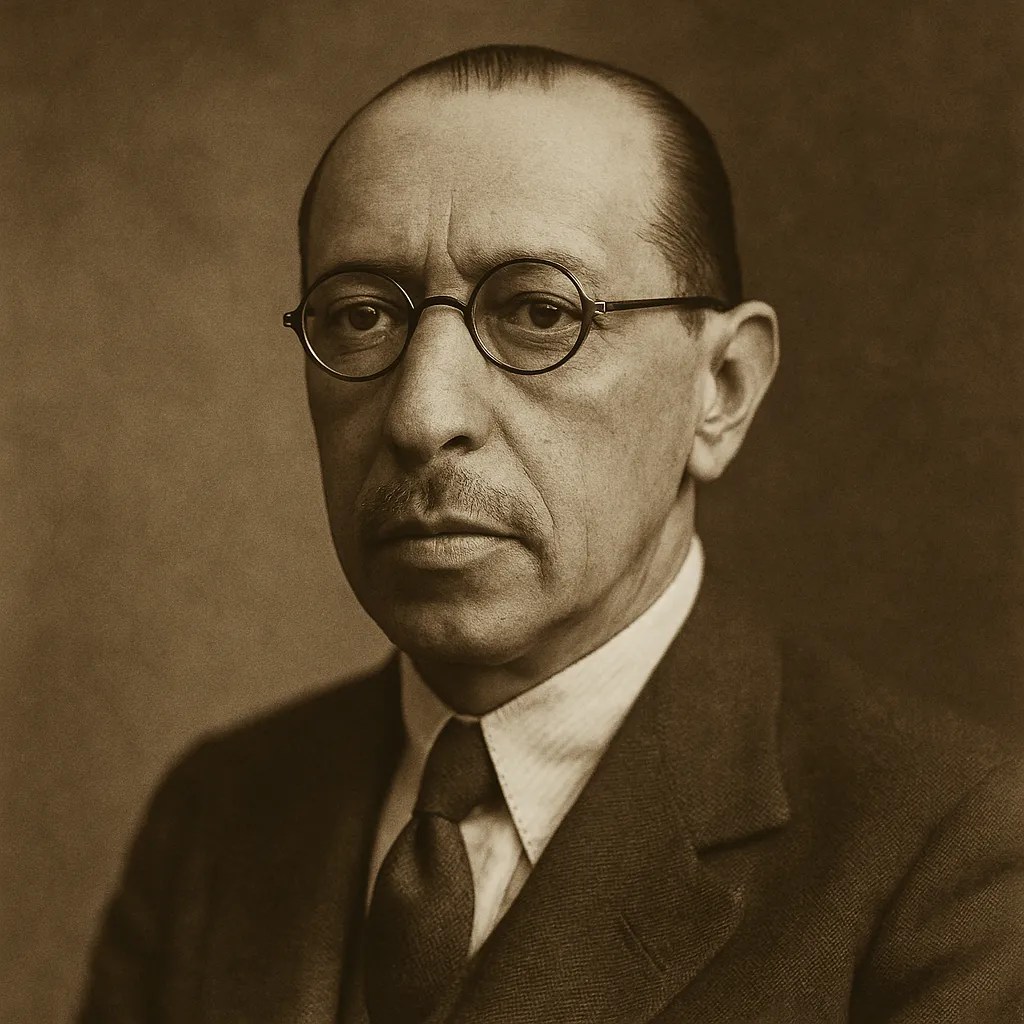
Essay Two: The Boy from Nowhere — Stravinsky and the Constructed Self
This essay is part of Chameleons or Charlatans: The Art of Reinvention — a series examining artistic reinvention across the twentieth century through six figures, the cultural theory that illuminates them, and the question of whether what they did is still possible. Each essay stands alone. The series opens with The Invitation.
Part One: The Arrival
Igor Stravinsky did not arrive from nowhere, though he subsequently did his best to suggest otherwise. He arrived, in fact, from the fifth place on a list. When Sergei Diaghilev — impresario, cultural entrepreneur, and the most consequential tastemaker in early twentieth century European art — needed a composer for his new Russian ballet season in Paris in 1909, Stravinsky was not his first call, nor his second, nor his third, nor his fourth. Tcherepnin declined. Glazunov declined. Liadov — a man famous primarily for his procrastination — declined or simply failed to deliver. Possibly a fifth candidate was approached. After an increasingly frantic search, Diaghilev turned to a twenty-seven year old composer who was virtually unknown outside St Petersburg, had completed one act of an unfinished opera, and whose chief qualification was that he had already orchestrated two numbers for the previous Ballets Russes season without making a mess of it. Being little-known, he would likely say yes to anything. Diaghilev was right. Stravinsky got to work before the formal commission had even been offered.
Within a year he had written The Firebird. Within two, Petrushka. Within four, The Rite of Spring. The fifth choice had become, in the estimation of Leonard Bernstein and most of musical history, the composer of the most important single piece of music of the twentieth century. The chancer had become the colossus.
We begin here not to diminish Stravinsky but because the circumstances of his arrival are essential to understanding everything that follows. This is a man whose entire career was launched by accident and opportunity, whose first major work was commissioned because everyone more established had said no, and who understood — with a shrewdness that never left him — that the opportunity had to be seized completely or not at all. He began composing The Firebird before Diaghilev had formally offered him the job. That is not the behaviour of a naive artist grateful for patronage. That is the behaviour of someone who understood exactly what was at stake and moved faster than the situation required.
This matters because of where Stravinsky was coming from, and what he was carrying with him into that Paris commission. He was the son of Fyodor Stravinsky, principal bass at the Mariinsky Theatre — which is to say he grew up inside the Russian musical establishment, breathing its assumptions, absorbing its hierarchies. His teacher was Nikolai Rimsky-Korsakov, the great custodian of the Russian nationalist tradition, a man who had himself inherited the mission of the Mighty Handful — Balakirev, Mussorgsky, Borodin and the rest — to build a distinctively Russian musical culture from the raw material of folk song, Orthodox chant, and Slavic mythology. To study with Rimsky was to receive a technical education of the highest order and a set of aesthetic assumptions about what Russian music was for and what it should sound like. Stravinsky absorbed both, and later — characteristically — minimised the debt.
Stravinsky later described himself to Robert Craft as a double émigré, born to a minor musical tradition and twice transplanted to other minor ones. The Russian tradition, the inheritance from Rimsky, the folk sources that saturate his early work — all of this Stravinsky retrospectively diminished, reframed, or simply denied. Taruskin, in his magisterial 1996 study Stravinsky and the Russian Traditions, demonstrated conclusively that this self-portrait was a fiction. The man who claimed stylistic statelessness was a composer whose sensibility remained profoundly Russian his whole life long — even, or especially, when he was working hardest to disguise it.
Why the disguise? This is where biography and history converge in ways that illuminate the reinvention argument. Stravinsky left Russia in 1910 to work on the Firebird commission and never meaningfully returned. He was in Switzerland when war broke out in 1914, cut off from his financial resources in Russia, watching from a distance as the world that had formed him collapsed. His brother Gury died at the front in 1917. The Revolution made permanent what the war had begun. What pushed him into such conscious and intense exploration of Russian folklore was precisely the loss of the possibility of absorbing it naturally. The folk material in the great early ballets is not straightforward nationalism. It is, at least in part, elegy — a reconstruction of a home already becoming memory.
The first dialectic of the essay announces itself here. The Russian period, which looks from the outside like Stravinsky’s authentic origin — the real self before the reinventions began — is already a construction. Already shaped by exile, by loss, by the specific demands of Diaghilev’s enterprise, by the tastes of a Parisian audience primed to receive Russian exoticism as the fashionable frisson of the season. Diaghilev himself had written, with magnificent commercial clarity, that he needed a Russian ballet — the first Russian ballet, since there is no such thing. He was packaging a cultural identity for a Western market, and Stravinsky was his instrument.
The Rite of Spring, premiered on the evening of 29 May 1913 at the Théâtre des Champs-Élysées, dismantled the assumptions of European concert music with such force that its reverberations are still audible in virtually every subsequent tradition of Western music. Its influence runs from Bernard Herrmann’s film scores to the rhythmic foundations of minimalism, from Charlie Parker’s harmonic explorations to the Imperial March in Star Wars. You cannot adequately account for a substantial portion of the music you have heard without this twenty-minute assault on Paris by a Russian émigré who got the commission because four other people said no.
The premiere has become one of the founding myths of musical modernism — an audience scandalised into uproar, the old order repudiating the new. Like most founding myths it is partially confected. What actually happened was an audience so violently divided that the noise of argument made it impossible for the dancers to hear the orchestra. Uproar, certainly. Scandal, absolutely. Full-scale riot, probably not. And Diaghilev understood exactly what kind of cultural occasion he was staging. The scandal was real and it was also, from the outset, a production. Stravinsky did not discourage the myth. He inhabited it, elaborated it, made it part of his own story. Here, for the first time, we see the quality that will define his entire career: the ability to occupy simultaneously the position of the genuine artistic revolutionary and the brilliantly calculating cultural operator.
Part Two: The Retreat That Wasn’t — Neoclassicism and the Uses of the Past
Paris, 1920. Europe has just consumed itself. Roughly seventeen million people are dead. The optimism of the belle époque lies in the mud of Verdun and the Somme alongside everything else. The artists who survived had to decide what art was now for. What it could honestly say.
Stravinsky’s answer, arrived at gradually through the war years and crystallised with a single commission, was to turn towards the past. Not in nostalgia — or not only in nostalgia — but in something more complex: a deliberate, ironic, structurally sophisticated act of reaching back across the rubble of the present to find forms that had survived previous catastrophes. The trigger was Pulcinella, commissioned in 1920 by Diaghilev — always Diaghilev, always the market mechanism in the room — with sets and costumes designed by a certain Pablo Picasso. The score was based on music attributed to the Baroque composer Pergolesi. Stravinsky took this material and did something that wrong-footed almost everyone: he neither reproduced it faithfully nor demolished it, but held it at a precise ironic distance, refracted it through a twentieth century sensibility, made it simultaneously familiar and strange.
This was the beginning of what musicology calls his neoclassical period, which would last — through Diaghilev’s death in 1929, through the move to America in 1939, through a second world war — until The Rake’s Progress in 1951, a full thirty years. It is the longest of his three periods and remains the most contested.
Chief among the detractors was Theodor Adorno, whose 1949 Philosophy of New Music devoted a substantial and lethal essay to what he called Stravinsky and Reaction. For Adorno, writing from the Frankfurt School’s position that genuine art must resist the conditions of its production rather than accommodate them, Stravinsky’s neoclassicism was a form of aesthetic bad faith — what he called a regression. The result, in Adorno’s reading, was music that had abolished its own subjectivity, replaced genuine expression with ritual gesture.
It is worth pausing on Adorno here because he was both right and interestingly wrong, and the gap between the two is where the essay lives. He was right that Stravinsky’s neoclassicism involves a complicated, sometimes uneasy relationship between surface and substance. What Adorno missed, or refused to see, is that the performance, the construction, the ironic distance — these are not failures of artistic nerve. They are, in the context of post-war Europe, a completely coherent aesthetic and philosophical response to a world in which the rhetoric of organic unity and authentic expression had just been pressed into the service of mass slaughter. Stravinsky himself said, with characteristic provocation, that music is by its very nature essentially powerless to express anything at all. Coming from the composer of The Rite of Spring, which expresses primordial terror with almost unbearable force, this is either a breathtaking act of self-contradiction or a very precise statement about what he wanted from his new aesthetic. Possibly both.
The more revealing self-contradiction concerns the Russian folk material that underpins everything. In 1931 Stravinsky acknowledged openly that the famous opening bassoon melody of the Rite was taken from a Lithuanian folk song. Then, as the neoclassical period deepened and his self-image as a stylistically stateless cosmopolitan hardened, he began to distance himself from this inheritance. By the time of the serial period he had arrived at this remarkable formulation: if any of his music sounded like folk material, it might be because his powers of fabrication had managed to tap some unconscious folk memory. The same source material travels from conscious quotation, through denial, to unconscious emanation — a biographical arc that maps precisely onto his shifting need to control the story of who he was.
What the neoclassical period also demonstrates, in ways that matter for the larger argument, is the cost structure of genuine reinvention. By the mid-1940s, the young Pierre Boulez and his contemporaries were audibly booing his work in Paris — the man who had scandalised the city thirty years earlier now being jeered as irredeemably old-fashioned by the next generation of radicals. The revolutionary had become the establishment. And the establishment was being dismantled in turn.
Part Three: The Rightness of Wrong Solutions — The Serial Conversion and the Question of the Rival’s Ghost
There is a Hollywood story that belongs in a film rather than a musicology textbook. For most of the 1940s, two of the greatest composers of the twentieth century lived within a few miles of each other in the sun-bleached hills above Los Angeles — Igor Stravinsky in his house on North Wetherly Drive, Arnold Schoenberg nearby in Brentwood. Both Russian-inflected European émigrés, both utterly displaced from the world that had formed them, both circling each other’s reputations with the wariness of rival predators. Their camps had spent decades conducting a proxy war over the future of Western music. Yet despite attending some of the same concerts, moving in overlapping circles, the two men had not formally met since 1912.
Then Schoenberg died in July 1951. Stravinsky sent a telegram to his widow describing the death as a terrible blow to the entire musical world. Within months he was writing serial music.
The speed is almost indecent. The man who had spent decades dismissing Schoenberg’s procedures as rigid, who had conducted his entire neoclassical project in explicit opposition to the serialist world Schoenberg had built, annexed that world within a year of his rival’s death. Whether this was genuine artistic necessity, the influence of Robert Craft who had been living in the Stravinsky household since 1948 and whose enthusiasm for Schoenberg and Webern had been steadily dripping into the composer’s ear, a calculated reading of where cultural power had shifted, or some combination of all three — the question remains genuinely open. Probably all three. Always probably all three.
But here is where the stranger-than-fiction detail changes everything. The conventional narrative misses the emotional register of what actually triggered the first genuinely serial work. In May 1953 Stravinsky met the Welsh poet Dylan Thomas in Boston. He was hoping they could collaborate on an opera. He invited Thomas to come to Hollywood to discuss it. Thomas never arrived. He died in New York in November 1953, at thirty-nine. All Stravinsky could do, he said later, was cry.
His response was In Memoriam Dylan Thomas — a setting of Do Not Go Gentle Into That Good Night for tenor, string quartet and trombones. The poem Thomas had written for his own dying father, with its famous refrain — rage, rage against the dying of the light — became, in Stravinsky’s hands, the vessel for his first fully serial composition. The serial conversion does not begin in theory. It begins in grief, in a collaboration that never happened, in the rage of a man in his seventies writing music for a poet he had met once.
Unlike Schoenberg and Webern, Stravinsky was not anxious to avoid any suggestions of a tonal centre. His treatment of twelve-tone sequences was intended to generate a melodic feeling. He did not become a serialist. He became Stravinsky using serial techniques — which is a completely different thing, and the distinction is audible in every bar.
Aaron Copland, reviewing the late works, produced the most precise critical formulation anyone has managed: the rightness of his wrong solutions fascinates. The notes themselves seem surprised at finding themselves where they are. That quality — of notes arriving at positions that feel simultaneously inevitable and unexpected, as if the music has discovered rather than constructed itself — is the Stravinsky signature across all three periods. One analyst identifies the primacy of rhythm as the single constant across all three phases — the short gestural phrases, the approach to orchestral colour, the particular way Stravinsky handles silence and space. The surface changes entirely. The fingerprint does not.
There is also the Cold War dimension, which Stravinsky himself probably preferred not to think about too carefully. The Cultural Cold War festival in Paris opened with a performance of the Rite of Spring by the Boston Symphony Orchestra. A senior CIA official declared that the orchestra had won more acclaim for America in Paris than a hundred speeches by John Foster Dulles or Eisenhower could have achieved. Stravinsky, the Russian émigré who had never been a propagandist for anything except his own music, found his revolutionary masterpiece pressed into service as proof of Western cultural freedom against Soviet socialist realism. His position in the propaganda war was described as incidental — which is almost worse than deliberate. He did not choose to be a Cold War instrument. He was simply available, famous, and on the right side of the iron curtain.
And then there is the Hollywood failure, which rounds the story with an irony so complete it could only be biographical. Stravinsky spent three decades in Los Angeles, attempted to establish contracts with MGM and Disney, and was ultimately disillusioned, frequently finding himself in disputes with studios over the misuse of his music. His music appeared in precisely one Hollywood film — Fantasia — which he apparently hated. The man whose Rite of Spring had directly shaped the grammar of cinematic tension, whose rhythmic and orchestral innovations were absorbed so completely into film scoring that they became invisible, could not work in the industry that depended on him. Harvey, again, would nod. Accumulation by dispossession operates culturally as readily as economically.
The Requiem Canticles, completed in 1966 when Stravinsky was eighty-four, is a fifteen minute setting of fragments from the Latin requiem mass — compressed, concentrated, stripped to essentials with the economy of a man who knows he is writing towards his own silence. It contains elements from all his stylistic periods — the Russian rhythmic pulse, the neoclassical clarity of line, the serial harmonic language — gathered into a single vessel as if the work itself is performing a retrospective. It was performed at Stravinsky’s funeral in 1971. He had written his own requiem and not known it, or perhaps known it perfectly well and said nothing.
That is the closing image of the Stravinsky story. Not the riot that wasn’t quite a riot. Not the Hollywood hills where two giants lived in mutual silence. Not the fifth choice commission that became the century’s most important piece of music. But an eighty-four year old man, three times exiled, three times reinvented, writing music for the dead in a language he had learned from his greatest enemy, music that contained all of himself at once, music that would be played over his own grave.
Rage, rage against the dying of the light.
Key Works
The Firebird (1910) — the arrival: the Russian inheritance detonated on the Paris stage.
The Rite of Spring (1913) — the rupture: the founding myth of musical modernism, whatever actually happened at the premiere.
Pulcinella (1920) — the pivot: the neoclassical turn crystallised, with Picasso in the room.
Symphony of Psalms (1930) — neoclassicism at its most serious: formal rigour in service of genuine spiritual expression.
The Rake’s Progress (1951) — the neoclassical summation: Auden’s libretto, Hogarth’s imagery, the end of one phase.
In Memoriam Dylan Thomas (1954) — the serial beginning: grief as the trigger, not theory.
Requiem Canticles (1966) — the final word: all three phases present simultaneously, played at his own funeral.


Leave a comment