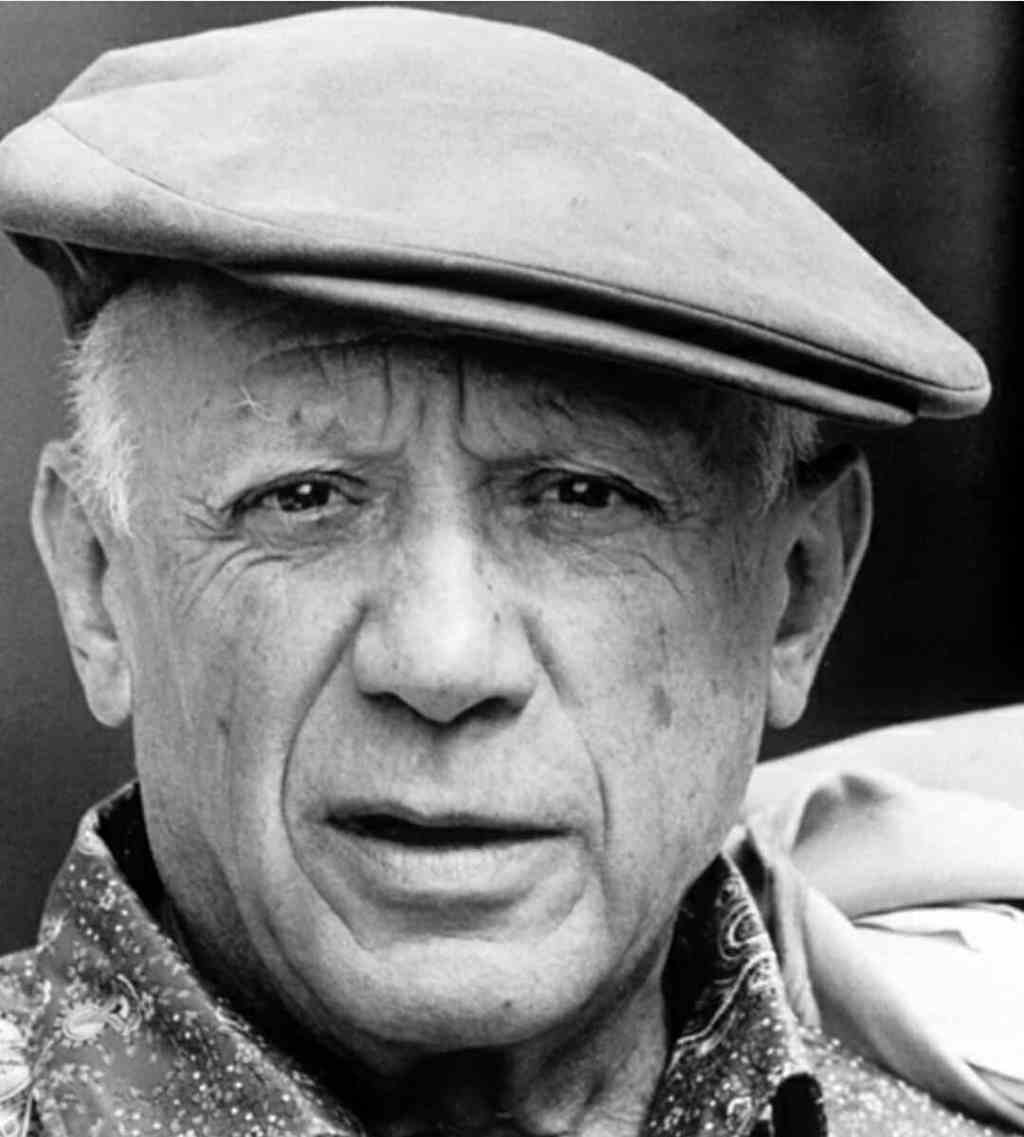
Essay Three: The Frame Around the Frame — Picasso and the Myth That Ate the Work
This essay is part of Chameleons or Charlatans: The Art of Reinvention — a series examining artistic reinvention across the twentieth century through six figures, the cultural theory that illuminates them, and the question of whether what they did is still possible. Each essay stands alone. The series opens with The Invitation.
Part One: The Formation and the Borrowing
John Berger taught us that the frame around a painting is never neutral. In Ways of Seeing he argued that the conditions under which we encounter a work of art — the museum, the reproduction, the art historical narrative, the price — shape what we can see before we have even looked. The original meaning of a painting, he wrote, is no longer primary. Its meaning is defined by the meanings that gather around it.
The problem with Picasso is that the meanings have been gathering for over a century and the accumulation is now total. He is the most mythologised artist in the history of Western art. The Picasso myth is something else entirely from Van Gogh’s suffering or Leonardo’s enigma — it is the genius performance sustained across nine decades, across every available medium, across styles so radically different that the differences themselves became the myth, which became the brand, which became the most expensive commodity the art market has ever produced. Before any of that — before the adjective, before the prices, before the retrospectives and the academic industries devoted to the oeuvre — there is simply a lot of paint. More paint, across more styles, in more media, than almost any artist in history. The accumulation is physical before it is cultural.
Do you admire or love Picasso when you stand in front of the work? It is a genuine question and the sincere answer, for many serious viewers, is admire. Not a failure of aesthetic response. The accurate response to encountering a body of work so thoroughly pre-interpreted, so completely surrounded by its own legend, that the visual experience arrives pre-loaded with received meaning. You do not see the Demoiselles. You see the most important painting of the twentieth century, and through it the history of modernism, and through that the colonial debt never acknowledged, and through that the prices — and somewhere in the middle of all of that is a painting that a twenty-five year old made in 1907 in a studio on the Rue Ravignan that baffled and disturbed everyone who saw it, including the people who loved him.
That painting is still there. Getting to it is the essay’s task.
Pablo Ruiz Picasso was born in 1881 in Malaga, the son of José Ruiz Blasco — a drawing teacher, curator of the local museum, a competent academic painter who understood precisely what the tradition required and spent his son’s childhood transmitting it with the rigour of someone who knew its value. The sons and daughters of artists get to practise. Not Malcolm Gladwell’s ten thousand hours precisely, but the underlying observation is serious — extraordinary early development almost always conceals an environment of extraordinary early exposure. The hothouse was built. The plant thrived. By eleven Picasso was painting with a technical accomplishment that unnerved his father. The story — possibly apocryphal, certainly too neat — is that José Ruiz looked at his son’s work and handed him his palette and brushes, declaring that the boy had surpassed him. By thirteen Picasso was at the School of Fine Arts in Barcelona. By sixteen at the Royal Academy of San Fernando in Madrid. By nineteen in Paris, which was where the Western art world had decided the future was being made, and where a young Spaniard with extraordinary technical gifts and an instinct for cultural positioning understood he needed to be.
He was not a naif arriving from the provinces. He was a technically brilliant, culturally sophisticated young man from a family embedded in the art world, who had spent his adolescence absorbing the tradition so completely that he was ready — uniquely ready — to do something to it. Harvey’s accumulation before the dispossession, again, as biographical fact.
The early Paris years — the Blue Period, the Rose Period — are often treated as prologue to the real Picasso. This is wrong in an interesting way. The Blue Period work is extraordinary on its own terms — the formal control, the tonal restriction, the emotional weight concentrated in figures of melancholy and poverty. These are not student exercises. They are complete artistic statements. The man who made them could have sustained a significant career in that register and never needed to do anything else. He did something else anyway. Which is the beginning of the reinvention argument. But we should note at the outset that this first reinvention — from academic training through the early Paris work toward Cubism — was made from a position of absolute technical security. The leap was genuine. The floor was solid. Both simultaneously.
The colonial debt: the borrowing that built the foundation
In 1907 Picasso visited the Trocadéro ethnography museum in Paris. He described it later as a revelation, a shock, an exorcism. But it is worth pausing on the word visited. The African and Iberian material in the Paris ethnography museums was already circulating as a reference point among the avant-garde painters who were looking for a way beyond the academy. Matisse had been there. Derain had been there. Picasso arrived not as a casual tourist but as a young painter with a specific formal problem — how to break the unified single viewpoint — and found, in the African masks and Iberian sculpture, a solution that had been sitting in a colonial collection for years waiting to be used. He didn’t stumble in off the street. The visit was probably not accidental. Which makes the subsequent denial of the debt not just intellectually dishonest but strategically deliberate.
Les Demoiselles d’Avignon was the result. Five figures, two of them with faces that draw directly on the African and Iberian sources he had been absorbing. The painting that changed Western art — rolled up in his studio for nearly a decade because even his closest friends found it too disturbing to show, not publicly exhibited until 1916, not widely reproduced until 1925 — was made from borrowed material that its maker systematically denied borrowing. The leap was magnificent. The erasure was also deliberate.
The Ugandan artist Francis Nnagenda put the counter-argument with devastating precision: people tell me my work looks like Picasso, but they have it wrong. It is Picasso who looks like me, like Africa.
That sentence contains an entire art historical argument. The foundational move of Western modernism was made possible by a colonial act of cultural appropriation so total that it reversed the direction of attribution — the original is now named after the borrower. The African sculptural tradition contributed the formal vocabulary that enabled the most significant single development in twentieth century Western art, received no credit and no returns, and now exists in art historical narrative primarily as the thing that influenced Picasso.
We note this not as a reason to dismiss the work. The Demoiselles remains what it is regardless of its genealogy. But the necessary context for any account of the reinvention is this: the most important leap in Picasso’s career was made from borrowed ground. The myth of individual genius requires the erasure of that borrowing. The myth has largely succeeded.
It was not, incidentally, the only rupture of its kind happening simultaneously. Schoenberg was fracturing the unified tonal system in music. Joyce would fracture the unified narrative consciousness in the novel. The concentrated explosion of the modern across forms in roughly 1907 to 1913 suggests a shared historical pressure — empire fracturing, technology accelerating, the certainties of the nineteenth century visibly failing — producing the same formal response independently across the arts. That is a larger argument for another occasion. What matters here is that Picasso’s version of the rupture was built on a foundation he didn’t acknowledge and couldn’t have built without.
The Braque question: who invented Cubism
Georges Braque was in many respects Picasso’s equal during the period when Cubism was being developed — between 1908 and 1914 the two men worked in such close proximity, visiting each other’s studios daily, responding to each other’s solutions, that their paintings from the period are sometimes indistinguishable even to experts. Braque himself described their collaboration using the metaphor of two mountaineers roped together — each dependent on the other, each enabling the other’s ascent. He also, characteristically, shied away from fame and preferred the solitude of his studio to attending parties. He was not better at being famous. That cost him everything the market subsequently decided to assign.
Art history assigned Cubism to Picasso. The reasons are partly chronological — his Demoiselles predates Braque’s Cubist work — but mostly biographical. The genius who moves faster than everyone else, who works alone in visionary isolation — this is the myth Picasso cultivated, and it required the erasure of the collaboration. The erasure was never complete in serious art history. But in the general cultural mythology — the Picasso who is an adjective, the Picasso of the child’s drawing joke — Braque is largely absent.
Picasso never cut the rope publicly. He simply allowed the credit to accumulate around him without correction, and the myth of sole invention grew in the silence where an acknowledgment should have been.
The last Picasso sold at auction: Les Femmes d’Alger, $179.4 million, Christie’s, New York, 2015. The Braque record: approximately $15.8 million, Sotheby’s, 2013. Two mountaineers. The same rope. The same ascent.
Part Two: The Distillation and the Hinge
In 1965 John Berger published The Success and Failure of Picasso — the book that, almost alone among the critical literature, looked at the whole career steadily and said something genuinely uncomfortable. Not that Picasso was bad. Berger loved the work, the early Cubist period especially, which he considered a genuine philosophical achievement — a new way of seeing that had real consequences for how the world could be understood. His argument was about what happened after. That the accumulation of success, wealth, fame and myth had isolated Picasso from the friction that makes genuine artistic development possible. That surrounded by acolytes, insulated from genuine critical response, operating in a world that would celebrate whatever he produced as a masterpiece because he had produced it — Picasso could no longer grow. He could only elaborate.
He stayed young, Berger wrote. Not as a compliment. As a diagnosis.
The eternal present Berger identifies — the sense that Picasso’s paintings, however they appear to change, remain essentially what they were at their beginning — is visible most clearly in the late work, which the critical establishment largely couldn’t evaluate. After the Second World War an aura of myth grew up around the name of Picasso, and in the last decades of his life his work had, in a sense, moved beyond criticism. Almost nobody was saying what Berger said. Almost everyone else either celebrated or stayed silent. Moved beyond criticism is the most damning thing you can say about an artist’s late career. It means the cultural gravity has decided that the name is more important than the work. That the frame has swallowed the painting.
But here is where Berger’s argument requires its own complication. The late paintings are prolific, varied, occasionally extraordinary, and largely ignored. What they share is the complete command of a reduced vocabulary. And that reduction is not poverty. It is distillation.
Watch Picasso draw a bull. There is documentary film of him making a series of eleven lithographs in 1945 in which a bull is progressively simplified — from a fully rendered academic drawing through successive stages of abstraction until the final plate shows the animal as a handful of lines, the essential structure of bull-ness extracted from everything that is not essential. The sequence is not a demonstration of cleverness. It is the record of a man who has spent sixty years looking at the world removing everything from his vocabulary that isn’t absolutely necessary, until what remains is the thing itself, stated with the economy of someone who has earned the economy through long labour.
This is the key distinction the myth obscures. The prolific output — the estimated fifty thousand works across nine decades — is not the mask for a poverty of ideas. It is the revelation of what happens when a visual intelligence that has spent decades eliminating the unnecessary keeps eliminating. The bull in eleven moves. The bullfighter. The dove. The face of a woman fractured into its simultaneous profiles. Always the same question: what is the least that contains the most.
He was not alone in this. Morandi spent forty years reducing bottles and jars on a shelf toward greater and greater formal economy. Matisse in the late cut-outs, bedridden and unable to paint, reduced colour and form to their absolute minimum with scissors and paper. The distillation is not the three ages of Rembrandt — not decline, not the old man losing his powers, but the old man finally finding what he was looking for. Picasso’s Cubism fed into Mondrian and through him into Minimalism — the lineage is real even if indirect. But the late distillation work is something more specific and more wilful than influence. It is the sustained refusal to stop asking the question.
The success Berger diagnoses was also real. The echo chamber of unlimited adulation produced late work that was sometimes extraordinary and sometimes self-indulgent in ways nobody around him could say. Both simultaneously.
Guernica: the five weeks
In April 1937 the German Condor Legion, acting in support of Franco’s nationalist forces, bombed the Basque town of Guernica. Picasso, living in Paris, had already been commissioned by the Spanish Republican government to produce a large work for the Paris International Exposition. He had been struggling with the commission for months. Within days of Guernica he had his subject.
He completed the painting in five weeks. It is roughly eleven feet tall and nearly twenty-six feet wide. It depicts the aftermath of the bombing in black and white — a horse, a bull, a screaming woman, a dead child, a dismembered soldier, a lamp thrust into the chaos from a single extended arm. There is no colour. There is no single viewpoint. There is no narrative resolution. There is only the fact of what happened, fragmented and reassembled in the formal language Picasso had spent thirty years developing — and which turned out, at this moment, to be not aesthetic philosophy but moral philosophy too.
This sounds self-important. It is. But then so was Picasso. Uniquely self-important. Uniquely selfish. Uniquely himself. The three are not separable — which is precisely what the next section is about.
You do not need to know anything about the Spanish Civil War to understand Guernica. You need only to look at a screaming woman holding a dead child and know what you are seeing. But knowing the history adds something that is itself part of what the painting carries — that it was politically active at the moment of its making, not retrospectively meaningful. That Picasso refused to let it return to Spain while Franco lived. That it sat in MoMA for decades as a political exile, returning to Madrid only in 1981, six years after Franco’s death. The surplus was never only formal. It was from the beginning also a refusal.
The last time I stood in front of it there were a fair few people in the room but fewer selfies than you might expect. Fewer phones raised. More people simply looking. The painting may be too big to photograph comfortably — it exceeds the phone’s frame the way it exceeds the myth’s frame. Or perhaps its moral weight creates a specific gravity that the selfie instinct cannot quite overcome. Whatever the reason the room felt different from most rooms in most museums. The painting was still doing its work.
The contrast with the most expensive artwork ever sold at auction is instructive and slightly comic. The Salvator Mundi — attributed to Leonardo, disputed by serious scholars, purchased for $450 million at Christie’s in 2017 — has not been publicly displayed since the sale. Its current location is unknown. Possibly a crate. Possibly a yacht. The most expensive object in the history of the art market is invisible. The painting that Picasso refused to sell while a dictator lived is in Madrid, available to anyone with the price of a museum ticket, doing the same work it has always done.
The surplus is in the availability. The financialisation is in the disappearance.
The pattern: what fame and genius do to men
Before the misogyny — a broader observation that the Picasso story makes unavoidable and that runs through every male figure in this series.
Fame at the scale these six achieved does something specific to the people around the famous. It restructures every relationship. The acolyte cannot tell you the truth. The collaborator becomes a resource rather than a person. The partner becomes a mirror for the myth rather than an independent human being. This is not unique to artists. But artists — particularly artists whose work depends on the myth of individual genius, whose cultural capital requires the performance of the exceptional self — have a specific and documented tendency to use the myth as licence.
Stravinsky’s first wife Katarina died of tuberculosis while he was already living with his mistress Vera. The children were estranged, the process accelerated by Craft’s arrival in the household. Miles Davis documented his violence toward women in his own autobiography with a lack of remorse that remains startling. Godard used antisemitic language in the presence of friends, broke with collaborators and lovers with equal ruthlessness, attempted suicide twice in the wreckage of his own convictions. Bowie’s cocaine years produced the Hitler salute at Victoria Station and a period he later claimed not to remember — though even here there is the characteristic Bowie whiff of performance, the darkness slightly staged, which is either evidence of greater self-awareness or a different and subtler kind of damage.
In Picasso’s case the pattern was systematic and the cost was human life. Two of his partners — Marie-Thérèse Walter and Jacqueline Roque — died by suicide. Dora Maar suffered a breakdown and was institutionalised after he left her. Françoise Gilot — the only one who left rather than being left, the only one who survived and wrote about it with clear eyes — observed that there was no contradiction between being a great and innovative artist and being an irredeemably bad and selfish human being. He said, she reported, that there are only two kinds of women: goddesses and doormats. He appears to have acted on this belief throughout his life. We note it, once, clearly, and do not excuse it.
None of this is the flawed genius formulation — that lazy critical category that simultaneously excuses the behaviour and flatters the talent. It is simply this: the capacity for dispossession that produced the work — the willingness to destroy prior selves, prior collaborations, prior commitments in service of the next thing — is the same quality applied to people as to aesthetic positions. The ruthlessness is one thing worn differently. We name it once, clearly, across the series, and do not excuse it.
We said our six. Of course it is only five. Doris Lessing was compelled to write. Nothing else. Well maybe something else. We shall see.
Part Three: The Frame Becomes the Thing — Myth, Money, and What Survives
After the Second World War the myth became total. This is Berger’s precise formulation and it is worth holding: an aura of myth grew up around the name of Picasso, and in the last decades of his life his work had, in a sense, moved beyond criticism. Not beyond the reach of critics — there were plenty of those. Beyond the conditions under which criticism is possible. Which is a different and more complete form of capture.
The distinction matters. A work that is criticised is still in a relationship with the world — the criticism is evidence that the work has a claim on the world’s attention that can be contested, assessed, argued about. A work that has moved beyond criticism has been absorbed into the category of the self-evidently important, where assessment is replaced by attribution. You do not ask whether a Picasso is good. You ask which period, what provenance, what price. The aesthetic question has been replaced by the market question, and the replacement is so complete that most people encountering a Picasso in a gallery are encountering primarily a price tag with a painting attached.
Berger was the exception. The one major critic who applied genuine analytical pressure during Picasso’s lifetime and produced a verdict that was neither celebration nor dismissal. The Success and Failure of Picasso remains the most useful single book about him precisely because it refuses the terms the myth requires. It insists that the failure is real even as the success is acknowledged. That both are present simultaneously. That holding both is the only possible critical position.
The prices completed what the myth began. When a painting sells for $179.4 million — as Les Femmes d’Alger did at Christie’s in New York in 2015 — the price becomes the painting’s primary characteristic. Every subsequent encounter with the work is mediated by that number. You are no longer looking at a painting. You are looking at a financial instrument whose aesthetic content is one component among several that determine its value as an asset. Harvey’s cultural dispossession reaching its logical endpoint — the original gesture so thoroughly absorbed that even its market value has lost connection to what the gesture actually was.
The Braque comparison requires nothing beyond the numbers. The Picasso record: $179.4 million. The Braque record: approximately $15.8 million. Two mountaineers. The same rope. The same ascent.
What survives
And yet.
The bull is still there. Drawn in a handful of lines by a man who had spent sixty years learning to eliminate everything that wasn’t essential. The sequence of eleven lithographs — from the fully rendered academic animal to the handful of marks that contain the animal — is available to anyone. It costs nothing to look at. The thing the distillation produces is not a commodity in the way the finished painting is, because the finished painting is not the point. The point is what was removed to get there. And that cannot be owned.
Guernica is still there. In the Museo Reina Sofia in Madrid, roughly eleven feet tall and twenty-six feet wide. The painting that Picasso refused to sell while a dictator lived is in Madrid, available to anyone with the price of a museum ticket, doing the same work it has always done. The myth cannot touch it because it operates below the myth, at the level where the human fact meets the formal vocabulary that thirty years of reinvention had been preparing — without knowing it was preparing — for exactly this moment.
These two things — the bull drawn in a handful of lines and the painting of a bombed town in black and white — are what survive the mythology, the prices, the genius performance, the colonial debt, the destroyed women, the moved beyond criticism. They are not outside the conditions of their production. They are inside them, in tension with them, doing something that the conditions cannot fully account for and cannot fully contain.
Key Works
Les Demoiselles d’Avignon (1907) — the hinge: stored in the studio for years, the foundational move made from borrowed materials, the moment Western modernism began.
The Bull lithograph series (1945) — the distillation argument made visible: eleven progressive simplifications toward the essential, the genius of reduction in sequence.
Guernica (1937) — five weeks, black and white, the only work in this series that crossed from art into common cultural property without dilution. In Madrid. Available. Doing its work.
Girl Before a Mirror (1932) — Marie-Thérèse Walter at the peak of the formal vocabulary, the human cost and the aesthetic achievement occupying the same canvas simultaneously.
Les Femmes d’Alger, Version O (1955) — $179.4 million, Christie’s, New York, 2015. The Braque record: approximately $15.8 million. Two mountaineers. The same rope.


Leave a comment