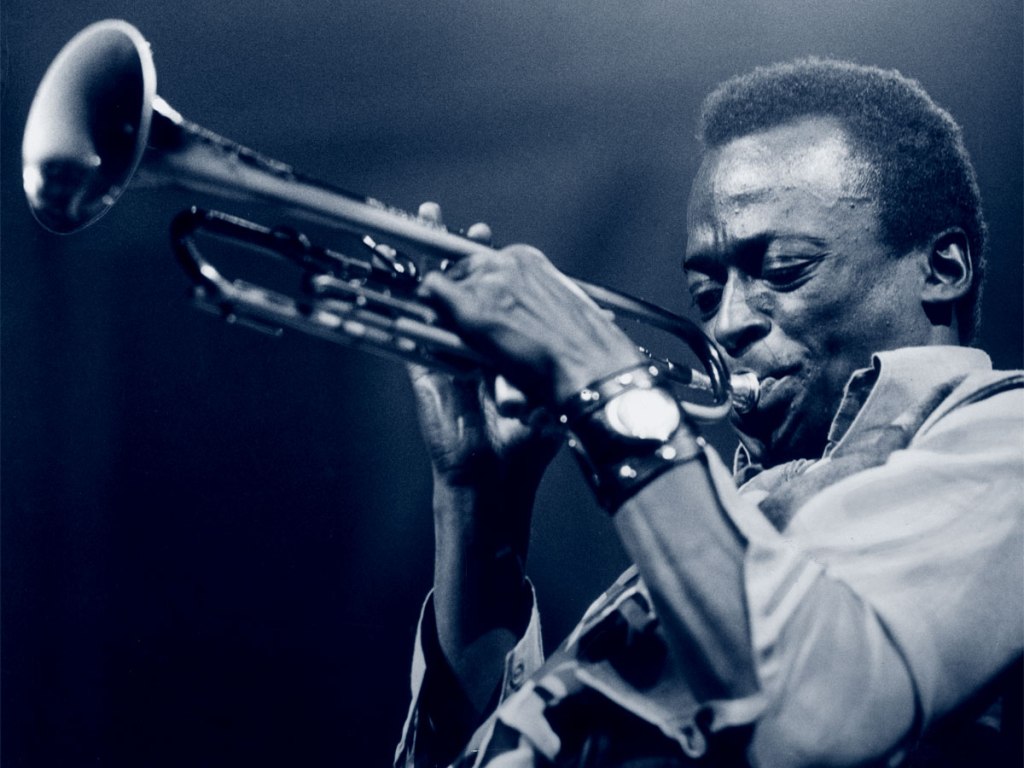
Essay Four: Miles Davies – The Music That Refused to Stand Still
This essay is part of Chameleons or Charlatans: The Art of Reinvention — a series examining artistic reinvention across the twentieth century through six figures, the cultural theory that illuminates them, and the question of whether what they did is still possible. Each essay stands alone. The series opens with The Invitation.
“I’ve changed music five or six times fundamentally. That’s probably why I’m here. Now share what you’ve done that’s important — other than being white.”
There is a question embedded in that sentence that the history of jazz has never quite answered to Miles Davis’s satisfaction. It is not really a question about music. It is a question about who gets to define what music is, who profits when the definition changes, and who pays the cost when the man doing the changing decides he is no longer interested in your version of him.
Miles Dewey Davis III was born in 1926 into Black middle-class comfort in Alton, Illinois — his father a dental surgeon, his upbringing materially secure in ways that distinguished him from the mythology of jazz as an art form produced exclusively by poverty and suffering. This matters. Davis was not reaching for music as the only available exit from deprivation. He was reaching for it as the most complete expression of something he understood, from very early, that he needed to say. The distinction is important because it means the choices he made throughout his career — the reinventions, the refusals, the pivots that baffled and alienated successive audiences — were made from a position of some agency. He chose. He always chose. Sometimes the choosing nearly killed him. He chose anyway.
Part One: The Arrival, the Apprenticeship, and the Recovery
He arrived in New York in 1944 at eighteen, ostensibly to study at Juilliard, actually to find Charlie Parker. He found him, joined his quintet, absorbed bebop — the most harmonically and rhythmically demanding musical language yet developed in jazz — from its greatest practitioner. Parker was a genius and a catastrophe simultaneously, already deep in the heroin addiction that would kill him at thirty-four. The young Davis watched, learned, and understood two things that would shape everything that followed. First: that bebop’s velocity and complexity was partly a political act — a refusal to make music that white audiences could easily consume or white musicians easily imitate. Second: that the cost of that refusal, for the Black musicians carrying it, was frequently everything.
He started using heroin. The bebop scene was saturated with it, partly because Parker made it seem inseparable from the music’s intensity, partly because the conditions of Black musicians’ lives in Jim Crow America created pressures that the needle temporarily dissolved. Davis later described this period as a four-year horror show. He pawned his trumpet for fixes. He played for almost nothing because the club owners who ran the jazz economy knew exactly what leverage addiction gave them.
Here the essay wants to resist the narrative that is already forming. The story of the genius destroyed by drugs and redeemed by recovery is one of the culture industry’s favourite templates — it keeps the focus on individual pathology rather than structural conditions, and it allows the audience to feel the appropriate mixture of admiration and pity without thinking too hard about who was running the clubs and who was signing the contracts. Davis’s own account is more direct and more interesting. He chose the heroin. And then in 1954, locked in his father’s farmhouse in East St. Louis, he chose to stop. Cold turkey. No treatment. No programme. By himself. He said afterwards: I came back to New York. I really felt good for the first time in a long time. My chops were together. I felt strong, musically and physically. I felt ready for anything.
Not redemption. Not recovery. Ready for anything. The distinction is his and it matters. He was not restored to a previous self. He was new.
Birth of the Cool and the erasure of Gil Evans
Birth of the Cool was recorded in 1949 and 1950 with a nine-piece group. It juxtaposed the improvisatory flexibility of bebop with a restrained, collectively voiced orchestral texture — space where bebop had density, lyricism where bebop had velocity, a quality of deliberate understatement that was almost the opposite of everything the jazz establishment had come to expect. It changed the direction of jazz. It was also, from the beginning, misread.
The sound of Birth of the Cool was not Miles’s alone. The arrangements — the specific orchestral texture that distinguished the nine-piece from anything that preceded it, the use of the French horn and tuba as melodic instruments, the cool collective voice that replaced bebop’s individual virtuosity — came primarily from Gil Evans. A Canadian-born arranger a decade older than Miles, Evans had been working with the Claude Thornhill Orchestra, developing a specifically cool orchestral sound that Miles heard and immediately understood as the direction he needed to go. Their collaboration was the most productive of Miles’s career and the least acknowledged in the standard narrative.
Evans and Miles would work together across three decades — Birth of the Cool, then the orchestral trilogy Miles Ahead, Porgy and Bess and Sketches of Spain in the late 1950s, records that remain among the most formally beautiful in the jazz catalogue. Evans wrote for Miles’s specific sound with an intimacy that no other arranger achieved — he understood the trumpet’s particular quality of restraint and longing and built orchestral worlds around it rather than beneath it. The collaboration was so complete that separating their contributions is almost impossible. Miles provided the sound and the instinct. Evans provided the architecture. Both were necessary. The mythology remembered one of them.
Evans died in 1988, three years before Miles. His funeral was attended by Miles, who wept. The man whose cultural capital the mythology had largely absorbed into the Miles Davis story was mourned by the man who had absorbed it. The debt was real even when unacknowledged. That is the pattern this series keeps finding — the collaborator present in the work, absent from the legend, returning only at the graveside.
The white critical apparatus received cool jazz as sophisticated, cerebral, European — and thereby domesticated it. The dinner party aesthetic, the background for serious people. What this reading missed, systematically and revealingly, was the political register of the cool itself. Davis’s stage presence — turning his back on the audience, never announcing tunes, walking off between solos, refusing the role white America had written for its Black entertainers — grateful, deferential, careful never to make the room uncomfortable — was not arrogance or eccentricity. It was a precisely calibrated refusal.
W.E.B. Du Bois, writing half a century earlier, had named the condition that Davis was navigating: double consciousness. The Black American living always behind a veil, seeing himself through the eyes of a world that looks on with amused contempt. The musical consequence was the art of saying two things simultaneously — the authentic internal expression and the managed external presentation, always both at once. Davis understood this viscerally. The cool was his solution: make the music so complete, so internally sufficient, so indifferent to the audience’s comfort, that the negotiation collapsed. Take it or leave it.
But taking it meant fixing it. And fixing it meant owning it. And that was precisely what Davis would not permit.
Kind of Blue and the moment before the commodity closed
1959. The second great quintet — Davis, John Coltrane, Cannonball Adderley, Bill Evans, Paul Chambers, Jimmy Cobb — goes into Columbia’s 30th Street Studio and records, largely from sketches Davis provides on the day, the best-selling jazz album in history. Kind of Blue abandons the chord-change improvisations of bebop in favour of modes — scales that give the improviser a different kind of freedom, more spacious, more melodic, organised around feeling rather than harmonic obligation.
The result is fifty-five minutes of music so concentrated in its beauty that it functions, for many people, as their entire relationship with jazz. It made Miles Davis the most celebrated jazz musician in the world. It put Kind of Blue on every aspirational bookshelf, in every sophisticated apartment, in every space where white liberal culture signalled its own depth and seriousness. It became precisely what Miles Davis had been refusing since Birth of the Cool: a commodity, a marker of taste, a possession.
He watched this happen and drew the conclusion that the logic of his career demanded. He moved again.
Part Two: The Electric Turn — Reclamation Not Betrayal
The standard narrative of the electric period — In a Silent Way in 1969, Bitches Brew in 1970 — frames it as a commercial calculation or a descent into noise. Both readings are wrong in the same way. Both read the music through a white institutional lens that cannot see what Davis was actually doing.
By the late 1960s Davis had revised his understanding of what he was working within and against. Jazz, he said, was an Uncle Tom word. Soul connoted any singer whose voice white people would like theirs to resemble. He identified not with jazz as an institution but with Black music as a set of practices and dispositions that transcended copyright and ownership. And the Black music that was politically and culturally alive in 1969 and 1970 — the music of Sly Stone, James Brown, the emerging funk tradition, the sound of Black Power’s cultural moment — was not happening in jazz clubs.
Going electric was not Miles Davis moving towards white rock music. It was Miles Davis moving towards the living popular music of Black America and away from the white-canonised jazz tradition that his own record label was using to sell him to an audience he didn’t want. Columbia Records was explicit about this in ways that enraged him. They told him they wanted to introduce him to a new audience. The new audience was always white. He told a music critic: they don’t even try to go into the Black neighbourhoods and sell records. Sheeit.
Bitches Brew is the sound of that fury finding form. Two drummers, two keyboardists, two bassists, electric guitar, distortion, dense overlapping textures. The jazz establishment’s horror was the sound of an institution defending its definition against the man who had built it. Davis’s response was characteristically precise. He named his next album Live-Evil. Then he kept going — On the Corner in 1972, whose cover art depicted figures with visual allusions to the Black Panther Party, whose music drew explicitly on James Brown and Sly Stone. He was not asking the jazz establishment’s permission.
Here Marcuse’s concept of repressive desublimation earns its place most precisely. Birth of the Cool gets absorbed as dinner party music. Kind of Blue gets absorbed as the thinking person’s lifestyle accessory. Each time Davis moves, the commodity form eventually catches up, smooths the edges, and sells the result as sophisticated background. Each reinvention is partly a refusal of that recuperation — staying ahead of the gravity that would fix and own him.
But here the essay must acknowledge a serious counter-argument. Stanley Crouch — not a white conservative but a Black critic — called Davis the most brilliant sellout in the history of jazz and argued that the electric period represented personal power and market visibility chosen over artistic integrity. James Mtume, who played with Davis, called that analysis nonsense and explained in granular detail why the electric turn was politically and musically coherent. Both men knew him. Both watched the same performances. They arrived at opposite conclusions. That irresolution is not a failure of criticism. It is the most accurate thing the critical literature has produced about Miles Davis.
The white liberal audience that had canonised Kind of Blue wanted a restatement of the great with some grit — the sophisticated background music with an edge, the jazz that signalled seriousness without demanding political engagement. The double bind is structural. Too smooth and you’re a sellout. Too political and you’re uncommercial. Too strange and you’re self-indulgent. Davis navigated this bind his entire career, and the electric period is where he stopped navigating and started driving through.
The parallel is uncomfortable but instructive. Curtis Mayfield, Marvin Gaye, Prince — Black artists of equivalent formal ambition who went somewhere too complex, too prolific, too formally adventurous for the white mainstream’s comfort and paid commercial prices that white artists at the same level of achievement didn’t face. Davis understood this with fury. The electric turn was partly his refusal to keep navigating on the white establishment’s terms.
Part Three: The Bill, the Comeback, and What Remains
In 1975 Miles Davis stopped. He retreated to a townhouse on West 77th Street in Manhattan and did not come out for five years. Cocaine, alcohol, chronic pain from sickle cell anaemia and a deteriorating hip — the accumulated physical cost of five decades of playing alongside the chosen states of the creative years. When Herbie Hancock came to check on him he sometimes didn’t open the door. When Dizzy Gillespie came he sometimes didn’t open the door. Columbia Records kept sending cheques under a retainer arrangement that now reads as the most expensive act of institutional guilt in the history of the music industry.
The temptation is the familiar narrative — the fall, the darkness, the redemption to come. Resist it. Davis had spent thirty years in continuous motion, reinventing before the commodity could close around each previous version of himself, paying the physical and psychological cost of that relentless forward pressure. The silence is what happens when the body finally presents the bill. It is not failure. It is the invoice for everything that came before.
He came back in 1980. Tentative at first, then more assured, then — in The Man with the Horn in 1981 and Decoy in 1983 and Tutu in 1986 — decisively modern in a specific and deliberate way. The productions are synthesiser-heavy, the sound thoroughly of the 1980s, the Marcus Miller arrangements on Tutu as precisely calibrated to the decade as the Gil Evans arrangements on Miles Ahead had been to the late 1950s. The critics who had celebrated Bitches Brew were largely appalled. The audiences were larger than any Miles had ever played to.
The question the standard narrative doesn’t quite ask is: whose approval was he seeking and whose was he finally getting? The essay on this blog on the co-option of Black music by a white industry has documented the systematic refusal of Columbia Records to market Miles to Black audiences — they told him they wanted to introduce him to a new audience, and the new audience was always white. The 1980s work, commercial and synthesiser-polished as it is, reached Black radio and Black audiences in ways the jazz period never quite had. Whether this was compromise or whether it was the long-delayed correction — the Black artist finally making music for his actual community through the accessible formats of his moment — is a question the white critical establishment is perhaps not best positioned to answer.
Probably both. Which is the only answer available for Miles Davis on almost any question.
The self-contradiction that completes the picture sits in the space between what Miles said and what history decided. Jazz, he said, was an Uncle Tom word. He identified not with jazz as an institution but with Black music as a set of practices. And yet he is now the defining figure of jazz history — his image on the cover of every introduction to the form, his albums the canonical texts, his name the shorthand for what jazz can be at its highest level. The thing he refused owns him posthumously. The cultural gravity absorbed what he wouldn’t give it while he lived and took it when he died. Harvey would not be surprised.
He died in September 1991. Three years before the end, at the funeral of Gil Evans, he wept. The man whose arrangements had made Birth of the Cool possible, whose orchestral imagination had built the worlds that Miles’s trumpet inhabited across three decades, whose contribution the mythology had largely absorbed into the Miles Davis story — Gil Evans was mourned by the man who had absorbed it. The debt was real even when unacknowledged. Miles knew it. The graveside was the only place the accounting was ever done.
What remains is the music. The trumpet sound arriving before you’ve prepared for it, in a place the criticism can’t reach. Kind of Blue still stopping you before you’ve registered it’s started. Bitches Brew still refusing to become background. The silence of the West 77th Street apartment still the most complete act of refusal on the list — not a statement, not a manifesto, just a man who had said what he had to say and wasn’t ready to say it differently yet.
Only Miles knew what Miles wanted. What he did was clear in art and in life. What he meant — perhaps not so much. Even to him. That irresolution is not a failure of the art. It is the art’s most clarifying quality. The music doesn’t explain itself. It doesn’t need to.
Key Works
Birth of the Cool (1949-50) — the anti-bebop made by someone who had mastered bebop completely. And Gil Evans.
Kind of Blue (1959) — the most complete artistic statement of his life. He said almost nothing about it. That too is the point.
In a Silent Way (1969) — the bridge: the electric period beginning, quieter and more ambiguous than what follows.
Bitches Brew (1970) — the rupture: two drummers, the fury finding form, the jazz establishment’s horror as evidence of what it was defending.
On the Corner (1972) — the political statement: the refusal of the white liberal audience made explicit, James Brown and the Panthers in the same frame.
Tutu (1986) — the comeback at full commercial reach: the question of whose music this finally was left deliberately open.
 At Home He Feels Like A Tourist
Leave a comment