Part 7 of 7 — The Final Movement
A canter through the history of luxury, consumption, and desire
Venice: The City That Has Been Selling Itself Since the Thirteenth Century, and Has Not Yet Stopped
Empire, trade, beauty, corruption, the sublime, the long death, and the circle closing
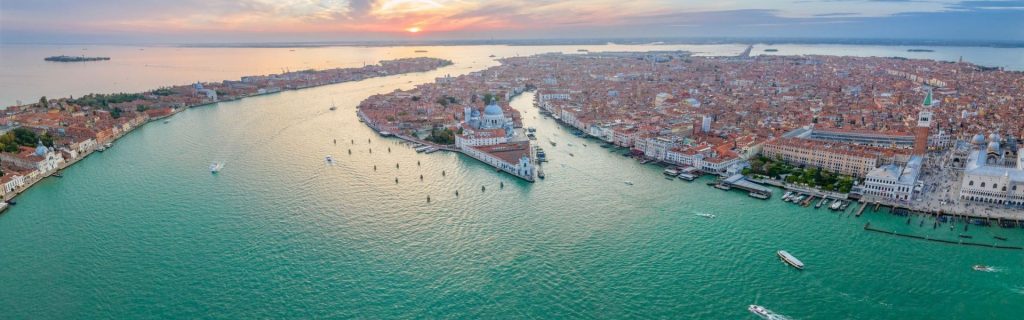
There is a game you can play in Venice, if you are the kind of person who reads Italian Calvino and has an hour to spare before the vaporetto. Stand on the Rialto Bridge — the tourist one, the one everyone photographs, the one that has been there in some form since the twelfth century — and watch the traffic below. Gondolas carrying honeymooners who will not remember the price. Water taxis ferrying businesspeople to conference hotels. Delivery barges loaded with cases of prosecco and boxes of tourist merchandise. Commuter boats carrying the city’s remaining residents, the fifty thousand or so who have not yet been priced into the mainland by short-term rental platforms, heading to work in a city that is simultaneously the most visited and the most abandoned in Europe.
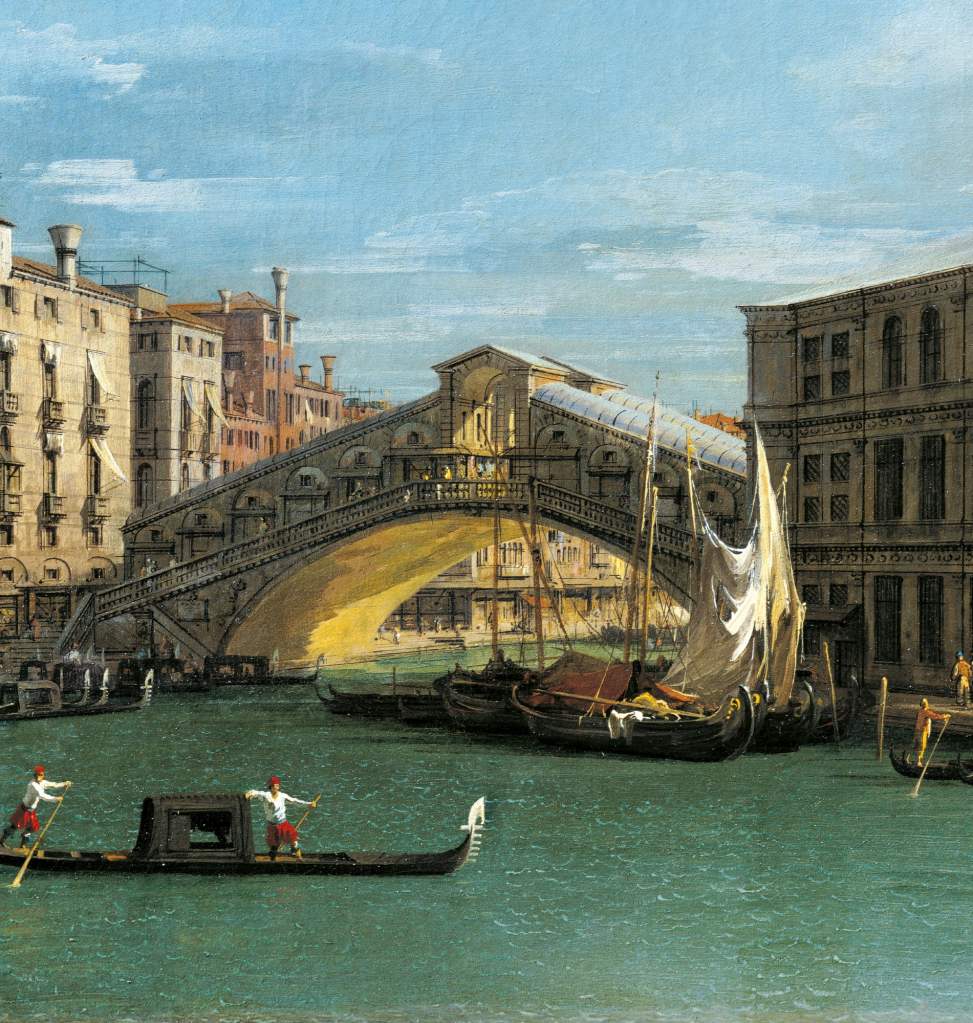
Now consider what you are looking at. The canal below you is the Grand Canal, which has been the main commercial artery of one of the most sophisticated trading cities in the history of the world. The bridge you are standing on was built at the site of the first Rialto market, which by the thirteenth century was the most important financial centre in Europe — the place where bills of exchange were invented, where the first secondary market in sovereign bonds was created, where double-entry bookkeeping was perfected, where the instruments of modern capitalism were quietly assembled by merchants who understood, before anyone else, that the real money was not in the goods but in the mechanisms for trading them.
And the people around you, taking photographs of the canal on phones made in factories in Shenzhen, are the latest instalment of a relationship between Venice and the outside world that has been running, without significant interruption, for eight hundred years. They are the Grand Tourists. They are the pilgrims on their way to the Holy Land who stopped to marvel at the city’s markets. They are the Ottoman ambassadors who understood that Venice was the one Christian power worth talking to. They are the European aristocrats who commissioned Canaletto to paint the view they were currently looking at, so that they could take it home and look at it there. They are, in the most literal possible sense, consumers of Venice — people who have come to experience something they understand, correctly, to be extraordinary, and who are in the process of consuming it in ways that are making it increasingly difficult for anyone to experience it at all.
This is the series argument in miniature. And Venice is not merely an illustration of it. Venice is its origin point, its most complete expression, and its most instructive case study. The city did not fall into the experience economy. It invented it. Everything that has followed — the luxury brand, the commodity fetish, the phantasmagoria, the appropriation of culture for commercial ends, the experience that destroys its own conditions — has a Venetian precedent. To understand Venice is to understand where all of this began, why it was always going to end this way, and what, if anything, survives the ending.
— — —
The invention of capitalism: the Arsenale and the Rialto
Start with the Arsenale, because it disturbs the most cherished story the city tells about itself.
Venice presents itself as a city of beauty, of art, of the slow and contemplative enjoyment of extraordinary things. The gondola, the palazzo, the frescoed ceiling, the glassmaker’s island, the lace of Burano — these are the images the city exports, the ones that fill the travel writing and the tourist photography and the dreams of people who have not yet been but intend to go. They are not false. Venice is genuinely beautiful in ways that resist the usual critical vocabulary. But underneath the beauty, from the city’s earliest prosperity, was a machine.
The Arsenale — from the Arabic dar al-sina’a, house of manufacture — was established around 1104 and became, by the early fourteenth century, the largest industrial complex in the world. At its peak it employed sixteen thousand workers, occupied sixty acres of the city’s eastern quarter, and was surrounded by fifty-foot defensive walls that enclosed drydocks, wet docks, forges, and workshops for every stage of shipbuilding and naval armament. It introduced assembly line production, standardised interchangeable parts, just-in-time delivery of materials, rigorous quality control, and systematic workforce management — all five centuries before Henry Ford’s River Rouge plant is credited with these innovations in the standard histories of industrial capitalism.
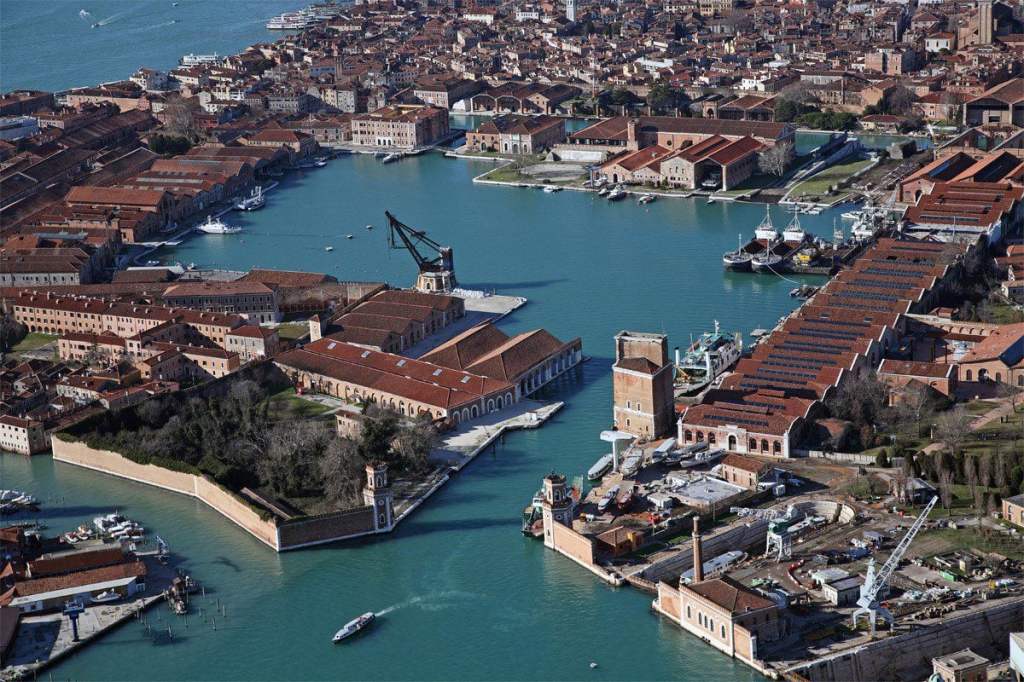
The party piece, reportedly staged for Henry III of France when he visited in 1574, was the construction of a fully rigged war galley in a single day. Historians doubt whether it was genuinely achieved in a day or whether the timing was theatrical — a production put on for a foreign monarch to communicate, with appropriate subtlety, that Venice was not to be trifled with. Either way, the performance itself is a Venetian characteristic: the city has always understood that the display of capability is as important as the capability itself. The Arsenale was the most powerful shipyard in the world and it knew how to show this.
Dante visited, probably in 1321, and was sufficiently impressed — or sufficiently disturbed — to use it as his image of industrious Hell in Canto XXI of the Inferno. He describes the workers boiling pitch for waterproofing, the hammering and sawing, the constant purposeful motion: a scene from which God is notably absent and in which human beings have organised themselves with an efficiency that the medieval theological imagination could only frame as diabolical. The first great poet of the Italian language encountered the first great factory and his response was to put it in Hell. He was onto something.
While the Arsenale was building the ships, the Rialto was financing them. The financial innovations that Venice developed between the eleventh and fourteenth centuries form, in aggregate, the foundation of the modern financial system. The bill of exchange — allowing traders to buy goods in one city and pay in another, effectively creating transferable credit across distance and time. The first secondary market in sovereign bonds, where the government’s forced loans to wealthy citizens became tradeable instruments, circulating as a form of money. Double-entry bookkeeping, which made systematic accounting of complex transactions possible for the first time. Limited liability partnerships. Deposit banking. The ducat as a stable reserve currency, trusted across the Mediterranean world.
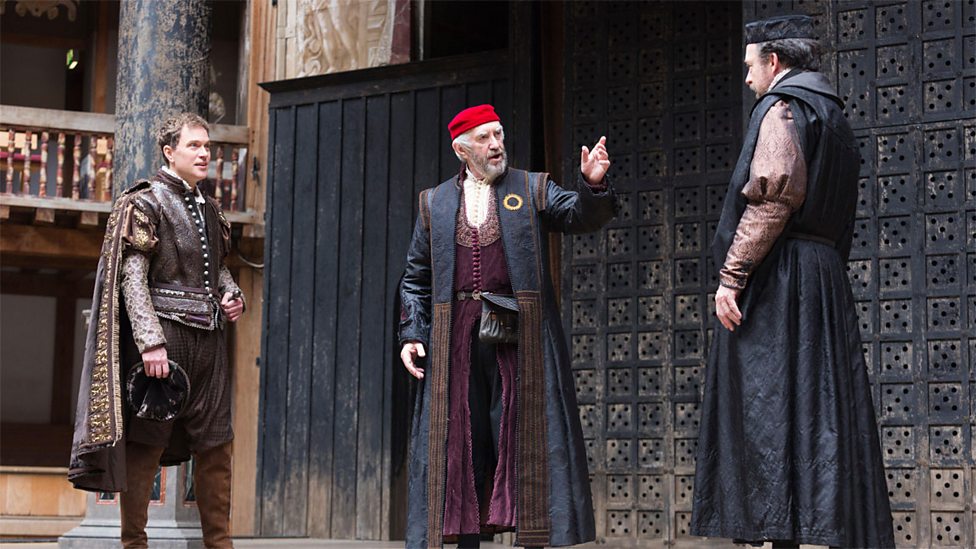
All of this was driven by the specific challenge of long-distance trade in conditions of radical uncertainty. Ships took a month to reach the eastern Mediterranean and two months to return. Death from shipwreck, piracy, and disease was common. Weather was ungovernable. Political conditions in trading partners changed without warning. The financial instruments Venice invented were solutions to these problems — ways of distributing risk, extending credit across time and space, and making large-scale commercial ventures viable despite the uncertainty. They were not invented by theorists. They were invented by merchants solving practical problems in real time, and they transformed the economy of the world. Shakespeare understood all of this, which is why the most searching examination of what money does to human relationships is set here, on this bridge, in this city
Venice did not fall into capitalism. It built capitalism, instrument by instrument, driven by the specific logistical challenges of being a small city-state with no agricultural hinterland, no natural resources, and an inexhaustible appetite for trade with the known world. The beauty came later. Or rather: the beauty was always the point, and the machinery was what paid for it.
The trade routes: reaching out to the barbarians
The Venice that built the Arsenale and invented the bill of exchange was also, simultaneously, the most cosmopolitan city in Europe. This is not coincidental. The city’s geographic position — at the head of the Adriatic, the meeting point of the Byzantine East and the Latin West, connected by sea routes to the Levant and by land routes through the Alpine passes to northern Europe — meant that it was, from its earliest prosperity, a city of encounter. Merchants from Constantinople, Alexandria, Damascus, and Cairo traded at the Rialto alongside merchants from Augsburg, Nuremberg, Antwerp, and London. The Fondaco dei Tedeschi — the German merchants’ house, now a luxury shopping centre, appropriately enough — was built in 1228 to accommodate the substantial German trading community. The Jewish ghetto, established in 1516 (the word ghetto itself is Venetian, from the foundry that previously occupied the site), was the first formally designated Jewish residential area in Europe: a segregation that was also, in its way, a protection, and that produced one of the most culturally productive Jewish communities in the early modern world.
The trade that flowed through Venice connected it to the luxury goods supply chains traced in Part Two of this series. The spices from the Moluccas, the silks from China, the cotton from Egypt, the slaves from the Black Sea — all of these passed through Venetian hands on their way to the markets of northern Europe. Venice was the entrepôt, the intermediary, the city that understood before anyone else that the real profit was not in producing things but in controlling the movement of things between producers and consumers who lacked the means to trade directly.
This is Marx’s insight about the circulation of capital, made concrete in the canals and warehouses of a thirteenth-century city-state. Venice accumulated wealth not by making things but by inserting itself into the exchange process and extracting a margin from every transaction that passed through it. The Venetian merchant was the tollbooth that the series’ tech billionaires have merely updated for the digital age. The structure is identical. Only the canal has changed.
And like all monopolies built on controlling flows, the Venetian commercial empire was vulnerable to anything that changed the flow. When the Portuguese rounded the Cape of Good Hope in 1498 and established a direct sea route to the spice islands, they did not merely find a new trade route. They made the Venetian entrepôt redundant. The city that had built its wealth on being the necessary intermediary between East and West discovered that necessity had expired. It took two centuries to die of this wound — Venice remained wealthy and powerful long after Vasco da Gama’s voyage — but the trajectory was set. The long death had begun.
The republic: a thousand years of managed power
It is one of the more remarkable facts of European political history that the city which invented financial capitalism also sustained the longest-lived republic on the continent. The Serenissima — the Most Serene Republic of Venice — endured from 697 to 1797, when Napoleon’s forces ended it without a siege or a battle, simply by arriving and demanding surrender. One thousand and ninety-seven years of continuous republican government, outlasting every other political form in European history by centuries.
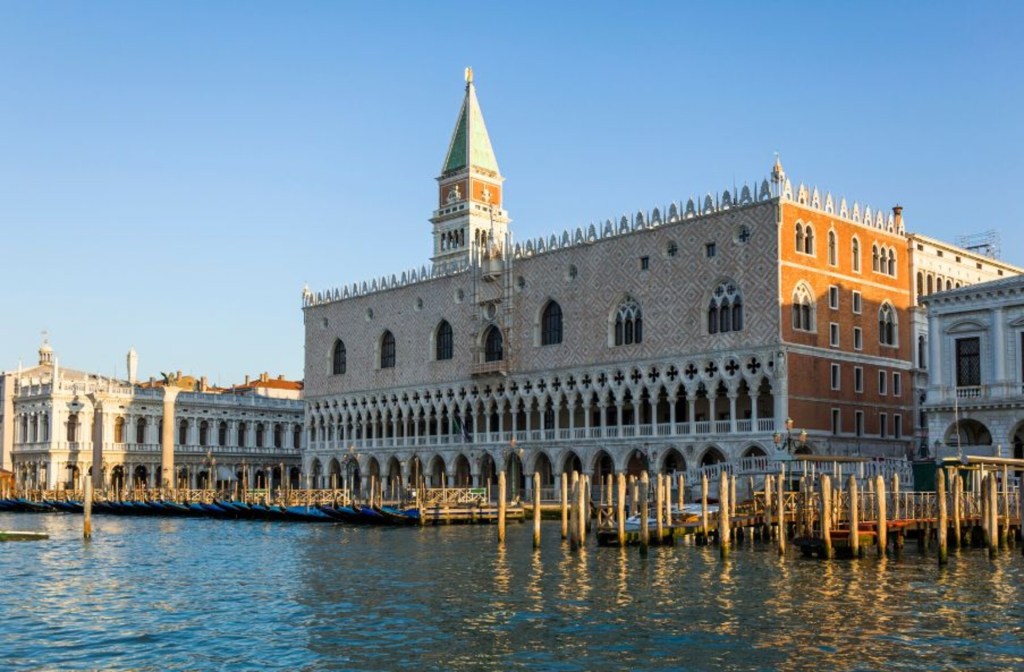
The Venetian constitution was a masterpiece of institutional engineering designed to solve a specific problem: how to prevent any individual, family, or faction from accumulating enough power to destroy the republic. The Doge — the elected head of state — was hedged around with restrictions of almost comical elaborateness. He could not leave the city without permission. He could not receive foreign ambassadors alone. His correspondence was read by the Council of Ten. After his death, a committee of inquisitors examined his conduct and could levy fines on his estate for misconduct. He was, in theory, the most powerful man in Venice. In practice, he was the most surveilled.
The Great Council, the Senate, the Council of Ten, the Inquisitors of State — the Venetian constitution distributed power across institutions in ways that the framers of the American constitution studied and partially imitated. John Adams read the Venetian political theorists. James Madison was familiar with the Venetian example. The mechanisms of checks and balances that structure American government have, in part, a Venetian ancestry.
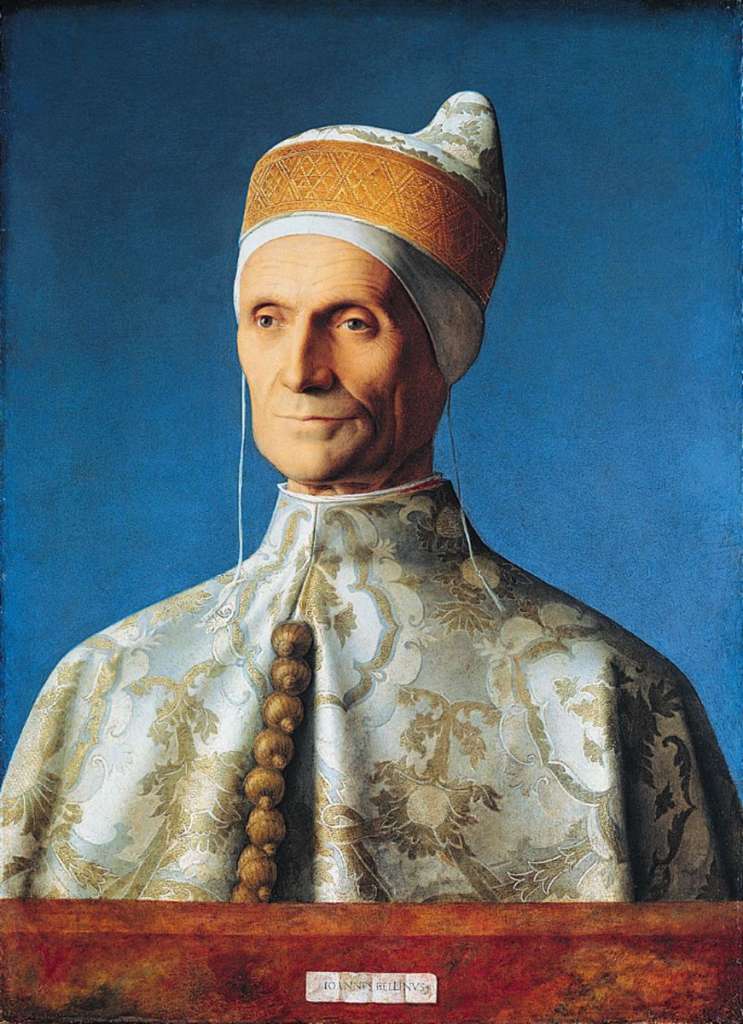
And yet. The republic was also an oligarchy. The Great Council was closed in 1297 — the Serrata del Maggior Consiglio — and membership became hereditary thereafter. The handful of noble families whose names appeared in the Golden Book of the aristocracy held political power exclusively for the next five centuries. The republic that lasted a thousand years did so partly because it was extraordinarily good at managing elite competition and preventing any single family from monopolising power. It was less good at managing the relationship between the elite and the enormous class of citizens, artisans, and workers who produced the city’s wealth and had no political voice whatsoever.
The Arsenale workers — the Arsenalotti — were among the most privileged of Venice’s labouring classes. They had guaranteed employment, housing, healthcare of a sort, and the right to serve as the Doge’s ceremonial guard. They were also, in any modern sense, unfree: bound to the Arsenale, surveilled, unable to leave the city’s service without permission. The skills that made them valuable — the knowledge of shipbuilding, of caulking, of rigging — were the state’s property as much as their own. Like the glassmakers of Murano, they were imprisoned by the very expertise that gave them status.
This is the Venetian paradox that runs through the whole political history: a city of extraordinary civic sophistication and genuine institutional innovation that was simultaneously built on the systematic exclusion of most of its inhabitants from political life, the exploitation of enslaved labour in its colonial possessions, and the violent suppression of any challenge to the oligarchic order. The beauty and the brutality are not separate. They are the same thing, funded by the same mechanisms, sustained by the same institutional structures.
The art: exporting the light
What Venice exported, beyond spices and financial instruments, was a way of seeing.
The Venetian school of painting — Bellini, Giorgione, Titian, Tintoretto, Veronese — constitutes one of the most concentrated outpourings of visual genius in the history of Western art, and its specific character is inseparable from the city that produced it. The defining quality of Venetian painting is colour: not the disegno — the emphasis on drawing, on line, on the intellectual structure of the image — that Giorgio Vasari celebrated in the Florentine tradition, but the sensuous, atmospheric, light-saturated deployment of colour as the primary vehicle of meaning. Titian’s reds. Tintoretto’s dramatic chiaroscuro. Veronese’s luminous, feasting scenes. These are not decorative choices. They are a response to a specific visual environment — a city built on water, where light reflects and refracts in ways that it does nowhere else on earth, where the boundary between solid and liquid, between the city and the sea that both sustains and threatens it, is never quite stable.
Titian became the first Italian artist to achieve a genuinely international reputation. Charles V, Holy Roman Emperor, made him court painter and knighted him. Philip II of Spain acquired his mythological paintings for the royal collection. The courts of northern Europe competed for his portraits. The influence of sixteenth-century Venetian painting on European art is almost impossible to overstate: Rubens came to Venice to learn from it. Velázquez absorbed it. Reynolds wrote about it. Delacroix studied it. The visual language that Titian developed in his Venetian studio in the sixteenth century shaped the practice of painting across Europe for two centuries after his death.
Venice exported its artistic tradition not by sending its painters abroad — most of them stayed — but by producing paintings that became the most desirable luxury objects in the courts of Europe, and by training a generation of non-Venetian painters who carried the Venetian approach back to their own cities. El Greco went to Venice to study before settling in Toledo, and his elongated, luminous figures are incomprehensible without the Venetian foundation. The city’s art was, in this sense, the most successful export product it ever created: infinitely reproducible in its influence, impossible to duplicate in its original form, and carrying within it the specific quality of the city’s light in a way that made every buyer of a Titian feel, however distantly, the pull of the place that had produced it.
This is Benjamin’s aura exported at scale. The Venetian painting in the Spanish royal collection carried with it the presence of Venice — the lagoon, the light, the specific history of making — in a way that made it irreplaceable and therefore infinitely desirable. The luxury goods industry has been trying to replicate this trick ever since. The Hermès bag that carries the mythology of the Faubourg Saint-Honoré workshop. The Rolex that carries the mythology of Swiss precision. The Venetian painting that carried actual, demonstrable, world-historical genius. The structure of the desire is identical. Only the quality of the thing desired differs.
Ruskin’s lament: the stones and what they mean
John Ruskin arrived in Venice in 1849 and began taking notes for what would become The Stones of Venice, published in three volumes between 1851 and 1853. He was thirty years old, already the most influential art critic in England, and entirely convinced that he was witnessing the death of the greatest city in the history of Western civilisation.
His argument was architectural and moral simultaneously — which is to say, it was Ruskinian, because for Ruskin those two categories were never separable. The great Gothic buildings of Venice — the Doge’s Palace, the Ca’ d’Oro, the Byzantine-Venetian hybrid of St Mark’s Basilica — were evidence of a society in which making was understood as a moral act, in which the craftsman was permitted to bring his own imperfect human judgment to bear on the stone, in which the resulting irregularity and vitality of the ornament was not a failure of precision but a record of human presence. The Renaissance architecture that succeeded the Gothic was, in Ruskin’s account, the beginning of the end: the imposition of classical regularity, the suppression of the craftsman’s individuality, the substitution of intellectual system for moral engagement.
And the Venice of 1849 — already a city in accelerating decline, its commercial empire long since overtaken, its political independence recently extinguished by Napoleon and then transferred to Austria — was, in Ruskin’s account, the consequence of that moral failure writ large. The city had abandoned the values that had built it. What remained was the shell: beautiful, increasingly shabby, sustained by the tourism of people who came to look at what it had been. The long decay as aesthetic.
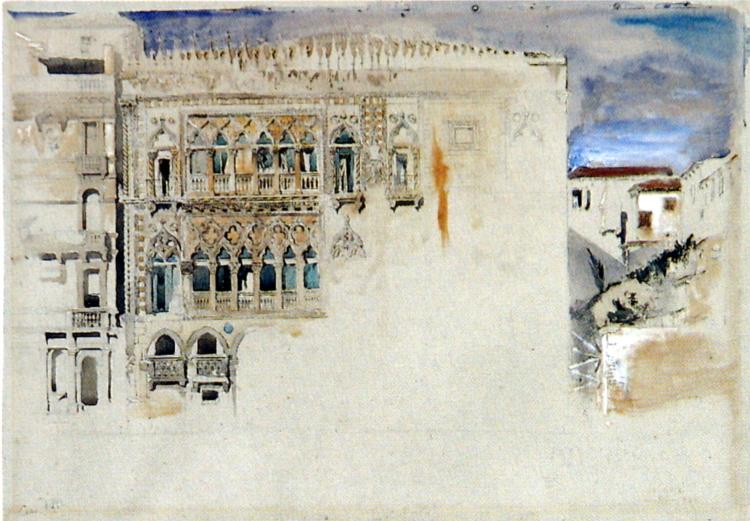
Ruskin was writing the obituary of Venice in 1851. The city is still here in 2026. This is either a refutation of his argument or its ultimate confirmation, depending on your view of what it means for a city to survive. The physical fabric of Venice has survived, expensively and with increasing difficulty, through a combination of international funding, Italian state subsidy, and the revenue from thirty million annual visitors. Whether the thing that makes Venice Venice has survived is a different question, and one that Ruskin would have found easier to answer than we do.
Turner and Canaletto: the sublime and the souvenir
Two painters, one city, the same light. The contrast between them is the contrast this series has been building toward since Walter Benjamin first introduced the concept of aura.
Canaletto — Giovanni Antonio Canal, 1697-1768 — was the most commercially successful painter of his age, and he achieved this success by understanding, before anyone had the vocabulary to describe it, what the experience economy would require. His patrons were primarily English aristocrats on the Grand Tour: wealthy young men making their obligatory Continental education, stopping in Venice for weeks or months, and wanting to take home a record of having been there. Canaletto gave them what they wanted with extraordinary precision and extraordinary beauty. His views of the Grand Canal, the Piazza San Marco, the Bacino di San Marco are topographically accurate, atmospherically luminous, and compositionally elegant. They are also, unmistakably, products — luxury goods produced for a specific market, designed to satisfy a specific desire, and valued partly for what they certified about the person who owned them.
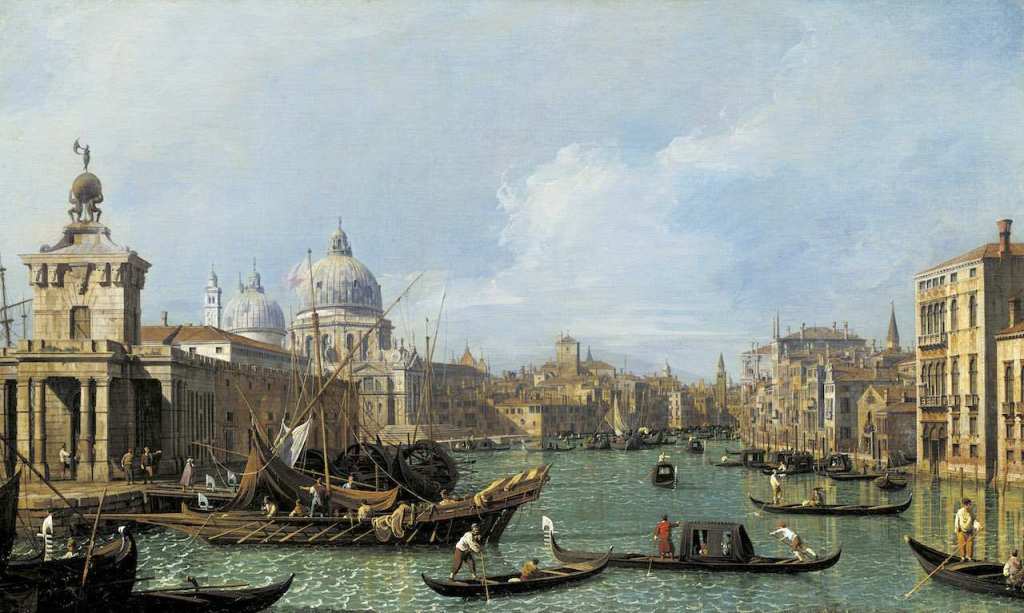
He was, as has been observed, the original Instagram. The desire he was servicing — to document one’s presence in a beautiful place and take that documentation home as evidence of the experience and of the taste that had led one to seek it — is structurally identical to the desire that fills the memory cards of the thirty million annual visitors. The medium has changed. The social function is the same.
J.M.W. Turner went to Venice several times, first in 1819 and most productively in 1840 and 1841. He was sixty-five years old on his last visit, already the most celebrated painter in England, and he produced from those trips some of the most extraordinary watercolours in the history of the medium. The Venice of Turner’s late watercolours is barely a city at all. It is light — light reflected in water, light dissolving architecture into atmosphere, light making the boundary between the solid and the liquid, the city and the lagoon, the present and the eternal, so unstable that the viewer is left with an impression of something encountered at the edge of visibility, something that might dissolve entirely if looked at too directly.
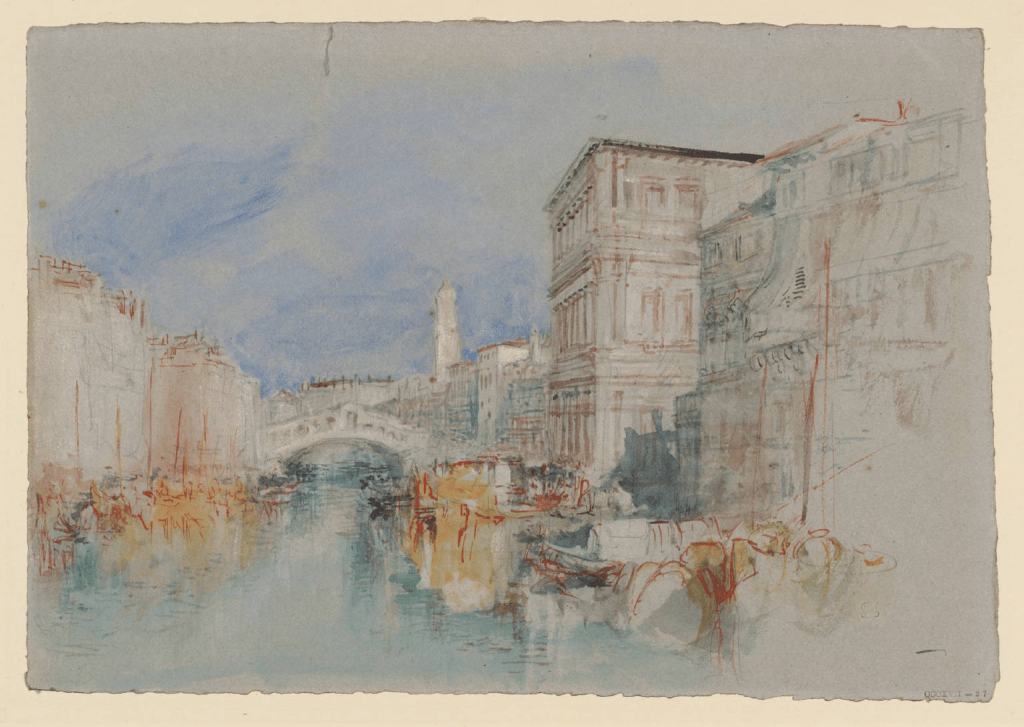
This is the sublime, in its specifically Venetian form. Edmund Burke’s sublime was the encounter with something so vast or so powerful that the self is temporarily overwhelmed by it — the mountain, the storm, the ocean. Turner’s Venetian sublime is more intimate and more ecstatic: the encounter with a city so beautiful and so impermanent, so saturated with history and so obviously dying, that the self dissolves not in terror but in something more like grief. The light that makes Venice beautiful is the same light that is slowly making it uninhabitable. The water that gives it its extraordinary quality of reflection is the water that is slowly taking it back.
Canaletto and Turner are not opposites. They are the two poles of every encounter with Venice, and with every beautiful thing that is also a commodity. Canaletto sees the city as it presents itself — beautiful, specific, buyable, a luxury object for the cultured consumer. Turner sees the city as it is — beautiful, transient, impossible to fully possess, already in the process of becoming what it will be when it is gone. Both responses are true. The experience economy sells Canaletto and cannot, by definition, sell Turner. But Turner is what you feel when the experience economy fails to deliver what it promised.
Death in Venice: Mann, Roeg, and the city that kills
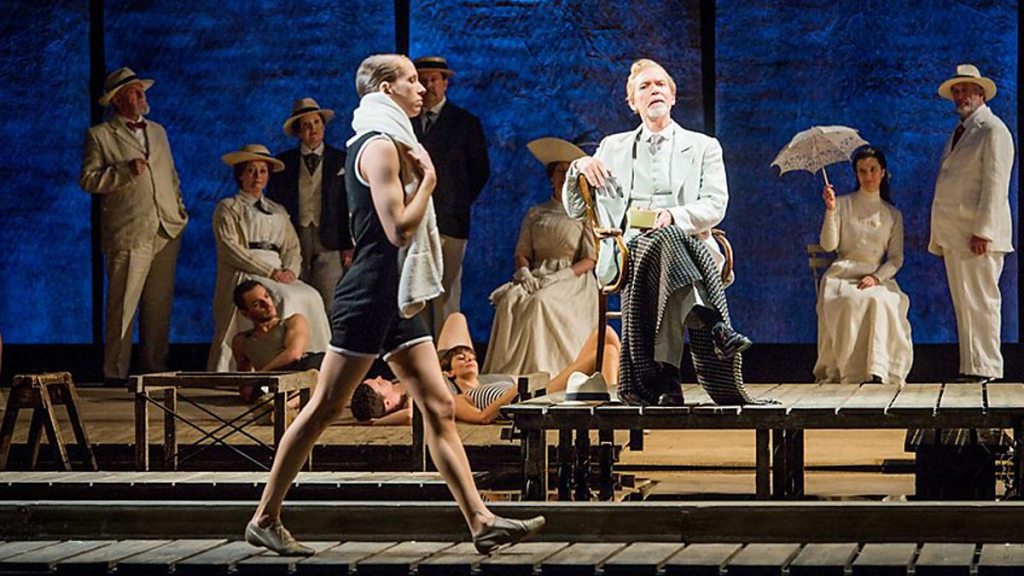
Thomas Mann went to Venice in 1911, spent three weeks at the Hotel des Bains on the Lido, and returned to Munich to write a novella that is ostensibly about an ageing writer’s obsessive desire for a beautiful Polish boy, and is actually about the encounter between northern European Protestant discipline and Mediterranean sensuous beauty — an encounter in which beauty wins, comprehensively, by destroying the person who encounters it.
Gustav von Aschenbach, the protagonist of Death in Venice, is a man of order, control, and renunciation. He has built a distinguished literary career by suppressing everything in himself that is not disciplined and rational. Venice undoes him. The beauty of the city, the beauty of Tadzio, the heat, the slightly rotten smell of the canals in summer — all of it conspires to dissolve the structures of self that Aschenbach has spent a lifetime constructing. He does not die of cholera, though cholera kills him. He dies of the willingness to let beauty overwhelm him that Venice produces in the susceptible visitor.
Mann’s Venice is a city of corruption in both the moral and the physical sense — decaying, fragrant, voluptuous, dishonest, unable or unwilling to warn its visitors that they are in danger. The city knows about the cholera epidemic but suppresses the information to protect the tourist season. The authorities who should warn Aschenbach instead permit the conditions that will kill him, because the alternative — acknowledging the disease, losing the visitors, suffering the economic consequences — is worse, from the perspective of the institutions that run the city, than a certain number of deaths among foreign tourists who do not vote.
This is not a metaphor. It is a description of how the experience economy actually behaves when the conditions of the experience conflict with its commercial interests. Barcelona’s city government knows that the tourist volumes are destroying the city. It continues to accept them, because the alternative — the loss of revenue, the political difficulty of transition — is worse, from the perspective of short-term institutional interest, than the long-term destruction of the thing being sold. The mechanism is identical to Mann’s Venice. The scale is different. The logic is the same.
Nicolas Roeg’s Don’t Look Now (1973) — based on Daphne du Maurier‘s short story, shot on location in Venice in winter when the tourists had gone and the city had reverted to something closer to itself — finds a different horror in the same geography. John Baxter, played by Donald Sutherland, is an architectural restorer working on a Venetian church while processing the recent drowning of his young daughter. Venice in winter is the right city for this project: a place where grief is the native condition, where the dead are more present than the living, where the water that surrounds everything is simultaneously the element of beauty and the agent of death.
Roeg’s Venice is a labyrinth of narrow calli and dead-end fondamente, of reflections in canals that may be premonitions, of figures glimpsed around corners who are not what they appear to be. John keeps seeing a small figure in a red coat — the same colour as the coat his daughter was wearing when she drowned — and pursues it through the city’s darkening streets to his death. The figure, when it finally turns to face him, is not his daughter’s ghost. It is the killer. Venice in Don’t Look Now is the city of the misread sign, the city where what you see is not what is there, where the desire to find what you have lost leads you directly to your destruction.
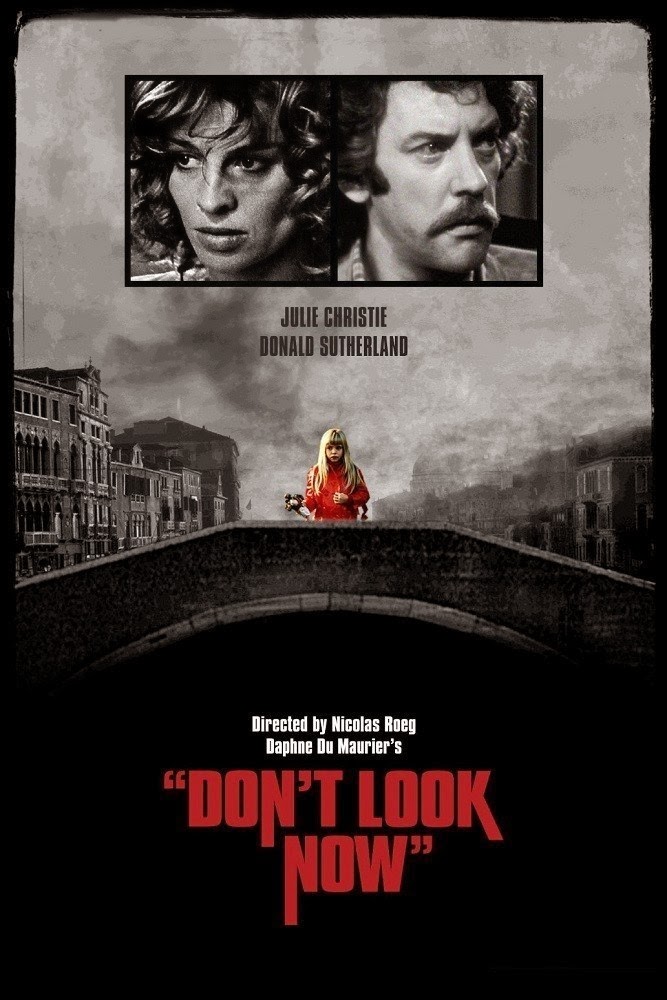
Both Mann and Roeg understand something about Venice that the tourist brochures cannot accommodate: that the city’s beauty is inseparable from its danger. The same qualities that make it extraordinary — the water, the decay, the sense of existing outside normal time and normal rules, the invitation to dissolve the boundaries of the ordinary self — are the qualities that destroy the unprepared visitor. Venice has always known this about itself. It has always chosen to leave the visitors unprepared.
Vivaldi and the exported orphan
Antonio Vivaldi spent most of his working life at the Ospedale della Pietà — one of four Venetian institutions for orphaned, illegitimate, or abandoned children, most of them girls, that had evolved by the eighteenth century into something closer to conservatories of music than to charitable homes. The Pietà’s ensemble was among the finest in Europe. Foreign visitors made special journeys to hear it. Charles de Brosses, a French magistrate who visited in 1739, wrote that the performers were “unsurpassed in Europe” and described the audience as “in raptures”. Vivaldi, as the ensemble’s principal composer and violin teacher, wrote hundreds of concertos specifically for it — the Four Seasons among them — and in doing so created one of the largest bodies of instrumental music in the baroque repertoire.
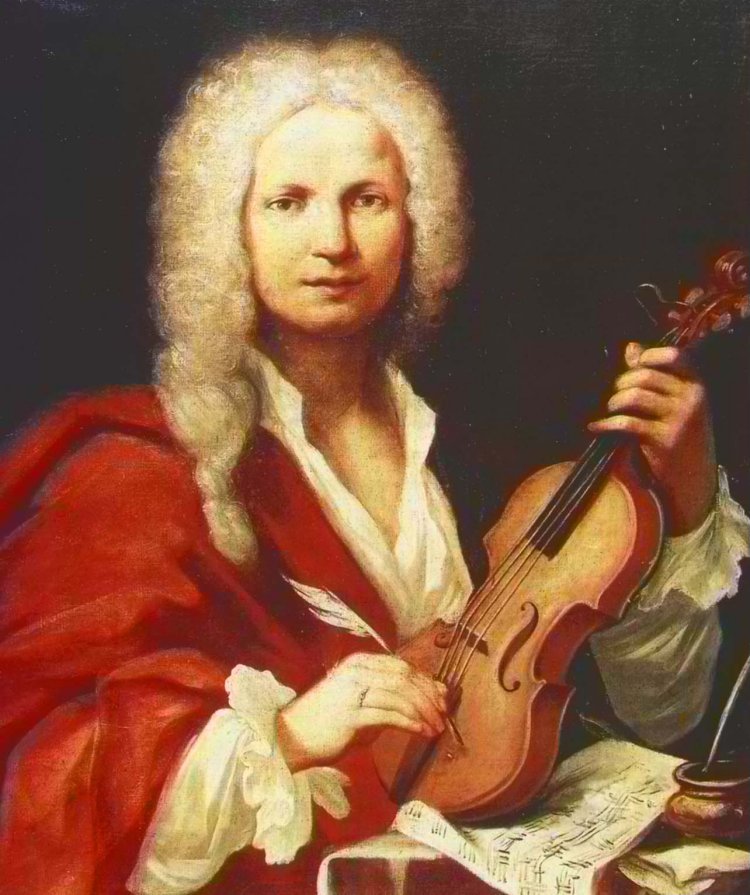
The Pietà was, in other words, a luxury product built on institutionalised charity. The orphaned girls who played in the ensemble had no choice about their vocation. Their musical training was thorough, their performance conditions were extraordinary, and their personal freedom was minimal. They were not permitted to leave the institution without permission, not permitted to marry without the Pietà’s consent, not permitted to profit from the performances that made the institution famous and its concerts one of the must-see experiences of the Venetian Grand Tour.
Vivaldi’s music — the concertos, the sacred music, the operas — circulated across Europe in manuscript copies, establishing a Venetian musical style that influenced Bach (who transcribed several of the concertos for keyboard), Handel, and the entire subsequent development of Western instrumental music. Venice exported its musical tradition the same way it exported its artistic tradition: not by sending its composers abroad but by producing work so influential that it reshaped the practice of music wherever it arrived. The city that had invented capitalism also invented, almost accidentally, the international touring concert season — the experience economy of classical music, which has been running, with interruptions, ever since.
Calvino’s invisible city
Italo Calvino never names Venice in Invisible Cities, published in 1972. He does not need to. The book, structured as a series of conversations between Marco Polo — Venetian explorer, the man who brought the East to the West’s attention — and Kublai Khan, the Mongol emperor whose empire is so vast he can no longer know it directly, consists entirely of descriptions of cities that are all, the reader gradually understands, Venice. Or rather: all versions of what Venice might be, has been, will become, or could never quite be.
Calvino’s cities are organised by theme — cities of memory, of desire, of signs, of the dead, of the continuous, of the hidden — and each description is a meditation on a different aspect of the relationship between human beings and the places they build. The cities of memory preserve what has passed in their architecture, forcing their inhabitants to live inside a continuous present tense made of accumulated history. The cities of desire are built toward something that is always elsewhere. The cities of the dead are indistinguishable from the cities of the living. All of these are Venice.
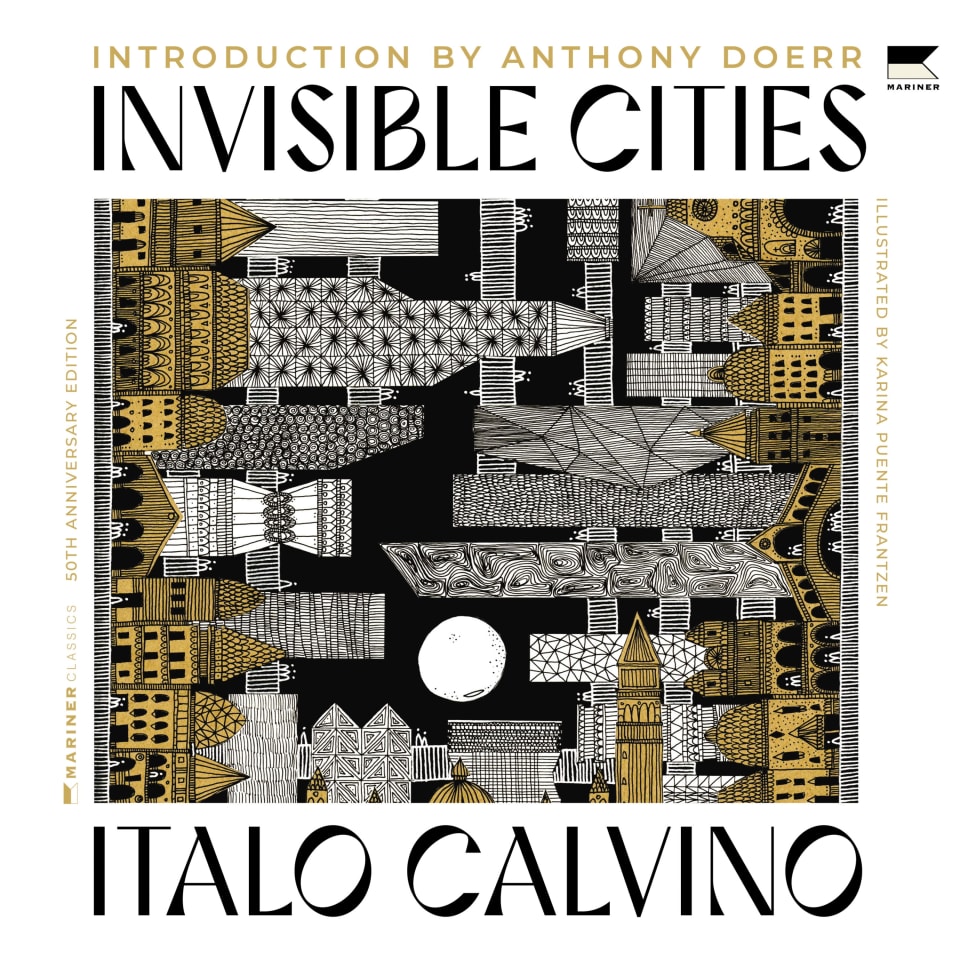
The conversations between Polo and Khan — between the traveller who has seen everything and can only describe it through metaphor, and the ruler who cannot leave his palace and can only know his empire through the reports of others — are a meditation on the limits of knowledge and the necessity of imagination. Khan understands, eventually, that all the cities Polo describes are the same city. Polo confirms it: “Every time I describe a city I am saying something about Venice.”
This is the deepest thing Calvino says about Venice, and about luxury, and about the desire for beautiful things in general. Every experience we seek — every destination we travel to, every object we acquire, every encounter we hope will complete us — is, at some level, a description of the thing we already have and have failed to see. The desire for Venice is, at least in part, a displaced desire for wherever we actually are, experienced with the quality of attention that Venice demands but that everywhere is, in principle, capable of producing. The experience economy sells us Venice when we already live in it.
The sinking: acqua alta and the long death
Venice is sinking. This is both literally and figuratively true, and both senses matter.
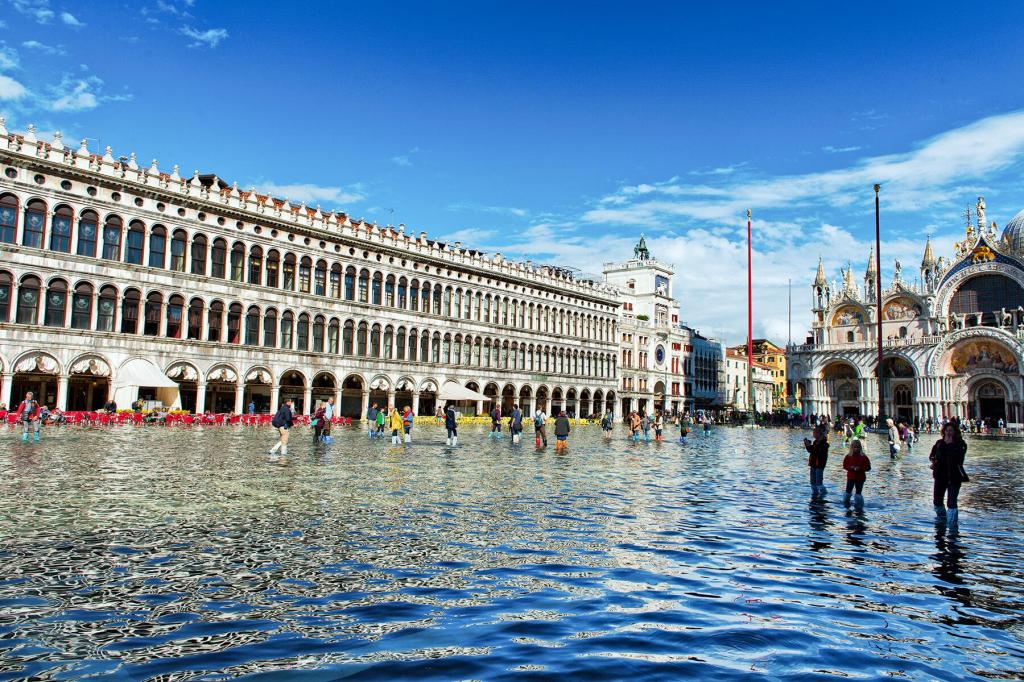
The literal sinking is a combination of natural subsidence — the city was built on wooden piles driven into the mud of a lagoon, and it has been settling into that mud since the first houses were built on the islands of Torcello and Rialto in the fifth and sixth centuries — and anthropogenic causes, primarily the industrial water extraction from the mainland aquifer that accelerated the subsidence by twenty centimetres in the twentieth century alone. The industrial extraction has been stopped, but the settling continues. Mean sea levels in the northern Adriatic have risen by about 26 centimetres since 1870, and continue to rise. The acqua alta — the seasonal flooding that fills the Piazza San Marco to ankle depth several times a year and occasionally to knee depth during major events — is becoming more frequent and more severe.
MOSE — Modulo Sperimentale Elettromeccanico, the system of mobile barriers designed to protect the lagoon from high tides — was conceived in the 1980s, begun in 2003, and completed in 2021, eighteen years late and at a cost of approximately five and a half billion euros, against an original estimate of one and a half billion. The overrun was partly engineering and partly the Venetian tradition of corruption so systemic and so theatrical that it reads less as a failure of governance than as a performance of civic irony. Forty-three people were convicted of corruption in connection with the MOSE project in 2014. The barriers now work. The city is protected, for the moment, from the most extreme tidal events. Whether this protection extends to the sea level rises projected for the end of the century is, among engineers and climate scientists, an open question.
The figurative sinking is, in some ways, more advanced. The city that once housed a hundred and seventy thousand people now houses fewer than fifty thousand. The population has been declining continuously since the 1950s, as residents are displaced first by the flooding and the maintenance costs, then by the transformation of residential property into tourist accommodation, then by the generalised economic logic of a city whose primary function has become the staging of itself for external consumption. The residents who remain are mostly elderly, mostly employed in the tourism economy in one form or another, and mostly aware that they are living in a city that the economic forces shaping it do not primarily regard as a place for people to live.
The thirty million annual visitors — arriving by cruise ship (banned from the Grand Canal since 2021, still arriving in the outer port), by train, by water taxi from the airport — generate revenues that fund the city’s maintenance and the Italian state’s willingness to invest in its preservation. They also generate the conditions that make it impossible to live there: the rents, the noise, the crowds, the conversion of every available space into accommodation or retail, the systematic replacement of the institutions that serve residents — schools, pharmacies, hardware shops — with the institutions that serve tourists — restaurants, souvenir outlets, luxury hotels.
Venice is the clearest possible demonstration of what the experience economy does at scale and over time. It identifies something irreplaceable and begins to sell it. The selling changes the thing. The changed thing is less worth selling. The response is to sell harder. The harder selling changes it further. The process ends either when there is nothing left to change or when the customers decide that the changed thing is no longer worth buying. Venice has been in this process for three hundred years and is not yet at the end of it, which is itself a kind of tribute to the inexhaustibility of what it started with.
Benjamin in Venice: the circle closes
Walter Benjamin visited Venice in 1924 and 1925, staying for extended periods while working on the early stages of what would become the Arcades Project. He was in his early thirties, the son of a Berlin antiques dealer, already beginning to formulate the ideas about commodity culture, aura, and the phantasmagoria that would define his mature work. He wrote letters from Venice describing it as a city where the boundary between the living and the dead, between the commodity world and the dream world, between the interior and the exterior, was thinner than anywhere else he had encountered.
This is exactly right, and exactly what the series has been building toward. Venice is the city where the argument closes on itself. It is the place where the commodity and the dream are most completely fused — where the beautiful thing and the mechanism of its production are most fully visible simultaneously, where the luxury and the exploitation are most obviously the same system, where the aura and the phantasmagoria are indistinguishable from each other.
The Arsenale produced the ships that built the empire that funded the palaces that attracted the Grand Tourists that commissioned the paintings that made the reputation that brings the thirty million visitors that are slowly making it impossible for anyone to live there. Each stage is both the product of the previous one and the condition of the next. The beauty is real. The machinery that produced it is real. The destruction wrought by the desire for the beauty is real. Benjamin’s commodity fetishism — the object that conceals the social relations of its production — has in Venice a form so total and so beautiful that the concealment is nearly complete.
Nearly. Not quite. Ruskin saw through it. Turner painted through it. Mann and Roeg filmed through it. Calvino thought through it. And the fifty thousand remaining residents, who live in a city that the economic system around them has decided should be a museum rather than a home, who negotiate the acqua alta and the tourist crowds and the rising rents and the conversion of their neighbourhoods into hospitality infrastructure — they see through it every day, with a clarity that no amount of beauty can quite obscure.
The Venetian republic lasted a thousand years and was ended in an afternoon by a general who had better things to do. The Venetian commercial empire lasted six centuries and was ended by a sea route around a continent. The Venetian school of painting lasted two centuries and was ended by the weight of its own influence. The city itself is still here, still beautiful, still sinking, still selling itself — and the question of whether it will still be here in another century, and in what form, and for whom, is the question that the entire history of luxury goods, from the lapis lazuli to the superfake Rolex, has been preparing us to answer.
Benjamin did not finish the Arcades Project. He ran out of time at a border crossing in 1940, carrying manuscripts that were never found. Venice is still here. The lagoon is rising. The tourists are queuing at the entrance. The barriers are holding, for now.
The circle closes. The stuff of dreams and exploitation, it turns out, is also the stuff of history — of everything that human beings have made and sold and lost and mourned, from the Afghan mines where the lapis lazuli was cut to the Williamsburg sugar refinery where Kara Walker built her sphinx, from the Arsenale where Dante smelled the pitch of Hell to the Rialto where the instruments of modern capitalism were quietly assembled by merchants who understood that the real money was in the mechanism, not the goods.
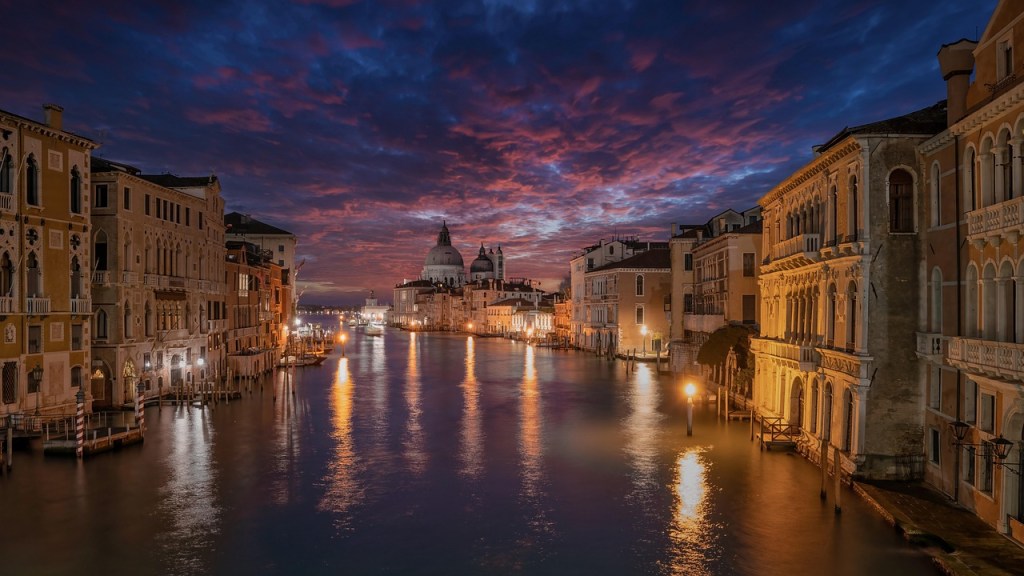
All of it is here. All of it has always been here. The only question is whether, standing on the bridge in the morning light with the canal below you and the crowds beginning to gather, you can see it.
— — —
A NOTE ON THE SERIES
This is the final part of The Stuff of Dreams and Exploitation, a seven-part canter through the history of luxury, consumption, and desire. The series began with Walter Benjamin at the Spanish border in 1940 and ends with the city he loved in 1925, still sinking, still beautiful, still selling itself. The preceding parts covered the full history of luxury from lapis lazuli to LVMH (Part Two); the racial ideology concealed in white marble and exposed in Kara Walker’s sugar sphinx (Part Three); the corporate reckoning and the death of aura in an age of superfakes (Part Four); the experience economy eating itself (Part Five); and the co-option of Black music by a white industry (Part Six). The arguments of all seven parts are connected. The thread running through them is the one Benjamin identified in the arcades of Paris in the 1930s: the commodity that promises everything and delivers the need for the next commodity, the dream that is also a mechanism of exploitation, the beauty that is real and the concealment that is also real, simultaneously and without resolution.
A NOTE ON METHOD
This essay, like all the pieces in this series, was developed in dialogue with Claude (Anthropic’s AI) as the research and synthesis engine, drawing on: John Ruskin, The Stones of Venice (1851-53); Thomas Mann, Death in Venice (1912); Italo Calvino, Invisible Cities (1972); Nicolas Roeg, Don’t Look Now (1973); J.M.W. Turner, Venice watercolours (1819-1841); the scholarship of Frederic Lane on Venetian commercial history; David Harvey, The Condition of Postmodernity (1989); and the author’s own multiple encounters with a city that repays every visit with new evidence for arguments already being made. The thinking is collaborative; the voice, selection, and responsibility are the author’s own.


Leave a comment