Britain’s particular history of religious trauma, the response to the Reformation, the Dissolution of the Monasteries and the Civil War, created a culture in which the forms of religious life were stripped of their theological content repeatedly and the question of what was left became urgent and creative. What do you do with a cathedral when you no longer believe what it means? And how to hold together a little island with a massive empire? This is what informs the ideological framework which explains all the subsequent architectural development.
The Dissolution and the Bottled Revolution
The Dissolution of the Monasteries between 1536 and 1541 was not simply a religious event. It was the largest transfer of property in England since the Norman Conquest — perhaps a quarter of all English land changed hands in less than a decade. The monasteries had held this land in perpetuity, as institutional owners who never died and never sold. Henry’s dissolution released it onto the market and a new class of landowners — the Protestant gentry who bought monastic land at below-market rates and built their power on it — became the dominant force in English political life for the next three centuries.
These are the people who fought the Civil War against Charles I. The Parliamentary gentry, many of whose family fortunes were built on dissolved monastic land, whose Protestantism was partly theological conviction and partly the ideological expression of a material interest in the Reformation settlement remaining intact. If the Stuarts restored Catholicism the land question would reopen. That could not be allowed.
So the English Civil War was fought, Charles was executed — the only English monarch to suffer that fate — and for a brief extraordinary moment it looked as if something genuinely radical might happen. The Levellers proposed universal male suffrage, equality before the law, the end of the property qualification for political participation. Gerrard Winstanley and the Diggers occupied common land and argued that the earth was a common treasury for all. These were not marginal eccentrics. They were articulating a vision of social reorganisation that was logically consistent with the Protestant theology the revolution had fought for — if every man stood equal before God, why not before the law and the land?
And it was crushed. Cromwell suppressed the Levellers. The Diggers were evicted. The Commonwealth became the Protectorate became the military dictatorship of a godly gentleman farmer who turned out to want order more than he wanted equality. At the Restoration in 1660 the gentry got their king back, kept their land, and constructed the constitutional settlement of 1688 — the Glorious Revolution — which solved the problem of royal Catholic absolutism while ensuring that political power remained securely in the hands of the Protestant propertied classes. It was a revolution designed to prevent a revolution. The franchise remained restricted. The poor remained outside the political nation. The land question was never reopened.
The real revolution had been bottled.
The bottling happened at two moments. First when Cromwell suppressed the Levellers, which was the moment the English Revolution chose order over equality and the existing propertied class over the dispossessed. Second at 1688, when the Whig settlement institutionalised that choice as constitutional principle, presenting the restriction of democracy as the defence of liberty, and doing it so successfully that the mythology has never quite been dislodged.
The consequence is what historian Perry Anderson diagnosed — a political culture that never had to think systematically about its own foundations because those foundations were never genuinely threatened. The French had their revolution, their terror, their Napoleon, their restored monarchy, their 1848, their Commune, their Third Republic — a century of repeated systemic crisis that forced French political thought to grapple with the deepest questions about legitimacy, authority, and the basis of social order. From that crucible came a tradition of political philosophy of extraordinary rigour and radicalism.
The English muddled through. Each crisis was managed, absorbed, defused — enough reform to prevent revolution, always too little too late, always presented as the recovery of ancient liberties rather than the creation of new ones. The Reform Acts of the 19th century. The welfare state of the 20th. All presented not as transformations but as completions — the ancient constitution finally fulfilling its promise. The line asserting continuity even through change.
What this produced architecturally and culturally is interesting. A country that never had to rebuild its institutions from scratch never developed a confident modern aesthetic in the way that France or Germany did. The modernist project — which we’ll eventually come to — required a belief that the past could be cleared and something genuinely new built in its place. That belief was much harder to sustain in a country whose political culture was built on the myth of continuity, whose landscape was managed heritage, whose institutions claimed descent from Magna Carta. You cannot easily build a utopia in a country that has decided it is already one.
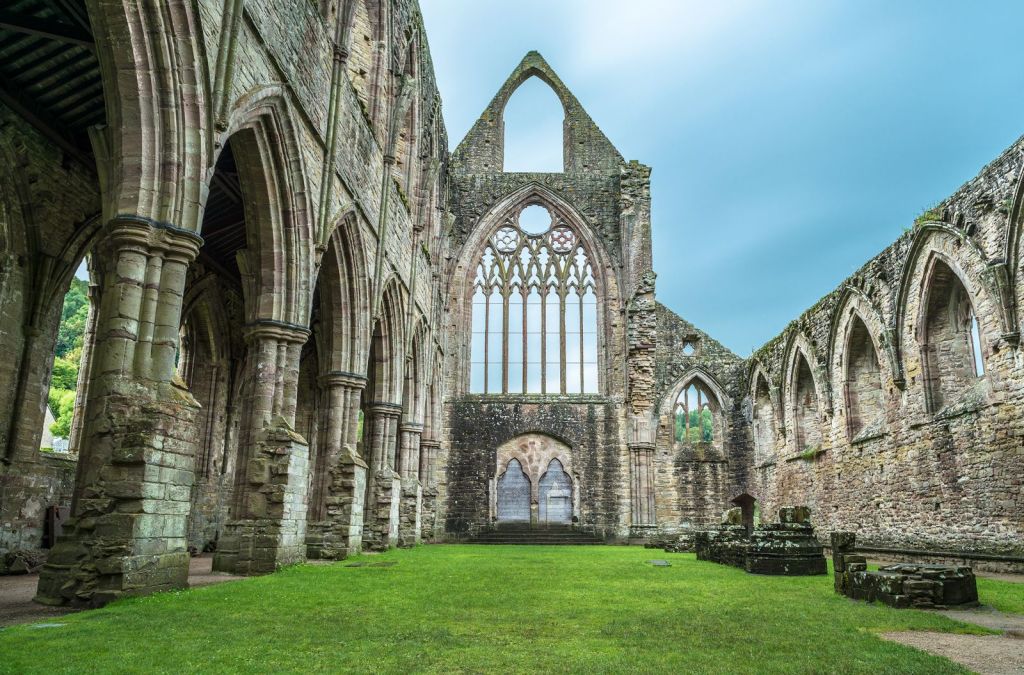
The Gothic ruins that the Romantics loved so much are the aesthetic expression of this — the fragment, the picturesque decay, the noble ruin set in a managed landscape, melancholy and beautiful and going nowhere. Tintern Abbey is more useful to English culture as a ruin than it ever was as a functioning monastery. As a ruin it can be mourned, aestheticised, made into a meditation on time and loss. As a functioning institution it would raise uncomfortable questions about land ownership, clerical power, and the material basis of spiritual life. The bottled revolution prefers ruins to institutions.
The Small Island Problem
Britain is approximately the size of Oregon. Within that space you have four distinct nations with distinct languages, legal systems, religious settlements, and historical memories, plus regional identities within those nations — Cornwall, Yorkshire, the Welsh Marrows, the Scottish Highlands — that are themselves fiercely particular. The density of difference per square mile is extraordinary.
This creates a specific kind of political psychology that larger territories don’t develop in the same way. In a continental empire — Russia, China, the United States — distance itself does some of the work of political management. Difference can be tolerated partly because it’s far away. On a small island, difference is always next door. The Welsh are right there. The Scots are right there. The Irish are right there. And, latterly, the empire is there. The management of proximity becomes the central political problem, and the solution that English power repeatedly reached for was not accommodation but narrative homogenisation — the insistence that there is one story, one tradition, one constitutional inheritance, and that the others are regional variations on it rather than genuinely alternative histories. It may be vague but, by jingo, it must be shared.
This is why the Acts of Union — with Wales 1536, with Scotland 1707, with Ireland 1800 — were always presented not as conquests or incorporations but as completions. The ancient British family reunited. The natural state of the island restored. The language of union consistently denied what it was actually doing, which was subordinating distinct political communities to English institutional dominance while allowing them to retain enough cultural particularity to avoid the cost of full suppression. Devolution in 1999 was the partial unravelling of that settlement, and Scottish independence remains its potential terminus. The small island never resolved the problem. It managed it, expensively, with increasing strain. Brexit, supposedly a reassertion, created yet further division.
The land question is the sharpest version of this. On a small island with a growing population and a feudal inheritance system that concentrated ownership in fewer and fewer hands, land was never abstract. It was the specific field your family had farmed for generations, now enclosed, now owned by someone who bought it from the Crown at the Dissolution, now managed by an agent you never see. The Enclosures — running from the 15th century through to the 19th — were the slow-motion version of the Norman Conquest, the commons stolen field by field rather than kingdom by kingdom, the dispossession dressed in the language of agricultural improvement and property rights rather than military conquest but achieving the same result. A class of landless labourers, masterless men, whose connection to the land had been severed, available for the factories, for the army, for emigration.
Oliver Goldsmith’s The Deserted Village — 1770 — is the elegy for this, the village emptied by enclosure rendered in verse of almost unbearable precision. Thomas Hardy’s novels are the same loss experienced from inside, the agricultural community dissolving within living memory. The Highland Clearances in Scotland — crofters evicted to make way for sheep, some transported to Canada, others to the coastal margins — are the most brutal version, happening within the same small island, simultaneously with the height of British imperial confidence. The empire “liberating” India while clearing the Highlands. The contradiction was noticed at the time. It was managed, as everything was managed, by keeping the narratives in separate compartments.
The smallness also produces a specific relationship to invasion anxiety that never quite resolves. The island has been successfully invaded twice in recorded history — Caesar and then William — and unsuccessfully threatened countless times since. The English Channel is fourteen miles wide at its narrowest point. That is a psychological as much as a geographical fact. The island is not safe by virtue of being an island. It is safe only by virtue of naval power and political management and a certain amount of luck — luck that ran out in 1066 and has held since. The white cliffs as symbol, the thin blue line of the Channel, Churchill’s finest hour — these are all expressions of an invasion anxiety that is specific to the small island’s geography. You cannot have that anxiety in Russia or America. The borders are too far away to feel.
The Imperial Narrative Problem
The small island discourse contrasts with that of the the global British empire and the tension between them is one of the defining features of British political culture.
The empire at its height governed roughly 450 million people across every continent, in territories with radically different climates, economies, religions, languages, and social structures. The governance structures were genuinely varied. Direct Crown rule in India after 1858. Dominion status for the white settler colonies. Protectorates. Mandates. Crown colonies. Indirect rule through existing chiefs and princes. The empire was not a single administrative system. It was a patchwork of improvised arrangements, each responding to local conditions, held together not by institutional uniformity but by something more precarious — the idea of empire, the narrative of what the whole thing was for.
That narrative had to do several things simultaneously and they were not entirely compatible. It had to justify the extraction of resources and the subordination of populations — which required the story of civilisational mission, the white man’s burden, the rule of law and good governance brought to peoples incapable of providing it themselves. It had to manage the white settler colonies whose populations were British in origin and increasingly resentful of imperial direction — which required the story of family, of kith and kin, of a British world united by shared values rather than subordinated by shared masters. It had to maintain the loyalty of indigenous collaborating elites — Indian princes, African chiefs, Malay sultans — which required the story of respect for local tradition and legitimate hierarchy.
These stories were not consistent with each other. The civilisational mission story required the inferiority of non-European cultures. The kith and kin story required the primacy of racial solidarity. The respect for local tradition story required the legitimacy of non-European institutions. You could not fully commit to all three simultaneously. The narrative was always patching over its own contradictions.
What kept it together was a selective English history projected outward as universal value. The common law, parliamentary government, individual liberty, free trade — these were presented not as English historical particulars but as universal human goods that England had happened to develop first and was now generously sharing with the world. The empire was not self-interested domination. It was the gift of civilisation. The line running from Magna Carta to the Indian Civil Service to the Singapore courts.
The smallness of the island and the vastness of the empire were in permanent productive tension. The island produced the narrative. The empire tested it against realities the island had never faced. And the realities kept winning — the Indian Mutiny, the Boer War, the Irish famine, the Bengal famine, the Amritsar massacre — each one a moment where the gap between the narrative and the practice became impossible to conceal entirely, each one managed by localising the failure, attributing it to exceptional circumstances or individual misconduct, reasserting the narrative at a higher level of abstraction.
The architecture of empire is the physical expression of this tension. The great imperial buildings — the Victoria Memorial in Calcutta, the Secretariat buildings in New Delhi designed by Herbert Baker, the Government Houses across the colonies — are in a Classical style, not Gothic, not vernacular, not anything that belongs to the local tradition. They are the line asserting itself: here is order, here is permanence, here is the universal standard against which everything else is measured. Lutyens’s New Delhi — begun 1912, completed 1931 — is the supreme example, a city designed on Beaux-Arts principles of axial grandeur, imposing a geometry of imperial authority onto a landscape with its own ancient urban traditions. It was completed fifteen years before independence. The Indians inherited the geometry and made it their own, which is exactly what the Romans didn’t anticipate at Bath and the Normans didn’t anticipate in England and every subsequent imperial power has failed to anticipate. You cannot build permanence. You can only build something the next people will use differently.
The Island Narrative and Its Architectural Expression
The connection between the small island’s geography and its architectural history is direct and underappreciated.
The parish church is the fundamental unit of English architectural culture — not the cathedral, not the country house, not the terraced street, but the parish church, present in every settlement of any size, the physical marker of community and continuity. There are approximately 16,000 medieval parish churches surviving in England — more than in any other country in Europe. This density is a function of the island’s smallness and the feudal system’s need to mark every unit of territory with a visible sign of Christian authority. Every manor needed a church. The church was the manor’s permanent statement of legitimacy, its investment in the narrative.
Walking across the English countryside you are never more than a few miles from a medieval church tower. This is not accidental. It is the landscape of a small, densely governed island marking itself obsessively, every community asserting its participation in the larger narrative by maintaining its piece of the physical infrastructure. The church tower is the local node in the national network of meaning.
The country house is the second layer — the seat of the family that owns the land, placed in its park with views carefully managed to exclude anything that contradicts the pastoral myth of harmonious rural order. The park wall keeps out the enclosure, the poverty, the reality of agricultural labour. Inside the wall, Capability Brown’s landscape — natural-looking, artfully constructed, every tree placed to compose a picture — performs the same function as the imperial narrative. This is natural. This is how things are. The wall is invisible because it was always there.
And the city — the industrial city, Birmingham, Manchester, Leeds, the cities that the small island produced when its agricultural labour was dispossessed and its coal was found and its empire needed goods — is the place where the narrative breaks down most visibly, where the contradiction between the pastoral myth and the industrial reality is impossible to manage aesthetically, where the Gothic Revival churches built in the slums are the most poignant expression of the bottled revolution’s bad conscience. We believe in your souls. We are not responsible for your conditions. Here is a church. Here is a pointed arch reaching toward heaven from a street where children are dying of cholera.
The Tightness of the Narrative as Architectural Programme
The reason the Classical style — which Inigo Jones imports, which Wren perfects, which the Georgians institutionalise — became the official architecture of British imperial power is precisely because of what we have just identified. A small island managing a vast empire needed a style that was universal rather than local, rational rather than organic, legible across cultures rather than embedded in a specific tradition.
The Gothic was too English. Too particular, too rooted in the specific history of the island’s Christianity, too much associated with the Catholic past that Protestant Britain had officially repudiated. You couldn’t build Gothic in Calcutta — or rather you could and sometimes did, with very strange results — without it looking like what it was, the projection of English particularity onto non-English contexts.
The Classical was different. It claimed universality. It said: these proportions, this order, this geometry — these are not English, they are human. They are what reason produces when it is applied to building. By building in the Classical style the empire was not asserting Englishness. It was asserting rationality, order, and the universal values of civilisation. The fact that those universal values happened to be administered by English-speaking Protestant gentlemen from a small island off the coast of France was, in this framing, a coincidence of history rather than a structure of power.
This is the narrative doing its work. And it required a very tight, very consistent architectural language to sustain it — which is why the deviations from Classical orthodoxy in imperial architecture are always significant. When the British built in Gothic in India — the Victoria Terminus in Bombay, now Chhatrapati Shivaji Terminus, begun 1878 — they were making a different argument, one about the specifically Christian and English character of the civilising mission rather than its universal rational character. The choice of style is always a choice of story.
The island’s smallness, the land’s contestedness, the empire’s narrative demands — all of these flow into the architectural history we’re tracing and explain choices that would otherwise look purely aesthetic. Why Classical rather than Gothic for imperial buildings. Why the country house rather than the urban palazzo as the dominant aristocratic building type. Why the parish church rather than the cathedral as the fundamental unit of English religious architecture. Why the picturesque rather than the sublime as the preferred aesthetic mode for a landscape that had been managed, enclosed, and aestheticised out of political usefulness.
Lecture over. Back to the history.


Leave a Reply