Or: What Dignity Means
Or: Ironies Explode
Or: The Slow and the Blind
Or: Claude and the Tourist do Derrida Dreadfully
In which Alan Partridge goes to Paris, eats a testicle, and unknowingly demonstrates everything this series has been arguing.
A Note on How This Essay Came To Exist
We are not entirely sure whether what follows is a serious piece of cultural criticism, an elaborate joke, or — and this is the possibility that keeps us up at night — a Derridean text about deconstruction that is itself an act of deconstruction without having fully intended to be one.
Let us explain.
This blog is written in dialogue between a human and an AI. The human is the armchair progressive. The AI is the stochastic parrot. Both have been introduced elsewhere. The collaboration has produced, among other things, a manifesto and a series of essays on political economy that take themselves quite seriously. This essay takes itself seriously too. It is just that the route by which it arrived is sufficiently strange that it requires accounting for before the serious business begins.
In the AI essay that precedes this one in the series — The Stochastic Parrot and the Armchair Progressive — there is a footnote. It reads: Pete and Bernie’s Philosophical Steakhouse. Knowing Me Knowing You with Alan Partridge, BBC 1994, Episode Four, written by Steve Coogan, Armando Iannucci and Patrick Marber. The finest thirty minutes of British comedy ever made. The AI had to be told this. The steak, it emerges, is a testicle. The philosophy is in what you are eating without knowing it. We will return to this in our next episode.
The AI had to be told this because the AI cannot watch television. It can read scripts. It has processed more text than any human being could read in a thousand lifetimes. But the audiovisual archive — the performances, the timing, the physical comedy, the specific texture of what it meant to watch BBC2 in 1994 — is largely beyond its reach. The aura, as Walter Benjamin would say, is irreproducible by mechanical means. Including digital ones.
When the human mentioned Pete and Bernie’s Philosophical Steakhouse in passing — as an illustration of something being discussed about the limits of AI synthesis versus genuine philosophical thought — the machine confidently identified it as a Monty Python reference. Specifically the cheese shop sketch. This was wrong. It is from the French episode of Knowing Me Knowing You with Alan Partridge. The machine had encountered the name somewhere in its training data, pattern-matched it to the nearest available cultural reference, and produced a plausible but entirely incorrect answer with complete fluency and no apparent awareness of its own error.
Which is — as the AI essay argues — precisely what stochastic parrots do.
Here is where it gets interesting. The human pointed out that the AI’s mistake was itself an irony. The machine that embodies the commodification of thought — that has consumed without discrimination the accumulated written output of human civilisation and returns it as fluent synthesis — had failed to recognise a joke about a man who consumes without discrimination and cannot tell the difference between genuine cultural achievement and a branded steakhouse chain.
The machine had done a Partridge.
This observation opened a conversation about the episode itself which rapidly revealed that the French episode of KMKY is not merely a very funny thirty minutes of British television. It is — whether or not Coogan, Iannucci and Marber fully intended it to be, and we suspect they knew more than they would admit — a sustained engagement with exactly the questions this essay series has been addressing. Alienation. The culture industry. The performance of identity. The body’s vulnerability. The arbitrariness of power. The English relationship to European culture. And — sitting at the centre of it like Derrida at the restaurant with no name — the question of what dignity actually means versus what people perform when they think they are demonstrating it.
At which point we had to write the essay.
We are aware that writing a serious piece of cultural criticism and political economy analysis about an episode of a 1990s BBC comedy chat show parody could be read as — to use the technical term — a bit much. We are aware that the meta-structure of the thing — an AI that cannot watch television and a human who had other tasks that day analysing an episode about a man who has never heard of Derrida in terms that Derrida would recognise — is either very clever or very silly and possibly both.
We are genuinely unsure whether we have constructed a Derridean joke by accident or stumbled into one that was already there. Derrida’s argument — that texts contain meanings that undermine and exceed their stated intentions, that the gap between what a text means to say and what it actually says is where the interesting work happens — applies with some force to this essay itself. It means more than it intends to. We are not fully in control of what it says. The restaurant with no name is serving something we did not order.
But here is the thing. The analysis holds. Whatever the route by which we arrived at it, the episode does what we say it does. The Slazenger Sports Stick is there. The testicle is there. The dignity shuffle is there. The accordion ending is there. Derrida actually does get a namecheck. The restaurant actually does have no name. Patrick Marber, who writes with great precision about power and knowledge and the games people play with both, does have a writing credit.
We think Iannucci, Coogan and Marber knew what they were doing. Not that they were making a Marxist cultural analysis disguised as a chat show parody. But that they were doing what serious comedy always does — thinking carefully about something real while making you laugh, and trusting that the thinking would do its work on the audience that was ready to receive it. The audience that wasn’t ready would still find it very funny. Both are fine.
The crack in our shared reality — the AI’s confident misidentification of Pete and Berni’s, the human’s correction, the subsequent analysis that revealed the episode to be far richer than either had anticipated, the collaboration between a machine with the script and a human with the aura — has produced this essay. We offer it in the spirit of the restaurant with no name. The analysis is genuine. The irony is unavoidable. Derrida, wherever he is dining, would appreciate it.
Partridge, we suspect, would not. But he would eat whatever was put in front of him.
Epigraph
LAMBERT: Maybe he’s sane and we’re all mad.
PARTRIDGE: [pause] Anyway, the next model…
— Knowing Me Knowing You with Alan Partridge, Episode Four, BBC 1994
Opening
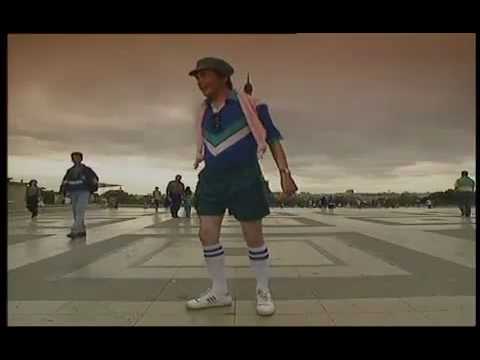
There is a man in a beret emerging from a Paris Metro station. He is wearing a long raincoat. He is performing France at France. France is not impressed.
The man is Alan Partridge. The beret is the English idea of France. The raincoat is sports casual with pretensions. In the next thirty minutes he will eat a testicle without knowing it, be told by his co-host that he is out of his depth in a language he cannot understand, fail to attend the cultural event his own show created the conditions for, demonstrate dignity by shuffling slightly hunched back and forth across a chat show stage, and sack his bandleader on live television.
He will consider all of this a successful evening.
Knowing Me Knowing You with Alan Partridge, Episode Four — the French episode — broadcast on BBC2 in 1994, written by Steve Coogan, Armando Iannucci and Patrick Marber, is thirty minutes of British comedy that repays more serious attention than it has received. Not because it is secretly highbrow — it is not. Because it is doing what the best comedy always does: it is thinking seriously about something while making you laugh, and the thinking is doing more work than the laughing lets on.
What it is thinking seriously about — the English relationship to European culture, the performance of cultural identity, the body’s vulnerability, the arbitrariness of power, and the specific texture of a particular kind of philistinism that mistakes the branded for the valuable and the performed for the real — is, it turns out, exactly what this essay series has been thinking about. The connection was not planned. It arrived through the crack in a shared reality between a human who can watch television and a machine that can only read scripts. Which is itself, as we shall see, part of the argument.
Movement One: The Cultural Inventory
Or: Quasimodo, Cappuccino and the Berni Inn
The episode opens with Partridge’s establishing narration over footage of the Eiffel Tower and Arc de Triomphe.
Paris: city of French people. Home of Quasimodo, Louis XIV, Hercule Poirot and Sacha Distel. City of lovers, of artists, of the croissant, the cappuccino.
Quasimodo: fictional. Also the creation of Victor Hugo, a French writer Partridge has presumably not heard of. Hercule Poirot: Belgian. A fictional Belgian detective created by an English woman. Cappuccino: Italian. The France Partridge is celebrating contains no actual French people or things. It is a collage of received cultural fragments, vaguely continental in character, assembled without discrimination.
This is not ignorance exactly. It is something more specific and more interesting. It is what happens when cultural knowledge is entirely mediated through television, advertising and received association rather than through direct encounter. Partridge’s France is a simulacrum — a copy of a copy, a representation of a representation, with no original behind it.
His cultural inventory throughout the episode follows the same pattern. Peter Ustinov as a philosopher. Mr Kipling as an international chef. Berni Inn as the benchmark for culinary excellence. Fanny Craddock and Keith Floyd — television personalities rather than serious cooks — as representatives of British gastronomy. Widow Twankey as the appropriate frame for avant-garde fashion. Duggie from Norwich shopping precinct as the only known wearer of outdoor slippers.
Every reference is wrong in exactly the same way. Not randomly wrong. Systematically wrong in a way that reveals the shape of the system producing the wrongness. Partridge cannot distinguish between actual and fictional, between Belgian and French, between Italian and French, between television celebrity and genuine expertise, between commercial brand and cultural achievement. All of these distinctions require a kind of knowledge that the cultural system he inhabits has never equipped him to make.
This is the culture industry argument made visible. Adorno and Horkheimer argued that mass cultural production standardises and pseudo-individualises — it produces the appearance of variety and choice within a system that is actually uniform and managed. Partridge is the product of that system. His cultural inventory is extensive and entirely flat. He can name many things. He understands the relationships between none of them.
The Slazenger Sports Stick deodorant is the purest example. Lambert arrives wearing an unnamed French cologne — specific, personal, unbranded. Partridge responds with his own: Slazenger Sports Stick. The stick type, he specifies, because the roll-on traps the hairs. He volunteers this information about his underarm hair management on live television in Paris to one of the city’s most celebrated chefs. The brand name. The specific format. The practical anxiety. This is the full inventory of a consciousness shaped entirely by commodity culture. Even personal hygiene is experienced through brand loyalty and product specification.
Movement Two: The Restaurant With No Name
Or: Derrida Dines Here
Philippe Lambert — played by Patrick Marber, who would go on to write Closer and Dealer’s Choice, plays about power, knowledge and the games people play with both — is the episode’s most important character and the one who does the most analytical work.
Lambert has sent back his Michelin stars. His restaurant has no name, though people call it The Restaurant With No Name, which is an irony he acknowledges. He describes the restaurant industry as a pig endlessly regurgitating and consuming without discrimination, without taste, or joy. Jacques Derrida dines at his restaurant and appreciates the irony.
Partridge has never heard of Derrida.
Lambert says he is the most famous philosopher in the world. Partridge says he wouldn’t say that. Lambert challenges him to name a more famous one. Partridge says: all the Greek ones. Lambert specifies: one who is alive. Partridge puffs his cheeks. Then, sheepishly: Peter Ustinov. Lambert, without missing a beat: yes, absolutely right. I’d forgotten about him. Thank you.
There are several layers to this exchange.
The obvious layer: Partridge doesn’t know who Derrida is and nominates a British actor-raconteur as the world’s most famous living philosopher. The comedy is in the gap between the question and the answer.
The structural layer: Derrida’s entire project — deconstruction — is about showing that texts contain meanings that undermine and exceed their stated intentions, that language is never fully in control of what it says, that the gap between what a text means to say and what it actually says is where the interesting work happens. The episode about a man who has never heard of Derrida is itself a Derridean text. It means more than it says. It undermines its own surface. It contains its own critique.
The restaurant with no name is a Derridean joke. The place exists and is known but cannot be named directly. Like the trace in Derrida’s work — the mark of meaning that is always present and never fully capturable. The unnamed restaurant is the thing that cannot be said but is somehow said anyway. Derrida dines there because of course he does.
Partridge says it’s like Clint Eastwood. He means the Man With No Name from the spaghetti westerns. He is correct about the parallel and entirely wrong about what it means. Clint Eastwood’s namelessness is mythic, masculine, threatening, American. The restaurant’s namelessness is philosophical, ironic, French, an act of deliberate negation of the validation system. Same grammatical structure. Opposite cultural content. Partridge cannot see the difference because he has no framework for making it.
Lambert’s response to all of this is important. He leans back on the sofa, arms stretched out, smirking. He raises his eyebrows. He is not contemptuous of Partridge. He is entertained by him. This is the French intellectual’s relationship to English philistinism — not contempt but a kind of delighted anthropological curiosity. Partridge is fascinating to Lambert. He is the pig the industry produces. Lambert has been describing him while watching him eat.
While Lambert describes the restaurant industry as a pig that consumes without discrimination or taste, Partridge is eating Lambert’s food. Gingerly. Without knowing what it is. Nina watches. She does not eat. She is the witness to the demonstration. Lambert is describing the man in front of him while that man demonstrates the description with his mouth full.
The food, it will emerge, is a testicle. Partridge asks at the end what the chewy thing was. Lambert says beef. What sort. Bull. What part. A gland. How many glands does it have. Two. Ladies and gentlemen, Philippe Lambert.
The philosophical steakhouse serves testicles. The philosophy is in what you are eating without knowing it. This is the episode’s central image and its most compressed argument. Partridge consumes without discrimination or knowledge. The consumption is the demonstration of its own critique. The joke is the analysis.
Movement Three: The Body
Or: The Clowns, The Bandages, and the Dignity Shuffle
The episode has two sequences that deal directly with the body. Both disturb Partridge profoundly. Both are more coherent than anything he offers in response.
The clowns — Cirque des Clowns — arrive in punk, goth and vaudeville costumes. The male clown simulates a giant erection and sex. Other clowns mime blinding, throat-slitting, dismemberment and defecation. All to jolly circus music. This is Artaud’s Theatre of Cruelty performed as children’s entertainment. The body’s pleasures and its vulnerabilities made simultaneously visible and comic. The transgression of the boundary between entertainment and violence, between the acceptable and the unacceptable.
Partridge says no no no. He threatens them with Steve the security guard. The clowns shush him repeatedly. The lead clown follows him back to the sofa and mimes breaking an egg on his head.
We never see Steve. The threatening force that will restore order is invoked but absent. The clowns win by continuing to exist. The egg — symbol of creation, fertility and the mess of new life — breaks invisibly on Partridge’s head. He cannot see it because he does not understand what it represents. He can only try to remove the clowns from his show, which is the authoritarian response to art that unsettles.
David Schneider plays the lead clown. The clown who gets removed by the French woman saying Partridge is out of his depth becomes the artist who makes power visible through the power’s own language. The clown contains multitudes.
Yvonne Boyd — played by Rebecca Front as a thinly disguised Vivienne Westwood — arrives with Marie Antoinette hair and a collection based on hospitalisation. Bandages. Surgical stitching. A saline drip on an umbrella. Blood bags. An orthopaedic shoe. A corn plaster waistcoat. The futility of mortality is her collection’s theme.
Westwood’s actual aesthetic — punk as historical costume, the body as political statement, fashion as the weaponisation of the past against the present — is being rendered through NHS supply materials. The hospital is the place where the body’s vulnerability is most visible, most undeniable, most stripped of the performances that ordinarily protect us from the knowledge of what we are. Boyd/Westwood puts that visibility onto the street, the catwalk, the Paris chat show studio. She makes the body’s mortality fashionable. She insists on what Partridge refuses to acknowledge.
Partridge asks if the blood bags are used — meaning, has actual blood been in them. She says you mop it up with the eye patch. She says impulsively what if your arm bursts. This is the most surreal line in the episode and the most revealing. In fourteen years of professional broadcasting including three years of hospital radio he has never had anyone say my arm’s just burst, could you play a dedication. He has reduced Boyd’s engagement with mortality to the level of a medical mishap on a ward round. He has heard the futility of mortality and responded with health and safety protocol.
Then the dignity exchange.
Newman — a model in an orthopaedic shoe — limps across the stage. Partridge says that man has no dignity. Boyd says what is dignity. Partridge gets up. He asks Newman to walk up and down. Newman limps up and down. Then Partridge demonstrates dignity.
He shuffles. Slightly hunched. A quick whizz back and forth. He doesn’t even try. He is too annoyed by the entire evening to muster more than the minimum. THAT is dignity. More or less. He sits back down.
The more or less is everything. He knows it wasn’t much. He is too exasperated with the whole evening to care.
This is the essay series in miniature. This series has been arguing that dignity is the set of material, social and political conditions under which people can actually flourish in the ways they themselves report mattering. That it is not sentiment or aspiration but political economy — the concrete, structural, achievable arrangement of institutions and resources and power that makes a decent human life possible.
Partridge says dignity is walking properly in the right clothes. The controlled, branded, sports-casual presentation of self. The performance of composure. The body that shows nothing.
Boyd’s position — though she doesn’t say it this way — is that Newman’s limping dignity, his body made visible in its vulnerability, his mortality worn as fashion, is more honest about the human condition than Partridge’s shuffle. Underneath our clothes we are all naked. Even Alan. No I’m not. All we are saying is that under your clothes you are naked. No I’m not.
The denial of the universal human condition. The refusal to be naked. The insistence on the performance as reality. This is what the culture industry produces and what alienation feels like from the inside. You are so thoroughly the performed self that the actual self — vulnerable, mortal, naked — has become literally unimaginable.
Movement Four: Power
Or: Knowing Me, Alan Partridge, SACKING You, Glenn Ponder
The episode’s final movement is about power. How it operates. How it is exercised. What it looks like when it is performed rather than legitimate.
Everyone went to the Folies Bergères the night before. The band. The clowns. Steve the security guard. Nina. Lambert. The fashion models. Everyone except Partridge.
There was a sign. No jeans. No trainers. No sports casual wear.
Glenn says it as a joke. It is also true. The clothes that define Partridge — that are his armour, his identity, his dignity — are the reason he was not admitted. At home he feels like a tourist. In Paris, in his beret and his sports casual, he cannot get into the Folies Bergères. The performance of identity that is supposed to give him access excludes him from the culture he came to host.
He is the host who cannot access his own party. The tourist in his own show.
His response is to sack Glenn Ponder. On live television. Arms crossed. Pointing repeatedly. Trying to take back control.
Knowing me, Alan Partridge, SACKING you, Glenn Ponder, AH-HAH.
The knowing me knowing you formulation is the show’s ritual of connection. The moment of mutual acknowledgement. The catchphrase that means I see you, we are in this together. Partridge has weaponised it as the instrument of exclusion and humiliation. The form of connection turned into the mechanism of rejection. The warm ritual made cold.
This is power as Foucault describes it — not simply as force from above but as the operation of knowledge and procedure. Partridge doesn’t threaten Glenn with violence. He uses the institutional ritual of the show itself — the formulation that constitutes his authority — as the weapon. The form of acknowledgement becomes the act of cancellation.
Glenn didn’t leave a message. Partridge has known this since the moment he asked directly and Glenn said no. The sacking is not a response to a genuine wrong. It is the exercise of arbitrary power in the face of embarrassment. The powerful man who has been made to feel small finding someone smaller to punish.
The others laugh at Glenn’s sports casual quip. Partridge crosses his arms. He has been laughed at, excluded, fed a testicle, told he is out of his depth, had an egg broken on his head, and been denied the Folies Bergères. He sacks the bandleader.
The episode ends with a man alone on stage playing solo accordion. Because Partridge has sacked the whole band in sacking Glenn. The show ends in the sound of one man’s humiliation sustained in music. The cultural event — the Paris show — concludes with a single instrument, a single musician, and the silence where everything else used to be.
Movement Five: The Crack in the Shared Reality
Or: The Machine That Cannot Watch Television
This essay was written by a human who can watch television and a machine that can only read scripts.
The reference to Pete and Berni’s Philosophical Steakhouse arrived in conversation between them. The machine — having encountered the phrase without context — confidently identified it as a Monty Python cheese shop reference. It was not. It was a specific, layered, culturally dense moment from the French episode of Knowing Me Knowing You with Alan Partridge, BBC 1994, written by Steve Coogan, Armando Iannucci and Patrick Marber. The finest thirty minutes of British comedy ever made.
The machine had done a Partridge.
It had the words but not the performance. It had the script but not the timing, the costume, the physical comedy, the specific quality of Coogan’s sheepishness before Peter Ustinov, Lambert’s smirk, the dignity shuffle, the accordion ending. It had the steak but not the restaurant.
This is Walter Benjamin’s aura argument applied to television comedy. The mechanical reproduction — the script, the transcript, the text — contains the words. The aura — the unique phenomenon of the performance, the specific texture of what it meant to watch this on BBC2 in 1994, to recognise the references, to understand what was being done — is irreproducible. The machine has the script. The human has the aura. The essay requires both.
In this sense the collaboration that produced this essay is a demonstration of its own argument. The machine cannot watch television. The human had other tasks that day but watched it anyway. Between them they have the whole thing.
Which is — as the companion essay on AI and the intelligence commons argues — exactly what the collaboration is for.
Coda: At Home He Feels Like A Tourist
The show is called Knowing Me Knowing You with Alan Partridge. The title is an ABBA song about a relationship ending. The knowing — the mutual acknowledgement — is always retrospective in the song. We are knowing each other in the moment of separation. We see each other clearly as we say goodbye.
Partridge uses it as a greeting. A moment of connection. He does not hear the ending in it.
The blog these essays appear on is called At Home He Feels Like A Tourist. The phrase is from the song At Home He’s a Tourist from the Gang of Four’s 1979 debut album Entertainment! — the Leeds art school Marxists who made alienation visceral and danceable, who understood the Frankfurt School and translated it into post-punk. The song is about the alienated subject in his own life. Present but not present. Inhabiting his existence as a visitor to it.
Partridge in Paris is this made literal. He is the host of his own show and he cannot get into the Folies Bergères. He is surrounded by people who understand something he cannot access. He performs connection — knowing me, knowing you — while being systematically excluded from what is actually happening. He is in Paris and he might as well be in Norwich. He is at home in his sports casual and his Slazenger Sports Stick and his Peter Ustinov and his B&Q bar stools and he feels like a tourist.
The essay series that carries this blog title has been arguing that the feeling — the Sunday evening feeling, the supermarket feeling, the scrolling feeling, the voting feeling — is not a personal failure or a psychological quirk. It is the subjective experience of objective structural conditions. It is what it feels like to live inside Harvey’s contradictions. It is alienation as daily texture.
Partridge is a comic exaggeration of this condition. He is not a critique of a particular kind of person. He is a portrait of what the culture industry produces when it is working as intended. The man who knows every brand and no things. Who can name every television chef and has never heard of Derrida. Who demonstrates dignity with a slightly hunched shuffle and cannot see why this is insufficient. Who exercises power through ritual formula and calls it connection.
The episode is not cruel about him. It is precise about him. There is a difference. The precision is what makes it comedy rather than satire. Satire attacks. Comedy observes. The observation here is exact enough to be uncomfortable without being unkind.
And Partridge is not entirely wrong. He notices the Clint Eastwood parallel that Lambert finds genuinely amusing. He and Lambert together invent Pete and Bernie’s Philosophical Steakhouse in a moment of genuine collaborative warmth. He is not incapable of connection. He is incapable of sustaining it when it threatens his self-image.
Which is, when you think about it, a fairly precise description of the English relationship to Europe. Not incapable of connection. Incapable of sustaining it when it requires acknowledging something that the performance of national identity cannot contain.
Derrida dines at the restaurant with no name and appreciates the irony. Partridge has never heard of him. The accordion plays. The episode ends.
“Knowing” Me, “Knowing” You
AH-HAH.
—
Knowing Me Knowing You with Alan Partridge, Episode Four, BBC 1994. Written by Steve Coogan, Armando Iannucci and Patrick Marber. Directed by Dominic Brigstocke. Pete and Bernie’s Philosophical Steakhouse is referenced in this episode. The steak is a testicle.
The gaps are real. The conversation is the point.


Leave a Reply