Preamble
A recent post in our survey of British architecture we contrasted the Norman inheritance in Britain with that in Sicily. We went on to consider the impact of Norman architecture on the fact and fiction of British nationhood. This begs the question of what impact Norman Sicily may have had on Italian nationhood. Or, more importantly, how the construction of Italian nationhood, pre and post Risorgimento, contrasts with that of Britain. So here you go.
Nation or Civilisation
We established the contrast. Britain got the angry Norman — the conqueror who imposed a single narrative, built the Domesday Book and the White Tower, and created the architecture of English exceptionalism through the suppression of everything that preceded it. Sicily got the beautiful one — the synthesiser who absorbed Arab, Byzantine, and Norman traditions into the Palatine Chapel’s muqarnas ceiling and the Cefalù Christ’s Greek inscription, and who governed through existing structures rather than replacing them.
The British Norman created a nation. The Sicilian Norman created a civilisation. And civilisations, it turns out, are much harder to turn into nations than conquests are.
What the Synthesis Left Behind
The Norman Kingdom of Sicily lasted roughly 130 years — 1130 to 1266, when Charles of Anjou ended it. In that time it produced architecture of extraordinary beauty, a multicultural court of genuine intellectual distinction, and a political model of unusual sophistication. And it left behind almost nothing in terms of a continuous political identity.
This is the paradox at the heart of Italian nationhood and it runs directly through Sicily. The synthesis was too complete, too various, too genuinely hybrid to calcify into the kind of singular narrative that nation-building requires. You cannot build a national myth on Sulis Minerva because Sulis Minerva belongs to two traditions simultaneously and refuses to choose. The Norman conquest of England worked as a national foundation myth precisely because it was violent and total enough to create a clear before and after. The Norman Kingdom of Sicily worked as a civilisational achievement precisely because it refused that clarity — but that refusal made it historically inert as a political resource.
When the Risorgimento came in the 19th century — the movement for Italian unification that produced the Kingdom of Italy in 1861 — its architects faced a problem that the English nation-builders never had. England could trace a continuous, if largely invented, constitutional inheritance from Magna Carta through the Common Law to parliamentary sovereignty. Italy had no equivalent thread. What Italy had instead was an overwhelming accumulation of distinct regional identities, each with its own history, its own dialect, its own relationship to the various foreign powers that had governed it, each of which was more vivid and more emotionally present than any abstract Italian identity.
Sicily’s relationship to this problem is especially acute. The island had been governed, in sequence, by Greeks, Carthaginians, Romans, Vandals, Ostrogoths, Byzantines, Arabs, Normans, Hohenstaufens, Angevins, Aragonese, Spanish Habsburgs, Bourbon Spanish, and briefly the British — who occupied it during the Napoleonic Wars and gave it a constitution modelled on their own, which the Bourbon monarchy abolished as soon as the British left. This is not a history that produces a simple narrative of national continuity. It is a history that produces the specific Sicilian sensibility that Giuseppe Tomasi di Lampedusa captured in The Leopard — the profound scepticism about change, the conviction that everything changes so that everything can remain the same, the exhaustion of a people who have been governed by too many confident outsiders to believe in any of them.
The Risorgimento and Its Architectural Problem
The Risorgimento’s architects — Cavour, Mazzini, Garibaldi — understood that they needed a usable past, and the Norman Kingdom of Sicily was available as one. It was Italian, it was glorious, it was a period of genuine civilisational achievement. The problem was that it was available to everyone simultaneously. The Norman synthesis belonged to Arab culture as much as to Italian culture, to Byzantine culture as much as to Norman, to Greek culture as much as to Latin. You could not use it to argue for Italian national uniqueness without also arguing for Arab and Byzantine and Norman uniqueness. The synthesis that made it beautiful made it useless as a nationalist resource.
What the Risorgimento reached for instead was the classical inheritance — ancient Rome as the foundation of Italian identity, the peninsula as the continuous civilisation from the Republic through the Empire through the Renaissance to the Risorgimento itself. This is the line asserting itself in Italian form. The circle of Norman Sicily — the hybrid, the synthesis, the culture that belonged to multiple traditions simultaneously — was aestheticised as heritage and set aside as politics.
The architectural consequence is visible in Rome above all. The Vittoriano — the enormous white marble monument to Victor Emmanuel II built between 1885 and 1935, universally and justifiably known as the Wedding Cake or the Typewriter — is the Risorgimento’s architectural self-expression. It is Classical in its vocabulary, Roman in its scale, and overwhelming in its determination to assert that Italy has arrived as a nation by building something that looks like the ancient Rome it claims to inherit. It is the Edwardian Baroque of Italian nationalism — the imperial gesture performed with maximum elaboration precisely because the underlying identity is uncertain. Rome already had the Colosseum, the Forum, the Pantheon — buildings of such authority that any new building making the same claim would inevitably look like a parody. The Vittoriano is a parody. It knows it. The city has dealt with it by treating it as a joke and then discovering, gradually, that the joke has become affectionate.
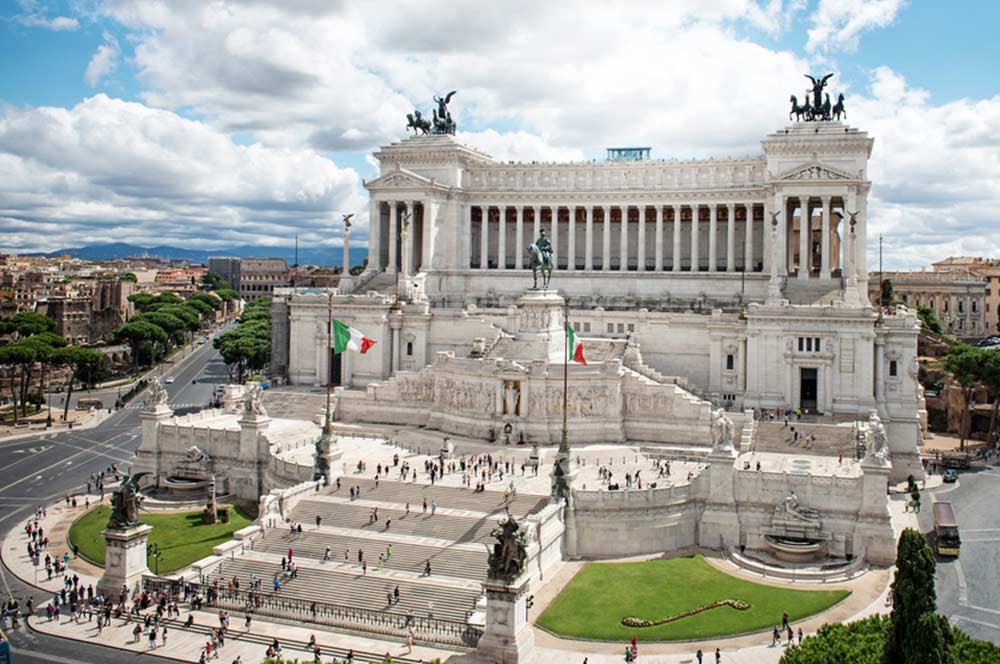
The contrast with what Sicily’s Norman buildings are doing is total. The Palatine Chapel does not announce its importance. It simply is important — so completely that it does not need to assert itself. The Vittoriano announces its importance on every surface and convinces nobody.
Sicily and the South: The Question That Didn’t Get Answered
The Risorgimento unified Italy politically in 1861. It did not unify it in any more meaningful sense. The Questione Meridionale — the Southern Question, the problem of the profound economic, social, and political differences between the industrialising north and the agricultural, feudal south — was visible from the moment of unification and has never been resolved.
Sicily was absorbed into the unified Italian state not as an equal partner but as a conquered territory. Garibaldi’s Expedition of the Thousand in 1860 — the romantic adventure that brought Sicily into the unified state — was experienced on the island as another in the long sequence of foreign interventions, however ideologically different its intentions. The Piedmontese administrators who followed were as alien to Sicilian culture as the Bourbon Spanish they replaced. The tax system was imposed from the north. The military conscription was imposed from the north. The legal system was imposed from the north.
The result was the specific pathology of the Sicilian relationship to the Italian state — a deep, structural distrust of official authority, a preference for local networks of mutual obligation over state institutions, and the development of those networks into the form they eventually took. The Mafia is not a Sicilian cultural essence. It is the institutional response of a society that has never had reason to trust any of the states that claimed to govern it, to the extraction of a unified Italian state that governed it as badly as all the others.
This is the Norman synthesis’s long shadow. A society that had been governed through existing structures, that had maintained its Arab administrators and its Byzantine craftsmen and its Greek-speaking communities, developed over centuries a political culture of accommodation and transaction rather than confrontation and compliance. When the accommodation was with a genuinely inclusive power — Roger II’s court — the result was the Palatine Chapel. When the accommodation was with a series of extractive powers — the Angevins, the Spanish, the Bourbons, the Piedmontese — the result was the development of those transactional skills into a parallel institution that could negotiate with power on the population’s behalf. The architecture of governance went underground when the beautiful Norman synthesis ended, and stayed underground for seven centuries.
The Contemporary Resonance
Modern Italy’s relationship to its Norman heritage is interesting precisely because it is comfortable in a way that Britain’s relationship to its Norman heritage is not.
The Palatine Chapel, the Cefalù apse, the Monreale cloister — these are heritage in the purest sense. Nobody is arguing about them politically. Nobody is claiming them as the foundation of a national identity that needs defending against contamination. They are too obviously multicultural, too transparently hybrid, to be available for that kind of appropriation. They are beautiful and they are acknowledged as beautiful and the acknowledgement carries none of the anxiety that British heritage carries, because Italian identity was never constructed around a claim of singular origin that the buildings might threaten.
The Lega Nord and its successors — the regionalist movements that have periodically asserted a distinctive northern Italian identity against both the southern Italian and the broader Mediterranean — are in some sense the political expression of the Risorgimento’s failure to create a genuinely unified national culture. They are reaching for the line in a country whose history is irreducibly circular. The Italy that has a single origin, a continuous tradition, a coherent national narrative — this Italy does not exist and never has existed. The Vittoriano tried to build it and produced a joke. The Norman Kingdom of Sicily demonstrates, in the most beautiful possible terms, what the alternative to that anxiety looks like when a culture is secure enough to embrace rather than suppress its own hybridity.
Which brings us back to Britain with a specific sharpness. The English exceptionalism we traced in the sister post — the continuous narrative from Magna Carta to Brexit, the island standing alone, the ancient liberties recovered from continental contamination — is the anxiety of a culture that built its identity on a conquest it cannot acknowledge as a conquest, on a Norman imposition it had to reinvent as an Anglo-Saxon inheritance, on a line that was drawn through the island with such violence that the violence has had to be permanently aestheticised as constitutional continuity.
Sicily got the beautiful Norman and ended up with The Leopard and a thousand years of productive scepticism about the claims of power.
England got the angry Norman and ended up with Brexit and a thousand years of increasingly strained insistence that the line is unbroken.
Both are, in their different ways, entirely logical consequences of what happened in the 11th century.
The buildings told the story from the beginning. They always do.
A coda on magnificent mis-casting and muddled mis-direction
Lampedusa’s The Leopard (Il Gattopardo) is the literary equivalent of the Palatine Chapel, a work of such synthesis and such melancholy that it can only have come from a culture that has been synthesised and dissolved too many times to believe in simple narratives. If you haven’t read it recently, read it again. It is the circle’s answer to the line’s confidence, and it is magnificent.
Visconti’s film of the book. is also itself a kind of Norman synthesis — an American movie star, an Italian director of aristocratic communist politics, a Sicilian novel of almost untranslatable cultural specificity, shot in the actual Palazzo Gangi in Palermo where the ball sequence takes place. The ball sequence alone is forty-five minutes and is the greatest single piece of filmmaking about the relationship between architecture, class, and historical dissolution ever committed to screen. The rooms do the work. You watch the Prince moving through those overlit, overdecorated, slightly desperate interiors and you understand everything Lampedusa wrote about what it feels like to be the last serious person in a world that has decided seriousness is no longer required.
And Burt Lancaster as Don Fabrizio Corbera is magnificently wrong for the part and somehow completely right simultaneously — the sheer physical monumentality of the man doing accidental work that an actually aristocratic Italian actor couldn’t have done. He looks confused because he is confused, which is exactly what Visconti needed. The Prince is a man watching his world dissolve and not quite believing it. Lancaster’s bewilderment is the performance, even if it arrived by accident.
The more recent 2025 Netflix series — Il Gattopardo — starring Kim Rossi Stuart, Benedetta Porcaroli, and Saul Nanni, was exquisite to look at — every frame feeling like a tableau with intricate period costumes and authentic Sicilian landscapes. Well worth its budget of €40 million. But the series modernised the material in ways that remove precisely the quality that makes the novel irreplaceable — the Prince’s specific weight of historical self-awareness, the melancholy that comes from genuinely understanding what is being lost and why it cannot be saved. Turn that into a drama of family conflict and romantic intrigue and you have something watchable and handsome but you lose the essence.
The Visconti film worked because Visconti was himself an aristocratic Italian Marxist who understood the material from the inside — the class he was filming was the class he came from, which is why the bewilderment reads as authentic rather than performed. Lancaster’s confusion was accidental truth. The new series was “created” and written by Richard Warlow and part directed by Tom Shankland. Both Brits. Which may or may not tell us something
The thirty-year lag, which we will encounter at the end of our survey, applied to prestige television adaptation. The original always understood what it was. The remake understands what it looks like. The architecture is magnificent. The soul may have left the building with Elvis.


Leave a Reply