
B at the Royal Court Theatre review ***

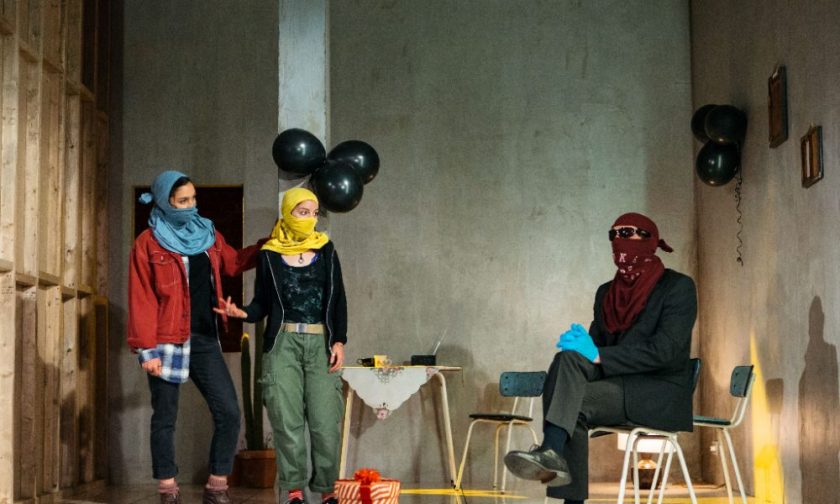
c2aehelenmurray-b-by-guillermo-calderc2a6n-directed-by-sam-pritchard-royal-court-261-1000x600

B

Royal Court Theatre, 12th October 2017

I wasn’t entirely sure what to see from the plays on offer in this latest season at the Royal Court. I don’t know enough about the writers and the teasers on the website are exactly that, teasers. Seeing too many is an extravagance, but waiting for reviews risks missing out on some outstanding theatre. Sounds like I’ve already ballsed up by missing The Fall if my friend the Captain is to be believed, and she usually is. And now, with this play B and Victory Condition, both of which had their moments, but were not altogether convincing, I am beginning to doubt my picks. Still first world problems. eh.

B was written by Chilean playwright Guillermo Calderon and commissioned by the RC. Chile has a history of impassioned political protest, which has spilled over into violence, with several hundred bombings since the constitutional changes in 2005. “Noise” bombs, intended to cause damage to property and highlight apparent injustice, are prevalent. This play, which concerns a plot to plant just such a bomb, therefore lost a little bit in translation here in the genteel surroundings of Sloane Square.

It is set in a room in a flat where Marcela (Aimee-Ffion Edwards) and Alejandra (Danusia Samal) are being comforted by neighbour Carmen (Sarah Niles). Marcela’s boyfriend has apparently been killed by a terrorist bomb. This turns out to be a ruse as Marcela and Alejandra are hatching their own bomb plot. Jose Miguel (played by the ever watchable Paul Kaye) turns up with the bomb. Cue a nervous run through of the plan which is played, successfully, for comic effect. As the night wears on though the motives behind the plot are exposed with Jose Miguel advocating a more violent approach to protest than the two women. The tone shifts, the black comedy evaporates, and we build to three impassioned monologues from each participant questioning why and what and why they are doing. Carmen the neighbour returns and is not quite what she seemed. There is a dramatic finale.

Sounds good on paper right? I agree. It also reads pretty well in the text. The problem is that the tone oscillates and the tension, which should build to breaking point given the material, just never seems to ratchet up. I suspect this is not the fault of the production under the direction of Sam Pritchard and designer Chloe Lamford, but lies in Mr Calderon’s claustrophobic and phlegmatic plot. I am not sure that enough really happens, or that we find out enough about the three conspirators, early enough in the play. Which leaves the three, admittedly fervent, monologues near the end shouldering much of the interesting and unsettling debate between the unfocussed, politically naive but heartfelt protest of today’s youth, with the more organised, direct and ideologically informed revolutionaries of previous generations.

I went with the SO. She can write the sort of sharp, sarcastic, Pinteresque (sorry its the only word for it) dialogue that this started off with in her sleep. She wasn’t best impressed. Mind you if she had stayed for Victory Condition I reckon I would have been in real trouble. Such is the danger of picking theatre in advance. Ho hum,
 

Blade Runner 2049 film review *****

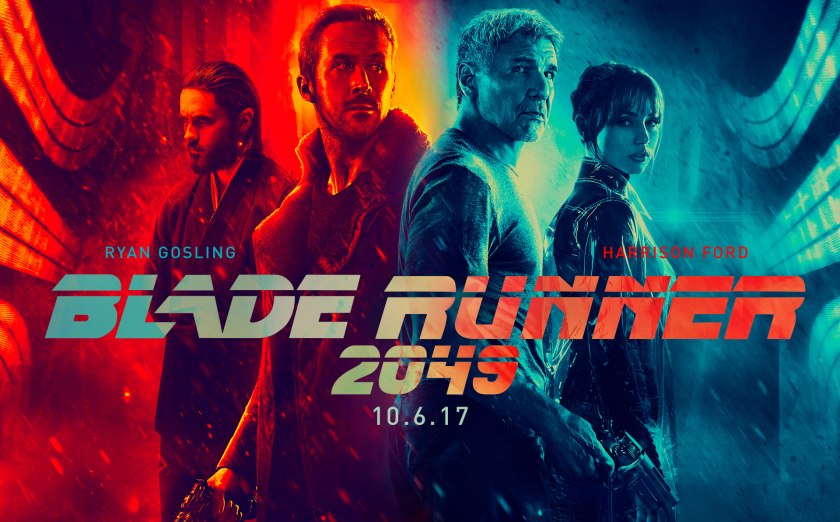
blade-runner

Blade Runner 2049, 12th October 2017

Confession time. I think the original Blade Runner film is OK. Even in all the re-cut versions. Not brilliant, not a great leap forward in the cinematic science fiction genre, not a searing insight into the human condition. Just OK. Worth seeing but just didn’t have much to say. Whisper i,t but a bit like Philip K Dick’s stories; once the central conceit is out it is all a bit predictable.

I also think Harrison Ford, even in American Graffiti and The Conversation (which are brilliant films), right at the beginning of his career, always looks like a small part of him would rather be somewhere else. With this in mind I am always a little chary of any film where he is involved.

However I have to say I was bowled over by Blade Runner 2049 and am even prepared to forgive Mr Ford’s passable impression of a septuagenarian Putin as he puffs his chest out and roars gruffly at the film’s climax. (To be fair his grizzly Deckard was actually pretty good). Of course the film looks superb courtesy of cinematographer Roger Deakins. You will purr inwardly with pleasure at some of the visuals and all the imagined technology. There is surely enough burnt orange sky, acid rain and neon signage to keep afficionados of the original film very happy. I also think I might prefer Vegas in this, rather than its current, look. The score is imposing, an electronic howl which imitates the original Vangelis pulse but wisely nicks a lot from the late C20 masters like Xenakis and Ligeti.

Of course there are also some superb performance: even I, who is very suspicious of all Hollywood actor types until they prove it on stage, have to admit Ryan Gosling is the real deal (even after his inauspicious beginnings, I mean Disney, not Canada). Mr Gosling here is a master of restrained emotion – notably in the scenes with holographic partner Joi (Ana de Armas) – exactly what his character demands. Sylvia Hoeks as Luv, Mackenzie Davies as Mariette and Carla Juri as Dr Ana Stelline, also stood out for me.

And of course the film plays with some big, bold and important ideas, about what it is to be human. Yet it is the way that director Denis Villeneuve, and co-writer Hampton Fancher, allow these ideas to breathe that is most impressive about the whole enterprise. Avoiding too much CGI crash, bang, wallop (though there is plenty of this at the end), and stretching the film out to 160 minutes, all helped but this was no guarantee of metaphysical success though.

The pace is undeniably languid in places, (which I gather is a problem for some), but this means there are plenty of scenes and lines which explore the border between humanity and artificial intelligence, in, er, a very human and intelligent way, if you see what I mean. As it happens, I reckon the meaning of consciousness will increasingly become a feature of everyday discourse. Which will be fun. When neuroscience shows us that we have no free will. Or that there is no such thing as the “mind” or the “soul”. Have a read of that Homo Deus by Yuval Noah Harari to get into the swing of things.

It also helps that there is a decent plot here, albeit as old as the hills with its variation on an “orphan” setting out to uncover his true past. Moreover the nods to Franz Kafka’s novels, with their themes of alienation and helplessness, are inspired and give the film some backbone. In contrast to his namesake Ryan Gosling’s Joe K has agency however, even as he threatens the Wallace Corporation, the inheritor of the Tyrell Corporation’s legacy, headed by the eponymous Niander, played with gnomic gusto by, who else, Jared Leto. We learn very early on that K is not quite what he seems, but how he came to be turns out to be a satisfying detective puzzle. It is only at the end (after a fine homage to Kubrick’s The Shining) that the film lapses into the obvious.

So a marvellous film which is way better than the original. If you want explosions stick with Star Wars. If you are prepared to put a bit more in, (and to cross your legs), then this is infinitely more rewarding. I suspect the whole thing is littered with references which may not have been revealed on first viewing. Thus making it even more appealing to the pretentious, intellectual w*anker like me. Neat.