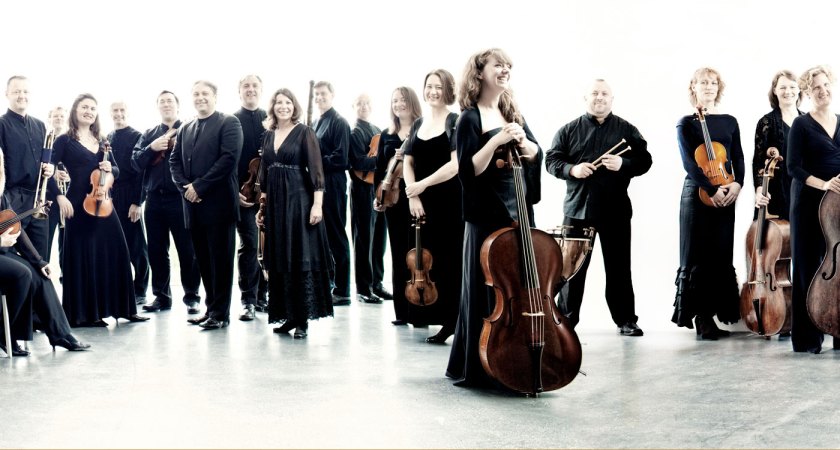
Akademie fur Alte Musik Berlin at the Wigmore Hall review *****

50709-0-m114-510-akademie-fur-alte-musik-berlin-kristof-fischer

Akademie fur Alte Musik Berlin, Isabelle Faust, Bernhard Forck

Wigmore Hall, 29th June 2017

  • JS Bach – Suite No 2 in A Minor BWV 1067a
  • JS Bach – Violin Concerto in E Major BWV 1042
  • JS Bach – Violin Concerto in A Minor BWV 1041
  • CPE Bach – String Symphony in B Minor Wq 182/5
  • JS Bach – Concerto for Two Violins in D Minor BWV 1043

I had never seen the Akademie fur Alte Musik Berlin nor Isabelle Faust before but was aware of their reputations so I was really looking forward to this concert. Well I certainly wasn’t disappointed. This was thrilling stuff. I can safely say these were the best performances of Bach Violin Concertos that I have ever heard (mind you I haven’t heard that many live to be fair).

The opening suite set out the stall. The Akamus was founded in 1982 with many long standing members. It is also boasts a prolific performance schedule. This shared experience shows. The unanimity of the playing was astounding with the whole chamber ensemble moving as one, with every line of Bach’s music audible. A masterclass in amplitude if you like. The A Minor Suite is comprised of six dance movements preceded by an overture and was compelling from the off. There are only relatively brief periods when the solo violin line shines through but this was our introduction to Ms Faust’s ostensibly delicate, but remarkably convincing, playing. It is a mystery to me how someone who appears to barely stroke the strings with the bow creates such grand and convincing phrases.

In the subsequent JS Bach pieces,, the violin of Bernhard Forck was increasingly prominent, both as sympathetic leader, and and as support to Ms Faust. This really was Bach concerto musicianship of the highest order especially in the closing Double Concerto with its majestic fugal opening, sweet slow movement and finale with that three note repeated riff running through The link back to Vivaldi (ritornello is great for dummies like me – all the music I love is repetitive in some way) was highlighted, but the clarity of the playing made it easy to pick out the Bach innovations in each of the violin concertos. I haven’t heard better. 

The CPE Bach piece was new to me and was a fair way from the inoffensive galant style that I had thought was the hallmark of these String symphonies. Not sure I will go out of my way to explore these pieces further but this was more striking than I had anticipated.

I would love to hear more of this ensemble and soloist playing this repertoire. I am even prepared to forgive the couple of frightening perms and suspicious mullet sported by some of the gentleman on show. This will definitely figure in my annual top ten. How sad is that. I am 53. I am not holed up in a musty smelling bedroom. I should have grown out of making lists four decades ago.



Common at the National Theatre review ***

common_960x230_tcm618-162513

Common

National Theatre, 28th June 2017

Is it possible to feel sorry for a play? Common has had some pretty poor reviews from the criterati and the public alike and there are tons of tickets left for the month or so left on the run.

Well I can’t pretend it isn’t without some pretty deep flaws but I didn’t think it was as bad as some have painted. As usual the Tourist has come late to the run. I gather it has been subject to some judicious cuts and it might be that the cast has become more attuned to playwright DC Moore’s curious and fruity language. It is a bit bonkers and a long way from what I had expected but I have seen much worse.

Our heroine Mary, played by Anne-Marie Duff who proves once again she is incapable of a having an off day at work, returns to her unspecified “home” after a spell in the den of iniquity that is London. Why she returns is never made clear. She might be seeking to exact revenge on her “brother” King (John Dagleish), she might be returning to her love, and “sister” Laura (a spirited Cush Jumbo), she might be seeking to help the ‘”villagers” succumb to the pernicious consequences of land enclosure. She has run ins with a bunch of Irish labourers, with the “Lord” (a perfectly cast though somewhat reticent Tim McMullan) and the Lord’s henchman Heron (Trevor Fox in full on Geordie) and with assorted villagers including the naive Eggy Tom (a touching Lois Chimimba). She, Mary, dies, is resurrected and then wreaks various revenges. Is she a con-woman, a seer, a harbinger? Who knows.

The programme some excellent essays. One is on the impact of enclosure on rural England from the late Medieval period, through the Tudors and, most aggressively, in the last C18 and early C19, when Common is set (1809). Capital has been screwing over labour, in more or less brutal ways, from the off and there is hardly anything more vital for theatre to examine. Another essay is on the importance of magic and spirits in the everyday existence of the “common people” alongside established religion and in the absence of universal education. These are interesting and important themes that the play seeks to explore. However, the slipperiness of the plot, and the focus on how the characters sound and look, serves to obscure these themes in my view.

DC Moore’s text in parts is written in a mangled, “rustic” English (think Yoda as a Wurzel) with plenty of profanity. Most of the criterati don’t seem to get on with this at all. I did. It takes a bit of getting used to but I think this, together with the lighting (Paula Constable deserves a special mention), the sound, the costumes, the set (though once again the Olivier stage offered too much space to the production) and the appropriate music written by Stephen Warbeck, all served to create an atmosphere which I think worked to the play’s advantage. And, as I have indicated, the performances, in large part, gave as good as they got with the material on offer.

The faults then for me largely lie in the meandering plot and the absence of an overarching narrative. This was not some non naturalistic, surreal or absurdist theatre. There was a story and there were ideas; they simply didn’t coalesce. I think Jeremy Herrin, the director, and the Headlong production team, who can normally be relied upon to manufacture a “hit”, probably know Common is a way off what they all hoped to create, but I for one would still applaud their bravery in trying to make this work.

So overall then I don’t think this is quite the turkey that some have painted it as. Yes it does fall down on many counts but it is also, in my view, interesting in other ways. You have been warned but if your expectations have been set low you might be pleasantly surprised if you do splurge all of £15 on one of the remaining performances.

And I wouldn’t mind betting that one day, after a re-write and a re-think, it comes back and is heralded as a misunderstood classic. Mind you it won’t be at the National I suspect.

Churchill film review **

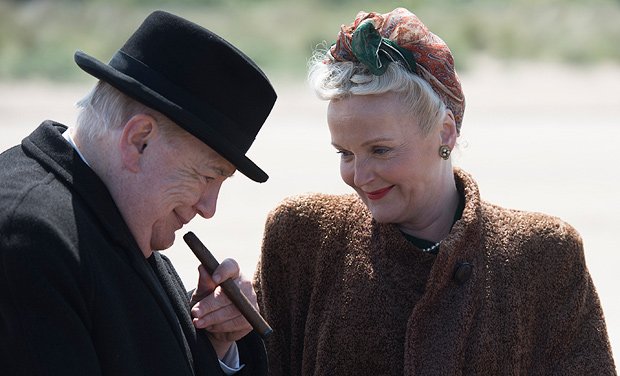
churchill-still-03-vl-lst2473001

Churchill, 25th June 2017

I am a sucker for screen portrayals of Churchill. I didn’t really get on with The Crown last year on NetFlix but John Lithgow was on the money as the great man. And the past performances from the likes of Brendan Gleeson, Timothy Spall, Michael Gambon, Albert Finney and obviously Robert Hardy all live in the memory. Obviously “the greatest ever Briton” was a barrel of contradictions but the mythology runs very deep in my and prior generations.

We have Gary Oldman to come in the Darkest Hour later in the year directed by Joe Wright (recently expertly pulling the strings in the Young Vic’s Life of Galileo Life of Galileo at the Young Vic review ****). And here the Brian Cox took on the role in this eponymous film directed by Jonathan Teplitzky with Miranda Richardson alongside him as wife Clementine. The film deals with the few days leading up to the D Day landings (Operation Overlord) and focuses on Churchill’s seeming reluctance to embrace the plans (explained by the horror of Gallipoli in the WWI). The screenplay and performances do a good job of showing why he was opposed to the operation but there isn’t really much in the way of plot beyond that.

It is all a bit ponderous I am afraid with Cox barking out the majority of his lines and an awful lot of him looking morosely into the distance. It s hard to actively dislike and the two leads try their best with what they given but it just doesn’t really have enough bite or depth.

Never mind. They’ll be plenty more Churchill’s to come.


Monteverdi Vespers at the Barbican Hall review *****

orchestra

The Academy of Ancient Music, Choir of the AAM, Robert Howarth, Louise Alder, Rowan Pierce, Thomas Hobbs, Charles Daniels

Barbican Hall, 23rd June 2017

It was the Academy of Ancient Music and its choir performing Monteverdi’s 1610 Vespers. It was bound to get 5 stars.

If you have spent your life blissfully unaware of Monteverdi’s Vespers then I implore you to take a listen. I can see that a few people have accidentally stumbled upon this blog, normally when looking for reviews of plays that proper critics and bloggers haven’t bothered to see. So they had no choice but to read my nonsense. If you are one of these people and you happen to open this post by mistake, PLEASE PLEASE PLEASE find a way to listen to the Vespers of 1610.

I don’t care what bag of music you are into. I don’t care if you think classical music is a load of nonsense. This is different. I promise. It does go on a bit I admit. Hour and a half. But it is broken up it to lots of different chunks. And it is divine. In both the sacred and secular sense.

Now if you or I wanted a new job we would ask around. Probably scan the press, specialist and general. Contact an agency or if you are an important sort, tap a headhunter. You would dust off the CV and hawk it around. Not our Claudio though. When he wanted to escape from his overbearing employer the Duke of Mantua, feeling overworked and under-appreciated, he wrote this and sent it off to the movers and shakers in the rest of Italy (though it wasn’t Italy then of course) with a particular eye on a job with the cashed up Pope. He was well known largely for his madrigals, where he was the bees knees, the Ed Sheeran of his day. But he wanted a more prestigious position where he could churn out more weighty stuff – like what happens to all talented pop stars when they “want to be taken seriously”. In the end he got the top gig at St Mark’s in Venice.

This explains why Monteverdi mixed up the various styles of church music, some taken from tunes he had already written, to create this Vespers. The title says it all: “To the Most Holy Virgin: a Mass for four voices, for Church chorus, and Vespers to be sung by several voices, with a few sacred songs”. All of the elements of the standard Catholic Vespers are there but interspersed with other elements which make for a masterly mash-up. The piece is unique for its time in the way it looks back to the Renaissance with plainchant melodies anchoring the structures in the five psalms, the hymn (Ave maris stella) and the choruses of the Magnificat, that make up the Vespers. Yet it also looks forward into the Baroque of Bach, and even some proto-Classical homophony, in the four “concertos” and sonata which are more “secular” in sound despite still praising the Virgin Mary to the hilt. All of the contrasting textures, both for voices and instruments, also show why Monteverdi effectively invented opera.

The performance by the AAM and chorus under the guiding hand of Robert Howarth at the harpsichord was excellent I think. Of the soloists we, (BUD wasn’t going to be allowed to miss this one), were most taken with Thomas Hobbes (tenor) and Louise Alder (soprano) but it almost seems churlish to say so. The twenty strong choir was on top form and the AAM (which is made up of some of the finest period music interpreters anyone) was magnificent.

Now you will find smartarses who reject this way of performing the Vespers – several voices to a part, two tenors and two sopranos, step out soloists, “echo’ effects meaning soloists whizzing around the building and so on – but trust me, they can safely be ignored. A perfect Vespers might need a Cathedral and candlelight rather than the Barbican stage but the music is just so amazing that I strongly recommend that you just add this to your bucket list and get on with ticking off. I cast iron guarantee you won’t regret it.


Ensemble InterContemporain at the Wigmore Hall review ****

ensemble-intercontemporain-wigmore-hall

Ensemble InterContemporain

Wigmore Hall, 20th June 2017

  • Debussy – Premiere rapsodie
  • Bruno Maderna – Viola
  • Messiaen – Le merle noir
  • Philippe Schoeller – Madrigal
  • Luciano Berio – Sequenza 1
  • Ravel – Violin Sonata
  • Matteo Franceschini – Les Excentriques

Ensemble InterContemporain was founded in 1972 by Pierre Boulez and tenures 31 musicians, based in Paris but international in origin, and allows them to focus on contemporary chamber music. Thank you dirigiste France and take note you English philistines.

Having said that I confess I needed a bit of encouragement to pitch up to this which was provided by the Ravel Violin Sonata, which I haven’t heard performed live for donkeys years, as well as the Berio and the Messiaen pieces. I was less interested in the Debussy and the others works were going to be pot luck. But I figured if anyone could make this all work it would be this renowned collective.

Anyway it turned out to be a largely fascinating programme. The Debussy was more colourful than I anticipated. It was written as a test piece for students at the Paris Conservatoire so it gave clarinettist Jerome Comte a chance to work out accompanied by pianist Hideki Nagano (who I think on the night was the most assured performer – I would like to here him play in a solo capacity). The Bruno Maderna is a whole different barrel of fish. This is scored in open form which means the performer (Odile Auboin here) can choose their own route through the score. Interesting but I couldn’t help feeling this made for a somewhat tentative performance with no line I could follow,

The Messiaen piece was also written for students at the Conservatoire, this time flautists. There is a bit of bird song at the off as you might expect, then a few twiddly phrases and finally a mix of serial phrases on the piano and more rhythmic patterns on the flute, here sympathetically played by Sophie Cherrier. Good stuff. Now I confess the structure of the Philippe Schoeller piece escaped me, and the programme notes here went in to pretentious overdrive as they did with the premiered work by Matteo Franceschini. It is a piano quartet “informed” by Renaissance madrigals which contained some dazzling tremolo and glissando sounds as strings and piano came together. It will require some further investigation.

Berio’s Sequenza I is written for flute and, like all the Sequenzas, is a fine, direct piece. It consists of individual notes but you can discern the chords these would create so has a logic which makes listening straightforward. I thought Sophie Cherrier’s rendition was perfect. Ravel’s Violin Sonata (No 2) took him a bit of time to complete and is contemporaneous with his opera L’Enfant et les Sortileges. Like that work it is imbued with the spirit of the jazz, most notably in the “Blues” second movement, but also in phrases in the first movement. The last movement with its dancing semi-quavers for the violin is a personal favourite and I thoroughly enjoy Jeanne-Marie Conquer’s playing.

The soloists all returned for the Franceschini piece which is a collection of six character studies based on real though unnamed “eccentric” people. The first and last studies had a bit of pace about them but the other four were a bit more pedestrian and I am afraid I wasn’t up to the task of following the thread of the music.

Overall this was a rewarding evening listening to some fine musicians explore some exciting repertoire. Both Mr Schoeller and Mr Franceschini were in attendance. It is such a joy to see a composer and performers taking a bow. Glad I took the plunge. Contemporary classical music is a specialist pursuit and I get that for the vast majority of people this is all nonsense. But for me it is important that composers and musicians push the boundaries. The audience for modern and contemporary plastic arts is expanding. In time I think the same will happen for contemporary classical music. Mind you finding some mug to go along with is proving a challenge for me but I am convinced I will prevail, even if I may have to employ a little subterfuge.