Directors’ Festival at the Orange Tree Theatre review

jvudn7az

Directors’ Festival 2017

Even Stillness Breathes Softly Against A Wall ***

The End of Hope *****

Albert’s Boy ***

Orange Tree Theatre, 26th, 27th, 28th July 2017

Now this really is a mighty fine idea. Take five short plays by some of Britain’s finest contemporary playwrights and hand them over to five talented young directors currently completing their MA’s at the local St Mary’s University (just down the road). Assemble fine actors and students to support the enterprise, carve out a week of rep, and charge just £7.50 a ticket to us punters. Everyone’s a winner.

Now I was only able to make 3 of the 5 offers, missing out Enda Walsh’s Misterman and Kate Tempest’s Wasted. But the three I did see where very good, and, in the case of David Ireland’s The End of Hope, outstanding.

Brad Birch has form at the Orange Tree with his The Brink being performed a couple of years ago and Black Mountain coming up. Even Stillness …. has some of the qualities I observed in the Brink. There is an anger and paranoia in the way characters react to contemporary life which is interesting if not entirely satisfying. In the Brink the lead character, teacher Nick, may have stumbled across a conspiracy or may be cracking under the stress of the job. It is funny and sharp but, once the direction of travel was established, seemed to run out of steam a bit for me. Here,  Even Stillness ….. shows a couple, Him and Her, in full on alienation at work mode, who then slowly retreat into each other at home, but whose rejection of their rubbish modern life spells another type of disaster. It is spiky and angry but in some ways lacks surprise. On the other hand it is hard to see how the direction of Hannah de Ville and the acting of Orlando James (last seen by me as a convincing Leontes in Cheek by Jowl’s Winter’s Tale) and Georgina Campbell could have been bettered.

Albert’s Boy is, I believe, the first play from the pen of James Graham. Mr Graham is now the master of the socio-political comedy – witness Ink at the Almeida (Ink at the Almeida Theatre review *****). This two hander sees Andrew Langtree’s Bucky, friend of the family and Korea vet/POW, visiting Robert Gill’s Einstein, in the US in 1953. Einstein is tortured by his involvement in the programme that led to the launching of the atomic bombs, Bucky is scarred by his recent internment. Cue an examination of the big picture political landscape of the times and smaller scale demons of our two leads. Like Mr Graham’s more mature works this has some laugh out loud lines and easy to digest learnings. yet is is a little worthy and static. Once again though I couldn’t fault cast or the direction of Kate Campbell.

Now I have to say I think The End of Hope is a terrific play. I ended up having to cancel Cypress Avenue at the Royal Court last year (bloody kids were up to something) which annoyed me immensely. And I missed Everything Between Us at the Finborough recently. That was stupid judging by this. The End of Hope takes a slightly surreal one night stand and proceeds to mercilessly skewer notions of identity, political, religious, sexual, the nature of fame, high and low culture and pretty much anything else that takes Mr Ireland’s fancy over 50 minutes or so. It is hilariously funny with twists and turns which are not at all forced. As with his other plays sectarian division in his native Northern Ireland acts as the backdrop for the satire. But this is far from geographically bound. Breathless stuff with a real chemistry between Elinor Lawless and Rufus Wright as Janet and Dermot. And hats off to director Max Elton. I suspect getting the pace of performance right here is much trickier than it looks.

So there we have. Three fine plays. Theatre alive and well in the hands of these lovely young people and an urgent need to see more of David Ireland’s plays.
Dunkirk film review ****

18198201_1305343799560849_1174691762453026571_n

Dunkirk, 26th July 2017

Regular readers of this blog (soon to be counted on the fingers of more than one hand I confidently predict) will have worked out that I am not a committed film buff, preferring the theatre, art exhibitions and, within limits, classical music concerts. And I am a bit random in what I do end up seeing at the cinema, though with a bias to the kind of foreign language efforts that the Guardian approves of.

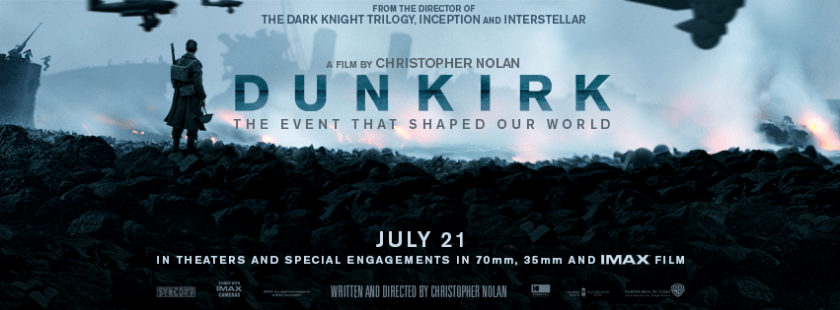
Dunkirk though was going to be an obligatory view however largely for the subject. As I observed in my review of the rather pedestrian Churchill (the film not the bloke – see here Churchill film review **) the mythology of this history is deep-rooted. What I didn’t do though was pay much attention to director. cast or the much vaunted production choices which underpin Dunkirk the film. So the absence of CGI, the focus on character as metaphor, the absence of blood and guts, the intersection of time periods, in fact the whole Sunday morning 1950s matinee quality which pervaded the whole affair was a welcome surprise.

Nothing wrong with using technology to create visual drama and spectacle for the cinema audience but, in my experience, it can mean plot. character and meaning can take a subsidiary role to the visual extravaganza. Not here. You are not going to be surprised by the depth of psychological introspection revealed in the dialogue nor should you expect a devastating indictment of the politics that lie behind what was a humiliation for the Allied forces. This is a straightforward telling of the “story” but smartly avoids moralising or mythologising precisely because of what is not there. Instead it is an engrossing impression, complete with banging score and some cracking camerawork, of a sequence of events. Branagh does a Branagh, Rylance does a Rylance, Hardy does a Hardy and the somewhat lesser known cast members (all blokes) all fall into line (including that Tom Glynn-Carney who shines in The Ferryman on the stage).

I couldn’t tell you if director Christopher Nolan’s non-linear storytelling is the mark of an auteur or just a way to cut down editing costs but it is effective for me. Too much mainstream cinema is boring for me because it is linear and predictable so this was a welcome diversion.

Anyway all I up I wandered in. sat down, got caught up in the film and the people in it, came out and broadly forgot about it. That’s enough for me and way more than I normally get when I inadvisedly see a “blockbuster” film.


Daniel Kitson at the Roundhouse review ****

86

Daniel Kitson: Something Other Than Everything

The Roundhouse, 25th July 2017

I really can’t be doing with most stand-up comedy and will rarely pay money to go and see it. Most stand-ups are mildly diverting at best and often begin to grate as they default to cheap laughs from tired observational tropes.

LD and I recently went along to the benefit gig at the Hammersmith Apollo for victims of the Grenfell Tower fire. Good cause so well worth it, but, with the exception of that Russell Kane and Rob Beckett, in flashes, it served as a reminder of the above rule. Don’t get me wrong, I will laugh and generally have a good time, but this doesn’t normally do much more for me.

There are some exceptions however. En famille we can still get a lot of pleasure out of the quality punnery of Milton Jones and Tim Vine. And Stewart Lee will likely remain mandatory viewing every year until I die. (See here Stewart Lee: Content Provider review *****). As, probably, will Daniel Kitson.

Now I can’t pretend I have pitched up to everything Mr Kitson delivers but I have seen enough routines over the years to know his gifts and I also have a high regard for his more recent theatrical forays, notably Tree at the Old Vic which was a 2015 Top 10 Theatre pick for me, and the more challenging, but still very rewarding, Analog.Ue at the NT in 2014.

So high hopes going in to this. And by and large Mr Kitson delivered. Several strands woven together, enhanced by sound and lighting effects with the usual mastery of comedy technique. When it works it is still very very funny as well as being reflective to an almost exquisitely painful degree. Comedy self-examination requires discipline and by and large Mr Kitson exhibits this. However he sets such a high standard that, just occasionally here, the edifice wobbled. Two hours with this many paths through the material, with diversions, reversions, checks, balances is asking a lot of us mere mortals. How to be a liberal, how to be good, determinism and free-will, empathy, all this and more, presents an awful of possibilities for Mr Kitson to explore and sometimes I frankly wasn’t up to it.

So a qualified recommendation. It’s Daniel Kitson so if you know what to expect you will be rewarded. and it is only £12 thanks to Mr Kitson’s principled generosity. But I still have this nagging feeling that if he could just rein in the brilliance a bit and revert to a more conventional stand-up format it might have been even funnier.

Still mustn’t grumble. Like I said most stand-up comedy is pants.

Ink at the Almeida Theatre review *****

tony-turner-bertie-carvel-geoffrey-freshwater-richard-coyle-jack-holden-tim-steed_c-marc-brenner

Ink

Almeida Theatre, 24th July 2017

Recipe for a very satisfying night at the theatre.

  1. Choose your company. I spend the vast majority of my theatre going life flying solo. So it is such a pleasure to be joined by some choice chums. In this case the SO, the Blonde Bombshells, BUD and KCK. Lovely.
  2. Have a bite to eat beforehand. Now having a “pre-theatre supper”, (I f*****g loathe the concept of “supper” and all who refer to it – it is called dinner), is sailing perilously close to the limits of poncey stuckuppery as far as I am concerned. But I have to say plate of delicious comestibles at that Ottolenghi realy did hit the spot even if the price/volume interplay was very suspect. I may go again. What a toff I have become.
  3. Go to the Almeida Theatre. This is starting to get silly. As far as I can see the Almeida under Rupert Goold has not put a foot wrong in the last four years and is now, in my humble opinion, London’s best theatre. Mr Goold is blessed with Robert Icke as a wingman and can call on just about any stage acting heavyweight he fancies. And he and his team are fortunate to be well oiled by the cash of the professional and chattering classes of Islington. But what has been most impressive for me is the string of new works that have been showcased alongside the classics. As proof I give you Hamlet, Mary Stuart, Oil, They Drink it in the Congo, Richard III, Uncle Vanya, Little Eyof, Medea, Oresteia, Bakkhai, Carmen Disruption, Game, King Charles III. 1984 and American Pyscho. All great and, in many cases, outstanding works of theatre. Even the misfires have had something of value.
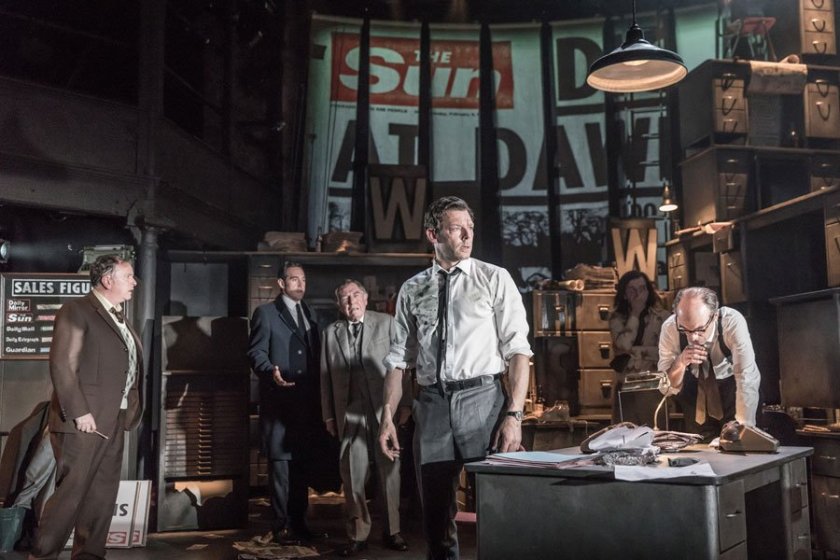
  4. Choose your writer, James Graham. Now it looks to me as if Mr Graham has found his groove and is now busy perfecting it. Dramatising relatively recent socio-political events brings recognition to us, the audience, which means we can ruminate on the parallels with the right now, whilst still being thoroughly entertained. Mr Graham just has the knack of picking and writing a good story. That is not as easy as it sounds. In the case of Ink he has gone one stage further than in This House for me by shining a light on the genesis of the populist tabloid, here the Sun, just at the point when maybe, the power of this particular beast is waning. The story of the first year of the Sun, following Rupert Murdoch’s purchase of the title in 1969, turns out to be theatrical gold. Murdoch’s desire to take on the British establishment and “give the people what they want”. his relationship with editor Larry Lamb, Lamb’s own personal battle with Daily Mirror editor and mentor Hugh Cudlipp, the pulling together of a team of Fleet Street rejects, waifs and strays to create the new style tabloid, the shocking kidnapping and death of Muriel McKay, wife of Murdoch’s lieutenant, the provocation of Page 3: all of this is deftly and pacily explored by Mr Graham in an often acutely amusing way. The motives for recasting journalism and the press in the UK are laid bare: the consequences we know from the intervening decades. Brilliant stuff.
  5. Savour the performances. Unsurprisingly the attention of the critics has focussed on Bertie Carvel’s Murdoch. It’s another bravura performance from an actor who seems to relish “the method” as far as I can see. I thoroughly enjoyed the physicality of his Yank in the Old Vic’s Hairy Ape (which was underrated in my view) and here he captures the awkwardness of Murdoch, his prudishness, his curious accent and his “outsider” psychology perfectly. He is not the caricature demon we “liberal” types need him to be but he is the archetype of “destructive capitalism”. (As an aside I once had a breakfast meeting in Washington. Rupert Murdoch sat down alone on the table next to us. His presence dominated our meeting for the next hour. All he did was eat toast and read the paper but all eyes were on him.) However, if I were Bertie I might have fancied taking on the Lamb role instead. On the other hand Richard Coyle does such a good job there was probably no vacancy. I have seen, and I am sure will see, more virtuoso, scenery chewing, thespianism on stage this year (Lars Erdinger/Greg Hicks in Richard III, Andrew Garfield in Angels in America, Cherry Jones in the Glass Menagerie, Andrew Scott in Hamlet, Brendan Cowell in Life of Galileo, by way of example) but Mr Coyle absolutely nails this from the off. This is a character whose seems compelled to test boundaries. He carries much more of the play than I expected but, even so, this really is an ensemble piece, and that is what makes the “us against the world” dynamic so persuasive.
  6. Take your hat off to Rupert Goold as director. I could be wrong but I reckon that Mr Goold is one of those rare leaders who can control his own ego. What you see on the stage in his productions is what writers, cast, designers and all the other good folk around want to show. I am guessing he guides, he doesn’t dictate. the world needs more leaders like that. My guess is Mr Murdoch would disagree.
  7. Set, Light, Sound, Action.  It is a tabloid in 1969/1970. Activity, headlines, demarcations, flares, eyeliner, dodgy haircuts and dodgy views. You can conjure up a picture in your mind I reckon but what you actually get far surpasses this. Bunny Christie’s set is the antithesis of minimal but so perfectly captures place and time. Some of the movement and dance (yep) is very witty and the scene elucidating the production process is inspired.

All in all a tip, top piece of theatre that I defy anyone not to enjoy. It lifts you up and carries you along from the open and makes you laugh, whilst still getting a little bit vexed about how this instrument of shabby, public discourse could have become so powerful.

So if it were to pop up in a transfer, as so much of the Almeida’s work now does, and you haven’t seen it, don’t hesitate. A proper story. Popular not populist.