
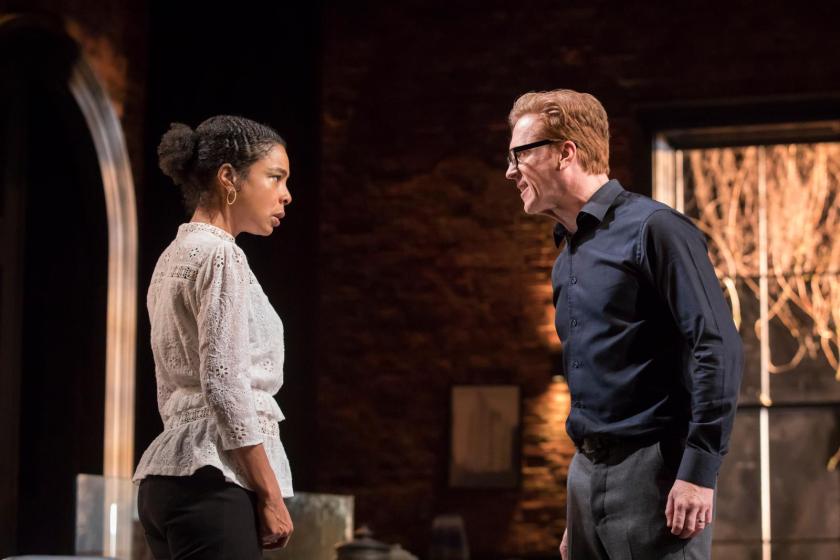
The Goat, or Who is Sylvia
Theatre Royal Haymarket, 25th May 2017
I love the theatre. It wasn’t always so. Until relatively recently I confess I didn’t have the time or, more importantly, the patience to really grasp what it was all about. Yes I would see a few plays, and sometimes, if the production delivered, and I wasn’t tired or distracted, I could get lost in the drama for a couple of hours. This was though, an infrequent distraction.
Things have changed. I count myself immensely fortunate that I now have the time, and the means, to indulge what is developing into a passion, nay addiction. Which brings me to Mr Edward Albee. Until the last couple of months I had never seen one of his plays. I was just about cognisant of his existence, and had seen the Burton/Taylor Virginia Woolf film version, but that was it. Now I have seen, in quick succession, the Who’s Afraid of Virginia Woolf production, directed by James MacDonald and with Imelda Staunton and Conleth Hill acting their socks off, and now this version of The Goat.
And I can’t wait to see more of his plays. This was really, really good. The set-up is as simple as it is provocative. Martin, our prize winning architect played by Damien Lewis, reveals to best friend Ross (Jason Hughes) that he has fallen in love, emotionally and physically, with a goat. Ross is compelled to tell Martin’s wife Stevie (Sophie Okonedo), who then tells son Billy (Archie Madekwe – what a play to debut in). So we have a man at the top of his game with a fatal flaw who through the action of another is brought crashing down. So this is the classic Greek tragedy updated (apparently the word tragedy comes from “goat ode” in ancient Greek). This forms the structure from which Albee explores the nature of love, its relationship to sex, what society admits is permissible and what is not, and, through an immensely rich text, why this is so,
The ultimate transgression of bestiality is a brilliant device to play with an audience. Obviously it puts us into a very uncomfortable place but also encourages us to laugh, both because some of the dialogue is genuinely funny (Martin and Stevie’s intelligence and liberalism make them very aware), and as a way to deal with the apparent absurdity of Martin’s behaviour. Yet as the other characters come to terms with what Martin is telling them the tragedy of the situation comes through. Hearing and feeling the audience’s reaction to the drama is what makes this an outstanding play.
Damien Lewis perfectly captures Martin’s pedantry and, as he moves from a curiously passive matter-of-factness, to a more impassioned exhortation of what he has done, we get pitched between disgust and sympathy. Jason Hughes as Ross represents a society that cannot, and will not, tolerate his actions. I confess that I think Sophie Okonedo is a brilliant actor – her performance of Margaret in the Hollow Crown is the best thing on the screen which, given the competition here, is saying something. Anyway the way she charts Stevie’s journey from disbelief and incomprehension through anger and vengeance, yet still being reflexive, was riveting.
A play ideally makes you laugh, cry, think and reflect. Inwardly, if not always outwardly. It should also stick with you. This fits the bill for me and, I gather, other theatrical smart-arses. I also gather there have been some highly regarded performances since it premiered in 2002. So maybe the play itself was what bowled me over but I am hard pressed though to see how this production could have been better. A more conflicted Martin from the off maybe – but then that removes his fatal justification on which the reactions hang.
In the hands of director Ian Rickson, nothing gets in the way of the tragi-comedy on the stage. That is as it should be. Next up he is directing Against at the Almeida. I can’t wait.
So if you are like me a couple of years back – a bit too busy to do more than a handful of plays a year – this is what you should do. Book this, there are a few weeks left, the transfer of the Almeida Hamlet at the Harold Pinter Theatre and the transfer of the Royal Court’s The Ferryman at the Gielgud Theatre. No risks, five star reviews for all of them across the board. Then just wait for the next blockbuster.

 At Home He Feels Like A Tourist