
Grounded at the Gate Theatre review ****

image_crop-1-e1488913174438

Grounded

Gate Theatre, Notting Hill Gate, 15th March 2017

Given that Grounded is now into its third run at the Gate and that is has had critical acclaim heaped upon it the last thing it needs is this chump adding to the sound and fury. But it seems I am something of a completist when it comes to recording my cultural journey so so no let off for you I am afraid.

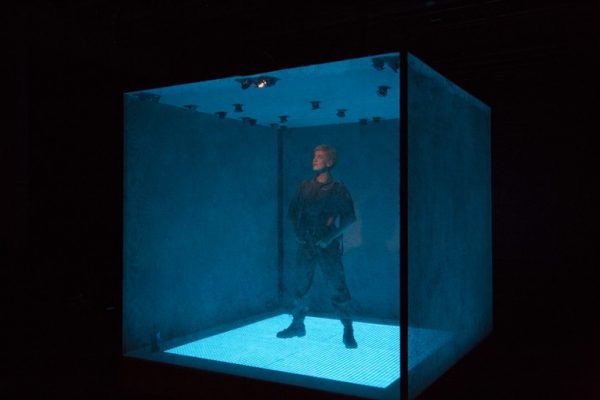
And it is good. I mean really good. There was a bit of me that was a bit dubious going in to this. Potentially obvious target with an an obvious outcome (I swear no irony intended in this). But it is some much more than it appears on the surface. To check this I whizzed through the script. Do that and compare to what you have just seen and I think what the writer George Brant has created and, in particular, what Lucy Ellinson, conjures up alone on stage is just really, really good theatre. Makes you care and makes you think without overtly moralising (well maybe right at the end).

The Pilot at the outset is exactly what you might expect of an F-16 fighter pilot. Then love, husband and child take over and the Pilot ends up flying a drone from a base in the Nevada desert. That is when the dilemmas and the twists (of a sort) kick in. The pace of the monologue is rapid but full of imagery (sky, desert, Vegas, family life, being boxed in amongst many others) and Lucy Ellinson completely inhabits the character. In some ways the journey the pilot takes and where she ends up is, in retrospect, predictable but the insight into being a woman in this world, into balancing home and this sort of work (including its drudgery and social interaction as well as its obvious purpose), into the psychological stress of killing from afar, into the morality of this sort of war, are all revealed in a smart way.

Now it is possible that this worked for me because I am a liberal type who knows f**k all about what it is to be the person who is tasked with killing but Brant certainly got me thinking about all of that.

Anyway see for yourself whilst it is still on. Or make a mental reminder should in pop up elsewhere in future.

Oh and a reminder that the best way to see theatre is not in some poxy, neo-classical Edwardian fol-de-rol but above a pub on a bench (though I confess the Gate’s benches are back-breaking – just as well most everything I have seen there has captivated).


Russian Art at the Royal Academy review ****

SONY DSC

Revolution: Russian Art 1917-1932

Royal Academy of Arts of Arts, 15th March 2017

Right short and sweet I think here. This was fascinating. But maybe less for the art itself and more for the insight into Soviet history. I only had a vague sense of the events that marked the Revolution, the civil war, the ascent of the Bolsheviks under Lenin and the dictatorship of Stalin. And even less of an idea of how art developed in the period beyond the vague shift away from the avant-garde towards a state approved Socialist Realism. Thanks to this fascinating exhibition I now know a lot more.

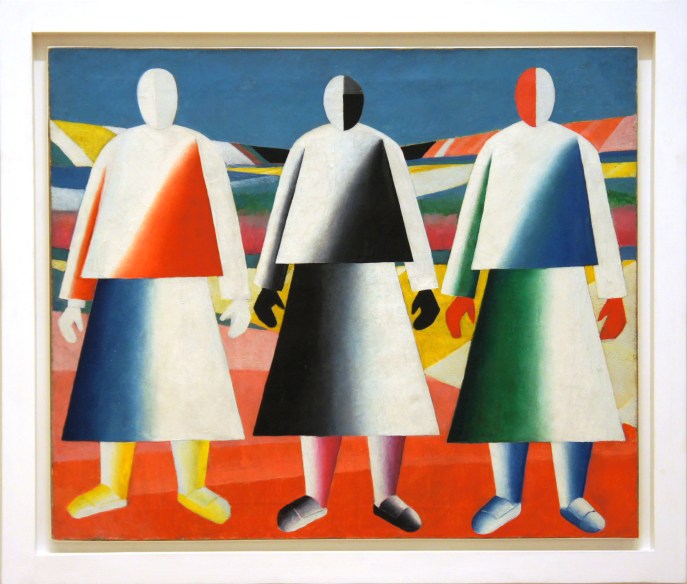
So what struck me most was the diversity of artistic movements jostling side by side under Lenin and how the early optimism led the artists of the period to try to support the aims of the Revolution and Bolshevism. We see how the state tried to accommodate the various strands of avant-garde art notably its arguably most important figure Malevich. But it also becomes quickly apparent that the communist regime cannot accommodate this diversity and that the attempts of artists across all forms to criticise the regime as it all starts to go wrong are brutally extinguished. Then we are left with artists either being co-opted entirely by the propaganda of the state or offering a critique in the most elliptical fashion possible. (My only previous exposure to this is through the life and music of Shostakovich so a real eye opener to see this going on elsewhere).

So I highly recommend you take a whizz around this exhibition. Optimism turns to despair and then suffering or deception. Better still contrast with the America After After the Fall exhibition also at the RA as I am sure the curators intend you to. I saw this in Paris (how lah di dah is that) and will run along again to see it shortly (it is that good) but from memory this also shows how art reveals the darker undercurrents in a society racked by economic collapse in the 1930s albeit with a veneer of optimism about the future.

In no particular order the highlights for me of the Russian Art exhibition were ….

  • Just how quickly the cult of Lenin took hold – the crowds turning out for his arrival in St Petersburg and the scale of the mourning at his death
  • Kliment Redko – Insurrection 1925 – this is in the first room I think – looking back critically on the Revolution and aftermath and a very powerful work
  • The real beauty of some of the photographs and paintings in room 2 which capture the industrial advance and the heroic worker
  • The early optimism of some of the artists as they embraced Lenin’s attempt to turn art into propaganda and perhaps how easily they were co-opted
  • The paintings of Pavel Filonov in room 3 – made up of small fragments building into beautiful images
  • Just how quickly the optimism was broken and how brutal was the repression as there were killed – there is a row of photographs of key artists in I think room 3 which conveys this eloquently
  • I don’t really get on with Malevich’s suprematist paintings but the casts of the buildings in room 4 were very interesting
  • The disastrous impact of collectivisation on rural Russia is well conveyed as is the links back to the pre-Revolutionary past – I loved the two Chagalls which have been sneaked in as part of these rooms
  • The various food coupons in I think room 7
  • The model of Tatlin’s glider is a real stand-out and a thing of beauty
  • The room devoted to Kuzma Petrov-Vodkin – never heard of him before but the still lifes in particular are really fascinating in terms of colour, perspective and content – the one with the herring is beautiful and very sad
  • The last room contrasts the daft socialist realist Stalinist sport paintings – and the complete stamping out of any Modernist art –  with a moving memorial

Sorry not so short in the end. Go take a look.