Fear, greed and the retelling: why we watch the founders fall, and who gets paid when we do
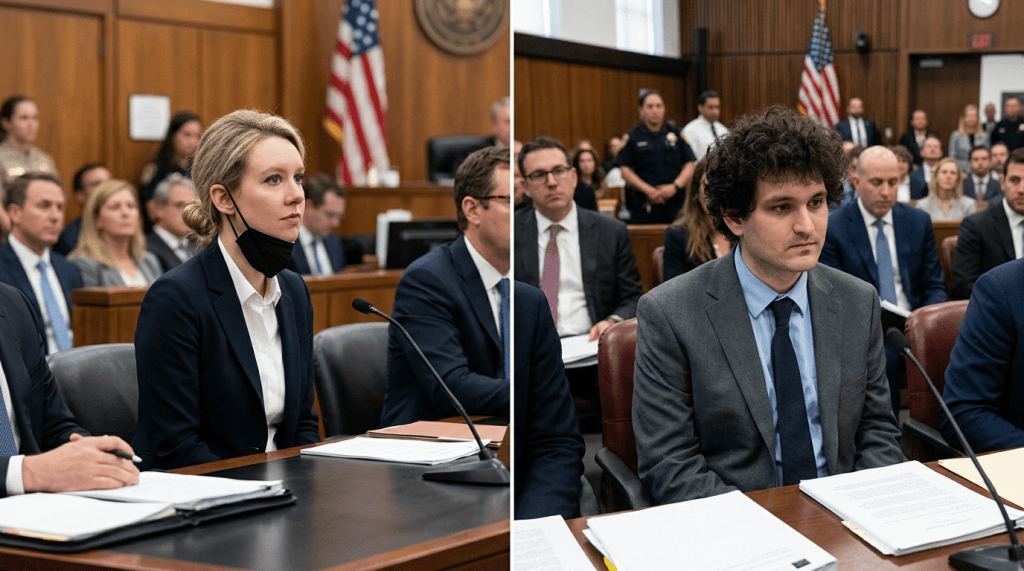
Amanda Seyfried has now played Elizabeth Holmes twice, and the second time Holmes was in the building. In 2022 Seyfried played her in The Dropout, Hulu’s drama about Theranos, with real archive footage of Bill Clinton cut in to applaud her. This autumn she turned up again in You Can See Everything, Nathan Fielder and Lance Oppenheim’s documentary, made after Holmes invited a film crew to follow her through the thirty-four days before she reported to prison. In it Seyfried acts out the conversations between Fielder and Holmes that were never recorded, meets Holmes briefly, questions Holmes’s partner Billy Evans alongside Fielder, and talks on camera about the ethics of having played a fictional version of a real person. The actor who wore the mask is now interrogating the woman who wore it first. Holmes has a clemency petition pending. Yesterday Netflix released The Altruists, eight episodes on the fall of FTX, with Anthony Boyle as Sam Bankman-Fried and Julia Garner as Caroline Ellison.
These dramas are usually argued over as a matter of taste, and taste is the wrong question. Do they glamorise the grifter, do they forget the victims? The more interesting thing is the space between the real story and the dramatised one, because the real story was already a performance. An actor playing Holmes is playing a woman who was playing a part. What follows looks at that double performance through one lens, Marx’s, and follows the money to the end of the story, which now includes the box set.
1. The mask
Marx wrote the founders’ job description in 1867. In the preface to Capital he says he deals with individuals only in so far as they are personifications of economic categories. Elsewhere he calls these roles character masks, Charaktermasken. Capital needs people, but it needs them in costume, acting to the part. The capitalist is capital with a face and a pulse.
The founders of the last twenty years wore the mask so well that the mask became the product. Holmes had the black turtleneck, the unblinking stare and the baritone, and Theranos put her face beside a device that did not do what she said it did. Bankman-Fried had the shorts, the beanbag, the hair, the video games during investor calls, and a moral philosophy to go with them: effective altruism, earning to give, the billionaire who meant to give it all away. Adam Neumann had the bare feet and a mission to elevate the world’s consciousness, for a humdrum business that leased offices. Billy McFarland sold the Fyre Festival with a film of supermodels on a Bahamian beach before there was a festival to sell. None of this was decoration. When the story is the asset, the person telling it is the balance sheet.
The mask recruited a chorus, and each member of it lent the founder their own credit. Theranos’s board read like a cabinet: Henry Kissinger, George Shultz, James Mattis. Its money came less from Silicon Valley than from old fortunes: Rupert Murdoch, the Waltons, the DeVos family. FTX had Tom Brady and Gisele Bündchen in its adverts, Larry David in its Super Bowl commercial, and Tony Blair and Bill Clinton on stage at its conference in the Bahamas. Masks vouching for a mask.
2. Why the mask could be financed
The mask needed money that was cheap and impatient at the same time, and the decade after 2008 supplied it. Almost every one of these companies grew during the long stretch of near-zero interest rates, and most fell as rates rose from 2022. Venture capital’s own arithmetic pushed the same way: one giant winner pays for a fund full of failures, so a backer’s real fear is missing the one, not losing on the rest. Greed and fear arrive together, as the fear of missing out. Companies stayed private for longer, with less disclosure and more control for the founder. The story got to run a long way before anyone had to show the books.
The backers did not merely fail to see through the mask; they wrote its lines. In September 2022 Sequoia published a long, adoring profile of Bankman-Fried, in which one of its partners floated him as the world’s first trillionaire. Two months later it wrote its investment down to zero. SoftBank put a value of $47 billion on WeWork before the 2019 attempt to float the company exposed the numbers. These were professional investors, paid to be sceptical, doing exactly what their role required. The mark in these cons was not a gullible outsider. It was capital, wearing its own mask.
3. Three actors, three pairs
Fear and greed, pleasure and pain, winning and losing drive everyone in these stories, but never at the same time. For the founder, the rise is greed and pleasure: the mask works. The fall is fear, and the crime is often the effort to keep the mask on: customer money moved to cover a hole at FTX, Theranos running tests on other companies’ machines while claiming they ran on its own. For the backers, the rise is greed with fear riding along. At the fall most of them lose, while the few who sold early, bet against the company or were paid fees come out ahead. For the viewer, the order runs the other way.
The dramas put us through the bubble ourselves. The first episodes sell the rise: the montages, the parties, the penthouses, the swagger. We buy in, as the investors did. Then the market turns and we are paid in pain, someone else’s. Our pleasure peaks at exactly the moment theirs collapses. The old con men’s saying was that you can’t cheat an honest man: the mark’s own greed does the work. The viewer gets to feel that greed in safety, enjoy its punishment, and keep the subscription.
Schadenfreude, to use another German word.
4. Cooling the mark
In 1952 Erving Goffman described the part of the con that comes after the sting. In “On Cooling the Mark Out” he observed that a con needs someone to stay behind with the victim and calm him, so that he accepts the loss, goes home quietly and does not call the police. The cooler offers the victim a story he can live with.
The prestige drama is the cooler, working at scale, and what it offers is “psychology”. The real con worked by hiding what went on inside. The drama’s task is to invent the inside: motives, wounds, the love affair, the parent who never approved. Netflix has built The Altruists around the relationship between Bankman-Fried and Ellison. The showrunner of The Dropout said she never thought of it as a scam show; she saw it as a character study. That is the move. Once we understand Sam or Elizabeth, the arrangements drop out of the picture: the cheap money, the fund economics, the board of statesmen, the profile published under Sequoia’s own name. One bad apple goes to prison, and the barrel is reassured.
The cooling works: the system carries on, and so, often, does the mask. Neumann left WeWork with a package worth several hundred million dollars, and within three years had raised money from Andreessen Horowitz for a new property venture. WeWork filed for bankruptcy in 2023. McFarland served his sentence and announced a second Fyre Festival. Holmes, from prison, has a clemency petition and an A24 documentary. The mask outlives the company.
5. The retelling
Kindleberger set out the stages of a mania as displacement, boom, euphoria, distress and revulsion; the last twenty years have added a sixth, the retelling. The revulsion is now a product. The supply chain is efficient: a magazine article or a reporter’s podcast, then a documentary, then a prestige drama, then a companion podcast for the drama. A true story comes with a ready-made audience and little development risk. The fall is good content, and lately it has been very good business. You Can See Everything cost A24 a few million dollars to make. It opened in October on fewer than 900 screens, took $15 million in its first weekend, the biggest opening for a documentary in thirteen years, and has since grossed around $80 million in North America. Holmes’s investors lost their money once. Her story keeps paying.
Fyre shows how tight the circuit can be drawn. In January 2019 two documentaries about the festival came out within days of each other, one on Hulu and one on Netflix. The Netflix film was co-produced by Jerry Media, the agency that had run Fyre’s social media campaign. The people who sold the mask went on to sell the story of the mask slipping.
6. Follow the money
FTX shows where the money settles once the show is over. The estate recovered enough to pay most customers 118 per cent of their claims, measured in dollars at the date of the bankruptcy. That sounds like a happy ending. But the claims were fixed at November 2022 prices, close to the bottom of the crypto market, and bitcoin later traded at several times that level, so customers who had held crypto got back dollars rather than the coins they lost. The professionals running the bankruptcy had charged more than half a billion dollars in fees by mid-2024. Bankman-Fried’s lawyers used the prospect of full repayment to argue for a lighter sentence. He got twenty-five years.
The repayment came largely from one bet, and the upside went to whoever bought it. In 2021 FTX put $500 million into Anthropic, an AI company then just a few months old. In 2024 the estate sold the stake for about $1.3 billion, much of it to a group that included a vehicle linked to Abu Dhabi’s Mubadala and the trading firm Jane Street. On 19 November, the day The Altruists premiered, Anthropic’s shares began trading on Nasdaq. They closed their first day at $97.17, which values the shares FTX once held at about $43 billion, more than thirty times what the estate got for them. The creditors were made whole by a fraudster’s lucky punt on the next boom, and the gains from the next boom went elsewhere. Netflix released the drama of the fall on the same day the market crowned the bet.
The emotions are shared out; the money is concentrated. Across the three actors (founders, backers and viewers) the story looks zero-sum: one side’s pain is another’s pleasure. Across capital as a whole it is nothing of the kind. Fees on the way up; short positions and restructuring fees on the way down; cheap assets for the patient buyer; subscriptions for the retelling. Every stage pays someone.
7. Bad barrels, not bad apples
None of this is new, which is part of the point. The South Sea Company had its directors and its dupes in 1720. Trollope gave Victorian London Augustus Melmotte, and Dickens gave it Mr Merdle, financiers whose credit was their persona. Galbraith called the hidden stock of undiscovered fraud “the bezzle”: it swells in good times, when everyone feels richer and nobody checks, and shrinks in bad times, when the auditors return. What digital technology changed was speed and scale: cheaper money, a story that could reach millions before there was a product, and an industry ready to sell the ending almost before the trial.
We will watch the next one, and the mask will be waiting for it. The roles in this circuit don’t change, only the faces. The founder wears the costume, the backers write the lines, the cooler offers us a character study, and we enjoy the fall. Marx’s lens does not make the founders innocent: they chose the costume and they committed the crimes. It makes them replaceable, which is the harsher verdict.
One last connection, for the record. This essay was written by a human with help from Claude, an AI model made by Anthropic, the company whose shares paid back FTX’s customers. Nothing in the argument depends on that. But a con man’s best investment ended up helping to write about him, and it would be odd to leave that circuit open.


Leave a Reply