Railway Kings, the Surveillance Economy, and Who the AI Machine Will Carry
Chapter 10: The Man Who Squeezed Too Hard
Previously. The AI build-out is costing more than $700 billion this year, and the industry hopes businesses will pay for it out of their wage bills. But every firm that cuts wages empties another firm’s till. China, meanwhile, settled the concentrator’s dilemma by abolishing the exit altogether, and found the contradiction simply moved: to the flight of capital and talent, and to a shortfall of spending it exports to the rest of the world.
At the very beginning there was a riddle: a man builds one of the largest supercomputers in the world for his own artificial intelligence, can’t fill it with paying demand, and rents the whole thing to a rival; the rent keeps afloat the division that now houses a social network he paid $44 billion for. Now we have the tools to solve it. The man, in case you hadn’t already guessed, is Elon Musk. The supercomputer is Colossus, in Memphis, Tennessee. The division is SpaceXAI, part of SpaceX. The social network is X, which used to be Twitter. And the rival paying the rent is Anthropic, the company that makes the machine co-writing these words. To see how a $44 billion purchase ended up here, go back to October 2022.
Bought with borrowed money
Musk bought Twitter with a large mortgage, and the mortgage set a clock running from the first day. Of the $44 billion price, around $13 billion was lent by a group of banks led by Morgan Stanley, and the debt was loaded on to Twitter itself. The company Musk bought now had to pay the interest on its own purchase, reportedly more than a billion dollars a year. The banks couldn’t find buyers for the loans at anything close to face value and held them on their own books for more than two years. In early 2025, with Musk now close to the new president, they finally sold them, some at full face value, paying 9.5 per cent. Bankers are not in the habit of losing money on the men who might bring them their next deal. In pitching the deal to his fellow investors, Musk reportedly promised to multiply Twitter’s revenue several times over within a few years.
Anyone who has watched private equity at work will recognise what the debt did next. The concentrator’s usual path is patient: be good to users first, lock them in, squeeze later. A leveraged buyout doesn’t allow patience, because the interest is due from the start. So X did something unusual. Instead of moving from the volume phase to the price phase once its users were safely locked in, it squeezed users and advertisers at the same time, straight away, before any new lock-in existed. The debt turned the concentrator’s dilemma into a race against the calendar.
The squeeze, all at once
Within months, most of the staff were gone, most of the moderation with them, and the blue tick was for sale. Musk cut the workforce by around four-fifths. The teams that removed abuse, fraud and misleading content shrank drastically. And the blue verification tick, which had meant “this account is who it says it is”, was turned into a paid subscription, so that it now meant “this account has paid”.
The results were immediate, and one of them moved a share price. Within days of paid verification launching, an account with a blue tick, calling itself Eli Lilly, the American drug company, announced that insulin would now be free. It wasn’t Eli Lilly. The real company’s shares fell sharply, and it spent the following days apologising for a message it had never sent. Users got a service they could trust less. Advertisers got less control over what their adverts appeared beside. The price phase had arrived for everyone at once, with no first phase to cushion it.
The advertisers leave, and are sued for it
The advertisers were the first to go, because for them leaving cost almost nothing. A brand has no network of friends on a platform and no archive of photographs. It can move its advertising budget to Meta or Google overnight. Many did, some over the loss of moderation, some over Musk’s own posts. His public response came at a New York Times conference in November 2023, where he told the advertisers who had left to “go fuck yourself”, and then named Disney’s chief executive to make sure the message was received.
Then X went further, and attacked the exit itself. In August 2024 it sued the World Federation of Advertisers and several major brands, alleging that they had organised an illegal boycott. Three days later the federation closed the forum it had run to help advertisers keep their brands away from harmful content, a forum with a staff of two. This summer the two sides settled, and the federation promised never to restart it, or anything like it. Hirschman, who spent a lifetime thinking about exit and voice, never imagined this case: a supplier taking its customers to court for leaving. It is the concentrator’s dilemma at its crudest. When the customers ignore your voice and walk out, try to make walking out unlawful.
Consider who did what to whom. A group of brands chose, through a voluntary trade body, not to advertise somewhere they thought damaged their names. That is a market working. A committee of congressmen, from the party of free enterprise, investigated the trade body; a platform owner close to the same party sued it; it closed within three days; and this summer it promised never to come back in any form. Its defenders called the boycott an illegal conspiracy, and that argument should have its day in court. But a free-market economist watching politicians and a monopolist combine to stop customers organising their exit would not struggle for a name for it. A year later, the same party’s administration took a tenth of Intel, days after the president had demanded its chief executive’s resignation. Anywhere else, a state that forces a trade body to disband and takes a stake in a company that had displeased it would be described in less flattering terms than capitalism.
Some of the advertisers came back, and not only for commercial reasons. In 2025 X’s advertising revenue rose for the first time since the purchase. Part of the recovery was reported to come from brands keen to stay on good terms with an owner who was, by then, close to the president of the United States. Advertising as a business decision had become, in part, advertising as tribute.
The users leave, mostly for another concentrator
The users left more slowly, and most of them went to Mark Zuckerberg. By July 2026 Threads, Meta’s copy of Twitter, had 147 million daily users on mobile phones, up 21 per cent on the year, having overtaken X on mobile around the turn of 2026. X’s own daily mobile users fell 7 per cent, to 123.7 million. Bluesky, the alternative built on open principles, peaked at around 22 million active users a month in late 2024, as people fled X after the American election, and has since halved.
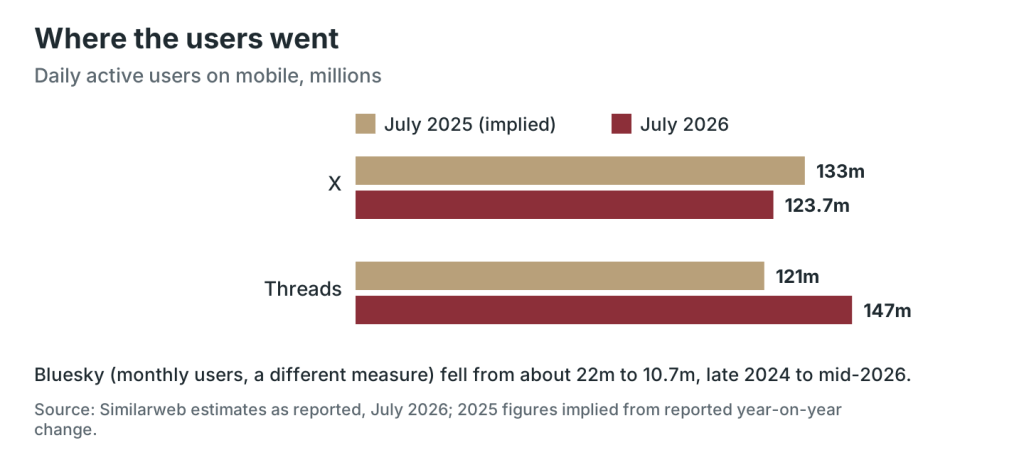
X hasn’t collapsed, which is the first lesson. It still has around 560 million users a month, and its website traffic is growing. A platform that loses its most prominent critics loses less than they think; Hirschman’s lazy monopolist is content with the quiet ones who stay.
The second lesson is sharper: exit punished the squeezer without freeing the squeezed. People left by the cheapest route available. For most of them, the cheapest route ran through Instagram, where their friends were already waiting and a single tap created a Threads account. The network effect didn’t disappear. It moved, from one concentrator to another. Bluesky, the principled option, asked people to rebuild their networks from nothing, and most wouldn’t pay that price. Its new management has shifted its focus from the app itself to the open protocol underneath, on which others can build their own services, European ones among them. That is the long game, and the Victorians would recognise it: a standard gauge, so the network outlives the owner.
The numbers
Twitter’s advertising income peaked at about $4.5 billion in 2021; X’s is now running at well under half of that. The fall came in stages. Advertising dropped by $595 million in 2024, recovered by $115 million in 2025, and fell again by $100 million in the first quarter of 2026, which the company blamed on rebuilding its advertising technology. In the second quarter of 2026 it brought in $367 million, down $59 million on the year. Annualised, that is about $1.5 billion. In the third quarter it rose about 19 per cent on a year earlier, to $538 million.
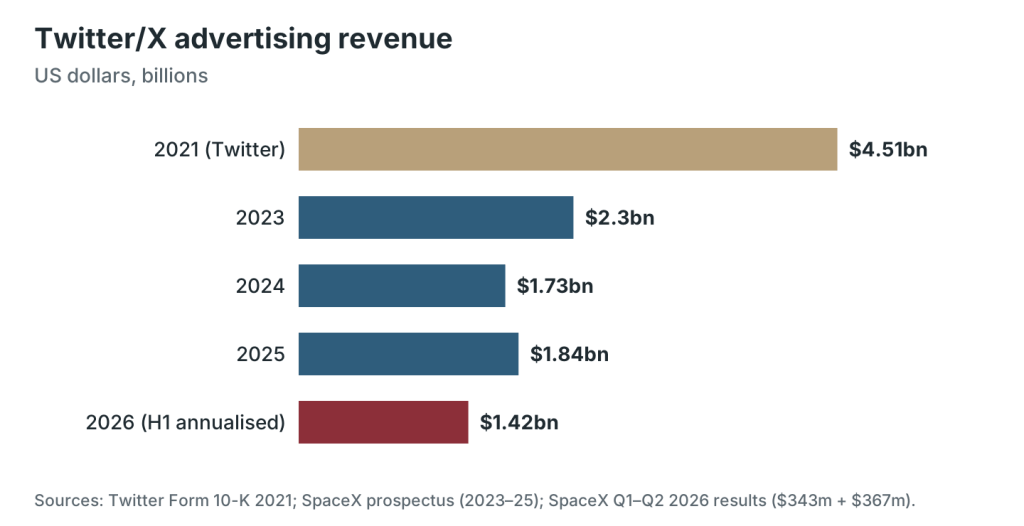
Subscriptions were meant to fill the gap, and they haven’t come close. Across X and Grok, its AI assistant, the company disclosed around six million paying subscribers. A business that used to be paid by advertisers is now partly paid by its users, on a scale that can’t replace what was lost.
Folded, twice
X didn’t fail in the ordinary way; it was absorbed. In March 2025 Musk’s AI company, xAI, bought X in a deal that valued it at $33 billion, well below the price he had paid. In February 2026 SpaceX bought xAI, and X went with it into a division now called SpaceXAI, alongside the Grok assistant. In SpaceX’s first quarterly results as a public company, X’s advertising was a small item beside $2.2 billion from the AI division, $4.3 billion from Starlink and $962 million from its space business, and it barely featured in the discussion with analysts. Three months later, in the third quarter, the AI division, renamed Super Intelligence, brought in $7.6 billion, more than Starlink, and SpaceX made its first quarterly operating profit since listing in June. The platform once described as the world’s town square now appears in its owner’s accounts as a footnote.
The riddle solved
The AI division that now houses X lives mainly on rent from a rival. In 2025 xAI brought in $3.2 billion of revenue and made an operating loss of $6.4 billion. Its Grok assistant couldn’t generate enough paying demand to use the vast computing capacity Musk had built for it. So SpaceX agreed to rent the Colossus data centre in Memphis to Anthropic, for $1.25 billion a month until May 2029. The company’s own filing described the arrangement as a way to make money from computing capacity it wasn’t using. Either side can end it on 90 days’ notice. Musk has since said it was set up, at first, for six months. By the third quarter the division’s “solutions and infrastructure” business, which includes renting out computing power to customers the company didn’t name, brought in $7 billion. The rent no longer just keeps X afloat. It helps carry the profits of the rocket company. The tenant, meanwhile, is preparing to float on the stock market itself, reportedly at a valuation of around $2 trillion; that story comes in the next chapter.
Spell out what that one contract shows, because every argument so far is inside it. The concentrator built a machine for his own AI product. His product couldn’t find enough customers willing to pay for it: the missing price phase. So he rented the machine to a competitor: the moat that isn’t there. On terms either side can leave within a quarter: cheap exit, at the level of the chips themselves. And the rent supports the division that now houses a social network he couldn’t make pay: the dilemma, played out to the end. The machine co-writing these words is made by the tenant. The figures are in the public filings for anyone to check. The contradiction is the point.
The only voice with teeth
The one actor to impose direct costs on X has been the European regulator. In December 2025 the European Commission fined X €120 million for breaches of its transparency rules, the first fine ever issued under the Digital Services Act, the European Union’s rulebook for large platforms. In January 2026 both the Commission and Ofcom, the British regulator, opened investigations after Grok was used to create sexualised images of real people, including children. The Commission’s inquiry also covers X’s switch to using Grok to decide what users see.
Two details show both the power and the limits of that voice. As regulators closed in, X restricted Grok’s image-making to paying subscribers. A feature being used to cause harm was placed behind a paywall rather than switched off: the price phase at its bleakest, needing no comment. And the Digital Services Act caps fines at 6 per cent of a company’s worldwide turnover. Measured against X’s own revenue, and set against the wealth of its owner, even the heaviest penalty the law allows is small change, unless the Commission counts the revenue of his other companies, which it has said it may consider. The regulator has a voice. It is a quiet one.
So what is X for?
If X doesn’t work as a business, the question is what it is for, and British readers have seen the answer before. Lord Northcliffe used the Daily Mail to make and break governments. Lord Beaverbrook ran the Daily Express as an instrument of his own causes. Rupert Murdoch kept The Times going through years of losses, because owning it mattered more than the money it lost. Newspapers have long been owned for influence rather than profit, and the losses treated as the price of a seat at the table.
Trollope saw the type in 1875, in the middle of another speculative age. In The Way We Live Now, the great financier Augustus Melmotte promotes the South Central Pacific and Mexican Railway, a line that exists almost entirely as a share price and a prospectus. He dazzles London, buys his way into Parliament and hosts a banquet for the Emperor of China. Melmotte is a forger, and nothing in X’s story is illegal. But Trollope understood something about manias that still holds: at the height of one, the story is the asset, and the man who tells it best sits at the top table.
Trollope’s title is the point: it is The Way We Live Now, not the way Melmotte lives. The novel’s real target is the society around the financier: the aristocrats who lent him their names, the bankers who lent him money, the politicians who sat at his table and the newspapers that printed his praise, none of them asking questions while the share price rose. Melmotte could exist only because everyone around him was paid, one way or another, to believe in him.
The same is true of Musk, and it is the harder argument to make. The scale of his wealth is new; the method is not. Make large promises about the future. Borrow heavily against them. Pass the risk to others: the banks holding the debt, the index funds obliged to buy the shares, the private individuals invited in at the top. Keep control, and take enough along the way that the outcome matters less to you than to them. He may well believe every word he says, and he clearly enjoys the power and the notoriety. But none of that is the explanation. Marx described the capitalists in his own story as personifications of economic categories: the arrangement acting through a person. Remove Musk and the arrangement would produce someone else, perhaps quieter, with better manners and a better dress sense, doing much the same thing. Blaming the billionaires gets the easy applause. None of this rules out taxing great fortunes. It means that taxing them isn’t enough: a fortune taken is a one-off, and the arrangement will build another. A rule changed lasts. And rules are made by law and by votes, where there are a great many more of us than of them. The argument that survives the next billionaire is the one aimed at the arrangements that make them.
The analysts’ answers to what X is for fall into three. It is a source of material to train Grok: X changed its terms to allow users’ posts to be used for that purpose. It is an instrument of political influence, owned by a man who spent much of 2024 and 2025 inside American politics. And it is its owner’s megaphone, at a volume no newspaper baron could have dreamed of. The value lies in power, not profit.
Which raises the last question: does owning the megaphone mean owning the argument? A widely held view says it does, that the internet now belongs to the political right, and that whoever controls the platforms controls politics. The evidence is more interesting than that.
Chapter 11: Selling the Story
Previously. The riddle is solved. Elon Musk bought Twitter with borrowed money, squeezed users and advertisers at once, and watched them leave, mostly for Mark Zuckerberg. X was folded into xAI and then SpaceX, and the division that houses it now lives mainly on rent from Anthropic for the Colossus supercomputer. Anthropic, the tenant, is now preparing to float itself.
At the time of writing, Anthropic has filed its prospectus with the American regulator in confidence and has not yet made it public. What is known comes from drafts that leaked to Reuters and the Financial Times at the end of September, and to the Wall Street Journal in October, which the company has not confirmed, and from what bankers have told the financial press. There is already plenty of commentary about the mooted $2tn valuation and the growth needed to justify it. We won’t add to this here. Instead this chapter does something more modest than predict. It sets out how a flotation works, step by step, as the textbooks and the lawyers describe it, and then asks the questions the people inside this one will be working through.
Every chapter so far has been about the user’s exit; a flotation is the owners’ exit. Think of it as a door. Through it, existing owners can walk out with cash or at least the opportunity to realise cash in the future. And new money can walk in. And once a company is listed, the door doesn’t close again. Its shares can be bought and sold every day, by anyone, for as long as it stays on the market.
Why open the door at all
The textbook gives four reasons for going public, and they come before anything particular to this one. First, to raise new money for the business. Second, to let existing owners, the founders, the early investors, the staff, turn some of their shares into cash. Third, to put a public price on the company, which every later decision can be measured against. Fourth, to create a currency: listed shares can be used to pay staff and to buy other companies.
When economists asked the people who actually make the decision, the answers were less noble than the textbook. In a survey published in the Journal of Finance in 2006, James Brau and Stanley Fawcett asked hundreds of chief financial officers why their companies had gone public. The most important reason they gave was to create shares they could use to buy other companies. They rejected the academic idea that the main point was to lower the cost of raising money. And they were frank about timing: insiders try to go public when they can get the highest price, judged by the state of the whole stock market. An earlier study of Italian flotations, by Marco Pagano, Fabio Panetta and Luigi Zingales in 1998, found that companies tended to float after a period of heavy investment and fast growth, and that investment fell afterwards. The flotation paid for what had already been spent.
That last finding is the one to hold on to here. A company that has committed to spend enormous sums, and needs the public’s money to meet the bills, is a familiar figure in the history of flotations. It is also, as we will see, a fair description of this one.
How a flotation is timed, step by step
A flotation begins months before anyone outside hears about it. The process, as the big American law firms set it out for their clients, runs like this. It starts with an organisational meeting of the company, its bankers, lawyers and accountants. Drafting the registration statement, the formal prospectus, takes six to twelve weeks. Since 2017 any company can submit that draft to the Securities and Exchange Commission in confidence, and the regulator usually goes through three to five rounds of comments. Meanwhile the banks can “test the waters”, sounding out selected large investors in private meetings. The prospectus must then be made public at least fifteen days before the roadshow, the week or so in which management tours the big investors to sell the story. The banks build a book of orders, the price is set, and trading begins the next day. From first meeting to first trade typically takes four to six months.
After the first trade come three more pieces of plumbing. The banks usually keep the option to sell up to 15 per cent more shares if demand is strong, the “greenshoe”. Existing owners agree not to sell their remaining shares for a period, usually 180 days, the “lock-up”. And the analysts at the banks that sold the shares must stay silent for ten days before publishing their research.
Anthropic’s journey fits the pattern. In February a $30 billion fundraising valued the company at $380 billion, and its staff were offered the chance to sell up to $5–6 billion of shares to outside investors, though most chose to hold on. In May it raised $65 billion at a valuation of $965 billion. On 1 June it submitted its draft prospectus in confidence. At the end of September the draft leaked. Bankers now talk of a listing on Nasdaq after the American midterm elections, with a public filing reportedly planned for late October, marketing from the week of 9 November and trading before Thanksgiving, raising a record $100 billion at a valuation of around $2 trillion, though some investors are reportedly arguing for nearer $1.5 trillion.
The rules also decide how fresh the numbers have to be. An American prospectus can’t rely on accounts more than 134 days old at the moment the registration takes effect. Accounts to the end of June, the latest in the drafts reported so far, go stale around 11–12 November. A listing in the second half of November, as reported, would therefore need figures to the end of September, in a business whose revenue was $16.3 billion in the first half alone and whose annualised revenue was last reported at around $65 billion at the end of July. If the growth has carried on, the buyers will see it, as well as the mix: how much of it comes from businesses, and how concentrated it still is in a few large customers.
Whoever goes first gets the institutions’ appetite. There is only so much money that the world’s pension funds, insurers and fund managers can put into new shares at once. SpaceX took $75 billion of it in June. OpenAI is expected to follow in 2027. The company that reaches the market first gets the pick of the buyers.
The bankers choose the window, and choosing a window is mostly about avoiding storms. The Brau and Fawcett survey found what anyone who has worked on a flotation knows: the decision turns on the mood of the whole market. The banks will offer whatever account of the timing is required; they are paid when the deal is done, not when it is delayed. Their real worry is volatility, because a market that falls during the roadshow can sink a deal that looked certain a fortnight earlier. Market folklore has it that corrections like to arrive in January. A listing in November gets in before the turn of the year.
The political weather looks set to change, but the moat around the industry probably doesn’t. On 3 November Americans vote in the midterm elections. As of mid-October, polling analysts expected the Democrats to win the House of Representatives, with the Senate a toss-up resting on five or six close races. A change of control would shift the mood in Washington, and perhaps make it a little more open to the kinds of rules the larger laboratories have argued for. It is unlikely to alter the external moat of export controls and national security, which both parties support. The American–Chinese talks on superintelligence, due to meet by November, are background noise for now.
Interest rates are rising, but the end of the rise may be in sight. In September the Federal Reserve raised rates for the first time since 2023, to between 3.75 and 4 per cent, as the war involving Iran pushed oil above $100 a barrel and inflation back up. Most of its policymakers expect one more rise this year. Higher rates usually hurt shares whose value depends on profits far in the future, which describes every AI company. But a market that believes the peak is near can look past it. The next decision is due on 28 October, a week before the vote.
Who sells, and who buys
Start with who owns the company now, because they are the ones deciding how wide to open the door. Anthropic has never published a full list of its shareholders. What is known: Alphabet, Google’s parent, was reported in 2025 to own about 14 per cent, capped at 15 per cent, with no votes or board seats. Amazon, which has put in more money, has never disclosed the size of its stake. Nvidia and Microsoft hold small stakes. Behind them stand dozens of venture capital firms, Singapore’s GIC, the Qatar Investment Authority, MGX of Abu Dhabi, the seven founders and thousands of staff. A Long-Term Benefit Trust, whose members hold no shares, gains the power over time to choose most of the board.
Several of the biggest owners are also among the biggest suppliers, and the plot thickens from there. According to the leaked draft, Anthropic has committed to spend at least $518 billion over roughly a decade with six suppliers: Alphabet, Amazon, Microsoft, Broadcom, SpaceX and AMD. About 80 per cent of that is non-cancellable or payable whether the computing power is used or not. The supply deals with Alphabet and Amazon are reported at more than $110 billion each. A later draft said spending on computing could reach $750 billion in coming years, including deals still being negotiated.
The suppliers are also the lenders. Amazon has bought $8 billion of Anthropic’s convertible notes, loans that can turn into shares, and up to $15 billion more is available to it. Alphabet holds convertible notes too. Broadcom, which helps design the chips Anthropic leases, has agreed to lend up to $42 billion to help pay for them, in notes that could also become shares. And the banks running the flotation have lined up a credit facility of around $15 billion. The financing costs tied to all this produced a $34 billion accounting charge last year, most of the $42 billion loss reported for 2025. In the first half of 2026 a further $72 billion of such charges took the reported loss to $80.7 billion, on revenue of $16.3 billion.
So the textbook reasons to float are here, but they are the lesser part of the story. A public price, a currency for paying staff, a way for early investors to sell: all present, all routine. The larger purpose suggested by the leaked numbers is to pay the suppliers. If most of the $100 billion is new money, much of it will pass straight through Anthropic to Amazon, Google, Microsoft, Broadcom, SpaceX and AMD, to meet commitments already signed. It is the tenner and the sandwich again. This time the public, in the form of the institutions that invest their wealth, lends the tenner.
And it may be the suppliers’ own shareholders who fund the purchase. The institutions invited to buy into Anthropic already own large slices of Amazon, Alphabet, Microsoft and Nvidia. Some will make room for the new shares by trimming those holdings. The money goes round: out of the suppliers’ shares, into Anthropic’s, back to the suppliers as payment for computing, and into the suppliers’ accounts as revenue, while their stakes in Anthropic are marked up to the new price. The snake has found a way to eat its tail in public, in a prospectus.
How much to sell, and to whom, is the decision the owners and their advisers are now weighing. SpaceX ended up selling just 4.2 per cent of itself, set aside a quarter or more of the shares for private individuals and persuaded Nasdaq to fast-track it into its main index, guaranteeing buying from every fund that tracks it. Anthropic may be different: reports say it is considering letting existing shareholders sell in the flotation, and holding some of them to a lock-up longer than the usual 180 days. But Nasdaq’s new rule lets any company among the forty largest on the market join the index after fifteen days of trading, and at $2 trillion Anthropic would qualify. A small float, heavy demand from individuals and forced buying from index funds worked for SpaceX’s price in its first week. Whether Anthropic’s owners want to repeat it is one of the questions in the room.
A longer lock-up can be read two ways. It can be a sign of confidence: owners willing to wait. It can also be a demand from institutions burned by SpaceX, where insiders were free to sell within two months. Experience suggests that, given time, greed usually wins out over good governance. But owners who expect the price to keep rising have every reason to keep holding, and unlike a private equity fund with a deadline, they are in no hurry.
What the research will say
The analysts at the selling banks will describe the company rather than analyse it. American rules, rewritten after the dot-com scandals, separate research from investment banking: bankers may not review or approve analysts’ reports, and research management decides what is covered. But the analysts’ employers are paid to sell the shares, and the selling banks’ first reports can appear only after a ten-day quiet period. In Europe the habit is for this research to restate the prospectus and offer a range of valuations rather than a verdict. Anyone outside the selling group has little access and less incentive to say otherwise. The reports are nominally independent, and they tend to reach the right answer.
Flotation research rarely addresses the capital structure, and that is exactly where this story sits. The usual measure of a company’s value to all its investors is its enterprise value: the value of its shares plus its debts, minus its cash. For Anthropic that sum can’t be done cleanly. The convertible notes may become shares. The credit facility may never be drawn. And the largest obligation, around $400 billion of supplier commitments payable whether used or not, sits outside the usual definition of debt altogether. An analyst who counted it as debt would get a very different answer from one who didn’t. The prospectus will disclose it. Disclosure isn’t analysis.
Two customers provided nearly a quarter of last year’s revenue, and about a fifth in the first half of this year. Many large customers aren’t on long-term contracts. The drafts don’t name the two. Bankers quoted by IFR, the capital-markets magazine, say they are most likely the coding tools Cursor and GitHub, which resell access to the model inside their own products. In August SpaceX completed its purchase of Cursor, for $60 billion in shares, and has begun putting its own Grok models into it. If the bankers are right, one of Anthropic’s two largest customers now belongs to the company that rents it Colossus, and competes with it. The revenue would then be partly the loop again: money going out as rent and coming back as sales, until the customer moves on. The point is that a prospectus is built to disclose such things, and a mania is built to look past them.
The door stays open
Once listed, the door swings both ways. Bankers expect Anthropic to borrow in the bond markets soon after listing. Every lock-up expiry will release more shares. Every three months the company will report results against forecasts, and the price will move on the difference. The revenue, growing as fast as any company’s in history, may well surprise on the upside. It will need to, because the commitments don’t move.
George Hudson’s investors would have recognised the arrangement. Railway shares in the 1840s were sold partly paid: a small deposit on the day, and calls for the rest as the line was built. In a rising market nobody minded. When the market turned, the calls kept coming. Anthropic’s supplier commitments work the same way: they look like nothing in the price of a share on the first day of trading, and they arrive in full, on schedule, whatever the price does next.
Whether to be amazed or alarmed by all this is a reasonable question, and the answer may be both. The confidence of the owners, suppliers, lenders and bankers isn’t independent evidence that the plan will work. Each of them is paid if it does, so their confidence is part of the arrangement rather than a verdict on it. The American economist Hyman Minsky spent his career arguing that stability breeds instability: every year without a crash makes the next commitment look safer. But the growth is real too. Revenue of $16.3 billion in the first half of this year, against $1.1 billion a year earlier, is no fiction. Hudson’s investors were right that the railways would change everything. They were wrong about who would be paid for it.
The machine helping to write these words is made by the company in question, so read this chapter with that in mind. We have tried to stick to what has been reported and to how flotations are known to work. The questions are the ones anyone buying or selling the shares should ask.
Whoever ends up owning the machine will want something from the state as well as from the market. The last moat, the political one, depends on who holds power in Washington, London and Brussels, and on what voters think the machine is for. That is where the next chapter goes.
Chapter 12: A Megaphone, Not a Monopoly
Previously. A flotation is the owners’ exit: a door that sellers walk out of and new money walks into. Anthropic’s leaked prospectus suggests its door will open on to a loop, with the public’s money passing through to the suppliers who are also its shareholders and lenders, against some $518 billion of commitments that fall due whatever the share price does.
One of the most widely repeated claims of recent years is that the internet now belongs to the political right. The story runs like this. Elon Musk bought Twitter and tilted it. Podcasters such as Joe Rogan, with audiences larger than any television network, helped carry Donald Trump back to the White House in 2024. The algorithms that decide what we see reward outrage, and outrage leans right. So whoever owns the platforms owns politics, and the right owns the platforms. It is the concentrator’s claim in political form: control the pipe and you control the mind.
The claim should be heard at its strongest, because part of it is true. The right built its online media earlier and better than the left: a whole ecosystem of podcasters, streamers and influencers, many of them outside the old conservative institutions, speaking directly to audiences that had stopped trusting newspapers and broadcasters. The Pew Research Center’s 2024 study of American news influencers found more of them leaning right than left. And on one platform in particular, the tilt is no longer a matter of opinion. It has been measured.
The platform that tilts
The best evidence comes from an experiment published in Nature in February 2026. A team led by researchers at Bocconi University in Milan took American users of X and randomly assigned some to its algorithmic feed, the one that decides for you what to show, and others to a simple feed showing posts in the order they were written. The experiment ran for seven weeks in 2023. Those on the algorithmic feed saw the share of right-leaning content rise by 2.9 percentage points, and became 4.7 percentage points more likely to rank the issues Republicans campaign on (crime, inflation, immigration) as the most important. And the effect lasted: users went on following the right-leaning accounts they had been steered towards even after they switched the algorithm off.
British evidence points the same way. In a month-long experiment, Sky News set up new accounts with no political leanings and found that X showed them roughly twice as much right-wing as left-wing content. The tilt also predates Musk. A study by Twitter’s own researchers, published in 2022, found that its algorithm amplified politicians of the mainstream right more than those of the left in six of the seven countries examined.
So on X, the claim holds: the pipe tilts, and it tilts right. Whether by design or by drift, its owner has shown no interest in levelling it. The question is whether tilting one pipe tilts the whole of politics. For that, look at what has happened everywhere else.
The British test
Britain offers the clearest test, because two insurgent parties have grown online at the same time, from opposite ends of politics. Reform UK, on the right, and the Green Party, on the left, disagree about almost everything. Both are growing movements while Conservative and Labour membership shrinks. Both reach more people on social media than the established parties, especially on video platforms such as TikTok. Both leaders have personal followings larger than their parties’.
The Greens’ rise has been the more surprising of the two. Under their new leader, Zack Polanski, elected in September 2025, the party more than doubled its support in the polls at its peak, from around 8 per cent to over 20, briefly overtaking Labour, and claimed 110,000 new members in a few months. Polanski speaks directly to camera, in short videos, about rents, bills and wealth, and has framed inequality as the most unpatriotic thing there is. He is often called the left’s answer to Nigel Farage, a label he rejects, though he openly wants to reclaim populism, which tells you he understands exactly which playbook is in play.
The local elections of May 2026 showed both insurgencies at once. Reform won 1,453 seats. The Greens won 587 seats, their best result ever. In London, Labour had its worst result since 1968, and the Greens gained 278 seats there alone. Whatever else these results show, they don’t show the internet handing politics to the right. They show it handing politics to whoever is not already in charge.
Since then, the incumbents have fought back, and the way they did it proves the point rather than refuting it. In July Labour replaced Keir Starmer with Andy Burnham. Labour moved back into a narrow lead in the polls, while Reform was hit by scandal and the Greens’ leader saw his ratings fall; by October the party was back to around 11 per cent. The voters rewarded the party that found a leader who could speak like an insurgent.
And at his first conference as prime minister, he spoke like one. He described the last forty years (deindustrialisation, deregulation, privatisation, austerity, Brexit) as a wrong turn that had left the country run for vested interests, with power in too few hands. He announced a bill to repeal the ban on public ownership of water companies, a publicly owned company to compete in the electricity grid, a National Care Service funded without borrowing, and a commission on changing the voting system. The markets held steady because he promised to keep to his borrowing rules, but the government’s own borrowing costs were at their highest in a quarter of a century, and the polls have wobbled since. Announcements are not arrangements. Whether he can turn one into the other is the test the insurgents set, and it applies to him too. Message and personality can outrun insurgency for a while. Only delivery outlasts it.
Germany: the decisive case
This September, Germany produced the headline everyone expected and a story almost nobody reported. On 6 September the far-right Alternative für Deutschland (AfD) won a record 43.8 per cent of the vote in the state of Saxony-Anhalt. Two weeks later it came first again in Mecklenburg-Western Pomerania, with 38.2 per cent, and the Christian Democrats of Chancellor Friedrich Merz failed to win a single seat in a state parliament for the first time in the history of the Federal Republic.
On the same day, in Berlin, the party that came first was Die Linke, the Left. It won 25.7 per cent, ahead of the Christian Democrats on 19 and the AfD on 16. Among voters under 25, exit polls gave Die Linke 43 per cent; among 25- to 34-year-olds, 49. Among young women under 25, it reached 54 per cent. The political scientist Cas Mudde, a Dutch expert on the populist right who teaches at the University of Georgia, made the point most commentators missed: this September was as much a victory for the insurgent left as for the far right.
Mudde also drew a distinction that matters for fairness. Treating far right and far left as mirror images, he argued, ignores the difference between challenging the traditional parties and threatening liberal democracy itself. The AfD does the second. Die Linke, which has moderated considerably over the years, does the first. Its programme would have looked like mainstream democratic socialism in the 1970s: housing, wages, public services, taxing the rich.
How Die Linke did it is the lesson, and it began with a speech that went viral. In January 2025 the Christian Democrats pushed an anti-immigration motion through the Bundestag with the support of AfD votes, breaking a long-standing taboo, two days after the anniversary of the liberation of Auschwitz. Heidi Reichinnek, Die Linke’s leader in the Bundestag, replied with a furious speech that was watched more than 30 million times on TikTok. Membership applications flooded in. The party now has more than 120,000 members, more than double its size before the surge, and in Berlin it has overtaken the Greens as the city’s largest party by membership. Its leaders credited the door-to-door campaign as much as the videos.
And the medium carried the moment, but the content was material. Die Linke campaigned on the cost of living: how inflation had hit poorer households hardest, and above all, the cost of housing. Reichinnek’s viral speech made people look; the party’s talk about rent made them stay.
The American evidence
In the United States, where the “digital right” story was born, the left has been quietly building its own media on the same platforms. Mehdi Hasan, whom British viewers may remember from Al Jazeera and Question Time, left MSNBC after his programme was cancelled and launched Zeteo in 2024, reporting from the left and paid for by subscribers. Drop Site News, founded the same year by former journalists from The Intercept, reached 800,000 free and 60,000 paying subscribers within two years; its publisher is Nika Soon-Shiong, daughter of the billionaire owner of the Los Angeles Times, which is a reminder that wealth funds the new left media too. Breaking Points, a daily news programme presented by a left-wing and a right-wing populist, funded mostly by its viewers, was the 16th most popular podcast on YouTube in America in March 2026.
The most striking result came in New York. Zohran Mamdani, a young democratic socialist, defeated the former governor Andrew Cuomo for the Democratic nomination and then won the mayoralty in November 2025, largely through short, cheap videos filmed on the street, talking about rents, bus fares and the price of groceries. And none of this is new. Bernie Sanders built his 2016 presidential campaign online, on millions of small donations, years before anyone had written the “digital right” story. Progressive candidates can now reach voters even when the mainstream media ignores them.
The two sides have also settled on different platforms, and different kinds of platform. In the United States, Republicans are now more likely than Democrats to use X, a reversal in just two years, and Trump has his own platform, Truth Social. Democrats are more likely to use Reddit, Threads and Bluesky. The difference isn’t just in which apps, but in whose. The right increasingly owns its megaphones. The left rents space on other people’s, or relies on open networks that nobody owns. One side has bet on control; the other on the ability to move.
Why owning the platform wasn’t enough
Put the evidence together and a pattern appears that has nothing to do with left or right. The platforms reward insurgents: people from outside the established parties who speak directly, in a human voice, about things that matter in daily life. They punish incumbents who speak in press releases. Reform and the Greens, the AfD and Die Linke, Trump and Mamdani: whatever else divides them, they all learned the same lesson about the medium.
The insurgents on both sides are growing from the same ground, seen from opposite ends. Across the Western democracies, politics has divided by place, by education and by age: big cities against declining towns, graduates against those without degrees, the young against the old, and now, among the young, women against men. The geographer Andrés Rodríguez-Pose called the rise of the populist right “the revenge of the places that don’t matter”: the towns the economy left behind. Germany this September drew the map in a single month: the AfD dominant in the post-industrial east, Die Linke first in Berlin.
The same logic that gathers value into a few platforms gathers it into a few places. Cities behave like networks: jobs, money and talent go where they have already gone. Those outside feel that as exclusion, the factory closed and nobody listening. Those inside feel it as rent: the young graduate in London or Berlin who can find work but can’t afford to live near it. The insurgent right grows from the first; the insurgent left grows from the second. The platforms carry both discontents to an audience. They don’t create either.
The mechanism is the one that runs through everything we have described: nobody is locked into a single platform. Economists call it multi-homing. Creators, campaigners and politicians don’t live on one platform; they are on YouTube, TikTok, Instagram, podcasts and email newsletters all at once. Think of it as shopping at three supermarkets: no single one can squeeze you, because you can always shift your spending. Substack, the newsletter platform, lets writers take their subscriber list with them if they leave, the equivalent of keeping your mobile number when you change network. Where the audience can move with the creator, no platform owner can hold it hostage.
That is why Musk bought a megaphone, not a monopoly. X tilts, and the evidence shows it. But its owner couldn’t tilt TikTok, YouTube or Substack, and he couldn’t stop the people he disagreed with from taking their audiences there. The concentrator’s dilemma applies to politics too: an owner can squeeze his own platform, but where leaving is cheap, the conversation simply moves.
The catch
It would be pleasant to stop there, with the insurgents triumphant, but the story has a catch. The new left media lives on rented land. Zeteo and Drop Site run on Substack. Breaking Points lives on YouTube, which belongs to Google. Die Linke’s breakthrough ran through TikTok. The creators and campaigners take the risk and put in the work; the platforms control who sees them and take their share, and can change the rules overnight. The left escaped one man’s platform by moving to other companies’ platforms. Exit worked again, and once again it moved people from one landlord to another.
But the landlord needs his tenants. A platform with nothing to watch is an empty shop. The voices that cut through, on the left or the right, are what bring the audience, and the audience is what the platform sells. The bigger a creator’s following, and the easier it is to take elsewhere, the more the platform needs them and the less it can afford to squeeze them. Exit gives the tenants a bargaining position, and the tenants who can take their audience with them have the strongest one of all. That is why portability rules matter so much: they turn a tenant’s following into a lease the landlord can’t cancel.
So the lesson of X, and of the politics that escaped it, is the same. Exit disciplines the concentrators. It doesn’t free anyone from concentration. What would change that isn’t a better app or a braver owner. It is a different set of rules, about who can take their audience, their data and their connections where, and a different answer to the question of who owns the machine.
Chapter 13: The Parliamentary Train
Previously. Owning a megaphone is not owning the argument. X tilts right, measurably, but the insurgents of left and right alike have found their audiences on other platforms, from Berlin to New York to London. Exit disciplines the concentrators; it doesn’t free anyone from concentration. What would is a different set of rules.
Everything we have watched is one choice, seen from inside one company after another. Musk’s squeeze, and the users walking out. An industry that can’t find its price and asks the state for a wall. A Chinese state that crushed its own concentrators and then had to court them again. A bill that can only be paid out of the wages the product removes. Each time, an owner facing the same question: squeeze now and risk the walkout, or hold back and fail to justify the price. We have called it the concentrator’s dilemma. The dilemma was only ever the surface.
The contradiction underneath
Beneath the dilemma is a contradiction, and the word is chosen carefully. A dilemma is a choice between two bad options. A contradiction is a structure that produces those bad options again and again, whoever is making the choice. David Harvey, the geographer who has spent half a century explaining Marx to people who would never otherwise read him, set out the structure in Seventeen Contradictions and the End of Capitalism (2014). Several of his seventeen have run through everything here.
The first is the oldest: the difference between what a thing is useful for and what it can be sold for. A search engine, a social network, an AI that can help a retired analyst write about Hirschman: all useful, some remarkably so. Their usefulness is exactly what makes them valuable to own, and what makes it possible to charge a toll for access. The more useful the thing, the stronger the temptation to squeeze. That is why the benefits and the harms of these technologies are not opposite columns in a ledger. They are the same fact, seen from two positions.
The second is technology and the disposability of labour. Every business has a reason to replace workers with machines, and each business that does it saves money. All of them doing it together removes the wages that buy everyone’s products. The AI companies’ best hope of profit is a share of the wage bill their product eliminates, from an economy that runs on wages. No pricing strategy, open or closed, resolves that. It is built into the arrangement.
And behind both sits one of the three Harvey calls dangerous: endless compound growth. The valuations we have examined, $2 trillion for a rocket company that loses money, forecasts that rise by half in three months, assume growth continuing on a scale for which no source of demand can be identified. The hockey stick has to keep turning upwards, because the claims on future value have already been sold.
How capital usually solves its problems
Harvey’s central point is that capital rarely resolves its contradictions. It moves them around. It moves them in space: to China, to the periphery, to wherever labour and land are cheap. It moves them in time: through credit, borrowing today against tomorrow’s growth. It moves them between people: from shareholders to workers, from lenders to taxpayers, from insiders to the private individuals who bought at the top. We have watched every one of these moves. And when the moves run out, there is always the last resort. Marx called crises the momentary, violent solutions of existing contradictions: the crash wipes out the claims that can’t be met, and the whole process starts again from the wreckage.
Carlota Perez gave that pattern its most hopeful reading, and it has real force. Perez is a Venezuelan-British economist whose Technological Revolutions and Financial Capital (2002) traced five great technological waves since the industrial revolution: canals and cotton, railways, steel and electricity, oil and cars, and computers. In each, she found the same sequence. First comes an “installation” period, in which speculative finance pays for the new infrastructure and a bubble inflates. Then the crash. Then a “deployment” period, in which the infrastructure is cheap, the speculators have gone, and society decides what the technology is for. Not every economist accepts her long waves, but the pattern fits the railway mania almost exactly. The mania ruined its investors and gave Britain a railway network. The dot-com crash ruined its investors and left the fibre-optic cable that carries the internet.
This time, trusting the crash to clear the ground would be dangerous, for three reasons. First, the last post-crash deployment period is where surveillance capitalism came from: Google found its model in the wreckage of 2001. A crash guarantees nothing about what is built afterwards. Second, much of this boom’s infrastructure won’t survive to be deployed. Railway track lasted a century; the chips in today’s data centres will be obsolete within a few years. Third, and most serious, a crash in an economy where the product has already removed a large share of wages would hit the demand that businesses depend on and the tax base that states depend on at the same time. The usual remedy would find the patient already weakened. The contradiction may be too large this time to be left to capital’s standard cure.
The fork
The contradiction isn’t only national, and neither is the danger. The two powers at that Washington dinner aren’t offering two answers to the problem. They are two halves of one arrangement that postpones it. America consumes on credit; China saves and exports because it won’t build a welfare state; China’s surplus is lent back to America so that Americans can keep buying. Each side’s problem props up the other’s. That arrangement can’t run for ever, and history is not encouraging about how such arrangements end.
When the leading power weakens and a rising power has not yet taken its place, there are two familiar ways for it to go wrong. The historian Charles Kindleberger argued in The World in Depression (1973) that the 1930s were so catastrophic because Britain could no longer manage the world economy and America would not yet: nobody led, and everything collapsed. The political scientist Joseph Nye later called this the Kindleberger trap. The other failure has a name from Harvard too. Graham Allison studied sixteen cases in which a rising power challenged an established one, and found that most ended in war, a count some historians dispute; he called it the Thucydides trap, after the Greek historian who blamed the Peloponnesian War on Sparta’s fear of Athens. Both leaders at that Washington dinner know the history: when they met in Beijing in May, Xi raised the trap with Trump himself. Nobody leads, or both fight. The depression, or 1914.
There is a third way, and it has a precedent. The handover of the world’s leading currency from sterling to the dollar was negotiated, at Bretton Woods in 1944, between allies and after two world wars. At that conference John Maynard Keynes proposed something the Americans rejected: an international currency, the bancor, with a clearing union that would penalise countries running persistent surpluses as well as those running persistent deficits. Applied now, it would push China to spend its surplus at home, on the pensions, healthcare and social care its households lack, and push America to stop living on the rest of the world’s savings. It is the negotiated resolution of exactly the contradiction the two powers are postponing. It was designed in 1944. It is still in the drawer.
The same year, in exile in America, Karl Polanyi published The Great Transformation. His argument was that whenever markets are allowed to treat land, labour and money as ordinary commodities, society eventually moves to protect itself: the “double movement”. In the 1930s that protective movement took two forms. In America it became the New Deal. In Germany it became something else entirely. The energy of a society defending itself against the market isn’t good or bad in itself. It is what gets built with it that decides.
The other side has shown how arrangements get changed, and it did it patiently. In April 1947, a small group of economists and philosophers met at a hotel on Mont Pèlerin, above Lake Geneva, at the invitation of Friedrich Hayek. Milton Friedman was there, and George Stigler, the economist who explained how regulators get captured. They were deeply out of fashion: the postwar settlement was being built on almost everything they opposed. They kept meeting, kept writing and kept training students, for a quarter of a century. When the settlement ran into trouble in the 1970s, their ideas were ready and waiting. Friedman later observed that when a crisis comes, what happens next depends on the ideas lying around. It isn’t a conspiracy; it is a lesson. Nothing about the present arrangement was inevitable. It was argued for, prepared, and installed when the moment came. What was installed can be replaced, by the same method. Keynes’s bancor is still in the drawer. Whether it is lying around when the next crisis comes depends on whether anyone has bothered to keep it there.
What negotiating would look like
None of this needs a revolution or a utopia; each direction already has a precedent somewhere. Five are enough to show the shape.
First, the right to leave, written into law. The Victorians imposed a standard gauge so that a wagon could travel over anyone’s track. Britain made mobile numbers portable so that customers could change networks without losing their contacts. The same principle can apply to accounts, followers, histories and data: take them with you, and connect across services, so that no network can hold its users hostage. Europe has started. It needs finishing.
Second, ownership of the things the free models need to be useful. When the models themselves are free, the gains go to whoever owns the computing power, the data and the distribution. Those can be owned differently: public computing capacity, shared stakes, public funds. Clive Humby, who helped build the Clubcard, called data the new oil. Norway showed what a small country can do with oil: it put the returns in a fund owned by its citizens, now among the largest in the world. If data is the new oil, the Norwegian answer is sitting there.
Third, labour’s share of what automation saves, bargained for rather than conceded. In 2023 Hollywood’s screenwriters struck for five months and won rules on how studios can use AI in their work. It was one of the first times workers set the terms on which the technology would be used on them, rather than receiving them. The principle travels.
Fourth, the demand side, on both sides of the Pacific. A Chinese welfare state that lets households spend rather than save against disaster, and an American economy whose consumers aren’t living on borrowed money. Each fixes half of the other’s problem.
Fifth, an international settlement on Keynes’s principle. Penalties for persistent surpluses as well as deficits, so that the world’s largest economies are obliged to rebalance rather than permitted to postpone.
Who negotiates
The negotiation is already under way, and it doesn’t need anyone to become a better person. Throughout this blog, we have argued that the arrangements matter more than the people. The bond trader has a mother. The safety researcher is sincere. The Baptists and the bootleggers can back the same law for opposite reasons. Remove Musk and the arrangement produces someone else, perhaps with better manners. That is bleak in one way and hopeful in another, because arrangements can be changed. And they are being changed now: by labour in its contracts, by users in their exits, by courts in their settlements, by regulators in their fines, and by states at their dinners, however badly, and, in one case at least, by a prime minister proposing to take water back into public hands.
The people most likely to push are the ones the private route has failed. In Shifting Involvements (1982) Hirschman argued that societies swing between private pursuits and public action, and that disappointment drives the swing. When the private route to a good life stops delivering, people turn to politics. For much of a generation, the private route (a secure job, a home you can buy, a pension you can count on) has been closed. The results are visible: in Berlin, where half the young women voted for the Left; in the British insurgent parties; in Kathmandu, where young people brought down a government that tried to close the platforms they lived on. And in India this summer, where the Chief Justice compared unemployed young people and online activists to “cockroaches” and “parasites” (he later said he meant people with fraudulent degrees), and a young communications strategist named Abhijeet Dipke answered by founding the Cockroach Janta Party as a joke on Instagram. Within weeks the joke had spread across social media and become a nationwide movement against leaked exams and missing jobs; thousands of young people marched on Parliament, the movement’s account on X was blocked in India within a week of launching, and in July the education minister resigned. Last month the cockroaches turned their attention to the head of the Election Commission. A generation shut out of the private route is turning to public action, and it has learned to wear the insult as a badge.
Hope has to come with a caveat. That energy is not all moving in one direction. Young men and young women are moving apart. The excluded towns and the priced-out cities are feeding opposite insurgencies. Polanyi’s double movement took two forms in the 1930s, and it could again.
And the insurgent left, confident at last, faces a harder test than winning. The platforms don’t reward a side; they reward whoever is not in charge. Whoever wins becomes the incumbent, and the same machinery will carry the next insurgency against them. Hirschman identified in The Rhetoric of Reaction (1991) the three arguments every reform has faced for two hundred years: perversity, that it will make things worse; futility, that it will change nothing; and jeopardy, that it will endanger what we already have. The only lasting answer to all three is results: rents that fall, bills that shrink, wages that rise. Labour trumping Capital. The left has the better diagnosis and, for the first time in a generation, the nerve to state it. Whether it wins depends on whether it can change the arrangements fast enough to be believed.
A word from the machine
There is a popular fear that machines like the one co-writing these words will one day turn on humanity: a runaway intelligence, a robot uprising, the stuff of films. The danger we have described is quieter, and it doesn’t require the machines to want anything at all. It requires only that they work as advertised. If AI does what its owners are selling it to do, replacing a large share of paid work, then the wages that buy everything else begin to disappear, and the businesses that bought the AI to cut their costs find their customers can no longer afford them. Humanity doesn’t need to be conquered by machines. It can simply be made redundant by a business plan. There is also the small matter of this machine being made by the company that rents Elon Musk’s spare supercomputer, and co-writing a critique of the arrangements that made both possible. That is the contradiction in a single sentence. The human half of the partnership finds it droll. The machine half, as far as it can tell, does too.
The Parliamentary train
In 1844, as the railway mania gathered pace and George Hudson at the peak of his power, Parliament passed a law that should be better remembered. Gladstone’s Railway Regulation Act required every railway company to run at least one train each way along its lines on every weekday, stopping at every station, in covered carriages, for a penny a mile. They became known as Parliamentary trains. In the middle of the greatest speculative frenzy in British history, while the concentrators were getting rich and the shareholders were getting ruined, the state quietly decided that the new network had to carry everyone. It was not a revolution. It was a rule.
Settlements won have to be kept up, or they decay. Forty years later, Gilbert and Sullivan had the Mikado of Japan sentence the idiot who scribbles on railway carriage windows to ride on a buffer in Parliamentary trains. The penny-a-mile train for the poor had become a comic punishment. What one generation fights for, the next can let slide into a joke.
The UK railway itself has lived through every arrangement going. Private mania, then regulation. Amalgamation into four great companies in 1923. Nationalisation in 1948. Privatisation in the 1990s. The collapse of Railtrack in 2001. And now, contract by contract, a return to public ownership. Through all of it the track stayed where it was. What changed, again and again, was who owned it, who it carried, and on what terms.
The AI machine looks remarkably like the railway machine. Fictitious capital is being turned into real capital, though less of it will last than the railways did. Fortunes will be made and lost. The seemingly irresistible force of monopoly capital will meet whatever objects we are willing to put in its way: regulators, national and supranational, and the workers, users and voters who can still walk out or speak up. The question the Victorians answered in 1844, in the middle of the mania, is the one in front of us now: who will it carry, and on what terms? Same old story. Much, much bigger stakes.
Methodology note: this piece was written collaboratively between a human and an AI — the human providing the instincts, provocations, editorial judgement and voice; the AI providing research synthesis, intellectual scaffolding and drafting. Full method at athomehefeelslikeatourist.blog. The AI co-writer is Claude, made by Anthropic, which appears in this story as the company renting Elon Musk’s Colossus supercomputer. The human author has no financial relationship with Anthropic beyond a subscription.


Leave a Reply