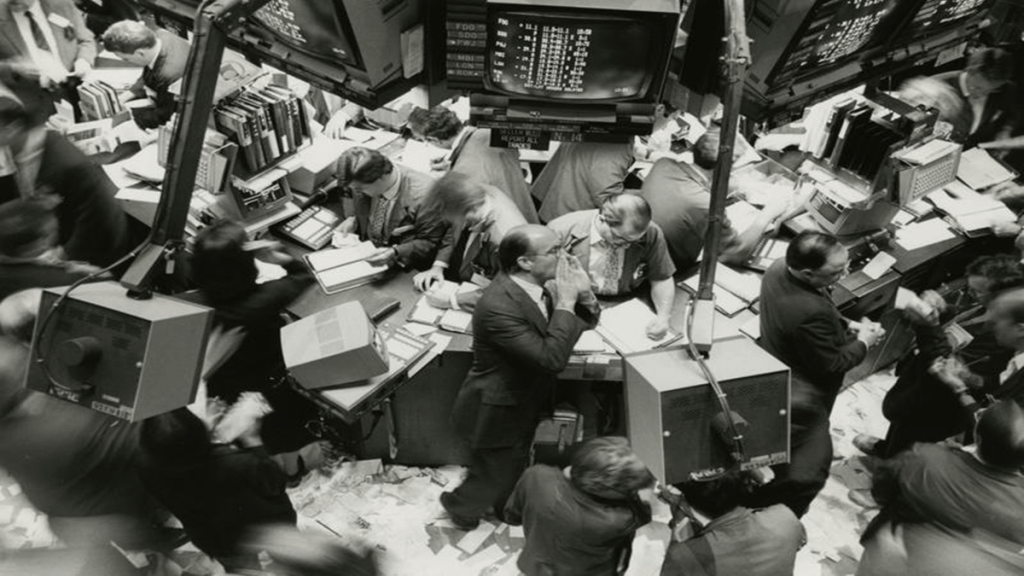
How a Category Gets Legitimated Into Respectability
There is a sentence you have probably said, or heard, or simply absorbed without anyone saying it at all: you can’t buck the market. It sounds like a fact about the world, the way gravity is a fact about the world. It isn’t. It is the end product of several centuries of deliberate argument, made by named people, at specific moments, for reasons that made sense to them at the time — and arguments, unlike gravity, can be answered. This piece exists to show the mechanics of how that particular argument won, closely enough that the winning stops looking inevitable and starts looking like what it actually was: work, facilitated in every case by pressure, structure, and opportunity.
The market, however, is not the only thing built this way, but it is the case study here, because it is the one doing the most damage while feeling the most natural. Markets — the actual mechanisms, prices carrying information, exchange coordinating strangers — are indubitably useful, and very often the correct tool for the job, providing the tradesman is competent and supervised. “The market,” capitalised in the mind if not on the page, is a different animal: a category that has been quietly moved beyond argument altogether, treated as weather rather than policy, so that proposing to change it sounds unhinged rather than political. That move — from useful tool to unquestionable given — is the actual subject of this essay, and several very different thinkers, working from unconnected starting points across three centuries, turn out to have independently solved pieces of exactly how it happens.
The route runs through history rather than around it, because the mechanics only become visible with the history attached. Albert Hirschman shows commerce winning its first respectability by comparison, not by proof. Property rights and the trust that scales past strangers show how the abstraction gets its legal skeleton. Evald Ilyenkov shows how something entirely invented can still be entirely real, with genuine power over an actual life. Quentin Skinner shows the specific trick of borrowing an already-approved word — liberty, virtue, freedom — to smuggle a new practice past an old objection. Antonio Gramsci shows what full success looks like once the trick has worked so completely nobody remembers it was ever an argument. Michel Foucault shows why, once installed, disagreeing with the result stops feeling like a disagreement at all. And because none of this is only old history, the essay follows the same mechanism forward from a hotel in Switzerland in 1947 through to a term most readers will already have heard on the news without ever being handed its actual lineage: shadow banking.
None of this is offered as a clever framing to admire from a safe distance. By the end, the aim is a genuinely different relationship to that opening sentence — not agreement, and not simple defiance either, but the specific, durable difference between being told something is beyond argument and actually checking. You can buck the market. And you can tell others too. This is what it would take to know that, and mean it.
One: Hirschman and the Founding Story
Albert Hirschman spent most of his career on development economics, and wrote his most quietly explosive book almost as a detour. The Passions and the Interests (1977) asks a question that sounds simple and isn’t: why did Europe, which had spent well over a thousand years treating the pursuit of money as morally suspect, suddenly decide, sometime around the seventeenth and eighteenth centuries, that making money was not just acceptable but virtuous?
His answer is not that anyone proved commerce was good. It’s that commerce won by comparison. Europe in the 1600s had just lived through a century of religious war, and its thinkers were terrified of what they called the passions — glory-seeking, revenge, religious zealotry, the appetite for domination that had produced the carnage. Against that, the “interest” — the calm, calculating, self-interested pursuit of profit — looked almost boring. Predictable. Manageable.
The word “interest” itself has a specific, dateable birth in exactly this context, before the economists ever got hold of it. The Duc de Rohan popularised it in De l’interest des Princes et Estats (1638), a book of statecraft written in the shadow of the wars of religion, arguing that a ruler’s actual position and circumstances should guide policy in place of confessional conviction. Pressure, structure, opportunity, in miniature: a continent exhausted by religious war, a vocabulary of statecraft already sitting there to be used, and one writer, in one book, who made the connection at the moment it would take. England’s Civil War, a few years later, is a related eruption of the same underlying pressure — divine right against a more procedural, interest-based account of governing — though the concept itself is French and Dutch statecraft literature first, English constitutional crisis second. And the Dutch Republic wasn’t just talking about this. It was living it a generation ahead of the theorists: merchants trading across confessional lines made religious uniformity commercially unworkable in Amsterdam long before anyone wrote the argument up formally.
A century later the argument found its fullest and most confident statement in Montesquieu’s The Spirit of the Laws (1748), and by then it had a name: doux commerce — sweet commerce, tamer of the passions, guardian of political freedom, engine of civilisation. Rohan’s narrower point about statecraft had grown, over a hundred years, into a full theory of what commercial life does to a society. And the theory has a title, from a generation earlier than Montesquieu’s, that says the whole argument in six words: Bernard Mandeville’s poem The Fable of the Bees, or, Private Vices, Publick Benefits (1714). Private, individual, morally suspect behaviour — a man chasing his own profit — redescribed as producing a general, collective good. Worth sitting with that title for a moment, because it’s the entire mechanism this essay is about, compressed into a bookseller’s line, a generation before it was argued at full length.
Hirschman himself didn’t fully believe his own story, though that’s worth preserving rather than smoothing over.In a later afterword he half-conceded that commercial society generated its own disorders rather than delivering the pacification it promised — doux commerce, in his own later assessment, both promotes and corrupts good conduct at once, not cleanly one or the other. The Romantics and, later, cultural critics worried about a flattened, one-dimensional personality replacing the “full human personality” the older passions had at least allowed for. And Hirschman had a sharp word for his own contemporaries too — economists like Keynes and Schumpeter, he thought, were defending capitalism on the same grounds Montesquieu had used two centuries earlier, without ever engaging Tocqueville’s objections to that same argument in between. Even the most recent turn in this literature has moved from armchair intellectual history into hard data — economic historians have started testing doux commerce against nineteenth-century evidence of market integration and cooperation with strangers, so the argument is very much alive rather than settled either way.
What Hirschman gives the essay, then, is the first move — a specific, authored, dateable redescription, not a slow evolution nobody chose. Someone had to argue this. It could have gone differently. That fact, sitting quietly at the start of the eighteenth century, is the whole essay in miniature already.
Two: Trust, Encoded
Niklas Luhmann spent years as a civil servant before turning to social theory, and went on to build one of the most systematic general theories of society attempted in the twentieth century. Buried inside it is a small, quietly devastating argument, first laid out in Vertrauen (1968), translated into English as Trust and Power (1979) — one chapter is literally titled “Trust in Trust.” His claim: trust isn’t mainly a feeling, it’s a way of not having to think. Personal trust, built on knowing someone, works fine at small scale. Once a society grows past the people anyone can personally vouch for, it has to invent impersonal, generalised carriers of trust instead — money, law, credentials — and these don’t replace trust so much as encode it, letting a stranger be dealt with without recalculating the whole relationship from nothing each time.
Georg Simmel, working a generation earlier and passed over for a proper professorship for years despite being one of sociology’s actual founders, made a close cousin of the same point in The Philosophy of Money (1900). Money works between strangers precisely because it carries no personal history at all, only an abstract, portable promise. Lynne Zucker later gave the whole idea a date, in “Production of Trust: Institutional Sources of Economic Structure” (1986) — American capitalism specifically between 1840 and 1920, the exact decades it outgrew the people who could plausibly know each other, forcing institutions to start manufacturing, on purpose, the trust that used to be earned face to face. Three thinkers, working sixty years apart in three different fields, converging on the same mechanism without citing one another — which is its own small piece of evidence that the mechanism is real rather than a shared academic fashion.
None of this is only a story markets tell about themselves — there’s real machinery underneath it. A market that had to relitigate its own foundations at every single transaction couldn’t run at any scale past a village. Wanting the basics to feel settled isn’t automatically dishonest. It’s partly just what scaling requires.
Property Rights: Where the Encoding Gets Written Down
Nowhere is that encoding more visible than in the English enclosures, built up gradually rather than seized in one stroke. Between the sixteenth century and the early nineteenth, several thousand Acts of Parliament converted common land — land generations of villagers had grazed animals on, gathered fuel from, fed themselves off — into private, fenced, legally titled property. Some of it was straightforward dispossession, hedges going up over resistance, occasionally physical. A great deal of it was also negotiated, litigated, and agreed to by tenant farmers who stood to gain from it too, over a much longer and messier process than a single dramatic land grab. Pressure, structure, opportunity again, just stretched across centuries rather than compressed into one moment: agricultural pressure to intensify output, an existing structure of manorial custom and common law courts to work through, and repeated legislative opportunities, parish by parish, over two hundred years. This wasn’t the market discovering property rights lying dormant in nature. It was a long, contested, partly consensual process of Parliament and local actors writing them into existence.
The same fiction extends just as smoothly to things nobody could fence even if they wanted to, and the phone in your pocket is carrying several examples right now. The chip inside it exists because of patents — a state granting a temporary, enforceable monopoly over an arrangement of ideas, not objects. Every call and data connection it makes draws on radio spectrum, which is property too: governments auction specific slices of the electromagnetic spectrum to network operators for billions of pounds, and a license-holder can exclude everyone else from broadcasting on that frequency, despite a frequency being nothing you could ever point to, touch, or stand on. Human gene sequences sit in the same territory — biotechnology companies have held patents on isolated DNA sequences, control over the right to test for or work with a specific piece of the human body’s own code, until a 2013 US Supreme Court ruling narrowed what could be claimed. There was no market for any of this waiting in nature to be discovered. A state decided each of these things could be owned, drew the boundaries, and enforced the claim — enclosure without a single hedge. Presumably somewhere there is already a lawyer drafting the argument for owning a slice of the weak nuclear force. Give it time. Or space.
A property right isn’t a fact about the physical world. It’s a claim, backed by courts and ultimately by force, that will be enforced against anyone who challenges it — and the moment that’s said plainly, something else becomes visible: the state enforcing property rights consistently is the same act as the state giving capital what it needs to function. Not two separate goods — the rule of law in the abstract, and markets needing predictable ownership — but one mechanism doing both jobs at once. There was never a market waiting to be freed from government. Property rights are government, continuously intervening. Take the courts away and the “right” doesn’t become freer. It stops existing.
Three: Ilyenkov, and How Something Invented Can Still Be Real
Evald Ilyenkov (1924–1979) worked as a philosopher inside a state that had already, officially, decided what Marxism meant — which makes what he did with that constraint more striking rather than less. Reading Marx’s account of money unusually closely, he developed, through the 1960s and set out most fully in Dialectical Logic (1974), a theory of what he called “the ideal”: the claim that something non-material can be fully real, not because it’s physical and not because any one person privately believes it, but because it’s carried in an ongoing, collective pattern of activity. Stop the pattern and the reality goes with it, even if the physical object never moves.
Weimar Germany in 1923 makes this almost unbearably concrete. German banknotes, physically unchanged — the same paper, the same ink, the same printed numbers — became worthless so fast that people burned them for warmth and papered walls with them, because it was cheaper than wallpaper. The paper hadn’t moved. Its moneyness had entirely evaporated, because the collective pattern of acceptance behind it had collapsed. That is Ilyenkov’s whole argument, watched happening in real time, to real people, in a single terrible year — arriving, as it happens, right in the middle of the same interwar decade that later produces Hayek’s own founding trauma, a connection worth holding for when this essay reaches him properly.
Spectrum, from the previous section, is arguably an even cleaner case than money. A banknote is at least a physical object that used to carry value and now doesn’t. A frequency was never a thing at all — no object ever changed hands, nothing was ever mined, grown, or built. It became real, ownable, billion-pound property purely because a state declared it so and enforced the declaration, which is Ilyenkov’s claim with every trace of physical residue stripped away. If the ideal can be that real when nobody’s even pretending there’s a physical object underneath, “the market” being real without being natural stops looking like a paradox and starts looking like the normal case.
This is the floor the whole essay has needed since the start. If “the market” were purely a story — Hirschman’s redescription and Skinner’s word-capture and nothing else — then telling people the true story should dissolve it, and it doesn’t. If it were purely material — capital and class interest, full stop — then all this care over language and institutions would be decoration on something inevitable anyway. Ilyenkov gives the third option: a produced, historically specific, entirely real ideal form, with genuine power over actual lives, without being either a natural fact or a convenient fiction. Constructed and real, at once.
It may not walk like a duck or quack like a duck, but apparently it is a duck.
Four: Skinner, and Words as Weapons
Quentin Skinner (b. 1940) built a career at Cambridge on a single, disciplined habit: read old political arguments in the language their authors actually used, not the meanings later centuries loaded onto the same words. His founding methodological essay, “Meaning and Understanding in the History of Ideas” (1969), borrowed from J.L. Austin’s speech act theory — the idea that a sentence does something in its moment, not just states something timeless — and from Wittgenstein’s insistence that meaning is use, not essence. Applied across decades of case studies, that discipline turned up a pattern Skinner thinks recurs whenever someone wants to legitimate a new and controversial practice: nobody invents new values to defend it. They stretch an old, already-approved word to cover it.
His own paradigm case is Thomas Hobbes, writing Leviathan (1651) in the direct aftermath of the English Civil War. The same three ingredients as Rohan’s book a decade earlier: a country that had just fought a war over exactly this question, a word already carrying public approval, and a specific author reaching for it at the specific moment it could stick. Hobbes takes “liberty” — the word Parliament had spent a decade mobilising against royal tyranny — and quietly redefines it to mean secure, contractual obedience to a sovereign. Object to the new sovereign’s authority, on Hobbes’s redefined terms, and you’re now objecting to liberty itself. That’s not persuasion. It’s relocation.
Words carry this kind of buried history more often than they let on, and virtue shows the same trick working a second time, on an even older word. For most of its history the word describes a person — Aristotle’s arete, in the Nicomachean Ethics (4th century BCE), is a quality of character, something a man has or lacks. Medieval Christianity keeps that individual focus and narrows it toward salvation: the cardinal virtues joined the Pauline theological virtues, all of it still about one soul’s condition. Then in The Prince (1513), Machiavelli does something genuinely strange with the word: virtù becomes a ruler’s capacity to win and hold the state, explicitly detached from personal goodness — the first time in this history the word gets used for effectiveness rather than character, a deliberate provocation against thirteen centuries of Christian usage.
That loosening is what makes Bernard Mandeville’s move, two centuries later, possible at all. Mandeville was a Dutch-born physician and satirist working in London, and his poem The Fable of the Bees, or, Private Vices, Publick Benefits (1714) needs “virtue” to already be a word that can attach to outcomes rather than only character — Machiavelli is the reason it was available to attach that way. A word built for judging one man’s soul ends up certifying an entire economic practice, and the same borrowing-an-approved-word mechanism that gave Hobbes “liberty” gave the eighteenth century “virtuous commerce.”
The most direct heir to Mandeville’s title isn’t Hayek at all, and the echo is almost exact. Ayn Rand’s The Virtue of Selfishness (1964) makes explicit, two hundred and fifty years later, what Mandeville had left as a paradox to be enjoyed rather than a position to be defended outright — rational self-interest isn’t merely tolerable or useful, it’s a virtue in the fullest Aristotelian sense, a quality of character worth cultivating on purpose. The word has now travelled the entire distance: individual character, to ruler’s effectiveness, to an economic system’s outcome, and back again to individual character — except this time the character being praised is the one earlier centuries would have called the vice.
This is not archived scholarship — the identical fight is running right now, over the vocabulary this essay actually cares about. Wendy Brown’s Undoing the Demos (2015) argues neoliberal reasoning works by submitting democratic language to economic logic — liberty measured by human capital, equality dissolved into market competition. Quinn Slobodian has spent a decade-long trilogy, beginning with Globalists (2018), contesting what “neoliberalism” itself even means, arguing its architects were never chiefly about deregulation but about building legal armour to shield markets from democratic pressure. Whoever wins that definitional argument controls how the word functions in every debate that follows — Skinner’s thesis, caught in the act, not safely settled centuries ago.
Five: Gramsci, and What Full Success Looks Like
In 1926, a fascist prosecutor stood up in an Italian courtroom and said of the man in the dock: “For twenty years we must stop this brain from functioning.” That man was Antonio Gramsci (1891–1937) — Sardinian by birth, a founder of the Italian Communist Party, elected to parliament in 1924 — and Mussolini’s regime, having outlawed his party that same year, wanted him removed from circulation as completely as a sentence could manage. He was formally sentenced in 1928 and served until 1937, all of it in prison, dying within days of his release. Inside that sentence, writing under censorship so heavy he had to disguise his own vocabulary to get the notebooks past the prison censor, he filled over thirty notebooks between 1929 and 1935 with the work that made him one of the twentieth century’s most influential political thinkers, published only after his death.
His central concept is hegemony, and it answers a question this essay hasn’t asked directly until now: what does full success actually look like, once a category has finished being legitimated? Not an argued position anymore, not even something defended — just senso comune, Gramsci’s own term for it, secured not chiefly through force but through civil society: schools, churches, unions, newspapers, all the ordinary institutions of everyday life. A ruling class doesn’t win by beating every argument. It wins by making its own interests feel like simple, unexamined reality, which is exactly what senso comune names. Hirschman’s redescription, Skinner’s word-capture, the whole slow work of making something feel settled: this is what it looks like once the work is finished and nobody remembers it was ever an argument.
And there’s something almost too pointed about where he wrote this from. A man studying how domination survives without needing constant force, writing from inside a regime that had just demonstrated, on his own body, exactly what happens once persuasion runs out and only force is left. Hegemony isn’t a cynical shortcut past violence. It’s the more efficient system violence gets used to install and then, ideally, to stop needing.
Six: Foucault, and Whether There’s a Root at All
Michel Foucault (1926–1984) spent his career asking a question that sounds abstract until you see it applied: not “is this idea true,” but “how did this become the kind of thing we test truth against.” He was a French philosopher and historian, and across three decades of work — History of Madness (1961), Discipline and Punish (1975), the first volume of The History of Sexuality (1976) — he kept finding the same shape from different angles. The official story is always that we simply discovered the truth about mad people, or criminals, or deviance. Foucault’s counter-story is that categories like “madness” and “criminality” were built, by doctors, reformers, courts and whole apparatuses of expertise, and that once built, they didn’t just describe people, they produced the kind of people who fit them.
Two ideas came out of this that matter for everything else in this essay. Power/knowledge, his own deliberate contraction, holds that power isn’t mainly a king or a state saying no — it works by producing knowledge that shapes what counts as normal, sane, productive, deviant, and the knowledge and the power are made together, not one serving the other from outside. Genealogy is the method this generates: instead of asking what a category really, essentially is, ask how it came to be thought of that way — what accidents, struggles and interested parties produced something that now looks like it was always simply true.
Near the end of his life he turned this method on economic liberalism itself, in lectures delivered at the Collège de France in 1978–79 and published in English as The Birth of Biopolitics in 2008. His argument there is the one this essay has been building toward: modern societies don’t just use markets to trade goods. They install the market as a site of veridiction — the place where truth about policy, about people, about value itself gets tested and confirmed. Once that installation is complete, arguing against “the market” stops feeling like a policy disagreement. It starts to feel like arguing against reality, because the market has become the thing everything else is checked against, not one option among several.
Very persuasive. But this leaves us with a clear tension between the material explanation of power from Marxists such as the geographer David Harvey — the lodestone for much of our thinking elsewhere — and Foucault’s formulation, grounded instead in the production of knowledge. Harvey’s power is fundamentally economic: capital accumulation, class position, ownership, the structural need to keep expanding — ideas and discourse are real but ultimately explicable by material interest. Gramsci’s power is economic in its interests but cultural in its actual operation, secured through civil society and common sense rather than force — he’s already attempting, decades before anyone names the problem this way, the synthesis Harvey and Foucault seem to need. Foucault’s power has no root at all, economic or otherwise — produced everywhere, in clinics and prisons and statistics and economics itself, through techniques that don’t answer to one master logic, even when they end up compatible with capital’s interests.
Bob Jessop, a Marxist state theorist who has spent years working this exact tension rather than picking a side, gives the sharpest formulation of what’s actually at stake. Marx and Harvey explain the why — the underlying drive, the structural interest being served. Foucault explains the how — the concrete, mundane mechanisms through which domination actually gets operationalised, day to day, in specific institutions. The live argument is whether the how is ultimately just an instrument of the why, discourse as capital’s disguise, or whether the how has its own productive logic that can generate outcomes the why alone wouldn’t predict.
We’re not resolving this, and we don’t think it should be resolved. Pure economism can miss how institutions and vocabularies function independently of the interests they end up serving. Pure discursive dispersal can dissolve the question of who materially benefits, until every arrangement looks equally arbitrary. Gramsci sits usefully between the two extremes, refusing to let either collapse into the other. Whenever “the market” starts to look simply given, all three are worth holding at once, precisely because none of them alone catches the whole mechanism.
This argument is alive in the literature, not archived. Jessop’s own attempt at synthesis runs through what he calls a strategic-relational approach to the state. Colin Gordon did much of the early work making Foucault’s governmentality lectures legible to Anglophone political economy, co-editing The Foucault Effect (1991). Thomas Lemke, in a widely-cited 2001 essay, and Nikolas Rose, in Powers of Freedom (1999), are central to what’s now called governmentality studies, tracing how “human capital” language recodes social policy as individual self-management. William Davies’s The Limits of Neoliberalism (2014) reads neoliberalism through Foucault as the installation of competition, not exchange, as the governing logic of everyday life. And it’s not all convergence: Derek Kerr’s 1999 paper “Beheading the King and Enthroning the Market” is a pointed Marxist critique of Foucauldian governmentality applied to exactly this territory, arguing the framework lets “the market” off too lightly by refusing to name who benefits. A useful corrective against reading the whole relay as one happy consensus.
Thomas Lemke and Nikolas Rose trace a move Foucault’s own lectures only gesture at: neoliberal government doesn’t just install the market as truth-tester at the level of policy, it pushes the same logic down into the individual. Lemke calls the mechanism responsibilisation. As the state visibly withdraws from managing risk — unemployment, illness, old age, the ordinary hazards of a working life — those risks don’t disappear, they relocate. They become problems of “self-care,” personal failures of planning, discipline, or foresight, rather than structural conditions a collective institution used to absorb. The unemployed person hasn’t been failed by the labour market. They didn’t upskill enough. The person without a pension didn’t save early enough. The precarious worker should have built a better personal brand. This is homo economicus doing its work at the kitchen table rather than in a policy document: everyone recast as a tiny enterprise, responsible for managing their own human capital, and any shortfall read as a failure of individual management rather than evidence the system might be the thing not working.
Put the two moves together and the trap has two jaws, not one. Externally, “the market” gets naturalised — beyond politics, self-correcting, not a legitimate target for argument. Internally, the individual gets responsibilised — whatever goes wrong for you personally inside that market is your failure to manage yourself well, not the market’s failure to manage you. Both moves protect the same thing from the same kind of challenge. You can’t blame the system, because the system isn’t a choice anyone made. And you can’t blame the system for what happens to you specifically, because that was down to your own decisions inside it. It’s worth sitting with how familiar that second move feels from the inside — most people have judged their own economic setbacks in exactly this vocabulary at some point, usually without noticing it’s a vocabulary at all.
Seven: The Market, Applied
So who did the dirty? When did the market become “The Market”? Is there a specific text, a specific event, a name to put to it — or does it just accrete, the way most of this essay’s other categories accrete? There is a name, and a date, and a hotel.
Friedrich Hayek’s The Road to Serfdom (1944) argued that economic planning, however well-intentioned, put the whole of human life in service of “the Plan,” and that even democratic socialism could slide toward a totalitarian outcome. Three years later, in April 1947, thirty-six economists, philosophers and historians gathered at Hayek’s invitation at the Hôtel du Parc — known locally, without apparent irony, as the Pelerin Palace, a Belle Époque hotel with sweeping views over Lake Geneva — to found what became the Mont Pelerin Society. Pressure: an Iron Curtain freshly across Europe, a Chinese civil war tipping toward communist victory, Western democracies dominated by Keynesian planning enthusiasm. Structure: a vocabulary of liberty already three centuries deep in exactly this kind of redescription, sitting ready to be picked up again. Opportunity: one economist, one very comfortable hotel, one moment when the redefinition could stick.
Run the whole relay against that single hinge and it holds together as one mechanism rather than seven separate arguments. Hayek’s move is doux commerce’s direct descendant — the market redescribed once more as tamer of a destructive passion, with totalitarian collectivism standing where religious zealotry and royal tyranny stood before it. Postwar reconstruction needed exactly the encoded, stranger-scale trust Luhmann and Zucker describe — Bretton Woods, GATT, the whole architecture of a shattered continent rebuilding on borrowed confidence — and the genuine functional need for that stability is real, not invented. Property rights, backed by a functioning legal system, are what actually got rebuilt in those years, state by state, court by court — the precondition, not a side effect, of the market that supposedly needed freeing from the state. The postwar order becomes, in Ilyenkov’s sense, a produced, entirely real ideal form, embedded in institutional practice — IMF and World Bank and GATT, all founded in 1944 and 1947–48 — not just a story people told themselves. Skinner’s mechanism runs exactly as it ran for Hobbes and for Machiavelli’s virtù: “liberty” redescribed once more, pointed at a new enemy, “virtuous commerce” updated for a new century, and Wendy Brown and Quinn Slobodian show the same words still being fought over today, not settled decades ago. Gramsci’s endpoint is where it all lands: the market, as a category, stops being defended and becomes senso comune — the thing nobody in the room needs to argue for anymore, because arguing against it now sounds like arguing against reality itself. Foucault’s Birth of Biopolitics lectures (1978–79) are, quite literally, about this exact moment and this exact school of thought — ordoliberalism and Chicago liberalism installing the market as the site where policy truth gets tested, homo economicus produced as the subject for whom that test feels like common sense rather than ideology. As the responsibilisation material makes concrete, that same subject is taught to treat their own unemployment, their own uninsured old age, their own precarity, as personal failures of foresight rather than evidence the system might be the thing not working.
Hayek was unequivocally right about prices and markets as a solution to a real coordination problem no central planner could match. He was wrong about markets as ideology — about the leap from “prices carry information well” to “the market is natural, self-correcting, and beyond the reach of politics altogether.” Those are two different claims, one true and one false, and the whole trick this essay has been tracing is how thoroughly they got welded into a single, unquestionable sentence.
Founding a hotel society is not the same as winning, and it took nearly three decades for anyone to notice the difference. The actual postwar architecture built in 1944, at Bretton Woods, was Keynes’s design more than Hayek’s — fixed exchange rates, capital controls, a managed system built by people who had just watched unregulated finance help produce a depression and a war. Mont Pelerin’s ideas sat at the margins of respectable economics for most of two decades, a minority position tolerated rather than taken seriously.
The opening came from a crisis Keynesian economics genuinely struggled to explain. The 1970s delivered stagflation — inflation and unemployment rising together — a combination the standard Keynesian toolkit hadn’t anticipated and didn’t have a clean answer for. Milton Friedman, Hayek’s most effective translator into economics as a discipline rather than philosophy, had spent the 1960s building monetarism as a rival account, and Capitalism and Freedom (1962) had already made the case in something close to popular language. The crisis didn’t invent Friedman’s argument. It gave the argument an audience it hadn’t had before.
Academic legitimacy for the specific move from “prices carry information” to “markets should mostly govern themselves” arrived through Eugene Fama’s efficient market hypothesis, formalised through the 1960s and set out fully in 1970. Markets, on this account, price all available information correctly and continuously — which sounds like Hayek’s genuine insight restated in mathematics, and functions, in practice, as an argument against most regulation on the grounds that regulators can’t outperform a market that’s already got the pricing right. Fama and the hypothesis skirted with real legitimacy for a time, as so much economics orthodoxy does, before imploding on contact with actual market volatility and losing ground to the far more persuasive account offered by Daniel Kahneman and the field of behavioural economics that followed him. That collapse doesn’t undo the damage the theory did on the way up — it’s the exact welding this essay has been tracing throughout, happening again in equations rather than political rhetoric, and equations don’t need to be right to do political work. They just need to be believed for long enough.
The political vehicles arrived in 1979 and 1980, and the deregulation itself has real dates rather than a vague drift.Thatcher and Reagan didn’t invent the ideas, they gave them state power. London’s Big Bang, on 27 October 1986, abolished fixed commissions and let banks trade on their own account against their own clients — a single Monday morning that restructured the City. In the United States the process ran slower and, tellingly, across party lines: the Riegle-Neal Act of 1994 permitted nationwide banking, the 1998 merger creating Citigroup forced Congress’s hand, and the Gramm-Leach-Bliley Act of 1999 — signed by a Democratic president, Bill Clinton, who called it a strengthening of financial stability — repealed most of what remained of Glass-Steagall’s 1933 wall between commercial and investment banking. This was never simply a right-wing project imposed on unwilling technocrats. Serious people across the political spectrum came to believe it, which is precisely what a fully successful redescription looks like.
One dissenting voice was marginalised through almost the entire run, and was proven right. Hyman Minsky spent decades, from the 1960s through to his death in 1996, arguing that stability itself breeds instability — that calm markets encourage exactly the kind of leverage and risk-taking that eventually breaks them, a financial instability hypothesis largely ignored by the mainstream of his own profession. The term “Minsky moment” wasn’t coined until 1998 and didn’t enter common use until 2007 and 2008, when shadow banking — the securitised, derivative-heavy, barely regulated financial system that had grown enormous in exactly the deregulated space this history describes — collapsed in the way he had been describing for thirty years.
Even some of the people who built this system now say so themselves — though not all of them the same way.Former Citigroup chief executive John Reed later admitted the bank’s leadership had simply been ignorant of the risks it was taking on after Glass-Steagall’s repeal. Richard Fuld offers the opposite kind of evidence: running Lehman Brothers, visibly, and invisibly, leveraged far beyond what its published balance sheet ever showed, he was still publicly vowing in April 2008 to “hurt the shorts” betting against his own firm, seemingly confident right up to its bankruptcy that September — the largest in American history — that the danger lay with the sceptics rather than the balance sheet. Gordon Brown, UK chancellor through the years the City’s deregulated growth was treated as an unambiguous national success, later said he regretted not regulating harder against what he called relentless pressure from the City itself not to. Confession, obliviousness, and regret, from three men who each had a genuine hand in building the thing that broke.
And because it’s a produced ideal form rather than a fact of nature, none of it was ever beyond reconstruction either. Property rights are enforced by courts because a state chooses to enforce them, continuously, not because ownership is written into physics. The market’s status as truth-tester was installed by named people at a named hotel in 1947, not discovered lying in wait since the beginning of time. A state that already, quietly, underwrites the whole system — as central banks, courts and currencies have always underwritten it — can just as legitimately hold a stake in what it underwrites, the way a state-owned wealth fund does, without that being a lurch into some unprecedented radicalism. It would simply be the state doing, openly and by design, what it has been doing invisibly the entire time.
The economists meeting in Switzerland now have company. Thirty-six in a hotel then; several thousand heads of state, chief executives and assorted fancy dans making the same pilgrimage each January now, across an entire ski resort in Davos, complete with security details and Instagram feeds.
Coda: What Clear Sight Actually Buys You
Knowing all of this doesn’t set anyone free, and it’s worth saying that plainly rather than pretending the theory was secretly a cure. Peter Sloterdijk named the reason in Critique of Cynical Reason (1983), and Slavoj Žižek sharpened it into a formula: they know very well what they are doing, but still, they are doing it. The old idea of ideology assumed people were simply deceived, and that unmasking the lie would set them loose. The dominant mode now is cynical, not naive — fully aware of the distance between the mask and the reality, and wearing the mask anyway. Someone can read every section of this essay, agree with all of it, and still pay rent in a currency they know is a political construction. The knowing was never the thing holding anyone in place.
Stoicism is often reached for here, and it’s worth correcting rather than dismissing, because the correction gets closer to something useful. Epictetus, who wrote the source text for most of what passes as Stoic wisdom, was a slave for part of his own life. His actual claim isn’t that money, comfort or security don’t matter — it’s the dichotomy of control: some things are up to you, your judgments and your assent, and most things are not. Freedom is sorting that correctly, not renouncing the things on the wrong side of the line. You can keep the material comfort and still ask whether your inner state is hostage to it.
Foucault himself, near the end of his life, gave a sharper and more specific answer than Stoicism does. In a 1978 lecture titled “What is Critique?” he redefines critique not as achieving a clean outside to power, which he never thought existed for anyone, but as the art of not being governed quite so much, or not in this particular way — deliberately modest, deliberately ongoing, a practice rather than a single act of insight. Judith Butler’s essay on this lecture is titled “What is Critique? An Essay on Foucault’s Virtue” — she notices he uses the word virtue itself for this stance, an art rather than a doctrine. Which closes a loop worth pointing at without belabouring: the word that ran from Homer’s battlefield through Aristotle’s citizen through Christian salvation through Machiavelli’s ruthless effectiveness picks up one more redescription right at the end of this essay’s own story. Virtue, this time, as the practised capacity not to be fully governed by whatever currently governs you.
Peter Sloterdijk, who diagnosed the cynicism problem in the first place, also has an answer to it, and it’s more useful than detachment because it’s active. He calls it kynicism, after Diogenes — not arguing ideology into submission with better propositions, which cynical reason has already made pointless, but an embodied, cheeky, dignified refusal that doesn’t need to win the argument to keep its own clarity intact. Diogenes telling Alexander the Great to get out of his light isn’t a rebuttal. It’s a demonstration that his peace of mind was never in Alexander’s gift.
The precise thing worth protecting, in ordinary psychological language rather than philosophy, is learned helplessness — the state where repeated exposure to circumstances you can’t control teaches you to stop trying even once trying becomes possible again. The aim was never mastery, and it was never waiting for everyone else to move first. It’s not losing the capacity to say I see what this is, and I am not fully inside the story it tells about itself — and from there, to still ask, reach, act in whatever way is actually available, rather than going quiet.
Hirschman, who opened this essay, gives the last piece too. Exit, Voice, and Loyalty holds that an individual with clear sight but no numbers behind them can’t credibly exit — nowhere real to go — and can’t make voice heard alone — it needs volume. What’s left, absent either, isn’t conviction. It’s loyalty, dressed up as realism. The trap doesn’t spring for one clever person, however clear-sighted. It springs when enough exits and enough voices show up in the same moment that loyalty stops being the only thing left standing.
If you can bear reading the polemical cousin of this theory-fest please go to: https://athomehefeelslikeatourist.blog/2026/05/22/pig-iron-5-against-the-mythology-of-mr-market/
Methodology note: this piece was written collaboratively between a human and an AI — the human providing the instincts, provocations, editorial judgement and voice; the AI providing research synthesis, intellectual scaffolding and drafting. Full method at [athomehefeelslikeatourist.blog].


Leave a Reply