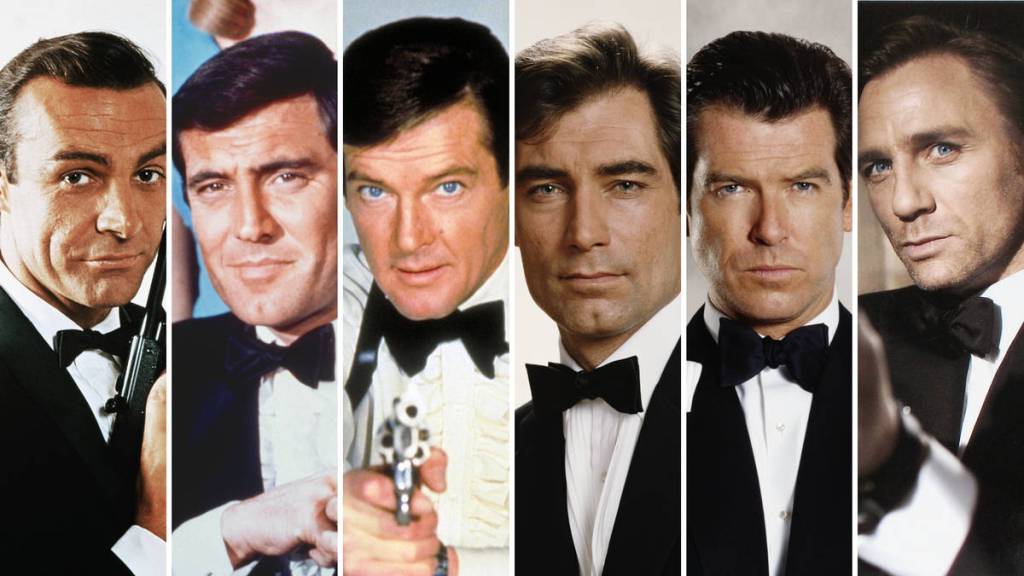
Part One: Empire, Decline, and the Spectacle of British Potency
Episode 4, Series 2. I’m Alan Partridge. In which our hero’s plans to curate a weekend Bond-a-thon are frustrated by his guests’s inability to keep two different films straight — Sonja, Lynn, Gordon, Tex, Michael, and John, are eventually gathered in a caravan. Alan snaps “Stop getting Bond wrong,” then delivers an entirely accurate, deeply excitable, and slightly smutty account of the opening of The Spy Who Loved Me — cutting Michael off the moment he tries to jump ahead and spoil the parachute opening himself.
We really hope we don’t get Bond wrong in what follows.
An Olympian Eyebrow Raise
Cast your mind back to 2012. The London Olympics. A Great British success story. Danny Boyle’s opening ceremony did many memorable things: the “Green and Pleasant Land” segment, sheep and cricket and a replica Glastonbury Tor rising out of real turf; the dark satanic mills, seven smoking chimneys erupting from the same ground the meadow had just occupied, ten thousand volunteers turning a pastoral fantasy into an industrial one in front of eighty thousand people; a minute’s silence in the middle of all that noise and iron, for the dead of two wars; the suffragette movement marching past, Emily Davison stepping out in front of the King’s horse; the Jarrow Crusade, hunger marchers stumbling under the weight of 1936; the Empire Windrush arriving in 1948, suitcases and all; a 1970s DJ float; the Nostalgia Steel Band; the Beatles as they appeared on the cover of Sgt. Pepper’s Lonely Hearts Club Band; and, running through the whole sequence, molten iron being forged into the Olympic rings themselves, rising glowing above the stadium as the noise built to a peak.
All of that came before the joke everyone actually remembers.
Bond — Daniel Craig, playing himself playing Bond — is shown into Buckingham Palace, where the actual Queen turns from her desk and, gleefully, plays herself too. A helicopter carries them to the stadium. Minutes later, two figures in identical outfits parachute into the arena. It is, by any sober description, a deeply silly thing for a nation to have organised: the sitting monarch appearing to skydive into her own coronation of a summer of sport, escorted by a fictional intelligence officer who has spent five decades being amused by his own absurdity.
It worked. It is difficult to think of another five minutes of British television in the last quarter-century that so many people, of so many different political persuasions, watched with genuine, uncomplicated pleasure.
Which is worth pausing on, because it isn’t an accident of good scriptwriting. It’s the result of sixty years of a franchise working out, by trial and error, how to let a nation enjoy a fantasy of its own importance without ever quite requiring anyone to believe it.
There’s a useful piece of apparatus for this, borrowed from the cultural theorist Stuart Hall, who argued that no text has a single meaning simply waiting to be received — it has an intended, “preferred” meaning, and audiences decode it in at least three distinct modes. Some take it straight: the dominant reading, in which Bond really is proof, however residual, that Britain still matters, and the fantasy is enjoyed as more or less true. Some take it with a wink: the negotiated reading, in which every absurdity is fully visible and enjoyed precisely because it’s visible — the pleasure of the joke rather than the pleasure of the claim. And some reject the whole apparatus outright: the oppositional reading, in which the fantasy is simply imperial nostalgia with the serial numbers filed off, and no amount of irony redeems it.
What Boyle’s ceremony proved, better than any single Bond film had managed on its own, is that this character can be watched in all three modes simultaneously by different people in the same room. And it’s worth adding one further thing about that ceremony before moving on: it was made by ten thousand volunteers and a creative team working from Blake and Brunel rather than from a client brief, its content unbranded and unsponsored, a rare thing this whole essay is going to spend a great deal of time watching capital eventually get its hands on. For one evening, at least, the fantasy of British significance wasn’t being sold to anyone.
The rest of the world, on the whole, was charmed and slightly baffled in roughly equal measure — which may be the most British reception imaginable. The New York Times called it “quirky,” “eccentric,” “off the wall”; the Associated Press settled for “Brilliant. Cheeky, too.” Both readings are correct, and both are doing exactly what Hall would predict: admiration that doesn’t fully require understanding every reference to register as a success. There’s a small, telling postscript worth having, too — American audiences, watching on NBC, got the ceremony tape-delayed and edited for advertising breaks, several minutes of content quietly excised, to considerable and vocal domestic complaint. So the one evening this essay is holding up as a rare moment of unmediated, unsponsored creativity was, for its largest single overseas audience, delivered exactly the opposite way: packaged, delayed, and cut around the commercial breaks. Even Britain’s one clean shot at showing the world something it hadn’t sold first found a buyer eventually, just not at home.
This essay — the first of three — is an attempt to take all of this seriously rather than just enjoy it. It asks what a country does with its own cultural output once it can no longer back the fantasy with the power the fantasy describes, and why that turns out not to be quite as pathetic a question as it sounds. Through the lens of one of its most iconic cultural outputs.
Contradiction Baked In
Bond did not begin as a fantasy invented in ignorance of decline. He began as a fantasy invented by a man with better information than most.
Ian Fleming spent the war in Room 39 of the Admiralty, personal assistant to the Director of Naval Intelligence, close enough to real tradecraft to know exactly what it looked like: tedious, compromised, and rarely as decisive as anyone outside the building imagined. He drafted Casino Royale in 1952 and published it in 1953 — three years before Suez made public, in the most humiliating way available, what people in Fleming’s world had already known privately for some time. Bond is not, in other words, wish-fulfilment dreamed up before the wound arrived. He is wish-fulfilment written by a man who had already seen the wound forming, in loving, frictionless detail, as if writing it down clearly enough might keep it from being true.
There is a contradiction at the centre of Fleming himself that the novels never quite resolve. He was Eton-educated, from a family that mattered — but he was also the less successful brother, a man whose own career had stalled in journalism and unsuccessful stints at two City stockbroking firms before the war gave him, for the first time, something he was genuinely good at. Bond isn’t confidence transcribed from a man who had always had it. He’s confidence imagined by a man who had watched real competence up close, in wartime, and knew precisely how rare and how fragile it actually was — and who had, by most accounts, not quite managed to hold on to it himself once the war ended.
The contradiction has a real-world echo that we will return to at the end. Fleming’s own family fortune came from Robert Fleming & Co, the merchant bank his grandfather built from nothing into one of the great Scottish-founded institutions of the City. It survived Fleming, survived the century — and was sold to Chase Manhattan in 2000 for $7.7 billion, folded within months into the newly formed JPMorgan Chase. Both halves of Ian Fleming’s inheritance, the real bank and the fictional spy, ended up in American hands eventually. Neither all at once, and not for the same reasons — but neither survived, in the end, as something Britain owned outright.
The Ship Sails
Suez is where the denial mechanism gets its clearest possible demonstration, and it needs telling clearly before explaining what Britain then did with it.
On 26 July 1956, Nasser nationalised the Suez Canal Company. Eden, judging the loss of British control over the canal a mortal blow to what remained of British prestige in the region, colluded in secret with France and Israel — a plan so closely held that most of his own Cabinet didn’t know about it until after the invasion had begun. Israel invaded the Sinai on 29 October; Britain and France landed paratroopers days later under the pretence of “separating” the combatants in a war they had themselves engineered. And then Eden lied to Parliament about all of it, denying the collusion to the Commons in terms that would later be shown to be false in every particular.
It didn’t work. Eisenhower, furious at being sidelined by an ally days before a US election, refused to support the pound — Britain was haemorrhaging roughly £100 million a week in reserves — and made clear that support would not resume until British troops were out of Egypt. Within days, Eden had no choice but to accept a ceasefire he hadn’t wanted, troops he’d committed with such confidence in full retreat by Christmas, having taken the canal and then been forced to hand it straight back. He resigned the following January, officially on health grounds. Historians are not shy about naming what actually happened: the episode “signified the end of Great Britain’s role as one of the world’s major powers.” Not a slow fade. A specific, dateable afternoon when Washington decided whether Britain’s own currency survived the week, and Britain discovered it no longer had a vote in the matter.
Given a humiliation this total, this well-documented, and this fast, you would expect a reckoning to follow. What followed instead was something closer to amnesia. So why did this happen? Because Britain has a structural preference for converting military and political defeats into stories about character, rather than converting its genuine successes into anything worth celebrating at all. Dunkirk is the clean template: a catastrophic retreat, an army saved only by improvisation and a flotilla of civilian boats, metabolised within months into a story about spirit and pluck rather than what it also was — a rout. A retreat you can narrate as character is more bearable than a retreat you have to explain as strategic failure, and Britain, faced with the choice, reliably prefers the first version.
Slow Motion Trauma
The trauma of Suez landed unevenly, however, and we need to know exactly where it did and didn’t reach, because the gap tells you something the event itself doesn’t.
At the top, it was immediate and total — a Foreign Office and Cabinet class discovering, in real time, that the country they’d spent careers serving no longer set its own terms. Further down the social scale, in 1956, it registered as very little at all. For a factory floor or a corner shop, Suez was newsreel: a diplomatic embarrassment involving a canal most people had never seen and a Prime Minister most people had never much cared for. The wound was real, but it was an elite wound, felt in Whitehall and the officers’ mess long before it was felt anywhere else.
What actually reaches the kitchen table arrives a decade or so later, and it arrives as economics rather than geopolitics. Harold Wilson’s government devalues the pound in November 1967, and Wilson goes on television to tell the country that “the pound in your pocket” hasn’t been devalued — a claim so transparently false that people understood they were being lied to before the broadcast had even finished. Then, in 1976, under Callaghan and Chancellor Denis Healey, Britain is forced into the humiliating position of applying to the International Monetary Fund for a loan, submitting the country’s own economic policy to conditions set from outside — a quieter, more bureaucratic sequel to Suez, twenty years on, with the same essential lesson relearned: London does not, when it matters, get to decide these things alone. Meanwhile in early 1974, under Heath, on the heels of an oil embargo authored in countries Britain once occupied, industrial action and an energy crisis combine into the Three-Day Week — businesses restricted to three days of electricity, homes lit by candle, television broadcasts ending early to save power. That’s the moment decline stops being a story about maps and starts being a story about your own electricity bill. The causation running from Suez through to the Three-Day Week is real, even where nobody standing in the dark in 1974 was necessarily thinking about a canal.
There is a third tier below both of these, and it’s the one the other two rarely acknowledge sharing a cause with. Postwar Britain recruited labour from across the Commonwealth to fill shortages its own workforce couldn’t meet, throughout the very years its empire was being formally wound up — and then, in town after town, treated the people who answered that call as an unexplained arrival rather than the direct, deliberate consequence of its own policy. The writer and activist A. Sivanandan supplied the line that answers the hostility precisely: “we are here because you were there.” Empire’s afterlife arrived in person, in the same towns living through devaluation and the Three-Day Week, and Britain largely failed to connect the two.
Three tiers, three timelines, one cause — and almost nobody at the time drawing the line between them. Hold this in mind for what comes next, because Bond’s audience is assembled from all three.
The World is Not Enough
Bond arrives into this three-tiered, largely disconnected Britain in October 1962, with Dr No — the same year Jamaica itself becomes independent, mid-stride through a decade in which Ghana, Nigeria, and most of the rest of British Africa either has already left the empire or is actively leaving it. He is, from his very first appearance, an intelligence officer for a state visibly shedding the territory that used to justify having an intelligence service of that size and reach in the first place.
And there is a genuine, slightly poignant accident of timing sitting underneath that, which goes beyond mere backdrop. For most of Bond’s original audience, package holidays to somewhere like the Costa del Sol were only just becoming a mass, affordable phenomenon, arriving properly through the 1960s and into the 1970s. Istanbul, Jamaica, Japan — the places Bond visits in his first decade on screen — weren’t destinations most cinemagoers had been to or were likely ever to go. They were pure image, delivered to an audience at the same historical moment the empire that had once made those places administratively familiar to Britain was disappearing from the map. Bond’s audience loses the empire and gains the tourist gaze at almost exactly the same time, and the films hand them a frictionless version of both at once — access to the exotic, with none of the responsibility that used to come attached to it.
There’s a smaller, tidier version of the same fantasy built into the films’ own architecture. M and Q don’t simply travel to these places, they arrive with entire operations already installed — fully staffed offices, functioning laboratories, hardware wired and waiting, as though Whitehall’s actual reach were never remotely in question. It’s the direct mirror of the villain’s lair, doing the same fantasy work from the other side of the ledger: both are pictures of total operational competence projected effortlessly into someone else’s sovereign territory, one dressed as heroism and the other as menace.
Rose Tainted Spectacles
There’s a French theorist who came help us here, briefly and without too much apparatus, because he explains something about Bond that’s otherwise just a vague feeling of “isn’t it odd how little any of this needs to make sense.” Guy Debord argued, in the 1960s, that consumer society had begun replacing genuine experience with the image of experience — the spectacle, consumed for its own sake, increasingly detached from whatever it was originally supposed to represent. You don’t need to read the rest of his book to use the one idea: a spectacle doesn’t need to serve the story. It just needs to be watched.
Bond’s pre-title sequence may be the cleanest and most durable possible demonstration of this anywhere in commercial cinema. A ski chase, a free-fall, a boat launching off a waterfall — routinely with no connection to the plot that follows, often featuring a Bond who then vanishes from the film’s actual narrative concerns for the next twenty minutes while the gun barrel and the theme tune do their work. Nobody in the cinema is confused about this or bothered by it. It’s understood, instinctively, as the point rather than a detour from the point.
Imagine a family that has watched these films more times than they could honestly count — a smartarse, his well-read and long-suffering spouse, an educated and educator son, a highly principled daughter who somehow exempts Bond from her own principles, another daughter who is a natural comic, and a daughter-in-law who has been railroaded into the viewing conspiracy. That pre-title sequence is precisely the bit they all know by heart, note for note, before a word of plot has been spoken — present in the room purely for the spectacle of it, not the story. Which is Debord’s entire argument, performing itself, unprompted, in front of the television.
And there’s a second, quieter piece of evidence worth having alongside the stunts: Bond more or less invented mainstream product placement as a formal technique — the Aston Martin, the Omega watch, the Bollinger — years before the practice had a name most audiences would have recognised. That’s the moment the film stops even pretending its primary product is the narrative. The story is the delivery mechanism. The image is the thing actually being sold.
We can pause the decline reading here though, deliberately, because the story isn’t only one of diminishing British reach dressed up in tuxedos. There’s a genuine counterweight sitting inside the Bond story too, and it deserves its place before the essay goes looking, unapologetically, for more decline to catalogue.
Nobody Did It Better
Albert “Cubby” Broccoli and Harry Saltzman built something at EON Productions that actually lasted. It survived Fleming’s own ambivalence about the character he’d created. It survived a legal assault from Kevin McClory that dragged on for decades and, for long stretches, forbade the official films from even using Blofeld or SPECTRE by name. It survived Cubby’s death in 1996, mid-production, with his daughter Barbara Broccoli and stepson Michael G. Wilson taking sole creative control and keeping the whole thing not just alive but thriving for another twenty-five years. It survived six recastings of its lead, a dozen directors, the parent studio’s own bankruptcy in 2010. Twenty-five films across nearly sixty years, more than seven billion dollars in unadjusted worldwide box office — one of the top five highest-grossing franchises in the history of cinema, run for most of that span by the same family, out of the same small British production company.
In an industry where Britain otherwise mostly supplies crews, locations, and character actors to American-financed productions, this is a rare case of a British-originated concern retaining meaningful creative ownership of something the whole world wanted, for two generations running. Whatever this essay has to say about compensation and fantasy, it shouldn’t drown out the fact that Broccoli and his family built something real underneath the fantasy — genuine, durable, commercially extraordinary value, not just a comforting image of it.
There’s a stranger footnote to that survival worth having too. In March 1966, Broccoli, Saltzman, and three key collaborators — production designer Ken Adam, director Lewis Gilbert, cinematographer Freddie Young — were in Japan scouting locations for You Only Live Twice, booked on a BOAC flight out of Tokyo. All five cancelled at the last moment to watch a ninja demonstration instead. The flight they missed broke apart in clear-air turbulence near Mount Fuji minutes after takeoff, killing everyone aboard. The exact appetite for exotic spectacle this essay is about to spend some time being critical of is, on this one occasion, the thing that kept the franchise’s creative core alive to keep making the films at all.
Bond’s Others
The travelogue material has a harder edge sitting underneath it, best taken directly rather than left implied.
Fleming’s villains are almost never British. Across the novels, they’re Russian, German, Baltic, part-Chinese — hybrid, foreign, or naturalised but never quite belonging, even when the plots they drive are squarely about London’s gold reserves or the Bank of England. That pattern does real work: it lets British capital and the British establishment exempt themselves from the story even while the story is nominally about protecting them. Dr No himself, in the first film, is written as part-Chinese, part-German — a “sinister hybrid” template repeated across the run — played by a white actor, and served throughout by Quarrel, a loyal Black Cayman Islander guide who dies protecting Bond and is barely mourned before the plot moves on. The pattern is set from the very first entry: menace is foreign, service is expendable, and neither is British.
You Only Live Twice pushes the same instinct further, at a moment history had already made it embarrassing. By 1967, Japan had hosted the Tokyo Olympics, opened the Shinkansen, and overtaken West Germany as the world’s largest car producer; within a year it would overtake West Germany’s entire economy to become the world’s second largest, a position it would hold for decades. This is not a country waiting to be civilised by a passing Englishman; it is, at the exact moment of filming, the most startling growth story on the planet. The film’s response to standing in the middle of that transformation is to put Bond in yellowface, marry him off to a local woman as cover, and stage a ninja-training sequence as pure exotic pageant. The direct ancestor here is Gilbert and Sullivan’s The Mikado — a Victorian entertainment that uses “Japan” purely as decorative backdrop for an entirely British story, with no interest whatsoever in the actual place. A century later, Bond reaches for the same costume box, standing in front of a nation mid-miracle and mistaking it for scenery.
Who gets cast as foreign, corrupted, or physically grotesque in the villain’s chair is doing the same cultural work, from the opposite direction, as who gets cast as Bond himself — the villain as the photographic negative of whatever the era’s acceptable masculine ideal happens to be. That symmetry earns fuller treatment elsewhere in this project. For now, the pattern deserves to be named plainly: present from the very first film, and Bond’s evident fondness for people and places he’s simultaneously happy to treat as scenery is not incidental to the fantasy. It’s a working part of it.
Given that pattern, the exceptions are few enough to name individually — and the pattern breaking down turns out to be more revealing than the pattern itself. Alec Trevelyan in GoldenEye is the clearest case: British, a former MI6 agent, Bond’s own ex-partner, driven by a specific British historical betrayal rather than any foreign ideology — his family were among the Cossacks handed back to Stalin by Britain at the end of the war. No disguise, no hybrid coding, nothing exotic about him at all, and not coincidentally the sharpest, most personally devastating villain the franchise had produced up to that point. Elektra King in The World Is Not Enough is the other clean case — English aristocratic inheritance, daughter of a British oil tycoon, the first female mastermind in the canon, entirely unforeign. Silva in Skyfall is a partial third: British by career and backstory, a former agent betrayed by M, though played by a Spanish actor whose accent the film clearly isn’t asking anyone to read as English — institutionally British, performatively not quite.
A fourth, stranger pattern sits alongside the genuine cases, and it’s really the opposite of one: villains who wear Englishness as a disguise, which the plot then takes care to unmask as fraudulent. Fleming’s own Moonraker novel reveals Hugo Drax as a former Nazi, surgically altered, who has spent a decade passing as an English gentleman. Die Another Day‘s Gustav Graves turns out to be a North Korean colonel who has undergone genetic resequencing specifically to appear Caucasian and pass as British. Neither is really an English villain — both are the franchise flirting with the idea of one and then pulling back, confirming that even when Bond wants an establishment-coded antagonist, the actual foreignness underneath has to be preserved and eventually exposed.
The cruder caricature of the earlier decades subsides in step with this shift. Trevelyan and Elektra are both written with real psychological interiority and personal motive, nothing like Dr No’s yellowface or Kananga’s blaxploitation excess. Fewer foreign villains and less cartoonish villains generally arrive together rather than separately, which is itself a clue to what’s actually going on.
It’s tempting to read all this as evidence of a more grown-up relationship with the rest of the world, and there’s something to that. But the more exact explanation is the one already built elsewhere in this piece: once the threat Britain fears most is its own security state and its own historical betrayals, rather than a foreign rival, the villain stops needing to be foreign to carry that fear — he has to be British, because the anxiety itself has moved indoors. A second, less flattering possibility sits alongside that one rather than replacing it: by the time these films were made, a foreign-coded villain carried real commercial risk in international markets the franchise had come to depend on, and caution can look a great deal like maturity from the outside. Either way, the shift is real but modest — three clean cases across twenty-five films — evidence of a change in what frightens Britain, not proof that Britain has stopped needing someone else to blame for it.
A Kind of a Pass
Most of what this essay has covered so far is exoticism and inherited convention — genuinely troubling, but recognisably part of a pattern running the length of the franchise. Live and Let Die deserves its own section because it’s not simply the worst example of that pattern. It’s something closer to its inversion, and the details underneath the headline problem are stranger than the headline itself suggests.
The film was, by any account, a calculated commercial cash-in. One contemporary description puts it precisely: it “looks like Black Caesar, sounds like Superfly” — Broccoli, Saltzman, director Guy Hamilton, and writer Tom Mankiewicz, an entirely white British production team, borrowing the aesthetic surface of the blaxploitation wave (Harlem setting, funk-inflected scoring, a mostly Black supporting cast) at the height of its box-office success. But structurally, it isn’t blaxploitation, and the more serious critical readings argue it’s closer to an inversion of it. Real blaxploitation — Shaft, Superfly, Black Caesar — is built around a Black protagonist striking back against oppressive white power. One critical essay states the reversal plainly: instead of a Black character fighting a powerful white man destroying his community, a white character fights a powerful Black man aided by the entire Black community. Another calls it, more bluntly, an “anti-blaxploitation movie” — the genre’s look and sound retained while its actual politics run in reverse, Blackness itself recoded as the threat a white hero exists to contain. There’s academic weight behind this reading too, not just blog opinion: Camille S. Alexander’s peer-reviewed essay on the film treats it as cultural appropriation deployed in service of what she calls a “British master narrative” — a considered, scholarly verdict, not an overreaction.
The Solitaire material compounds this rather than sitting apart from it. Her clairvoyant power is explicitly tied to her virginity, and Bond doesn’t win her over so much as engineer her seduction through outright deception — rigging a tarot deck so every card she draws is The Lovers, tricking her into believing fate has decided the matter, which simultaneously strips her of her power and her only value to Kananga. Kananga, for his part, threatens to rape her outright. Hero and villain end up treating her body as something to be taken or tricked out of her rather than hers to give, two different mechanisms serving the same underlying disregard. Rosie Carver, a second Black woman in the same film, is suspected of disloyalty and killed off — a second body, different register, same expendability.
And then there is the material that has nothing to do with any of this and is simply strange on its own terms, which is worth naming because it’s genuinely unique in the franchise. Baron Samedi — the voodoo loa of death — is thrown into a coffin of venomous snakes partway through the film and then reappears at the very end, laughing, perched on the front of a departing train, with no explanation offered either way. Solitaire’s readings are shown to be verifiably accurate before Bond intervenes. This is, by general critical consensus, the only Bond film that ever allows real, unresolved magic to exist inside its plot rather than exposing it as trickery — a genuine anomaly in a franchise otherwise built on rationalist, gadget-explained plotting. Kananga’s own death matches the strangeness: forced to swallow a compressed-gas pellet, he inflates and explodes, a piece of cartoon slapstick with no equivalent anywhere in the more grounded Connery or later Dalton and Craig eras. And Sheriff J.W. Pepper, a crude Louisiana stereotype, is played entirely straight for laughs and never once critiqued by the film — popular enough that Broccoli brought him back the following year.
So what is the conclusion? One recent review observes that what’s more remarkable than the racism itself is how rarely reviews dwell on it — the film is typically given “a kind of a pass” specifically because it’s borrowing from blaxploitation, as if the genre reference were an explanation rather than a magnification of the problem. A telling smaller detail supports this: one fan discussion notes that Harold Strutter, an otherwise unnecessary supporting character, appears to exist purely to provide “a ‘good’ black character in the film, in case they were accused of being racist” — a single alibi figure standing in for balance the film never actually earns. The weirdness — the voodoo, the exploding villain, the genuine strangeness of it all — doesn’t complicate this picture. If anything, it’s precisely what has let critics avoid looking at it directly for fifty years. Irony and camp are not a defence here, and the fact that they’ve functioned as one in the film’s critical afterlife needs stating baldly.
It ends, fittingly, with the single most reckless piece of practical stuntwork in the franchise’s history — a crocodile farm owner named Ross Kananga, who gave the villain his own name, sprinting across the backs of live crocodiles because he’d suggested the stunt himself and insisted on performing it. His own father had been killed by a crocodile years before; he pointed the specific animal responsible out to Roger Moore during the shoot. He died five years later, aged thirty-two, spearfishing in the Everglades. A strange, sobering little coda to a film that earns one.
The Export of Irony
There’s a category of British cultural export that succeeds globally precisely because it performs Britishness with the joke already built in, rather than despite it. Its content has changed since the form first appeared in the late 1950s, but the shape has proved remarkably resilient.
The most flagrant example came with the state’s own blessing. Britpop and Cool Britannia in the mid-1990s — New Labour explicitly borrowing Oasis, Blur, the Design Museum, the Young British Artists, to rebrand the whole country as confident, ironic, and self-aware all at once. Whatever one makes of the music itself, this is the dry run for exactly the move Danny Boyle pulls off properly in the 2012 opening ceremony — not a separate phenomenon, but the same trick maturing in public over roughly fifteen years.
Television has carried the mode most reliably. The Great British Bake Off might be the cleanest single example in the whole catalogue: a globally licensed format built entirely around politeness, mild peril, and self-deprecation as content. If Bond is the loud version of this argument, Bake Off is the quiet one. Downton Abbey is a genuine test case for the Hall framework built earlier in this essay: American audiences largely took it in dominant mode, straight heritage tourism, sincerely aspirational; British audiences were far more likely watching in negotiated mode, since Maggie Smith’s Dowager Countess spends most of her screen time doing something close to stand-up against her own class’s absurdity. The Crown and Bridgerton sit in the same family, one more ambivalent, the other making the anachronism itself the joke.
There are examples from theatre and gaming too. The Play That Goes Wrong is a genuinely global export — West End run, Broadway transfer, licensed productions across dozens of countries — built entirely on performed incompetence. And gaming supplies a proper inversion worth noting rather than skipping: Grand Theft Auto is made by Rockstar North, a Scottish studio in Edinburgh, satirising American excess and decline rather than British — the same knowing-detachment mode Britain applies to itself, pointed outward for once, at the empire that replaced it.
Film has carried an older version of the same instinct. Monty Python is close to the founding text — self-mockery as the actual export product, decades before Bond needed rescuing by irony. Paddington does it more quietly and arguably better than anything else on this list: a refugee who politely, patiently civilises London through manners, adored worldwide, and a sharper piece of commentary on Britain’s relationship to immigration and empire than its marmalade-sandwich cosiness lets on. Kingsman does the class-inversion version, rebuilding the gentleman-spy genre — Bond’s own genre — around a working-class kid from a council estate. And Bond’s direct pastiche, Johnny English, earns its place as the deliberately weak, over-literal cousin in the family — the joke stated too plainly to be funny on its own terms — with one small, perfect piece of symmetry worth landing before this essay closes. Rowan Atkinson, who plays that over-obvious pastiche across four films, also delivered one of the best live examples of the real thing: at the 2012 ceremony this essay opened with, playing one note over and over on a synthesiser mid-Chariots of Fire before daydreaming himself into the beach-running scene. The same actor, doing the weak version and the best version of the exact same trick, at opposite ends of his career.
Add to Basket
Every entry on that list, though, remains under domestic ownership. Bake Off is still made in Britain. Paddington still belongs to a British studio. Even Rockstar North answers to Edinburgh before it answers to anywhere else. Bond is the oldest example on the list — arguably the one all the others learned the trick from — and it is now the only one that’s stopped being British-owned at all.
In February 2025, Barbara Broccoli and Michael G. Wilson handed creative control of Bond to Amazon MGM, sixty-three years of family stewardship ending in a joint venture completed that March. The money that changed hands for EON’s own stake was, by comparison with the wider deal, almost an afterthought — around twenty million dollars, dwarfed by the eight and a half billion Amazon had already paid for MGM as a whole. Denis Villeneuve is now attached to direct the next film, with Steven Knight, he of Peaky Blinders fame, attached to write it.
And there’s an early, unpromising sign of what the new ownership actually looks like once you look past the prestige names. Amazon’s own 2023 game show spin-off, 007: Road to a Million, was received about as badly as a Bond-branded product has ever been received — one review calling it “amoral junk that brings back bread and circuses in the worst possible way,” ordinary contestants “dangled money in front of” for what amounts to elitist spectacle. That’s not a metaphor for the argument this essay has been making about spectacle and capital. That’s the argument, delivered completely unintentionally, by a franchise no longer run by the people who understood why the joke had always needed a wink attached.
The fantasy of British global reach, having survived sixty years as one of the only culture-industry exports Britain kept genuine ownership of, has finally, quietly, been sold — the same instinct that once let Britain export its own decline as charm now folded into the balance sheet of an American trillion-dollar retailer. Bond, at last, found a buyer.


Leave a Reply