Part 4 of 7
A canter through the history of luxury, consumption and desire
The Reckoning
LVMH’s fall, the superfake Rolex, Arnault versus the tech bros, and what happens when the phantasmagoria fails
In the first quarter of 2025, Bernard Arnault — founder and chief executive of LVMH, the world’s largest luxury conglomerate, and briefly the richest person on earth — lost $55.4 billion. In three months. This was the largest single-quarter wealth destruction recorded among the world’s 500 richest individuals. It was not caused by fraud, by a market crash, or by any particular corporate catastrophe. It was caused by the luxury goods market doing something it had not seriously done since 2008: contracting.
LVMH’s full-year 2025 revenue came in at €80.8 billion, down 4.6% on the previous year. Its fashion and leather goods division — the crown jewel, the home of Louis Vuitton, Dior, Givenchy, Celine — fell by around 5%. Its wines and spirits division, home to Moët, Hennessy, and Dom Pérignon, fell by 36%. The group’s market capitalisation dropped below that of Nestlé — a company that makes coffee and pet food. LVMH’s share price recorded its worst performance since the 2008 financial crisis.
It hasn’t recovered.
The luxury goods industry, which had spent four decades persuading the world that the desire for beautiful expensive things was an inexhaustible constant of human nature, was discovering that it was not. Or rather: that it was, but that the specific form in which it had been packaging and selling that desire had a shelf life. And the shelf life was expiring.
The phantasmagoria is not eternal. It requires maintenance. And the maintenance is getting harder.
The Chinese withdrawal — not a blip, a fracture
The proximate cause of LVMH’s difficulties is Chinese. For twenty years, the Chinese consumer was the luxury industry’s most reliable engine of growth. The numbers were extraordinary: by the early 2020s, Chinese consumers — at home and abroad — accounted for somewhere between 35% and 40% of global luxury spending. The growth rates were double digits, year after year, funded by the extraordinary expansion of the Chinese middle and upper-middle class and by a specific set of aspirations that Western luxury brands were perfectly positioned to supply.
Those aspirations have changed. The reasons are multiple and mutually reinforcing, and the luxury industry’s tendency to describe them as cyclical — a temporary softening that will reverse when consumer confidence returns — is, the evidence increasingly suggests, wrong.
The first reason is political. Xi Jinping’s anti-corruption campaign, which began in 2012 and has intensified since, made conspicuous consumption of Western luxury goods politically risky for anyone connected to the state or the party. The Hermès bag that was once a signal of arrival became a signal of exposure. This is not a cyclical phenomenon. It is a structural change in the relationship between the Chinese state and visible wealth.
The second reason is nationalist. The rise of domestic luxury brands — not yet at the level of LVMH in terms of global recognition but growing rapidly in quality and cultural prestige — has given Chinese consumers an alternative that did not exist a decade ago. Wearing a Chinese luxury brand is, for a growing segment of the market, a statement of cultural confidence rather than a compromise. This too is structural.
The third reason is generational. The Chinese consumers who drove the luxury boom of the 2000s and 2010s were buying something specific: the signal of membership in a global consumer class, the visible proof that they had crossed from scarcity into abundance. Their children have grown up in abundance. They do not need to buy their way into a class they were born into. The Birkin bag that meant arrival to the parent means nothing in particular to the child, or means something worse — the slightly embarrassing aspiration of a previous generation.
McKinsey, not an organisation given to unnecessary alarm, forecast in 2024 that global luxury growth would slow to between 1% and 3% annually through 2027. This, in an industry that had grown accustomed to 8-12% annually, is not a correction. It is a reckoning.
The superfake and the death of aura
While LVMH was watching its revenues fall, something philosophically interesting was happening in the counterfeit market. Not the old counterfeits — the obviously fake handbag sold from a blanket in a tourist market, the watch that fools nobody who looks twice. Something different. Something that the industry has taken to calling, with understandable anxiety, the superfake.
The superfake is a product of Chinese manufacturing excellence applied to luxury goods replication. It uses the same or equivalent materials. It is made on the same or equivalent machinery. In the case of watches, it uses movements that are mechanically comparable to the genuine article. The stitching, the hardware, the weight, the feel — in the best examples, indistinguishable from the original to any inspection short of laboratory analysis. Swiss customs authorities estimate that 30 to 40 million counterfeit watches are produced annually — far outpacing the approximately 25 million genuine Swiss watch exports.
The academic community has begun to take the superfake seriously as a cultural phenomenon rather than merely a legal one. Researchers at the University of Geneva have described the emergence of what they call a post-fake category — high-quality replicas that are not primarily understood by their purchasers as forgeries but as parallel consumer goods that occupy a different pricing and philosophical space. The purchaser is not deceived. They know what they are buying. They have made a rational decision that the aura premium — the additional cost of the genuine article over the superfake — is not worth paying.
This is Benjamin’s aura argument, completed and inverted. If the replica is indistinguishable from the original, the aura has not been diminished. It has been extinguished. The luxury good that nobody can tell from the fake is no longer an aura object. It is a design object. And design objects can be replicated without limit.
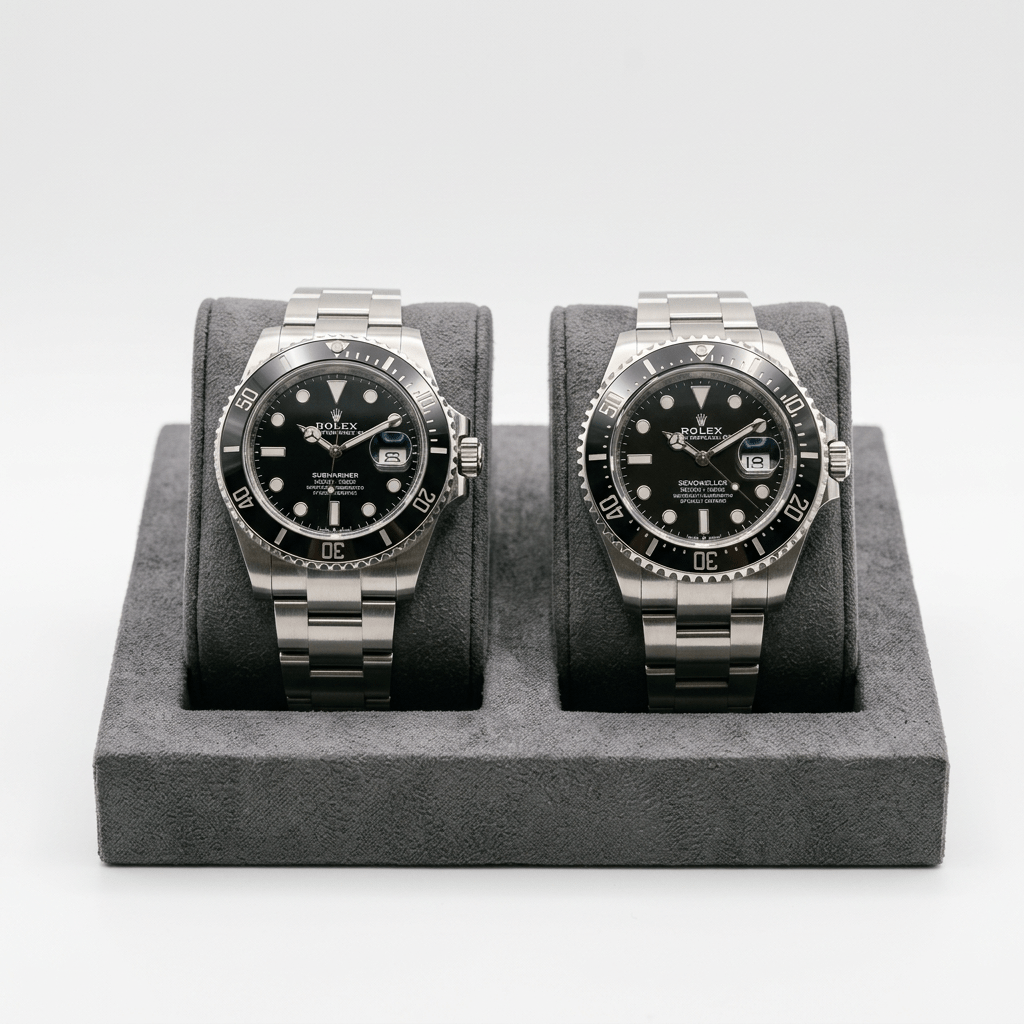
The watch display in Zurich airport captures this perfectly. The hushed cases, the trained staff, the 1970s cool of the Rolex Submariner or the Patek Philippe Calatrava — the entire theatre of Swiss watchmaking precision and heritage, performing its ritual of authentic presence. The genuine Submariner costs £9,000 at retail. The grey market price — because Rolex engineers its supply to be insufficient — is £12,000 to £15,000. The superfake costs £200 to £500 and is, to 99% of observers in 99% of social contexts, identical.
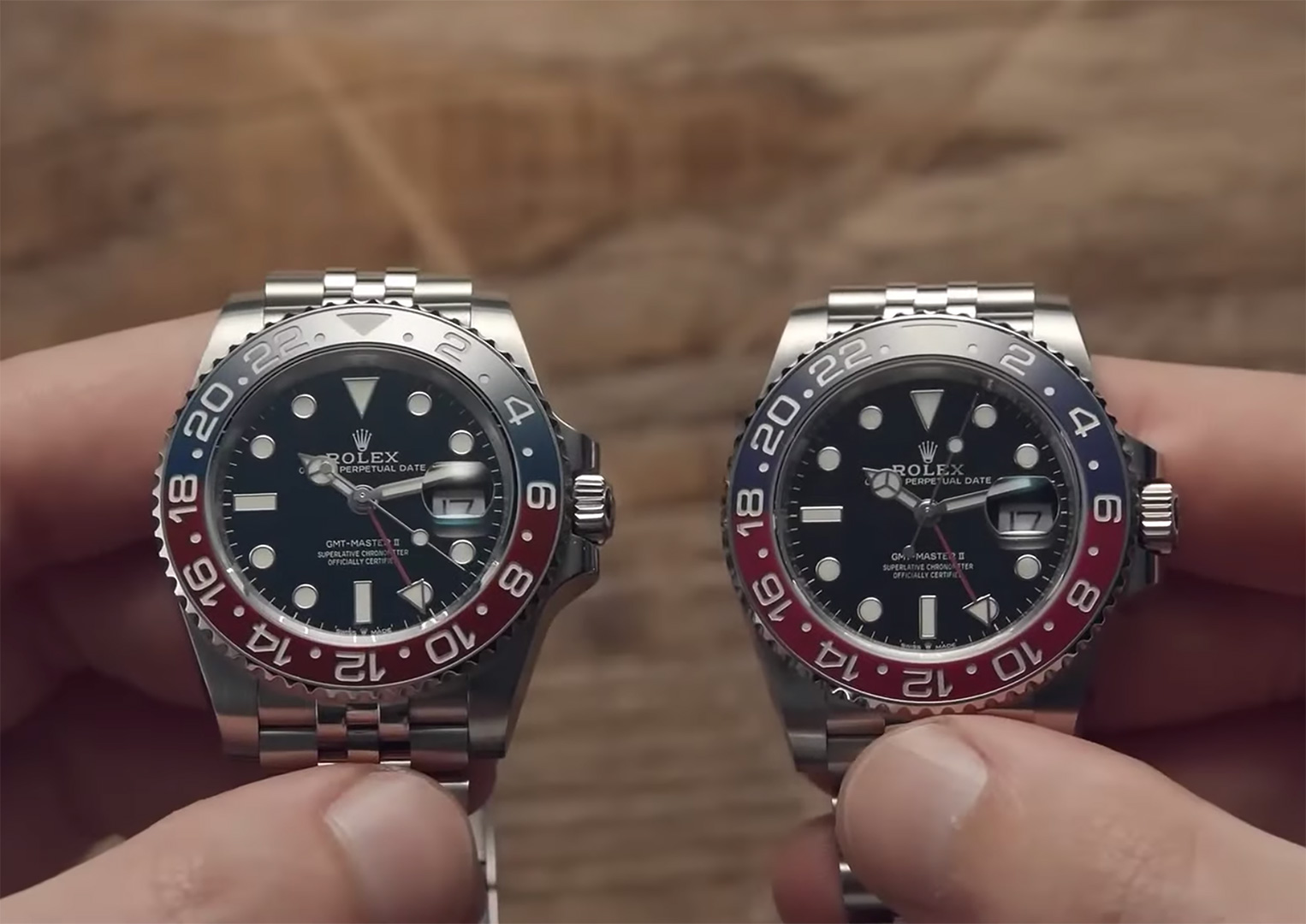
The reason for the genuine watch’s premium over the superfake is not the movement, which in a high-quality replica may be of reasonable quality. It is not the materials, which are equivalent. It is the aura — the knowledge that it is the real thing, made by these specific craftsmen in these specific workshops in Le Locle or Geneva or La Chaux-de-Fonds, with this specific history and this specific provenance. But in a world where nobody can tell, where you yourself might not be certain, the aura is maintained only by your own belief in it. It has become a matter of faith. And faith, unlike craftsmanship, is very hard to charge £9,000 for.
Arnault, Bettencourt, and the distinction that matters
Not all billionaires are the same. This is not a comfortable observation for those who prefer their moral categories simple, but it is true, and the luxury goods conversation requires that it be made.
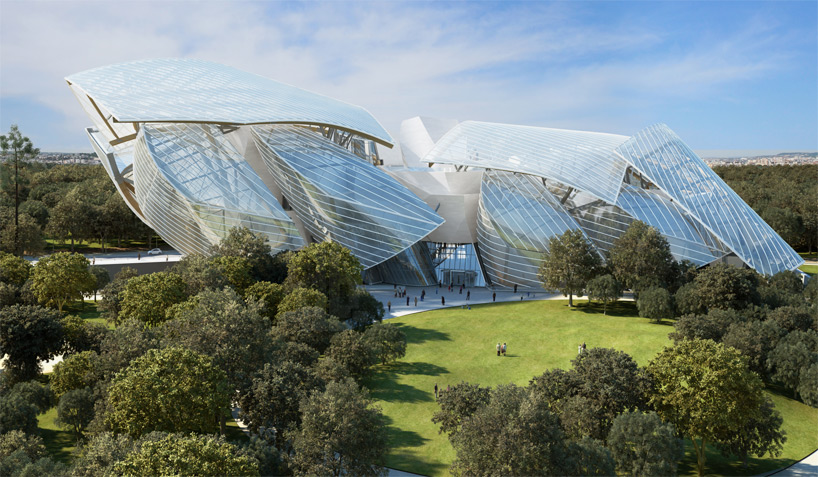
Bernard Arnault built LVMH through forty years of acquisition, negotiation, political manoeuvre, and brand management of extraordinary sophistication. He is a genuine industrialist of culture — someone who understood, before almost anyone else, that the luxury brand could be the most defensible business model in the world: high margin, low volume, culturally protected, heritage-reinforced, immune to the commodity competition that was destroying other industries. He is not a philistine. He commissioned the Fondation Louis Vuitton building from Frank Gehry. He has supported art foundations, acquired contemporary art on a serious scale, and understood that the relationship between luxury and culture is structural rather than decorative. His connection to making — however mediated, however commercialised — is real.
Françoise Bettencourt Meyers — heiress to the L’Oréal fortune, Europe’s richest woman — is different again. The L’Oréal fortune was built not on luxury in the strict sense but on the democratisation of beauty: the mass-market version of what luxury brands sell at premium. Because you’re worth it is one of the most politically interesting advertising slogans of the twentieth century. It takes the language of self-worth and dignity and attaches it to a bottle of hair dye at a price point accessible to most working women. It sells you your own dignity at a price you can afford. The Benjaminian reading is obvious — this is the phantasmagoria operating at scale, manufacturing desire and selling it back as self-realisation. But it is also, at its best, something genuinely more egalitarian than the Birkin bag. The desire to present oneself carefully, to use cosmetics as a form of self-expression, is not inherently false consciousness. It is a genuine practice of dignity, available to most rather than few.

The tech billionaires are different in kind, not just degree. Elon Musk, Jeff Bezos, Mark Zuckerberg: their wealth is not based on making or selling beautiful things. It is based on building platforms — infrastructure for other people’s transactions, communication, and attention. The value they extract is not from manufacturing or from cultural production but from the capture of the network: the fact that everyone uses the same system, which means the owner of the system captures a tax on everything that passes through it. They built tollbooths, not things. The distinction matters morally and economically: the luxury billionaire’s wealth, however concentrated and however dependent on exploited supply chains, is connected in some way to the human desire for beauty, skill, and distinction. The tech billionaire’s wealth is connected to the human need to communicate, which they have enclosed and monetised. Both are expressions of capitalism’s tendency to privatise what should be common — culture in the first case, communication in the second. But they feel different, because one of them at least gestures toward something worth having.
Arnault and Bettancourt Meyers donate to rebuild Notre Dame. Musk donates to himself. Zuckerberg donates through a company.
Trump — the end point
And then there is the man who is putting a gilded ballroom in the White House.

Donald Trump is not a luxury consumer in the Arnault sense, and not even a Veblen conspicuous consumer in the original sense — spending real surplus to signal real wealth. He is something genuinely new in the taxonomy: a luxury performance in which the thing being performed is not wealth but power, and in which the aesthetic of gold and excess is deployed not to signal taste but to signal domination.
The gold-plated everything in Trump Tower — the gilded taps, the marble, the mirrors, the ceiling — is not luxury in any sense that the history traced in this series would recognise. It is neither the lapis lazuli of the pharaoh, which connected the ruler to the cosmic order through genuine rarity, nor the Gothic cathedral, which embodied collective aspiration through collective craft, nor even the Hermès bag, which at least gestures toward a genuine tradition of making. It is the simulacrum of luxury — the image of wealth without the substance, the gold paint without the gold, the marble pattern without the marble. It is luxury as it appears in a dream about luxury, designed by someone who has seen pictures of palaces but never understood what made them.
This is Baudrillard’s hyperreality applied to political aesthetics. The map has replaced the territory. The image of opulence has entirely superseded any relationship to what luxury was supposed to mean — skill, rarity, the condensation of human attention and time into a beautiful object. Trump’s aesthetic is the logical endpoint of the phantasmagoria: the world in which the image of wealth is indistinguishable from wealth itself, in which the performance of power is the power, in which the gold paint is gold because everyone sees gold.
The move to install a gilded ballroom in the White House — the pre-eminent signifier of institutional republican power, the building whose value is precisely its restraint, its suggestion that the occupant serves rather than dominates — is the architectural version of the superfake watch. It replaces the aura of democratic legitimacy with the image of autocratic grandeur.
The White House’s power derived from its connection to a tradition of governance, its classical republican restraint, its suggestion that the institution was greater than any individual who occupied it. The gilded ballroom says: this is mine. I am greater than the tradition. The building that was designed to embody the subordination of individual power to institutional constraint has been redecorated to celebrate the opposite.
And the proposals — floated seriously, not merely as provocation — to demolish historic Washington for hotels and shopping malls, to replace the physical heritage of the republic with the infrastructure of consumption, is the colonial logic of luxury turned back on the metropole. The same logic that justified destroying ancient cities to extract their resources, the same logic that stripped colour from classical sculpture to confirm a racial hierarchy, the same logic that cleared Caribbean forests to plant sugar. Replace what is there with what can be extracted. Turn the heritage into a commodity. Sell the myth back to the people whose history it was.
The luxury system has arrived at the seat of power. The phantasmagoria is complete. The shopping mall has come for the republic.
— — —
What the reckoning reveals
Pull back from the specific catastrophes — LVMH’s falling revenues, Arnault’s vanishing billions, the superfake flooding the grey market, the gilded ballroom — and the pattern is visible.
The luxury system was built on a series of concealed relationships: between the object and the labour that made it, between the beauty and the violence that supplied it, between the brand and the exploitation it hides, between the image of wealth and the reality of power. Those concealments are failing simultaneously, and from different directions.
The Chinese consumer has withdrawn because the aspirational logic that made Western luxury desirable has been superseded by a different nationalism and a different generational relationship to abundance. The superfake has exposed the aura as a social construction rather than a material reality. The tech platform economy has revealed that the most valuable things in the world are not beautiful objects but attention, data, and network effects — which makes the luxury industry’s claim to represent the pinnacle of human desire look provincial. And Trump has made explicit what was always implicit in the system: that the aesthetics of luxury, stripped of any genuine relationship to making or to culture, is simply power performing itself.
Benjamin saw the dreamlike quality of the commodity display and called it the phantasmagoria. He predicted that it would eventually fail — that the dreaming collective would eventually wake, disturbed by something the dream could not accommodate. He did not know what form the waking would take.
Perhaps this is it. Not a dramatic rupture, not a revolution, but a slow souring — the withdrawal of the Chinese consumer, the rise of the superfake, the battered LVMH share price, the gilded ballroom that looks, to increasing numbers of people, not like wealth but like its desperate and slightly embarrassing performance.
The old man in the Italian hill town is still making leather goods. The knowledge is still there, in his hands, transmissible if anyone wants to learn it. The beautiful thing is still possible. The question — which the next two parts of this series will circle around, from the directions of spectacle and experience — is whether what survives the reckoning leaves any room for it.
— — —
A NOTE ON METHOD
This essay draws on conversations with Claude (Anthropic’s AI) as the research and synthesis engine, and on: LVMH financial reports 2024-2025; McKinsey Global Fashion Index 2024; University of Geneva research on counterfeit luxury markets; Swiss Federal Customs Administration data on counterfeit watches; Walter Benjamin, The Arcades Project; Jean Baudrillard, Simulacra and Simulation (1981); and current financial and political reporting. The thinking is collaborative; the voice, selection, and responsibility are the author’s own.
Next: Part Five — The Experience Economy Eats Itself: Debord, overtourism, Barcelona’s 26 million tourists, and why the young people bouncing up at the curtain call are not the problem.


Leave a comment