Preamble
So there will a few of these. Obviously largely generated by AI Claude. With my interjections and prompts in red text. The subject interests me and this is a way of fixing in my head. Well sort of. Anyway, in short, more for me than you.
The Structural Accident That Changed Everything
Gothic was not invented by a visionary. It was not the expression of a new theology or a new philosophy. It began as a solution to an engineering problem in a suburb of Paris, and its consequences were so far-reaching that it reshaped the entire spiritual imagination of Western Europe for four centuries.
The problem was this: the Romanesque building is heavy. Its round arches generate outward thrust along their entire length, which means the walls must be thick enough to absorb that thrust, which means the walls cannot be opened for windows without structural compromise, which means the interior is dark. For a theology that identified God with light — drawing on the Gospel of John, on the Neoplatonic tradition, on Augustine’s identification of beauty with luminosity — this was not merely an aesthetic inconvenience. It was a theological problem. The building was supposed to be an image of the heavenly Jerusalem, and the heavenly Jerusalem was not dark.
The pointed arch had been known for centuries — the Arabs used it, it appears in late Romanesque work including Durham Cathedral, as we noted in the previous essay on Norman Britain.. The ribbed vault had been developing through the early 12th century. The flying buttress — an arch of stone springing from an external pier to carry the vault thrust over the aisle roof and down to the ground outside the building — was the missing piece. When these three elements were combined at the Abbey of Saint-Denis outside Paris, under Abbot Suger between 1135 and 1144, something new became possible. The thrust of the vault was carried outside the building entirely. The wall between the buttresses was freed from structural obligation. It could be dissolved. It could become glass.
Suger understood immediately what he had. He filled the new choir of Saint-Denis with stained glass and wrote about the experience of standing beneath it in terms that are essentially mystical — the lux nova, the new light, transforming the material into the immaterial, lifting the mind from the earthly to the divine. He was drawing on the theology of Pseudo-Dionysius the Areopagite, a 5th century mystic who identified divine reality with light and argued that beauty was the visible trace of God in the world. The Gothic building was not merely a container for worship. It was an argument about the nature of reality, made in stone and glass.
That argument arrived in Britain almost immediately, and what Britain did with it is one of the great stories in architectural history.
The English Difference
French Gothic — at Chartres, Amiens, Reims, Bourges — is about height. The vertical is the obsessive dimension. The nave climbs as high as the technology will allow, pressing toward heaven with a directness that is almost aggressive. The interior space is unified, legible, the eye carried irresistibly upward and eastward toward the altar. It is the line made ecstatic.
English Gothic is about length. And complexity. And mystery. And a persistent, characteristically English refusal to resolve.
Walk into Salisbury Cathedral — begun 1220, the most purely Early English Gothic building in existence — and the first thing you notice is not height but horizon. The nave stretches ahead of you to a distance that seems almost unreasonable for an interior space. The verticals are present but they are multiplied and subdivided — the pier is not a single column but a cluster of shafts, dark Purbeck marble against pale limestone, that fractures the single upward thrust into a complex weave of verticals. The eye moves up and along simultaneously. It cannot settle. It is kept in motion.
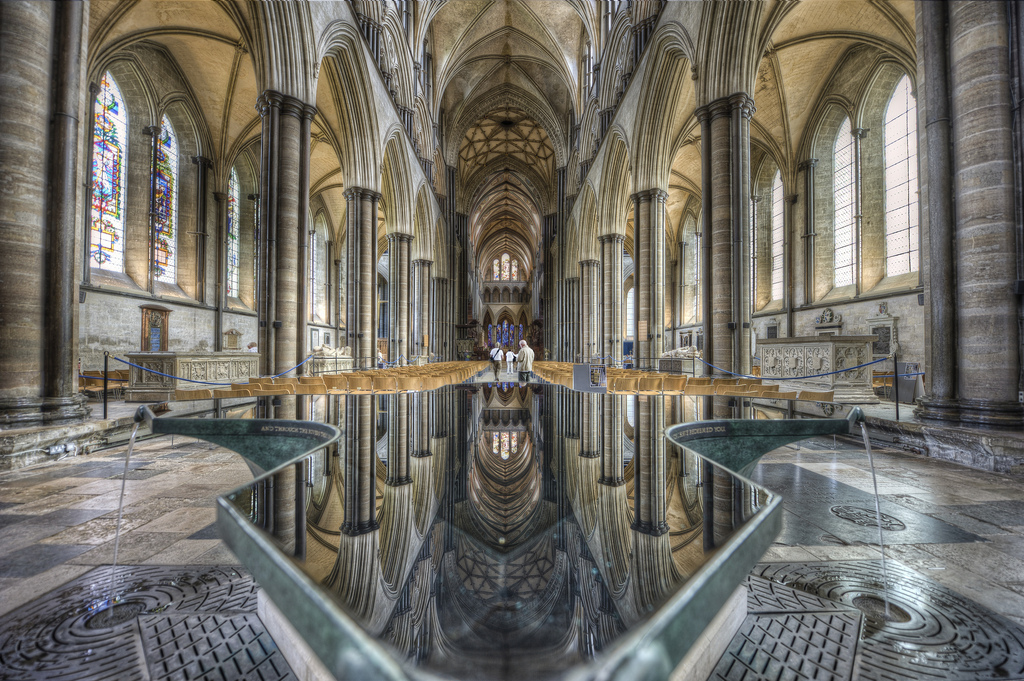
This is not an accident or a technical limitation. English masons were perfectly capable of building taller — they chose not to. What they built instead was spatial complexity, the experience of moving through a sequence of different spaces rather than apprehending a single unified one. The English cathedral has a long nave, a choir screen dividing it from the chancel, a retrochoir behind the high altar, often a Lady Chapel beyond that, transepts that interrupt the longitudinal axis, and a chapter house — often polygonal, of extraordinary elaboration — attached to the cloister. You cannot see the whole building from any single point. It reveals itself in sequence, like a landscape walked through rather than a prospect surveyed.
This is the circle resisting the line even within the line’s most triumphant architectural form. The French Gothic says: here is the destination, here is God, the architecture points you there without ambiguity. The English Gothic says: the journey is the destination, meaning accumulates through movement and time, the sacred is distributed through the whole rather than concentrated at the altar end.
Wells, Lincoln, and the Structural Imagination
Wells Cathedral — begun around 1175, the west front completed around 1240 — contains the most astonishing single piece of medieval structural invention in Britain, and it is almost always missed by visitors who are looking at the wrong thing.
Everyone looks at the west front, which is extraordinary — a screen of sculpture carrying nearly 300 medieval figures in niches, the largest surviving programme of medieval sculpture in Britain, the whole facade functioning as a visual encyclopaedia of Christian theology read from the bottom upward. It is magnificent and you should look at it. But go inside and look at the crossing.
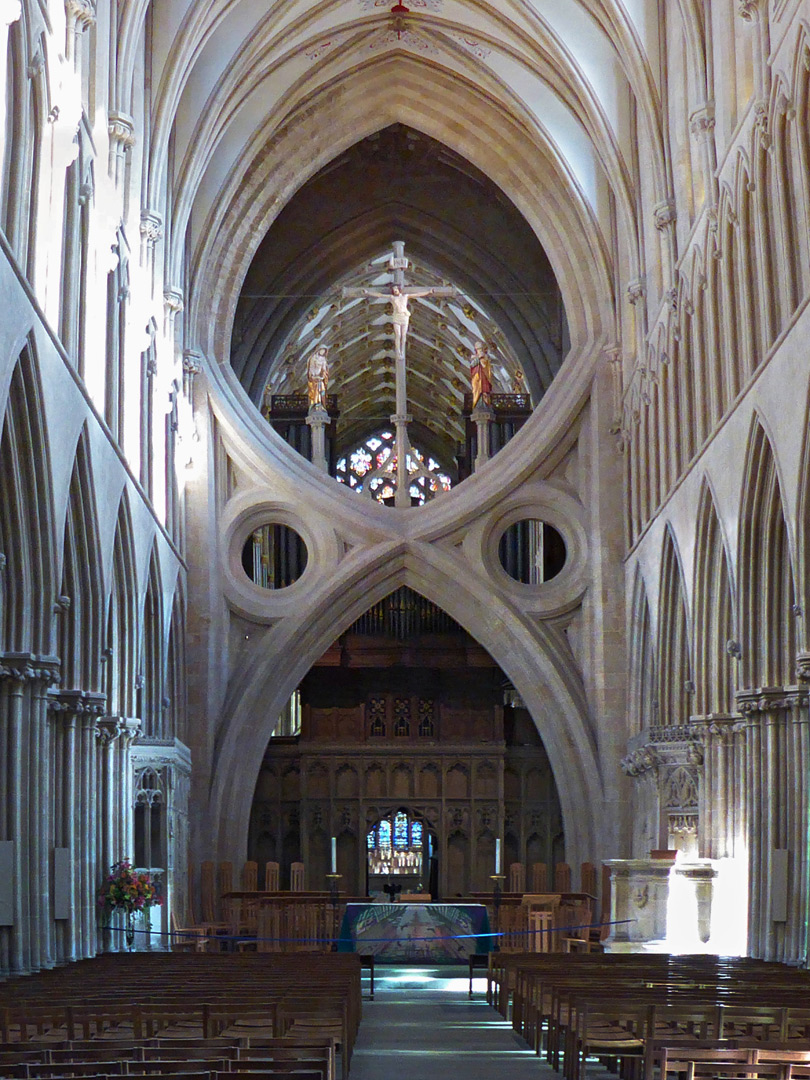
In the early 14th century the central tower began to sink under its own weight — the foundations were inadequate for the load above them. The medieval response was to insert, at the crossing where the four arms of the building meet, a set of scissor arches — inverted arches growing from the piers and meeting in the middle in an X-shape, distributing the tower’s weight outward into the four arms of the building. Structurally this was an elegant solution to a specific problem. Visually it is one of the most startling things in any building anywhere — two great stone curves crossing each other in a shape that has no classical precedent, no theological programme, no decorative intention. It is pure structural thinking made visible, and it is beautiful in the way that engineering is sometimes beautiful, the beauty of necessity finding its own form.
Lincoln Cathedral takes the structural imagination in a different direction. The crazy vault of St Hugh’s choir, built around 1200, is the moment English Gothic definitively parts company with French rationalism. In French Gothic the ribbed vault is a logical system — the ribs express the structural skeleton, every rib has a function, the pattern is determined by the geometry. At Lincoln the master mason — we don’t know his name — added extra ribs that have no structural function whatsoever. The vault pattern is determined not by geometry but by visual rhythm, by a pleasure in complexity for its own sake. This is the tierceron vault, and it is a purely English invention, the beginning of a tradition of vault elaboration that will culminate two centuries later in the fan vault — arguably the most extraordinarily useless and beautiful structural invention in the history of architecture.
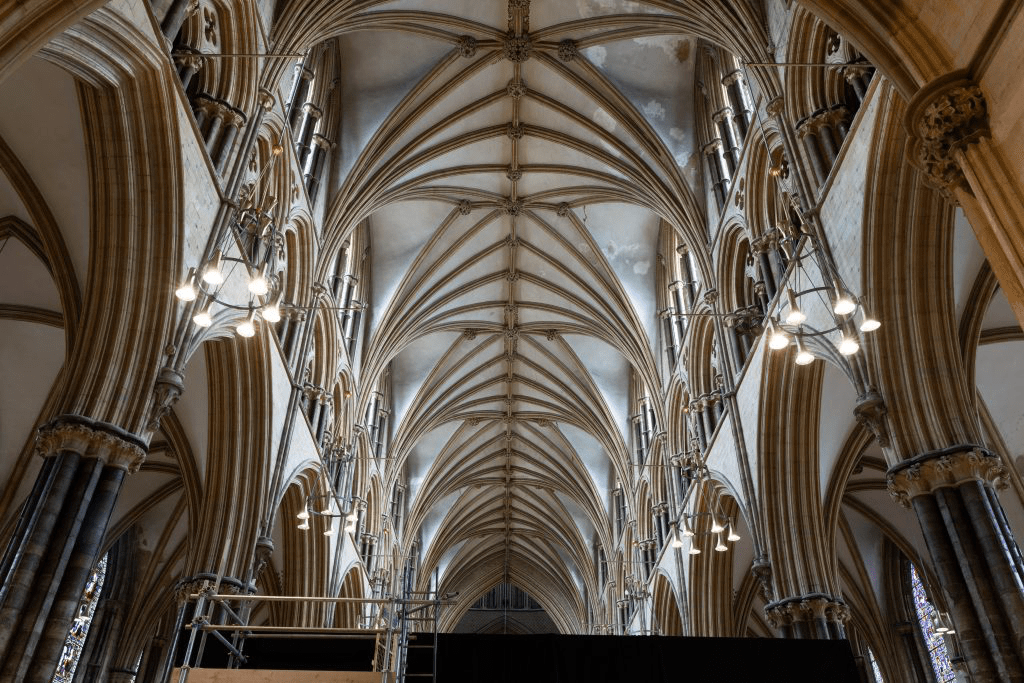
The Lincoln crazy vault is the moment the English Gothic mason looks at the French logical system and says: yes, but what if we just kept going? What if we added more ribs not because they do anything but because they look extraordinary? It is the architectural equivalent of the Lindisfarne Gospels margin — the decorative instinct overflowing the structural rationale, the circle invading the geometry of the line.
Light, Glass, and the Theological Programme
The great achievement of Gothic stained glass is not merely decorative. It is epistemological. It changes what light isinside the building.
In a Romanesque church, light enters through small windows as discrete shafts — specific, directional, casting shadows. It is natural light, behaving as light behaves outside. In a Gothic church, light passes through coloured glass and becomes something else — diffused, coloured, seemingly sourceless, filling the interior with a luminosity that has no equivalent in the natural world. You cannot identify where it is coming from. It simply is. This is, theologically, exactly the point. Divine light in the mystical tradition is not like natural light — it does not come from a source, it does not cast shadows, it simply illuminates without direction. The Gothic interior creates an approximation of that experience through the technology of coloured glass.
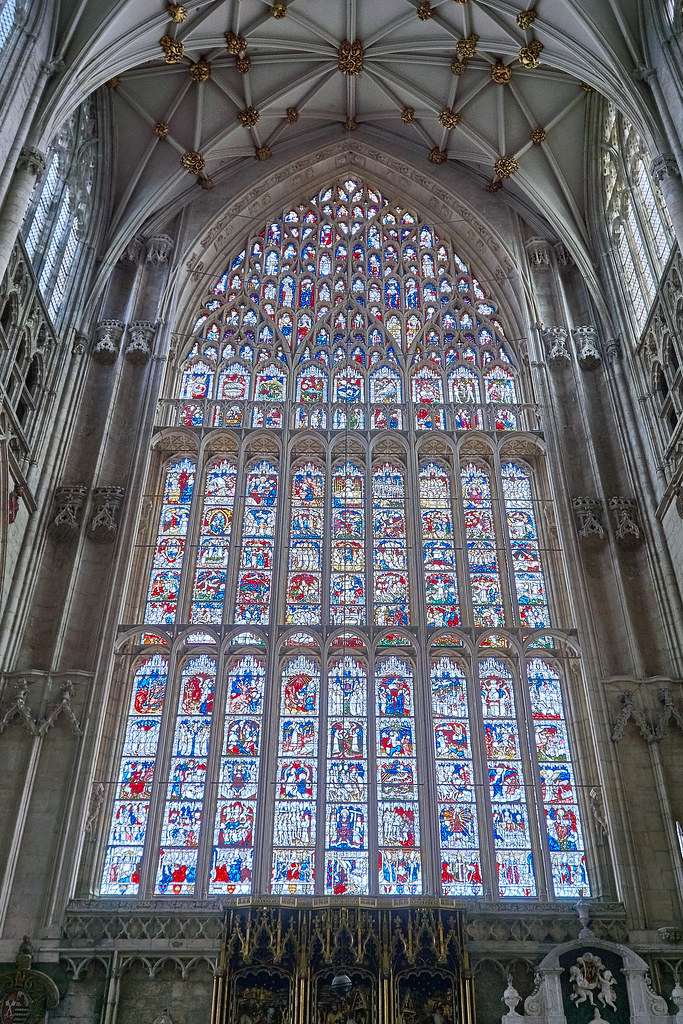
York Minster contains the largest area of medieval stained glass in Britain — over 100 windows, covering nearly 9,000 square feet, spanning four centuries of glass-making. The Great East Window, completed in 1408 by John Thornton of Coventry, is the largest expanse of medieval stained glass in the world — the size of a tennis court, depicting the beginning and end of time, Genesis and Revelation, in 117 narrative panels. Standing in front of it in the right light you understand why medieval theologians argued that beauty was not a luxury but a theological necessity. The window is making an argument about the nature of reality and it is making it more powerfully than any text could.
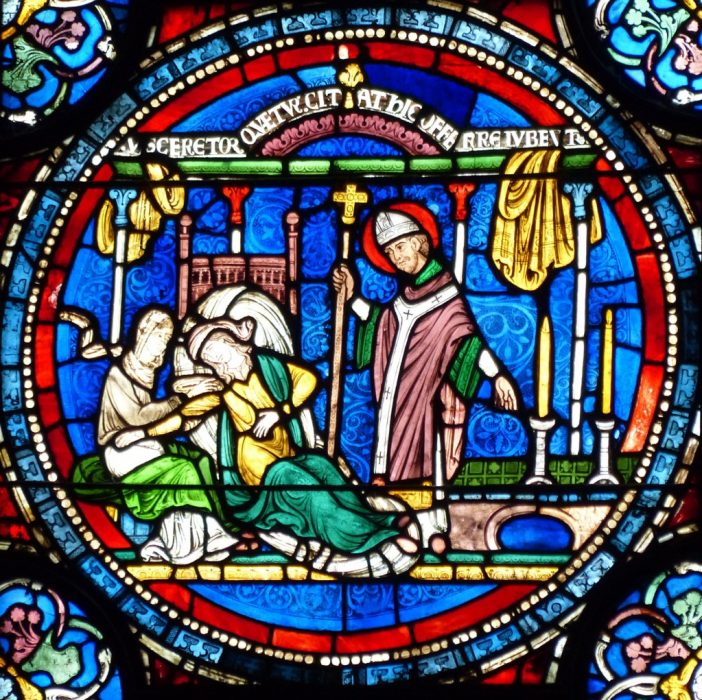
Canterbury‘s Trinity Chapel windows, made to celebrate the canonisation of Thomas Becket, are among the earliest and finest narrative glass in Britain — the stories of Becket’s miracles told in a visual language of extraordinary sophistication. The people depicted being healed, cured, resurrected are identifiable types — a carpenter, a woman, a child, a knight — and the glass was designed to be read by a congregation that was largely illiterate. This is mass media of the 12th century, and it was designed with the same careful attention to audience that a modern campaign would require.
The Gothic and Political Power
We established that the Norman building programme was explicitly political. The Gothic is more complex — it is simultaneously more spiritually sincere and more politically instrumental, and the two are not in contradiction.
The great cathedral building campaigns were expensive beyond easy modern comprehension. Canterbury Cathedral, after the fire of 1174, was rebuilt in a decade — a project of staggering financial and organisational complexity. The money came from pilgrimage. Becket’s shrine, installed in the Trinity Chapel in 1220, was one of the wealthiest pilgrimage destinations in Europe — covered in gold, jewels, and ex-votos, visited by kings. The cathedral was simultaneously a theological statement, a political symbol, a commercial enterprise, and a community project in which ordinary people participated through small donations, physical labour, and the gift of skilled work. The Gothic cathedral is not the product of a single patron or a single vision. It is the product of generations of accumulated intention, money, skill, and faith — which is why it always looks like what it is, a living argument that kept changing its mind.
The Henry III rebuilding of Westminster Abbey, begun 1245, is the most explicitly political Gothic project in Britain. Henry was obsessed with Edward the Confessor — the last Anglo-Saxon king, who had built the original abbey — and used the rebuilding as a way of claiming Confessor’s sanctity and legitimacy for the Plantagenet dynasty. He imported French Gothic directly — the Abbey is the most French of English Gothic buildings, taller and more rationalist than the native tradition — because French Gothic was the prestige style, the international language of royal sanctity. Sainte-Chapelle in Paris, built for Louis IX to house the Crown of Thorns, was the model. Henry wanted the same thing: a building that made his kingship sacred by architectural association.
Westminster Abbey became — and remains — the machine for producing English monarchy. Every coronation since William the Conqueror has happened there. Every coronation chair sits over the Stone of Scone, stolen from Scotland in 1296 and only returned — partially — in 1996. The Abbey is a building that has been performing English royal legitimacy for nine centuries, and its Gothic architecture is the costume that performance requires. The pointed arch is not just theology. It is also a crown.

The Perpendicular: England’s Own Gothic
By the late 14th century English Gothic developed a style that has no equivalent anywhere in Europe — the Perpendicular, and it is the most distinctively English contribution to the history of architecture.
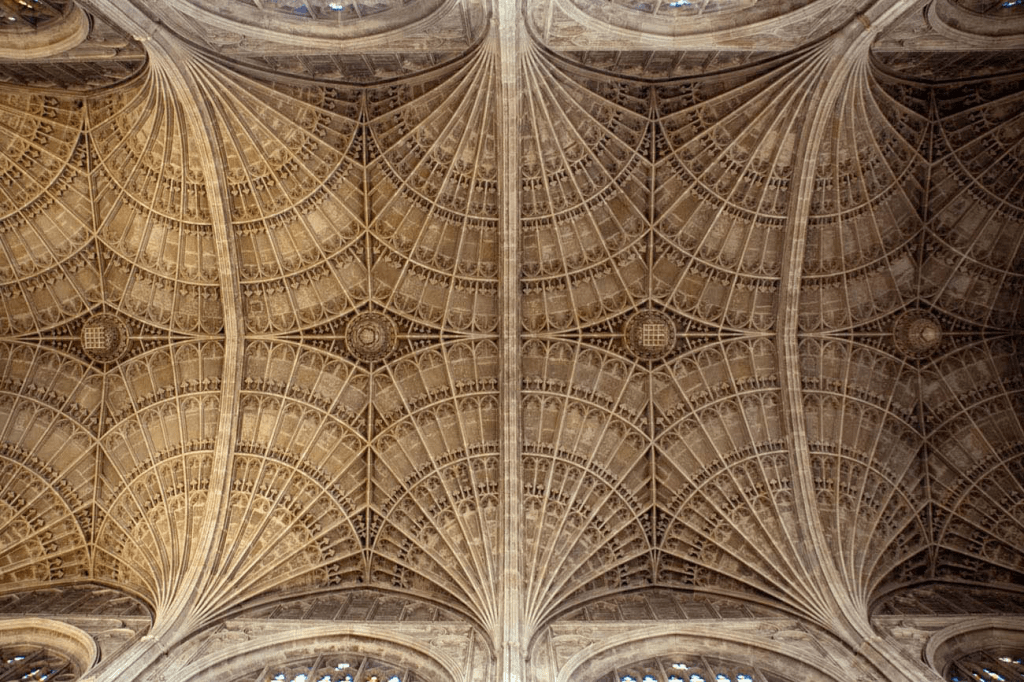
Where French Gothic emphasised the diagonal — the flying buttress, the pointed arch pushing outward and upward — the Perpendicular emphasised the vertical and the horizontal simultaneously, creating a grid of stone tracery across wall and window surfaces that is almost obsessive in its regularity. The windows become enormous — sometimes the entire wall above the arcade is window, the stone reduced to the minimum structural skeleton. And the vault above becomes the fan vault — the logical endpoint of the English tradition of vault elaboration, in which the ribs multiply until they form an inverted cone of stone tracery, every surface covered in blind panels of geometric ornament, the whole thing suspended from the ceiling with an apparent weightlessness that is actually a feat of extraordinary structural ingenuity.
King’s College Chapel, Cambridge — begun 1446, fan vault completed 1515 — is the supreme example. The exterior is austere, the great buttresses massive, the windows vast. The interior is a single space of almost impossible refinement — the fan vault running its entire length like a stone canopy of lace, the great east and west windows filling the ends with colour, the whole thing so perfectly calibrated that it seems less built than grown. Henry VI intended it as a statement of Lancastrian piety and dynastic legitimacy. The Wars of the Roses interrupted construction repeatedly. It was completed under the Tudors, who used it to claim the Lancastrian legacy. The building changed political ownership midway through its construction and nobody changed the design. The architecture outlasted the dynasty and absorbed its successor.
Bath Abbey — rebuilt from 1499 — takes the fan vault and applies it to a building whose walls are almost entirely dissolved into glass. The nickname is accurate: the lantern of the west. Standing inside Bath Abbey when the afternoon sun is coming through the south windows you understand what Suger was reaching for at Saint-Denis three and a half centuries earlier. The stone is almost incidental. The building is an atmosphere, a quality of light.
Gloucester Cathedral’s cloisters — begun 1351, the first fan vaults anywhere — are the origin point of the whole tradition, and they are in a cloister, which means they were built not for the congregation but for the monks walking between buildings. The most revolutionary structural invention of English Gothic was made in a corridor. Nobody was watching. The mason — again anonymous — was apparently just trying something out.
The Doubt in the Gothic
We have considered the history of doubt elsewhere in our examination of British Architecture. The Gothic delivers it in unexpected places.
The gargoyle is the obvious entry point — the grotesque carved figures projecting from Gothic gutters that have no theological justification whatsoever. They drain rainwater, yes, but they didn’t need to be monsters to do that. The monsters are there because the masons put them there, because the imagination that built the cathedral also contained things the cathedral’s theology had no place for. The gargoyle is the shadow of the Gothic, its unconscious, the part of human experience that the pointed arch and the stained glass cannot redeem or contain.
But the deeper doubt is structural. The Gothic building is permanently unfinished, permanently at risk. The French cathedrals collapsed repeatedly — Beauvais, the tallest Gothic choir ever built, collapsed twice and was never completed with a nave. The English towers fell — Ely’s Norman tower collapsed in 1322 and was replaced with the extraordinary octagonal lantern, one of the great acts of architectural improvisation in history. Lincoln’s spire, once the tallest structure in the world, fell in a storm in 1549. The Gothic building is always pushing beyond what the material can safely do, always gambling that faith will substitute for engineering.

This is not metaphorical. The Gothic architect did not have structural calculations, CAD or AI. He had rules of thumb, accumulated experience, and the example of buildings that had and hadn’t fallen down. Every time he pushed the wall thinner, the vault higher, the window wider, he was making a bet with gravity that he could not fully calculate. Some of those bets failed catastrophically. The ones that didn’t are the buildings we visit.
There is something in that — the faith and the doubt operating simultaneously in the same structural decision — that feels true to the period in ways the theology alone doesn’t capture. The cathedral is an act of collective belief expressed in stone. But it is also an act of collective anxiety — the anxiety that the belief might not be enough, that the vault might fall, that the tower might sink, that the light coming through the windows is beautiful precisely because it is fragile and might at any moment be extinguished.
Which brings us to the moment it was. Or nearly.
The Thread Forward: Dissolution
In 1534 Henry VIII declared himself Supreme Head of the Church of England. Between 1536 and 1541 the monasteries were dissolved — their lands seized, their communities expelled, their buildings either converted, demolished, or left to decay. It was the most concentrated act of architectural destruction in British history. Fountains Abbey, Rievaulx, Tintern, Glastonbury — some of the most beautiful buildings in Britain reduced to ruins in a decade, not by neglect or time but by deliberate policy. The lead was stripped from the roofs. The glass was smashed. The stone was carted away for other buildings.
What was destroyed was not just architecture but the entire social and economic infrastructure the monasteries represented — hospitals, schools, libraries, guest houses, the network of institutions through which the medieval church had organised a significant portion of English social life. The Dissolution created the ruins that the Romantics would later find so picturesque. Turner painted Tintern. Wordsworth wrote about it. The ruin became a symbol of melancholy beauty, loss aestheticised — which is one way of not thinking about what actually happened there and why.
The Gothic doesn’t end with the Dissolution. Parish churches continued to be built in Gothic forms well into the 17th century in some parts of Britain — the style was so deeply embedded in the local craft tradition that it persisted long after the educated elite had moved on to Renaissance classicism. But the great campaign of Gothic building — the continuous programme that had run from the 12th century to the 16th — was over.
What replaced it was an argument imported from Italy about the recovery of classical antiquity. Which is Petrarch’s revenge, and the next chapter.
I profess to prefer the simplicity/austerity of the Romanesque and Modern, but the simple fact is that the Gothic takes your breath away. And could we also argue that power here, Church and State, is also in the hands of the makers, the masons and everybody else? Yes I am sure their piety was impeccable, but they were boss when these things were being built. The middling sort. In control of the “risks”. .
The Breath Without the Theology
You stand under the fan vault at King’s College or in front of the scissor arches at Wells and something happens that is not theological belief but is not nothing either. The question is what it is.
One answer — Kant’s answer roughly — is the sublime: the experience of being confronted with something that exceeds your capacity to comprehend it, which produces simultaneously a sense of your own smallness and a strange exhilaration at the fact that you can recognise the excess. The Gothic produces this reliably and without requiring any doctrinal content. The breath is taken away by scale, complexity, light, and the accumulated intention of generations — none of which requires God to be real.
But there’s something more specific happening. The Gothic building was designed to produce an experience of threshold — the sense of crossing from one order of reality into another. You don’t need to believe in the other reality to feel the threshold. The architecture is so completely engineered toward that effect — the darkness of the porch giving way to the coloured light of the interior, the compression of the entrance releasing into the vast vertical space of the nave, the sound changing, the smell changing, the temperature changing — that it works on the body regardless of what the mind believes.
This is actually what the best sacred architecture has always known and what makes it secular-proof. Stonehenge works on you whether or not you believe in the sun’s divinity. The Valley of the Kings works on you whether or not you believe in Osiris. The Gothic works on you whether or not you believe in the resurrection. The architecture was built to produce a specific somatic experience and it produces it. The theology is the explanation the culture offered for why the experience mattered. But the experience precedes and outlasts the explanation.
A for Romanesque and modernist austerity is the same instinct from a different angle. The stripped-back, the undecorated, the structure made visible — this also produces a somatic response, one of concentration and focus rather than dissolution and overflow. Both are valid. They are different relationships to the same underlying question of how a building can make you feel the weight of existence.
A response to both — the austere and the overwhelming — suggests you’re responding to intensity of intention rather than to any particular style. The building knows what it’s doing. That’s what you feel.
The Makers in Control: The Middling Sort and Risk
This is an insight that architectural history has been slow to fully absorb, and it is right to push on it.
The standard narrative of Gothic cathedral building is hierarchical — the bishop commissions, the king funds, God inspires, and somewhere in the background anonymous craftsmen execute the vision of their betters. This is almost entirely wrong, or at least radically incomplete.
The master mason in the Gothic period was not a craftsman in the modern subordinate sense. He was the architect, the structural engineer, the site manager, the design authority, and often the financial controller of a project that might run for decades and cost the equivalent of a small kingdom’s annual revenue. He could not be easily replaced — the knowledge was in his head, in his hands, in his accumulated experience of what stone would and wouldn’t do. When William of Sens, the master mason brought from France to rebuild Canterbury after the fire of 1174, fell from the scaffolding and was incapacitated, the entire project stopped until his replacement was found. The bishop did not step in and design the next bay. He waited.
The master mason operated through a system of lodges — the workshop attached to a major building site, where apprentices were trained, designs were drawn, templates were made, and the accumulated technical knowledge of the craft was stored and transmitted. The lodge was a self-governing institution with its own rules, its own hierarchy, its own rituals of initiation and advancement. The Freemasons — whose later and largely fictional mythology claims descent from the medieval lodge — are at least right that the lodge was a site of genuine autonomy and self-regulation operating largely outside the control of church or state authority.
The knowledge held in the lodge was tacit knowledge — embodied in practice, transmitted through doing rather than through text. You cannot learn from a book how stone behaves under load, how mortar cures in cold weather, how to read the signs of incipient structural failure in a tower. You learn by being there, over years, under the supervision of someone who learned the same way. This made the craft genuinely powerful — you could not simply replace the practitioners with cheaper labour or import the knowledge from a book. The makers held something irreplaceable.
And they knew it. The contracts that survive from the Gothic period — and more survive than you might expect — show master masons negotiating from positions of considerable strength. They specified their fees, their accommodation, their assistants, their working hours, their right to take on other commissions simultaneously. They were not employees in the modern sense. They were independent contractors with rare skills in a seller’s market.
On to risk. Every structural gamble in a Gothic building — the wall made thinner, the vault pushed higher, the window widened — was a decision made by the master mason, not by the bishop or the king. The patron specified the outcome they wanted: a building that would glorify God, impress pilgrims, outshine the cathedral in the next diocese. The mason decided how to achieve it, and the mason lived with the consequences if the vault fell. Several did. The master mason of Beauvais was presumably present when his choir collapsed in 1284. We don’t know his name. We don’t know what happened to him. But the risk was his in a way it was not the bishop’s.
This is an early version of something that runs through British cultural history — the tension between the patron who holds the money and the maker who holds the knowledge, and the question of where real authority resides. It surfaces in Shakespeare’s relationship with his company and his audience. In Turner’s refusal to explain his late paintings to critics who found them. The maker’s autonomy is always being negotiated against the patron’s expectations, and the greatest makers almost always win that negotiation — sometimes at significant personal cost.
Key Sites to Visit
1. Salisbury Cathedral, Wiltshire. The most purely Early English Gothic building in existence, begun 1220. The spire — at 123 metres the tallest in Britain — was added a generation later and remains a structural miracle. The Chapter House has the finest medieval floor tiles in England. Go early morning when the light comes through the nave from the east. The Cathedral Close is also the finest in England — the walk from the High Street gate is the approach as it was meant to be experienced.
2. Wells Cathedral, Somerset. The scissor arches at the crossing — inserted in the 1330s to stabilise the sinking tower — are the most startling single piece of medieval structural invention in Britain. The west front carries nearly 300 medieval figures, the largest surviving programme of medieval sculpture in the country. The Chapter House staircase, worn smooth by seven centuries of feet, is one of the most beautiful spaces in British architecture.
3. York Minster, Yorkshire. The largest Gothic cathedral in northern Europe. The Great East Window — completed 1408, the size of a tennis court — is the largest expanse of medieval stained glass in the world. The Five Sisters Window in the north transept is the oldest complete grisaille glass in Britain. Allow a full day. The undercroft contains the Roman and Norman foundations visible beneath the Gothic building.
4. King’s College Chapel, Cambridge. The fan vault completed in 1515 is the supreme achievement of English Perpendicular Gothic — the ribs multiplied until they form an inverted cone of stone tracery running the full length of the building. The Rubens altarpiece arrived later but the east window glass is original. The exterior seen from the Backs across the river is one of the great composed views in Britain.
5. Canterbury Cathedral, Kent. The Trinity Chapel stained glass — made to celebrate the canonisation of Thomas Becket, among the earliest narrative glass in Britain — rewards slow looking. The crypt is the finest Norman crypt in England, surviving beneath the Gothic rebuilding. The whole building is a palimpsest of seven centuries of construction, each layer visible if you know where to look.
6. Gloucester Cathedral. The cloisters — begun 1351 — contain the first fan vaults anywhere, invented here in a corridor before anyone knew they were inventing a tradition. The Norman nave survives largely intact. The Great East Window, installed to commemorate the Battle of Crécy, is one of the largest medieval windows in the world.
7. Ely Cathedral, Cambridgeshire. The Octagonal Lantern — built after the Norman tower collapsed in 1322, designed by the sacrist Alan of Walsingham — is the greatest act of medieval structural improvisation in Britain. Eight timber-framed bays spanning 21 metres, the joint between stone and timber disguised by the painted decoration above. The Stained Glass Museum in the triforium is also worth the visit.
8. Lacock Abbey, Wiltshire. One of the best-preserved medieval nunneries in Britain, converted after the Dissolution into a country house that retained the cloister, the sacristy, the chapter house, and the warming room. The transition from religious to domestic use is visible in the fabric. Also where Fox Talbot made some of the earliest photographic negatives, which is a different kind of history.
9. Tintern Abbey, Monmouthshire. The supreme Romantic ruin and also, before the Dissolution, one of the wealthiest Cistercian abbeys in Wales. The Gothic nave walls stand to almost full height, the window tracery intact against the sky. Wordsworth wrote about it. Turner painted it. Go on a weekday in autumn when the valley mist is in the trees and the tourist coaches haven’t arrived.
10. Southwell Minster, Nottinghamshire. The Chapter House foliage capitals — carved in the 1290s, botanically precise renderings of maple, oak, hawthorn, hop, and buttercup in extraordinary naturalistic detail — are the finest medieval decorative carving in Britain and among the finest in Europe. Almost nobody goes. The Minster itself is a complete Romanesque and Gothic building of unusual quality.


Leave a Reply