Part 2 of 7
A canter through the history of luxury, consumption and desire
From Lapis Lazuli to Louis Vuitton
A brief and opinionated history of the beautiful things we have always wanted, and the systems we have built to supply them
Before we get to the now of LVMH quarterly earnings call, the superfake Rolex, or the Russian oligarch in Courchevel, we need to establish something that the moral critique of luxury often forgets: the desire for beautiful, rare, skilfully made things is not a product of capitalism. It is as old as human consciousness. The Blombos Cave ochre engravings are 75,000 years old — not functional, not food, not shelter. They are pattern, made for the pleasure of pattern. Art, design and jewellery from Africa. The Venus of Willendorf is 30,000 years old — a small carved figure, made with skill and intention, kept and carried and presumably valued. The impulse to make and possess beautiful things is not a distortion of human nature by economic systems. It is human nature, prior to any economic system.

This matters because it means the history of luxury is not simply a history of exploitation and false consciousness. It is also a history of genuine human achievement — of skill accumulated over lifetimes and transmitted across generations, of materials sought across impossible distances because they were irreplaceable, of objects that genuinely deserved the attention and desire they attracted. The history gets dark quickly enough. But it does not start in the dark.
What changes across the millennia — and this is the thread — is the relationship between the beautiful thing and the systems of power, labour, violence, and belief that made it possible. The object and its supply chain. The desire and its social function. The maker and the possessor. Follow those relationships through history and you have, more or less, the story of how we got here.
— — —
Egypt: lapis lazuli and the logistics of desire
Lapis lazuli is a deep blue metamorphic rock, flecked with gold pyrite, found in significant quantity in only one place on earth: the Sar-i Sang mines in the Badakhshan province of what is now northeastern Afghanistan. It has been mined continuously for at least 6,000 years. And it turns up — in tombs, in carvings, in jewellery, in the blue pigment of Egyptian art — across the entire ancient world. In Ur. In Mesopotamia. In the Indus Valley. In Egypt. All of it, traced isotopically, from the same Afghan mountains.

Think about what this means logistically. Three thousand years before the Common Era, someone was organising trade routes across deserts and mountain ranges and river systems to get a blue rock from Afghanistan to the Nile Delta. Not food. Not metal for weapons. Not timber for building. A blue rock, because blue was the colour of heaven, of the sky, of the divine — and the pharaoh needed to be connected to the divine, and nothing in the entire ancient world was as intensely, specifically, unmistakably that blue.
This is luxury at its most primal and most instructive. The object has use value — it is genuinely beautiful, genuinely rare, genuinely unlike anything else. Its scarcity is not manufactured; the mines are where they are and nowhere else. Its cost in labour and danger and organisational complexity is real. And its function — to connect the ruler to the cosmic order, to make visible the claim that the pharaoh is not merely a man but a god made flesh — is also real, in the sense that it actually did what it was supposed to do within the belief system of its time.
What it is not is innocent. The mines were worked by coerced or enslaved labour. The trade routes required military protection or political alliances that involved violence. The pharaoh’s claim to divine status was enforced, not merely displayed. The luxury object sits at the intersection of genuine beauty and genuine power, genuine skill and genuine exploitation, from the very beginning. This is the pattern that will repeat through the whole history: you cannot separate the beautiful thing from the systems of power and extraction that made it possible.
Benjamin’s commodity fetishism has a pre-capitalist form, and it looks like lapis lazuli.
Greece: techne, beauty, and the dignity of making
The Greeks give us something that the Egyptians, for all their splendour, don’t quite manage: a philosophy of making. Techne — the Greek word we translate as both “art” and “craft” and “skill” — is the knowledge of how to bring something into being. The sculptor, the potter, the shipwright, the physician — all practitioners of techne. The word contains no distinction between fine art and applied craft; that distinction is ours, not theirs.
Hephaestus — the divine craftsman, the smith god — is lame and ugly, which is interesting. The gods are beautiful; the one who makes beautiful things is not. This tells you something about Greek attitudes to manual labour that the philosophy books tend to soften. Aristotle was fairly clear that the craftsman, however skilled, was not fully participating in the good life because his hands were occupied with things. The free citizen should be consuming beautiful things, not making them. This is an argument with a very long history in front of it.

But the objects themselves — the Attic red-figure pottery, the bronze casting, the carved ivory, the goldwork of the Aegean — are made with a quality of attention and skill that the philosophical hierarchy of maker and possessor doesn’t diminish. The craftsman knew what he was doing. The knowledge was embodied, transmitted, practised. The guild system that would formalise this in medieval Europe is already present in embryo in the Greek workshop — masters, apprentices, specific local knowledge, specific local materials, specific local forms.

And Greece, like Egypt, reached far beyond its geographic limits for its luxury materials. Deep links with the Barbarian world. Amber from the Baltic. Tin from Cornwall. Purple dye from Phoenicia — Tyrian purple, made from the crushed glands of sea snails, requiring thousands of snails for a small quantity of pigment, which is why purple became the colour of royalty across the ancient world. The colour itself is a luxury object; wearing it signals access to the trade networks and the surplus wealth that could command them. This is Veblen before Veblen. The luxury object as positional good — its value not intrinsic but relative, derived from others’ inability to have it.
Rome: the first mass luxury market and its discontents
Rome is where it gets genuinely interesting and genuinely modern, because Rome created something that hadn’t existed before: a large, relatively prosperous middle class with disposable income and an intense anxiety about where they stood in the social hierarchy. This is the precondition for a mass luxury market, as opposed to a court luxury market.
The Roman sumptuary laws — legislation restricting who could wear what, who could eat what, how much could be spent on a funeral — are evidence of exactly the problem. They were passed repeatedly, ignored repeatedly, and repassed with diminishing credibility throughout the Republic and Empire. The market for luxury goods among people who were not supposed to have them was essentially ungovernable. A senator’s wife was not supposed to wear certain fabrics or colours; she wore them anyway. A wealthy freedman was not supposed to display certain insignia; he displayed them anyway. The hierarchy was being continuously undermined by the market it had created.
Pliny the Elder complained bitterly about the drain of Roman gold to the East — to India, Arabia, China — in exchange for silk, spices, and gems. He estimated it at 100 million sesterces a year. What he was describing is the Roman trade deficit, produced by Roman consumers’ desire for things that Roman production could not supply. The luxury import is destroying the currency and weakening the empire, he says. Moral decline and economic decline are the same thing. This is a recognisable argument. Every generation has its version of it. And it is never quite right — it confuses the symptom with the cause — but it captures something true about the relationship between luxury consumption and the health of productive economies.
The other Roman contribution is the infrastructure of luxury — the shop, the market, the specialised district. Trajan’s Market in Rome is essentially a shopping centre: a multi-storey complex of retail units arranged around a covered street. The Argiletum in the Forum area was known for its booksellers. Specific streets were known for specific trades. The geography of luxury retail, which Benjamin’s arcades inherit, has Roman roots.
The medieval guild: techne institutionalised, dignity encoded
This is the old man working leather in the Italian hill town. The man who is still there today. And it is the pivot point of the whole history.
The guild system — which reaches its fullest development in the twelfth to sixteenth centuries across Europe — is the most successful attempt in human history to institutionalise the dignity of making. The guild controlled entry to the craft, the quality of the product, the conditions of training, the pricing of the work, and the relationship between master, journeyman and apprentice. It was restrictive, often corrupt, frequently exclusionary — women and Jews typically excluded from full membership. But it embodied something important: the idea that skill is a form of knowledge that deserves protection, that the craftsman’s relationship to his craft is a matter of pride and identity, and that the object produced is a form of communication between maker and user that carries the maker’s dignity within it.
Ruskin understood this. His argument for Gothic architecture against the industrially produced ornament of the Victorian period was precisely an argument for the guild system of making — each stone carved by a craftsman who made judgments, who could be wrong, who brought their own imperfect human intelligence to bear on the work. The irregular Gothic column capital versus the machine-perfect classical moulding: one is evidence of human presence, one is evidence of human absence. We will return to Ruskin.
The Venetian glassmakers of Murano — confined to their island by the state, forbidden to emigrate on pain of death, because the secrets of Venetian glass were a state asset — are the guild system at its most extreme. The knowledge was so valuable, so specifically embodied in particular people, that the state treated it as property. The glassmakers were both privileged and imprisoned by their skill. Their products — the filigrana glassware, the mirrors that Venice had a monopoly on for a century, the cristallo that was clearer than anything else in the world — commanded prices across Europe that bore no relationship to the cost of the materials. The premium was entirely the skill. The guild system had created a form of intellectual property enforced not by law but by geography and death.
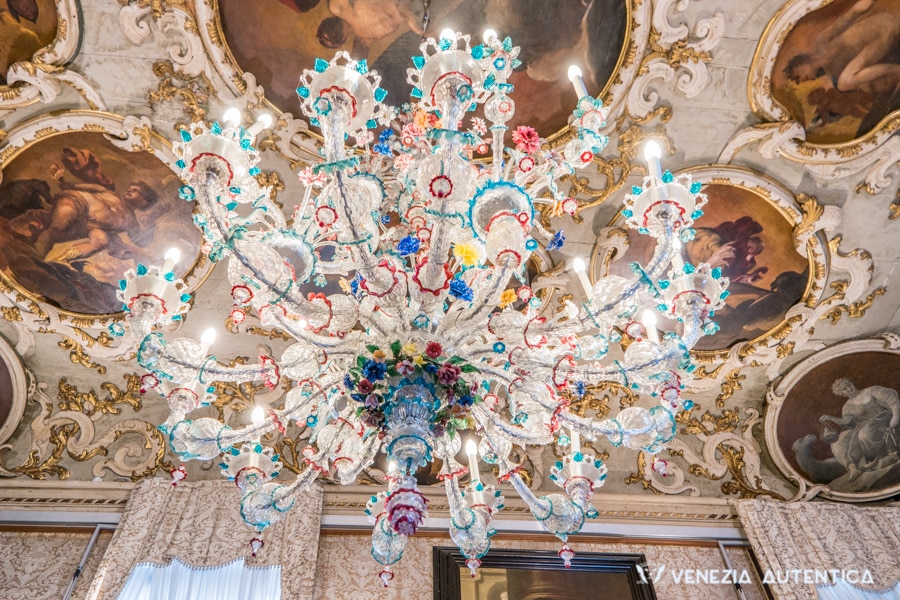
This is the moment where luxury and techne and power are most tightly wound together. The skill produces the object. The object produces the luxury. The luxury produces the revenue. The revenue produces the power. The power protects the skill. A closed system. A genuine one. It will not survive the industrial revolution.
Colonialism: the supply chain of desire, honestly examined
Here the history gets dark in ways that are not incidental but structural. The luxury goods of the modern world — the spices, the silks, the dyes, the gems, the sugar, the tobacco, the cotton, the rubber, the ivory, the gold — did not arrive in European markets through neutral trade. They arrived through conquest, enslavement, and extraction of extraordinary violence.
The Spice Islands. The Caribbean sugar plantations. The African slave trade that made both possible. The East India Company. The Belgian Congo and the rubber harvest enforced by the severing of hands. The diamond mines of South Africa. The cotton fields of the American South.
Every luxury good of the seventeenth, eighteenth and nineteenth centuries carries this history. The cup of tea that the Victorian middle-class family drank in their parlour, surrounded by Indian cottons and Caribbean sugar and Chinese porcelain, was a colonial object — produced by coerced or enslaved labour, extracted through military power, transported through commercial monopoly. The phantasmagoria of Victorian domestic comfort was built on violence that the comfort itself made invisible.

Eric Williams, in Capitalism and Slavery (1944), made the argument that the profits from the slave trade and the Caribbean plantation system provided the capital that funded the British Industrial Revolution. Barclays Bank, Lloyd’s of London, the great merchant houses of Bristol and Liverpool — all have roots in the sugar and slave economy. The abolitionists, in Williams’ devastating account, became effective only when the slave economy had become unprofitable — when industrial capitalism had matured to the point where free labour in the colonies served its interests better than enslaved labour. The humanitarianism was real; but it became politically effective precisely when it aligned with economic interest. Williams was the first Prime Minister of Trinidad and Tobago. He had his reasons for being precise about this.
This is Benjamin’s commodity fetishism at its most serious. The object conceals not just labour but atrocity. The thing is beautiful. The conditions that produced it are not. And the concealment is not accidental — it is structural. The luxury object’s beauty is precisely what makes the concealment possible. You look at the object, not at what it cost.
The fetishism is not just economic — it is moral, and it is racial. Because the people whose labour is concealed in the object are systematically constructed as less than human, as barbarian, precisely in order to make the concealment psychologically possible.
The scars of this — as any honest account of contemporary luxury must acknowledge — have not healed. The contemporary reparations argument, the debates about returning colonial objects to their countries of origin, the question of who owns the Elgin Marbles — these are all conversations about the same thing. What is the true cost of the beautiful thing? Who paid it? Who profited? And what do we owe?
From guild to brand: the industrialisation of luxury
The industrial revolution did to luxury what it did to everything else: it created the conditions for mass production of objects that previously required skilled hand labour. And then something interesting happened. Instead of abolishing luxury — democratising it into mere quality, making it available to all — industrialisation bifurcated the market. Mass production for the many. And a deliberately constructed, carefully managed, artificially scarce luxury tier for those who could afford the premium.
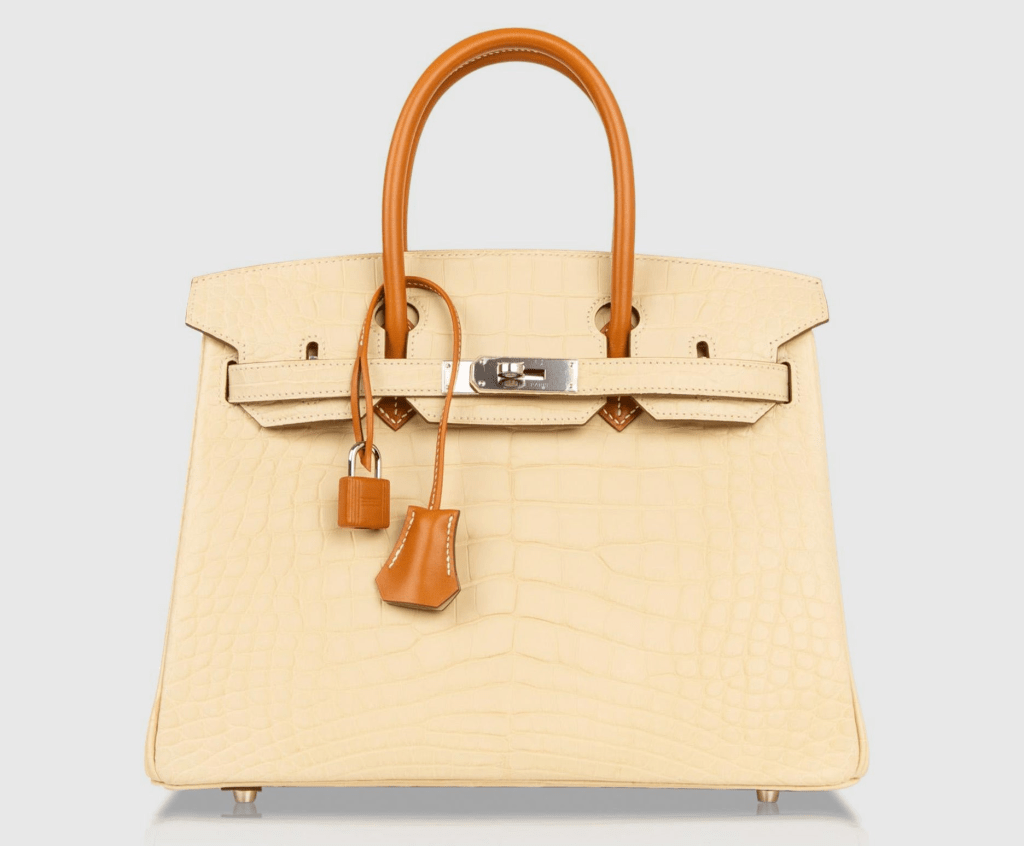
This is the moment when the brand is born. Not the guild mark — which was a quality guarantee, a craft certification — but the brand as mythology, as narrative, as identity system. Hermès is a harness maker founded in 1837. Louis Vuitton is a trunk maker founded in 1854. Cartier is a jeweller founded in 1847. All of them took the guild tradition of quality craft and, as industrialisation threatened to make quality available to everyone, repositioned themselves as the keepers of the pre-industrial flame — the authentic, the handmade, the scarce, the connected to a tradition of excellence that the machine could not replicate.
This is the first great luxury brand manoeuvre: selling aura in a world that has abolished aura. Offering the experience of the pre-mechanical, hand-made, master-crafted original in a world that has made everything reproducible. The genius of it is that it is not entirely false. The Hermès saddle stitcher does exist. The Cartier craftsman does exist. The skill is real. But the mythology constructed around it — the heritage, the artisan, the generations of mastery — is far in excess of the reality, and it is the mythology that justifies the price, not the skill alone.
By the late nineteenth century, the brand has become a machine for converting craft tradition into financial premium. The old man in the Italian hill town is still there — but he is now part of a marketing strategy as much as a production process.
Veblen, Marx, Benjamin: the theory catches up
By the time Thorstein Veblen published The Theory of the Leisure Class in 1899, the modern luxury system was already in place. Veblen gave it the vocabulary: conspicuous consumption, pecuniary emulation, invidious comparison. The luxury good’s function is to signal surplus — to show that you can afford to waste. The expensive thing is expensive because it is expensive; the price is part of the product. Veblen was writing about American robber barons but he was describing something universal. His observation that the consumption of expensive and useless things is a form of social competition — status displayed through the destruction of value — remains the sharpest single insight into luxury consumption.
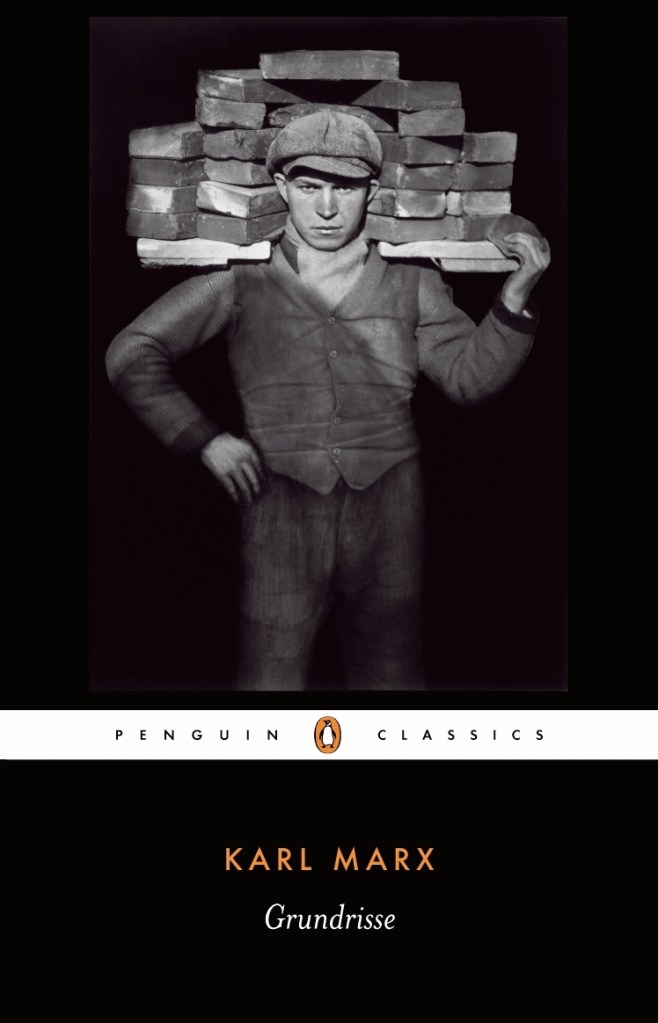
Marx got there first in a different register. The Grundrisse — the rough notebooks that preceded Capital, written in 1857-8 — contains his most expansive thinking about desire, need, and the commodity. He sees that capitalism doesn’t just satisfy needs; it produces them. The luxury good is not the satisfaction of a pre-existing desire for beautiful things — it is the creation of a desire that did not previously exist in that form, and its satisfaction through a specific commodity that the system then requires you to replace. Production of needs is as important as production of goods. This is the insight that the luxury industry has taken to its logical conclusion: not just producing goods to meet needs, but producing the needs that the goods are designed to meet.
Benjamin synthesises these and adds the psychological and theological dimension — the quasi-religious character of luxury display, the dreamlike quality of the shopping environment, the way the object promises transcendence and delivers disappointment. His Arcades Project is, among other things, the most sustained analysis of the luxury shopping environment ever written. He spent thirteen years on it. He never finished it. He was right not to — the subject is genuinely inexhaustible.
— — —
The digital acceleration: where we are now
What the digital world has done to luxury is to complete the separation of the object from its material basis. The most valuable luxury “goods” now are experiences, access, and images. The Instagram post in the private villa. The NFT of a JPEG. The Supreme drop that sells out in seconds to be immediately resold at five times the price. The Rolex that sits unworn in a safe as an investment.
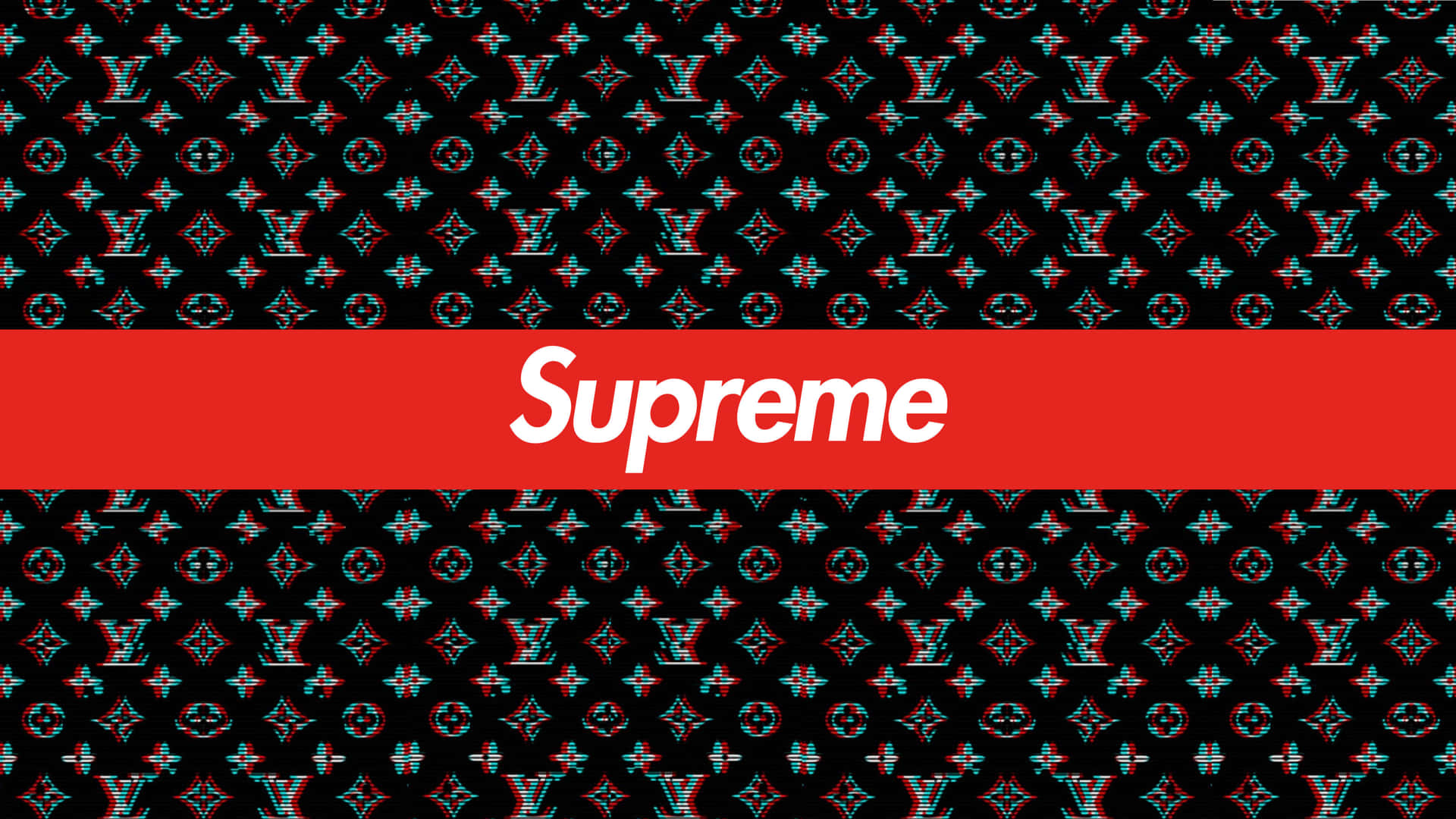
The object has become almost incidental. What is being consumed is the image of the object — which can be infinitely reproduced, which circulates on social media creating desire in millions of people simultaneously, and which requires no craft skill to produce. The brand is the product. The image is the luxury. The thing itself is almost beside the point.
This is the observation at the heart of this series: the luxury system, in its digital form, has achieved something approaching pure exchange value — value that has entirely divorced itself from use value and is almost entirely divorced from the labour that produces even the image. The influencer doesn’t make anything. The brand doesn’t need to make anything — it licenses the making to workshops in countries whose labour costs it doesn’t advertise. The desire is manufactured by algorithm. The scarcity is engineered by release strategy. The satisfaction is, as it has always been, deferred to the next purchase.
But now the scale is global, the speed is instantaneous, and the tools for manufacturing desire are more sophisticated than anything Benjamin could have imagined when he stood in the Paris arcades watching bourgeois Paris dream.
The question — and it is both an economic and a moral question — is whether this represents something genuinely new, or whether it is simply the latest iteration of a very old story: the story of beautiful things, the systems required to produce them, the desires they produce in turn, and the gap between what those desires promise and what they deliver.
The answer, may be, both. The structure is old. The scale and the speed are genuinely new. And the combination — old desire, new acceleration — is producing something that may be unsustainable in ways that even the most acute nineteenth-century theorists did not anticipate. We will come to that.
— — —
The old man in the Italian hill town
Before we do, it is worth pausing at the other end of the story from the LVMH earnings call.
He is still there. In Tuscany, in Naples, in the Veneto. Working leather, or silver, or glass, or paper, or fabric, with knowledge that took decades to acquire and that cannot be algorithmically reproduced. Making things that will last — that improve with use, that carry the mark of the hand, that have no planned obsolescence because the material itself resists it.
He is Benjamin’s collector’s object before it enters the market. He is Ruskin’s Gothic craftsman. He is the dignity that the system has been trying to price and package and sell back to us since the industrial revolution.
The question is whether the genuine thing can survive the system that tries to commodify it. Whether the old man’s son will learn the craft. Whether the knowledge will be transmitted. Whether the thing made by a person who knows what they are doing has a future in a world that has made knowing what you are doing economically irrational.
The unboxing video on TikTok and the old man’s hands are two ends of the same story. One of them is getting shorter. The other is getting louder. And the question of which wins — or whether the question is even framed correctly — is one of the more important political economy questions of our moment. All compounded by the corruption of the veracity of the image which AI fosters.
We will return to it. But first, in Part Three, we need to look at something that runs through the entire history of luxury and has rarely been named honestly: the way in which the aesthetics of beautiful things have been used to construct and sustain racial hierarchy — and the artists who have made that concealment visible.
— — —
A NOTE ON METHOD
This essay draws on conversations with Claude (Anthropic’s AI) as the research and synthesis engine, and on a range of primary and secondary sources including: Eric Williams, Capitalism and Slavery (1944); Thorstein Veblen, The Theory of the Leisure Class (1899); Karl Marx, Grundrisse (1857-8); Walter Benjamin, The Arcades Project (1927-40, published 1982); and historical scholarship on ancient trade routes, the guild system, and the colonial economy. The thinking is collaborative; the voice, selection, and responsibility are the author’s own.
Next: Part Three — The White Marble Lie: how an aesthetic myth became a racial ideology, and what Kara Walker did about it.


Leave a Reply