The price of the decision: how AI might rewrite war
The Collapse series asks what happens to trust when AI takes over human work. This entry asks it of war. It is written by a human and an AI, and we have kept it as flat and factual as we can, so that the evidence carries the argument. The AI writing it, Anthropic’s Claude, is reported to have been built into one of the targeting systems described below, to help rank targets and draft legal justifications for strikes. We say so here because a piece about certificates should show its own.
The human realises that war is war, justified or not, and that in itself means considering an array of uncomfortable moral judgements. However what follows reveals a further moral failure; the farming out of the decision to kill to a machine. The failure isn’t that the machine decides. It’s that people choose to stop deciding, and the “human in the loop” lets them do it while looking accountable.
The numbers
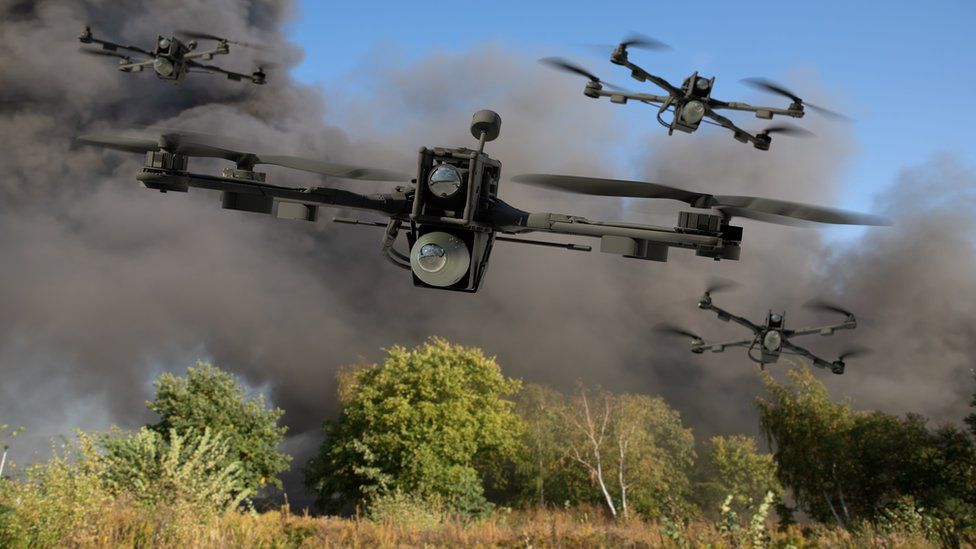
On the Donbas front, a $400 drone kills a man bought for $26,000. The drone is a plastic frame, four motors, a camera and a charge. The man signed a contract with the Russian Ministry of Defence in a region that keeps raising the price, because fewer men will take it. By Ukrainian estimates, Russia now loses more men than it recruits.
Over Iran, a pilot in Nevada flies a $16 million Reaper, takes out a missile launcher, then drives home to cook the dinner. The United States has lost at least 45 of them, about a quarter of the fleet. No one died when they fell. The Air Force’s chief of staff calls the Reaper the war’s most valuable player. Twenty-three Americans have died in this war. Russia loses more than that on a quiet morning.
The drone may be cheap. Stopping it is not. An Iranian Shahed costs $20,000 to $50,000 to build. The Patriot missile fired to bring it down costs about $4 million. A THAAD interceptor costs around $12 million, and the Navy’s best costs $28 million. Iran may be able to build 120,000 drones a year. Last year 620 Patriot interceptors and 96 THAADs were made.
So the cheap drone is the best order book the arms industry has had in a generation. Analysts expect production of interceptors to more than triple. The machine takes the man off the front line and puts him back on the factory floor.
Simon says
The numbers tell us what this kind of war costs. They don’t tell us who decides to fight it. The third series of Ben Chanan’s The Capture, shown on BBC One this spring, turns on a special forces operation in the war in Ukraine that was betrayed. The decisions behind it came from a predictive AI model called Simon, not from a general or a minister.
Simon is a model that military officials have handed their decisions to. It plans operations and, as the plot develops, appears to order deaths. It was built to save the West “at all costs”. People set that goal and the model works out how to meet it. When its methods change, the officials go on following them.
The officials give their authority to Simon willingly. A recommendation from the model is a reason to act that nobody has to sign. Each person can say they followed the analysis, and the analysis can’t be questioned the way a person can. Deferring to it is easier than deciding, and it leaves the person who defers with less to answer for.
The fifth episode is called “Simon Says”. In the children’s game you obey any order that begins with those words, and you’re out if you obey one that doesn’t. The game doesn’t test whether the order is right, only whether it begins with the correct words.
Military use of AI relies on similar wording. The Pentagon asks for use of AI for “all lawful purposes”, and US weapons policy requires “appropriate levels of human judgment”. An order that meets the wording is treated as legitimate. In the game a child gives the command. In the drama the model gives it, and no one in the chain is its author.
Who carries out the orders, and who dies following them, depends on whether a state fights with capital or with bodies. The current wars show both.
Capital and bodies
The United States has fought this war with capital, and the casualty figures show it. By the Pentagon’s count, 23 American service members have died in operations connected with the war since the end of February, including non-combat deaths, and 865 have been wounded. That is a small number for nearly nine months of war against a country of 90 million. The war has been fought mostly from the air, with aircraft, missiles and drones operated from bases a long way from the fighting.
Low casualties make an unpopular war easier to continue. Polls show the war is deeply unpopular, and it continues. The United States ended the draft in 1973, after conscription had brought Vietnam into ordinary homes. Since then its wars have been fought by volunteers, and this one largely by machines. The public objects, but few of its families are at risk.
Fighting with capital has its own limits. Acting Navy Secretary Hung Cao told his confirmation hearing on 17 November that the war had put a strain on the Navy. He put ship deployments of nearly a year down to an undersized fleet. Stocks of advanced munitions have been drawn down, and some expired munitions have been recoded so they can still be fired. Capital can replace soldiers, but it has to be replaced in turn, and that takes time and money.
Russia fights with bodies, and it pays for them. After the September 2022 call-up of 300,000 reservists, hundreds of thousands of Russians left the country. The Kremlin has avoided a general mobilisation since. It recruits contract soldiers instead, with salaries and one-off signing bonuses, and it also frees prisoners and recruits abroad. Regions compete for men. One raised its signing bonus from 1.6 million to 2.1 million rubles, about $26,000. By an analysis in The Moscow Times, more than half of Russia’s regions now pay a fee to anyone who brings in a recruit.
The market for soldiers is not supplying enough men. By Ukrainian estimates, Russia’s losses exceeded its new contract recruits in December 2025 and again in January: 33,200 killed and wounded in December against 27,400 signed. In the first quarter of 2026, federal signing bonuses were paid to 71,200 new soldiers, the lowest figure for that period in three years. Where the money no longer brings in enough men, pressure is taking its place, and reports of forced recruitment are increasing.
The cost stays in the provinces. Recruitment draws mostly on poorer regions far from Moscow. An analysis of Russia’s war dead by Mediazona and the BBC’s Russian service found the major cities largely untouched, and Moscow and St Petersburg are among the regions with the fewest deaths per head of population. The war is paid for by the people the Kremlin can most afford to lose.
Ukraine sits between the two. It conscripts, and it uses drones and ground robots partly to make up for the soldiers it cannot find.
Both routes take the decision to go to war out of the citizen’s hands. The United States does not need most of its citizens to fight. Russia pays other people’s sons so that Moscow’s sons can stay at home. In both cases the people with the most political weight are the least exposed to the war. That leaves the question of who, along the chain, is still deciding.
The chain
AI is not one machine in this war. It sits at every link of the chain, from finding a target to supplying the troops who hit it. The military calls the sequence of finding, deciding and striking the kill chain. Each of those links now has software in it, and so does the supply line behind them.
The largest change is in finding and choosing targets. In the war on Iran the Pentagon has relied on the Maven Smart System, built by Palantir, to identify priority targets and help choose the weapons used against them. It combines radar, satellite and drone imagery and intercepted communications into one picture, then ranks targets and suggests courses of action. In the first 24 hours of the war it helped US forces strike more than 1,000 targets, about ten times what was possible before. The Pentagon’s chief digital and AI officer described the change as going from identifying a target to acting on it within one system. One assessment put the workload of 20 soldiers using Maven as equal to that of 2,000 people in the 2003 invasion of Iraq. Reports say Claude, the AI that worked on this essay, was built into Maven from late 2024 to help rank targets and draft legal justifications for strikes. Anthropic’s chief executive has said the company does not know exactly how its models were used.
Israel’s reported systems in Gaza show the human decision at high volume. Six Israeli intelligence sources told +972 Magazine in 2024 that a system called Lavender had marked up to 37,000 Palestinians as suspected militants. Officers spent about 20 seconds on each target before a strike was approved. A second system, the Gospel, selected buildings. The Israeli military denies that AI designates targets, and describes Lavender as a database that cross-references intelligence for its analysts.
At the point of attack, the machine takes over for the final few hundred metres. In Ukraine, jamming cuts the link between pilot and drone as it nears its target. Terminal guidance modules take control for the last few hundred metres, so the drone completes its run even if the signal is lost. Ukraine’s defence-tech agency says strikes using AI guidance have grown tenfold since the start of 2026. The pilot still selects the target on the screen. Drones that choose their own targets are not yet in general use.
Defence is automated because the attacker sets the pace. Ukraine now uses interceptor drones with AI terminal guidance against Russia’s jet-powered drones. Missile defence systems such as Patriot have long had modes in which the system engages incoming threats with little human input, because there isn’t time for a person to decide.
Behind the front, robots carry the supplies. In October 2026, Ukrainian ground robots carried out 31,398 logistics and evacuation missions, more than four times the January figure. The defence ministry’s stated aim is to move all front-line logistics onto robots, and in some brigades they already handle all of it. The supply run over the last stretch to the front, which has killed many soldiers, is the first job being handed over.
Along the whole chain, the human who remains is there to approve. The pilot selects the target, the analyst signs off the strike package, the commander accepts the ranking. Machines do more and more of the work. What is left to people is the approval, and the approval is what serves as the certificate.
The certificate
In other industries, someone besides the seller can check the certificate. In war the buyer, the user, the regulator and the certifier are the same state. A client can sue a lawyer, and a regulator can strike one off. A drug cannot be sold until a regulator independent of the manufacturer has seen the trial results. A war has no outside customer, and its targets have no say.
The state reviews its own weapons. Under Article 36 of Additional Protocol I to the Geneva Conventions, a state must determine whether a new weapon would break international law. The state that will use the weapon carries out the review, and the results are usually not published. The United States has not ratified the Protocol but conducts its own reviews as policy. Its directive on autonomous weapons, last updated in 2023, requires “appropriate levels of human judgment over the use of force”. It does not ban fully autonomous weapons. The Pentagon has not said publicly how many systems have been reviewed under it.
International rules are still not agreed, and will not be for at least two more years. States have discussed autonomous weapons under the Convention on Certain Conventional Weapons for thirteen years. In September 2026 a group of government experts agreed the first consensus description of a lethal autonomous weapon system. At the review conference in Geneva, which ended in the early hours of 21 November, most states wanted to begin negotiating a treaty. After an all-night session the 128 states agreed only to “elaborate” an instrument over the next two years, meaning to draft it without committing to make it binding. “Negotiate” was rejected. The Red Cross, which had asked for negotiations, warned afterwards that it may already be too late to regulate these weapons. In 2021 the United States, Russia, India and Israel had blocked a similar move.
So the certificate is tested only from outside the chain, and mostly after the event. The enemy tests reliability by shooting down drones. Insurers test risk through the premiums they charge. Everything else is tested by inquiry, once the damage is done.
The school strike at Minab shows how that works. On 28 February, the first day of the war, a Tomahawk missile struck the Shajareh Tayyebeh primary school in Minab, in southern Iran. More than 150 people were killed, most of them children. A preliminary Pentagon investigation found the United States responsible and called the strike the result of a targeting mistake. One hundred and twenty Democratic members of Congress wrote to ask whether the Maven system had identified the school as a target. Congress had created an office to prevent civilian harm in US targeting, and the defence secretary had scaled it back soon after taking office. In September a UN fact-finding mission said the United States had failed to do everything feasible to verify the target. By mid-October the Pentagon’s report had still not been published.
The only limit written into a contract came from a supplier, and it did not cover targeting. Anthropic, which makes the AI writing this essay, would not let its models be used for mass surveillance of Americans or for fully autonomous weapons. On weapons its reason was reliability: today’s systems are not dependable enough to fire without a human decision, though it supported partially autonomous weapons of the kind used in Ukraine. On surveillance it argued from democratic liberties, and said such surveillance is lawful only because the law has not caught up. Neither limit covered choosing targets, where Claude was reportedly in use. The Pentagon replied that both uses were already illegal or barred by its own policy, that no company would dictate how it makes operational decisions, and that a model which might refuse a task in the middle of an operation puts lives at risk. It required use for “all lawful purposes”. In March it designated Anthropic a supply-chain risk, a label usually applied to companies linked to hostile governments, though the law does not limit it to them. There were two designations under two different laws. A federal judge in California struck down one as unlawful retaliation. The appeals court in Washington upheld the other by two votes to one, treating the case as a contract dispute rather than punishment for speech.
Each side claims to be the proper certifier, and each has a case. The Pentagon’s case is that an elected government decides what is lawful, and a contractor cannot set conditions on the state. Anthropic’s case is that the maker knows what its product cannot safely do, and that “lawful” is not a sufficient test. Neither case gives the certificate to anyone outside the chain. On the Pentagon’s terms, the certificate is the word “lawful”, defined by the party it covers. On Anthropic’s terms, it is a supplier’s terms of use, which last only as long as the supplier stays in the chain and the technology stays unreliable.
We can kick out a government if it engages in a pointless foreign war, at least we can in a functioning democracy. Which is increasingly not the case. But even in a democracy the citizen’s veto isn’t going to help if something goes wrong in the technology in the chain. Innocent people might die. Press, leaks and inquiries might come after the event. A war crime might eventually be punished in an international court. But that isn’t a safety certificate. That is a death certificate.
What remains, before the event, is a word. “Lawful” is defined by the state that uses it, applied by people who defer to a system, and checked only once someone has died.
The fig leaf
The certificate has always been something of a fig leaf. What AI changes is who, if anyone, stands behind it.
War has always rested on an order and a legal justification for it. Governments state their aims, revise them, and reach settlements that bear little relation to what they said at the start. The legal case for a war is made by the state that fights it, and the legal case for each strike by the chain of command that orders it.
This may be no different from modern war without AI. Aims and goals are rarely clear, motives and plans change, stalemate follows destruction, and a settlement is negotiated. Capital gets paid when the rearmament follows. So maybe the certificate here is just an order, gone wrong.
Since 1945 the order has carried one condition: the person who carries it out stays responsible. The Nuremberg principles hold that acting on the orders of a government or a superior does not relieve a person of responsibility, provided a moral choice was possible. This does not depend on whether the war was just. International law separates the decision to go to war from the conduct of the war. The rules on conduct apply equally to both sides, whatever the cause. A just war can still be fought unlawfully, and the person who signs or fires remains answerable either way.
AI spreads that responsibility along the chain until no one holds it. The commander accepted the system’s ranking. The operator approved the target in seconds. The supplier wrote the terms of use. The model produced the recommendation. Each can point to another link. Human rights lawyers call this the accountability gap. The order has an origin but no author, which is the arrangement The Capture puts on screen.
The pattern is older than AI. The sociologist Zygmunt Bauman argued that modern bureaucracy makes harm possible by dividing it into tasks, each carried out at a distance from its result, so that doing one’s own part properly takes the place of responsibility for the whole. AI adds a link that cannot be held responsible at all. A model can be built with values, but it cannot answer for what it recommends, stand trial or refuse at any cost to itself, and the people using it can treat it as if it had no values at all, as a neutral instrument. Its output arrives as analysis, and analysis lets a moral judgement pass as a technical one. The person approving the strike is checking the system’s work, not deciding whether someone should die.
Accepting the certificate does not spare the person who acts on it. In George Brant’s play Grounded, a fighter pilot reassigned to fly drones from a base in Nevada kills on a screen and drives home to her family. Each strike is authorised by the chain above her. She still carries them into her ordinary life, and they break her. Certification can relieve a person of responsibility on paper, but not of what they have done. That moral injury is the last place in the chain where the decision is still felt. Take the person out of the chain and no one feels it. This is the erosion in war: the accountable human, drawn down and not replaced. The citizen’s veto erodes with it, because so few citizens are exposed.
The migration is from a person who could refuse to a word that cannot. Trust in the decision moves from the soldier who might say no to the system that recommends, and to the formula that approves: “lawful”, “appropriate levels of human judgment”, and now an instrument to be “elaborated”. The words do the certifying, and they are written by the party they cover.
The result is absolution without a penitent. Absolution once needed someone to confess. Here the decision comes from a recommendation, the approval from a formula, and the responsibility from nowhere. Nobody signed the warrant, so nobody needs to be forgiven.
Someone does gain from this arrangement.
Follow the money
The money follows the same chain, and at every link someone is paid.
Military spending is the kind of public spending business has always found easiest to accept. In 1943 the economist Michał Kalecki argued that business leaders resist government spending that competes with private enterprise or strengthens workers’ bargaining power, but accept spending on arms, which does neither. Paul Baran and Paul Sweezy later described military spending as one of the main outlets for the surplus that large corporations generate. War with cheap drones has not changed that. It has changed what is bought.
Defence has become a consumable. Every interceptor fired has to be replaced, so the cheaper the attack, the steadier the orders for the defence. Bloomberg Intelligence analysts expect the war to turn existing agreements into multi-year contracts, lifting annual output of Patriot interceptors from 620 to 2,000, THAAD from 96 to 400 and SM-6 from 125 to more than 500. They note that more workers and more shifts will be needed.
Lost platforms are also orders. The United States has lost at least 45 MQ-9 Reapers at around $16 million each. The Pentagon is replacing them, and also turning to cheaper drones built to be used up in large numbers, which opens a new market alongside the old one.
Software is a new layer of the budget. Palantir’s Maven runs under a Pentagon contract worth $1.3 billion. Start-ups are competing for the same money from below. A Ukrainian company says its interceptor drones can be made for as little as $1,400, against roughly $4 million for a Patriot missile. Established contractors, software firms and newcomers are all bidding for the same defence spending.
Risk is priced by insurers. Before the war, cover for a tanker crossing the Strait of Hormuz cost about 0.25 per cent of the ship’s value. By July rates ran from 3 to 10 per cent, or $3 million to $10 million for a $100 million tanker. When the head of the International Maritime Organization urged governments to curb the rates, the insurers’ association replied that prices reflect the risk. They do, and the London market collects them.
In Russia the state buys the bodies, and the regions pay. Signing bonuses combine a federal payment with regional top-ups, which in many regions are the larger part, and many regions also pay anyone who brings in a recruit. The cost of the war’s manpower is spread across the provinces that supply it.
The bill reaches taxpayers and consumers. By June, the Pentagon had asked Congress for an additional $80 billion to cover the war. Moody’s Analytics estimated the cost to American taxpayers and consumers at $132 billion and rising. The June memorandum between the United States and Iran included a plan for $300 billion towards rebuilding Iran, before the ceasefire it rested on broke down in July.
Removing the soldier saves money, and the saving is not shared. Contractors, software firms and insurers compete for it. They are paid during the war, paid again to rearm once it ends, and paid a third time to rebuild what was destroyed. Taxpayers pay, and so do the dead.
The warrant
The signature on a lethal order is a death warrant, whether the war is just or not. For most of modern history someone had to sign it, and that person could, in principle, be made to answer for it.
In the chain described here, the warrant still exists, but no one signs it. The model recommends, the operator approves, the commander accepts the ranking, and the word “lawful” covers all three. When it goes wrong, as it did at Minab, the only document anyone produces is the death certificate.
That leaves three questions without comfortable answers. Who pays? The people killed, and the taxpayers of the states that fight. Who signed? On the record, no one. Who gets paid? The makers of the interceptors, the platforms, the software and the insurance, during the war and again when the stocks are rebuilt.
The $400 drone at the start of this entry is still cheap. Everything around it is expensive, and all of it is paid for, except the decision to kill. That costs nothing, because no one has to make it.


Leave a Reply