What Do We Mean By Decline?
Spain is, by any measure, one of the great capitalist success stories of the last seventy years. In July 2026, Ferran Torres scored in extra time to beat Argentina and win the men’s World Cup, three years after the women’s team had already won theirs in Sydney — for a stretch of the calendar, Spain held both titles at once, a double no other footballing nation can currently claim.
The food tells the same story from a different angle, and if you look closely, it’s already telling you something else too. The 2026 Michelin Guide lists 307 starred restaurants in Spain, sixteen of them at the top tier — level with Japan for the most three-star kitchens on earth, behind only France for the overall count. Look at any given year’s list of the world’s best restaurants and Spain will usually have a couple of entries near the very top — but increasingly, so will Peru, Mexico, and the rest of the Spanish-speaking world. In 2025, Spain held two of the top four places on the World’s 50 Best Restaurants list. The other two went to Lima and Mexico City.
Tourism is where the transformation is starkest, because there is almost nothing to compare it to. Under Franco, Spain barely registered as an international destination — the country was economically isolated, and the 1959 Stabilization Plan that finally opened it to foreign visitors produced 4.3 million arrivals in its first year, a number that felt enormous at the time precisely because it was starting from close to zero. By 1975 that figure had reached 30 million. By 2025 it had reached 96.8 million, and Spain now sits at or near the very top of the world rankings, its only serious rival for the position being France. A country that did not exist on the tourist map two generations ago is now fighting for first place on it.
Architecture makes the same point in concrete and steel, and it is not one lucky building. Santiago Calatrava, born just outside Valencia and trained at its Polytechnic, built the City of Arts and Sciences on the city’s old riverbed — a project that ran to roughly four times its original budget and left him facing lawsuits over his fees, but stands as one of the most photographed skylines in Europe regardless. Rafael Moneo, working from Madrid, became the first Spanish architect to win the Pritzker Prize in 1996, for buildings from Mérida to San Sebastián built on the principle that new architecture should extend a place’s history rather than compete with it. RCR Arquitectes, three architects working quietly out of the small Catalan town of Olot, won the same prize in 2017 for buildings most people outside architecture circles have never heard of. Three prizes, three regions, three decades — a system that keeps producing this, not a single exception mistaken for a pattern.
None of this is an illusion, and none of it needs qualifying. A country that was closed to the world under a dictatorship seventy years ago now wins World Cups on both sides of the game, feeds the world at the highest level its industry recognises, and builds the buildings other countries put on postcards. Art, festivals, nightlife, buildings, beaches. Measured from where it started, it is hard to think of a European economy that has travelled further, faster.
But Spain has done this kind of thing before. Four centuries ago, the rest of the world also looked at Spain and saw an unanswerable success — a crown whose ships came home from the Americas carrying more silver than Europe had ever seen in one place, a capital city that briefly held more raw wealth flowing through it than any other on earth. That earlier golden age ended very differently from how it began. The real question isn’t whether the resurgence is real. It’s what happened the last time the world looked at Spain and thought exactly the same thing.
Pressure Into Invention
Spain’s turn to the Atlantic wasn’t a natural next step for a rising power. It was the response of a treasury already broken by the war that finished the Reconquista. The final campaign against Granada cost the crown something in the region of 800 million maravedís — well over a billion pounds in today’s money — and left it needing new sources of gold before the ink on the surrender terms was dry. Columbus reached the crown’s ear in 1492 not as a visionary being indulged, but as a proposition arriving at the exact moment a debt-ridden monarchy needed one.
The instrument that made conquest possible wasn’t the sword, it was the contract. The capitulación bound crown and conquistador together as partners rather than employer and employee — the conquistador financed and led the expedition at his own risk, the crown licensed it and took a fifth of whatever came back, the quinta real. Cortés and Pizarro weren’t state agents. They were franchisees, operating under royal licence against a royal cut, which is why the crown could extend its reach across an ocean without paying to build the ships that crossed it.
And the model itself had already been tested, decades before it reached the Aztec or the Inca. Castile’s first overseas conquest wasn’t Mexico, it was the Canary Islands — annexed piecemeal between 1402 and 1496, worked with slave labour on sugar plantations, its legal treatment of the native Guanche population formalised into the Laws of Burgos in 1512. Everything that would later look like improvisation in the Americas — forced labour organised as a grant of people rather than land, a native population legally subordinated to a settler economy — had already been rehearsed on a smaller, closer stage first.
What made the conquest of Mexico fast wasn’t superior weaponry. It was that there was an existing empire to take over rather than build. The Aztec state the Spanish encountered in 1519 was already a centralised, hegemonic system extracting tribute from dozens of subordinate peoples across central Mexico. Cortés didn’t have to invent an extraction machine — he had to capture the one already running and redirect its output. That’s also why the conquest of the more decentralised Maya and Chichimeca territories, which had no single apex to seize, dragged on for decades rather than years. Historians working from indigenous-language sources — Matthew Restall, building on decades of work by the Mexican historian Miguel León-Portilla, foremost among them — have made the case that the old story of a technologically overwhelming Spanish force is overstated next to a simpler explanation: a fractured political landscape gave Cortés willing native allies who had their own reasons to see the Aztec tribute system fall.
Spain, unlike some of the empires that would follow it, actually argued with itself about what it was doing. Bartolomé de las Casas published his Short Account of the Destruction of the Indies in 1542, the same year the crown issued the New Laws restricting the encomienda system in response to it, and in 1550 the crown convened an extraordinary formal debate at Valladolid — theologian against theologian, in front of royal judges — over whether the indigenous peoples of the Americas were free men owed the same natural rights as Spaniards, or a lesser people who required Spanish guardianship. Las Casas argued the former. Juan Ginés de Sepúlveda argued the latter. Nobody declared a winner, and the encomienda system persisted regardless of the debate’s outcome — but the debate happened, inside the empire’s own institutions, at a moment when other emerging colonial powers weren’t having it at all.
Then, in 1545, the mountain that funded a century of European war was found. Potosí, high in what is now Bolivia, turned out to sit on the largest silver deposit ever discovered, and for the next hundred years it fed a river of bullion into the Spanish treasury on a scale nobody in Europe had ever seen. Combined with Mexican silver from Zacatecas, it made the Spanish crown, for a generation, the wealthiest state on earth in the one currency that mattered most.
And it did almost nothing for Spain itself, because the silver was never really Spain’s to spend. Most of it was pre-committed before it arrived — mortgaged to Genoese and German bankers who’d advanced the crown loans against future shipments, and routed straight into paying armies in Flanders, Italy, and Germany rather than into anything that might have built a productive domestic economy. The result was the price revolution: an influx of bullion so large it inflated prices across Castile faster than wages could follow, making Spanish goods too expensive to export while flooding the domestic market with money chasing too few things to buy. Spain became the richest empire on earth and one of its slowest to industrialise, in the same stretch of decades, for the same reason. The mountain that should have built a nation instead built the debts of everyone the crown already owed money to — a pattern that repeats itself, in different clothes, all the way to the present.
Fuenteovejuna: The Domestic Mirror
Castile was doing this to itself before Columbus ever sailed. Lope de Vega’s Fuenteovejuna, written around 1612–14, tells the story of a real Córdoba village whose inhabitants rise up and kill the Comendador — a remote military-order governor who has spent years abusing his authority over them with total impunity. When royal investigators arrive to find the culprit, the whole village gives the same answer: “Fuenteovejuna did it.” Nobody is punished. The Catholic Monarchs, consolidating their own authority against exactly this kind of over-mighty regional lord, let it stand.
The mechanics are the same ones the Americas would run at greater distance and greater scale. A remote authority, licensed by rank and by distance, treating the people under it as an extractable resource rather than subjects owed anything back. A periphery with no formal recourse except collective, extra-legal refusal. Swap the Comendador for a viceroy and the village for an encomienda and nothing needs adjusting.
The timing sharpens it further. Lope was staging a domestic abuse of power from the 1470s at more or less the same moment Spain’s crown was extracting tribute from a captured Aztec apparatus on the other side of the Atlantic. A Madrid audience in 1614 didn’t need the play to explain what an unaccountable authority skimming a captive population looked like. They’d grown up inside the domestic version.
The crown’s own response set a limit that the empire would later ignore at far greater cost. It intervened not to punish the revolt but to accept the village’s unified silence — choosing to look past a periphery’s defiance rather than crush it, because punishing an entire village, or admitting a royal-adjacent official had been that badly out of line, cost the crown more than it gained. Extraction had a ceiling at home. What happened when the same logic ran across an ocean, with no theatre audience watching and no crown close enough to notice the ceiling had been breached, is where Potosí comes in.
Desengaño: The Golden Age Diagnosing Itself
Fuenteovejuna had company. Calderón wrote his own version of the same story a generation later, El Alcalde de Zalamea, probably staged in 1636: a wealthy commoner elected mayor executes a military captain who has assaulted his daughter, entirely outside his legal authority to do so, and the king upholds the execution rather than punishing him for it. Same mechanism as Lope’s play, same royal choice to let a periphery’s overreach stand rather than enforce the centre’s formal claim — not one playwright’s idea, but a convention audiences kept paying to see twice in a generation.
No writer carries this argument further than Cervantes, because no writer lived it as completely. He fought at Lepanto in 1571 and lost the use of his left hand there. Four years later Barbary corsairs captured the ship bringing him home and sold him into slavery in Algiers, where he spent five years, attempting escape four times, ransomed only when his family scraped together the money. He came back to a Castile one biographer describes as “trapped between grime and luxury, going from one bankruptcy to another as it expanded its boundaries” — the empire’s silver still arriving, the country underneath it still coming apart. He wrote to the crown in 1582 stating his readiness to seek a post in the Indies, and applied formally in 1590 for one of four vacant crown positions in the Americas. The formal application was rejected, curtly enough that the refusal survives in the record. What he got instead was work collecting grain and unpaid taxes across provincial Andalusia, a job that saw him excommunicated twice by the Church for confiscating its stores and imprisoned more than once over money he didn’t have. Don Quixote was published in two parts, 1605 and 1615, when its author was in his late fifties and had spent his entire adult life failing to get anywhere near the empire that had cost him a hand and five years of freedom.
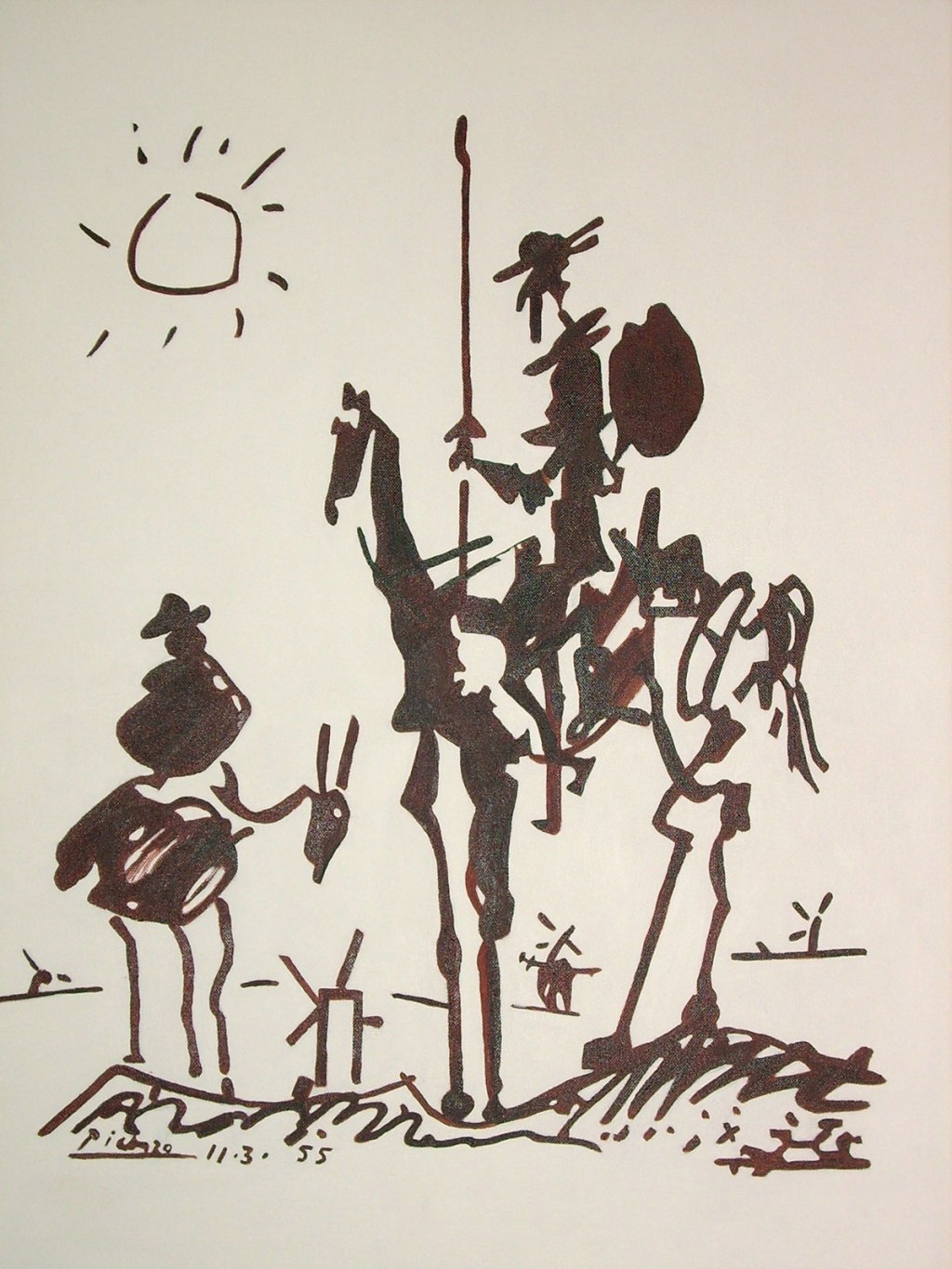
The novel doesn’t need an allegorical reading forced onto it, because the biography underneath it already makes the case. An ageing, impoverished minor nobleman, driven half-mad by stories of a chivalric age already over, sets out to live inside that fantasy and is beaten, mocked, and ruined by the real world at every turn. Written by a war hero the empire’s own administration had refused. The historian J.H. Elliott places the book directly inside Spain’s mood of the period, calling it “the parable of a nation which had set out on its crusade only to learn that it was tilting at windmills.”
Cervantes even put the emigration itself on the page. In Don Quixote’s own “Captive’s Tale,” a father with three sons and not enough land to keep them all sends each in a different direction: one to the profession of arms, one to complete his studies at Salamanca, and the second “decided upon going to the Indies, embarking the portion that fell to him in trade.” That’s not an invented detail for colour — it’s the real domestic calculus of the age, put as directly as fiction allows: a country too crowded and too poor at home to hold its own sons, sending the ones with nothing to lose across an ocean on the chance of coming back rich. We will come back to this.
Cervantes wasn’t reacting privately. He was living inside a diagnosis the country was already giving itself a name for. Spanish writers of the period had a word for the mood — desengaño, disillusionment, the moment reality breaks back in on an illusion that’s been maintained past its use — and a recognised school of economic writers, the arbitristas, spent the turn of the seventeenth century producing memorial after memorial trying to explain exactly what had gone wrong.
The sharpest of them made an argument three centuries ahead of the economics that would eventually name it. Martín González de Cellorigo, a jurist writing around 1600, argued that the gold and silver flooding in from the Americas was the cause of Castile’s collapse, not its cure — that the windfall let the crown avoid the harder work of building anything that could generate wealth on its own, and that easy bullion had produced a kingdom allergic to productive labour. Modern economists now recognise this as an early statement of what’s since been formalised as the resource curse: the pattern by which resource-rich states often develop worse than resource-poor ones, because the windfall removes the pressure to build durable institutions. Cellorigo’s own words for it are worth keeping exactly as he wrote them: Castile had become, he said, “a republic of enchanted men, living outside the natural order.”
And he wasn’t even the only person making this argument that year. In Naples, within roughly a decade of Cellorigo’s memorial, Antonio Serra was making structurally the same case about a different corner of the same empire — that raw resources without productive industry produce poverty, not wealth, while resource-poor Venice grew rich on manufacturing alone. Two men, in two cities on opposite sides of the same crown’s territory, independently diagnosing the identical disease at almost the identical moment. Neither seems to have known the other existed. The empire that couldn’t build a productive economy out of the largest silver windfall in history had, within one generation, produced two people who could explain exactly why — and a novelist, in between them, who gave the whole diagnosis its most durable image.
Velázquez: Painting the Hollow Centre
Velázquez painted the empire’s self-image at the two moments it needed one most, and neither one was true when he painted it. The Surrender of Breda, completed around 1634–35, commemorates a Spanish victory in the Eighty Years’ War — the handover of the Dutch city, staged with two generals meeting as equals in a gesture of shared honour. It was painted for the Hall of Realms in Philip IV’s new Buen Retiro palace, commissioned specifically to glorify the crown’s military record, at the exact moment historians now describe as the start of Spain’s economic decline. The empire that had just run out of the wealth to sustain the wars it was fighting commissioned a painting celebrating one of the wars it was still, for now, winning.
Las Meninas, twenty years later, is the same instinct pushed to its most self-aware extreme. Completed in 1656, near the end of Velázquez’s life and after thirty-three years in royal service, it places the young Infanta Margarita at the centre of a Madrid palace room, the king and queen visible only as a dim reflection in a mirror on the back wall, and Velázquez himself standing in the scene, brush in hand, painting the viewer. By 1656 Philip IV’s only son had been dead for a decade, the crown had no clear heir, Spain had spent decades losing ground in the Thirty Years’ War and the war with France, and the dynasty that had commissioned The Surrender of Breda’s confident battlefield handshake was quietly running out of future. The painting that resulted isn’t propaganda in the way Breda was. It’s a court so used to being watched that it has started watching itself watch — the monarchy reduced to a reflection in the background of its own official portrait, and the artist who painted it standing closer to the centre of the frame than the king does.
Nothing needs adding to make the point. The paintings already carry it. Spain’s Golden Age produced, in the same court, both the confident staged image empire wanted of itself and, a generation later, the same court quietly aware that the image had outlived what it was supposed to represent — and both paintings now hang in the same museum, a short walk apart, exactly as Velázquez left them.
The Periphery That Never Reached the Centre
Serra had already diagnosed why, decades before anyone had the numbers to prove him right. He’d argued that a kingdom of raw resources and no manufacturing industry stays poor regardless of what it’s sitting on — and Naples was about to become the case study, run by a crown that treated the whole kingdom as a source of men and money for wars fought somewhere else entirely.
What do we mean by decline? Spain, Portugal, the Dutch Republic, England, and France all eventually gave up the position Spain held in the sixteenth century, and so, centuries earlier, did Rome and Athens. Being at the top of any such pile is temporary by definition — the only direction left to travel is down, and calling that decline risks implying a fall that didn’t have to happen rather than a regression every dominant power eventually experiences. We aren’t asking whether Spain declined. Every leading power does. We’re asking whether the specific mechanism — silver passing straight through the treasury to foreign creditors, wealth pooling at the periphery rather than building the centre — made that decline sharper, faster, or more damaging than mean reversion would have produced on its own.
Naples wasn’t a rich periphery quietly enriching Madrid. It was itself the thing being squeezed. From its conquest in 1503, the kingdom functioned as what historians now call the military and fiscal cornerstone of Spain’s Mediterranean empire — a subordinate viceroyalty supplying troops and money to sustain Habsburg wars in the Netherlands, Italy, and Germany, not a source of reinvestable wealth flowing home. The crown’s demands on Naples only grew as the cost of empire-wide war rose, and by the early seventeenth century the kingdom was running its own recurring fiscal crises, debated at the time by Neapolitan and Spanish administrators, merchants, and bankers trying to work out how a supposedly prosperous kingdom kept finding itself broke.
And what got extracted from Naples never even had one owner — it got skimmed twice before Madrid saw a fraction of it. Beneath the viceroy sat an entrenched baronial class, holding vast agrarian estates and extracting rents, dues, and judicial fees from a peasantry with no real recourse against them — inequality that visibly worsened across the sixteenth to eighteenth centuries while ordinary rural incomes stagnated or fell. The viceroys themselves, appointed for terms of three to six years, lived in real opulence, building residences, surrounding themselves with the era’s best artists, and using the post to enhance the prestige of the crown they served. What actually reached Madrid from Naples wasn’t reinvestable capital. It was art — many of the paintings now hanging in the Prado arrived there as gifts from Naples’s viceroys, sent up the chain as prestige objects rather than productive wealth. Peasant to baron, baron and viceroy to court patronage, and only then, in the form of a painting rather than a coin, something reaching the centre at all.
New Spain tells almost the same story with harder numbers attached. Mexico City was already one of the richest cities on earth by 1625, fed by silver mines producing a fifth of the world’s total output by the early seventeenth century. By the close of the eighteenth century, New Spain had become the wealthiest of all Spain’s American territories — and by that same point, over half its land and nearly two-thirds of the money in circulation had fallen into the hands of the Church. The wealth didn’t fail to exist. It simply never left the periphery that generated it, pooling in local ecclesiastical and colonial hands rather than crossing the Atlantic to build anything in Castile.
And the silver that did cross the Atlantic mostly didn’t stop in Spain either — it kept moving, straight through the crown’s hands into someone else’s ledger. Bullion shipments were routinely pre-committed before they even arrived, mortgaged against loans the crown had already taken from Genoese and German banking houses, chiefly the Fuggers, to fund the wars Naples and everywhere else were also being squeezed to pay for. Spain defaulted on its own sovereign debt at least eight times between 1557 and 1666 — during the exact century in which more silver flowed into a single treasury than had ever been seen in Europe before. A kingdom holding the largest bullion windfall in early modern history went bankrupt repeatedly, because none of that money was ever really its own to spend.
Serra’s argument, tested three different ways in the same empire, comes back with the same answer each time. Naples had resources and no industry, and stayed poor. Mexico had resources and its wealth pooled locally rather than reaching the metropole. Castile had the resources of both, passed the silver straight through to its creditors, and defaulted anyway. These three aren’t the only cases the empire could offer — Peru and Sicily would tell close cousins of the same story — but they’re enough to establish the pattern rather than a coincidence. Wherever you looked in this empire, extraction without the institutions to hold onto what was extracted produced the same outcome: wealth that was real, visible, and almost entirely useless to whoever was supposed to be collecting it.
The Golden Age’s Own Death
The Golden Age has an end date, and it isn’t a metaphor. Calderón died in 1681, and literary historians conventionally close the period there — not because Spanish writing stopped, but because nothing produced afterward matched what had come before. The eighteenth century that followed was markedly thin by comparison: no Spanish equivalent of the French or English Enlightenment’s intellectual output, a national literature that had, by most accounts, simply run out of what had made it exceptional. The bullion had stopped building anything a century earlier. The writing that bullion’s era had produced took another hundred years to run out too.
And then, for a long time, nothing happened — until 1898 forced it to. Spain lost the Spanish-American War in a matter of months, ceding Cuba and the Philippines and losing the last substantial remnants of the empire that had defined the country’s self-image for four centuries. The shock produced a literary generation named for the year itself: the Generation of ’98 — Unamuno, Machado, Baroja, Azorín — writing an anguished, obsessive literature asking what Spain actually was, now that the thing it had always told itself it was had visibly ended. That’s not a forced parallel between economics and literature. It’s the same date doing both jobs at once — the empire’s formal end and the moment Spanish letters finally produced its next major movement, after two centuries of comparative silence.
Between Calderón’s death and 1898 sits over two hundred years in which Spanish culture had almost nothing left to say about what had happened to it. The gap itself is the evidence. A country that spent a century producing Cervantes, Lope, Calderón, and Velázquez, all wrestling openly with what empire was actually doing to the place that ran it, went almost silent on the subject the moment the empire’s practical wealth ran out — and only found its voice again at the exact moment the empire’s formal existence ended too. The silence in between isn’t absence of material. It’s what a country sounds like when it has stopped being able to tell itself a story about where its wealth went, and hasn’t yet been forced to ask.
Goya: Living Through the Collapse
Goya didn’t paint the empire’s decline from outside it. He held an official position inside the machine while it happened around him. Appointed court painter to Charles III in 1786 and elevated to First Court Painter under Charles IV in 1799, he was, on paper, the most successful artist in Spain — royal portraits, tapestry commissions, an intimate friendship with the powerful prime minister Manuel de Godoy. In 1792 a severe illness, its exact cause still disputed, left him permanently deaf at forty-six. He kept painting, and kept his court position, straight through what came next.
What came next was Napoleon. France invaded in 1808, deposing Charles IV, and Goya — instinctively hostile to authority by most accounts, but a court painter needing to eat — swore the oath of loyalty required to keep working under the new regime while privately sketching what he was actually witnessing: French troops subjugating his own countrymen. When the French were finally expelled in 1814, he petitioned the restored government directly, asking to “perpetuate by means of his brush the most notable and heroic actions of our glorious insurrection.” What resulted was The Second and Third of May 1808 — the second showing a Madrid street mob rising against occupying troops, the third showing the mass execution that followed, faceless soldiers levelling their rifles at civilians whose terror is rendered in exact, unflinching detail. Between 1810 and 1820 he also produced the Disasters of War, a sequence of over eighty etchings depicting massacre, rape, and starvation on both sides with no heroes, no glory, and nothing resembling a national narrative — so unflinching he didn’t publish them in his lifetime; they only appeared in 1863, thirty-five years after his death.
Then, with the war over and the monarchy restored, Goya simply withdrew. Ferdinand VII’s return in 1814 brought a repressive, reactionary court Goya had no appetite for. He kept his title but stopped attending it in any meaningful sense, was quietly superseded in royal favour by a younger painter, and in 1819 bought a farmhouse outside Madrid known as the Quinta del Sordo — the House of the Deaf Man, a name that already belonged to the property before he ever lived there, an irony he can’t have missed. There, deaf, in his seventies, and recovering from a second serious illness, he painted fourteen enormous murals directly onto the plaster walls of his own house — the Black Paintings, images of despair, myth, and violence, including Saturn Devouring His Son, never intended for public exhibition and never explained by their maker. He left for exile in Bordeaux in 1824, rather than live under Ferdinand’s regime any longer, and died there in 1828.
One court painter’s career runs the entire arc this section has been tracing. Official glory under a fading dynasty, private witness to the actual violence when the state itself came under attack, and then a total, wordless retreat once the crown that employed him proved not worth serving. Velázquez painted the empire’s confidence and, later, its quiet unease with itself. Goya lived long enough to paint its collapse in real time, then paint what was left of himself once it was over.
Lorca: The Poverty That Never Left
Lorca wasn’t writing about empire in any direct sense — he was writing about what centuries of it had left behind, in the exact region dominated by its worst legacy. He was born in 1898, the year of the Cuba and Philippines losses, near Granada, in the heart of Andalusia — a region sitting under the latifundio system, vast landed estates worked by a landless peasantry, running in one continuous line from the Reconquista’s redistribution of land through to the 1930s without meaningful reform in between.
His three great plays weren’t a coincidence of setting — Lorca planned them, explicitly, as a group about land itself. Blood Wedding (1932) and Yerma (1934) were conceived as parts of what he called a “trilogy of the Spanish land,” left formally unfinished at his death; The House of Bernarda Alba (1936) is usually grouped alongside them as a third, related piece even though he hadn’t placed it in the original plan. All three are set among rural Andalusian families where marriage, inheritance, and honour function as the mechanisms by which land and status pass between generations, and all three end in the same place: repression turning to violence because there is no other outlet available to the people living inside the system.
Bernarda Alba makes the mechanism plainest, because it strips out the folklore and leaves only the economics. A wealthy widow keeps her five unmarried daughters locked inside the family house under strict mourning, their only real function being to protect the family’s land and respectability until a suitable marriage can be arranged — the play’s own subtitle calls it simply “a drama of women in the villages of Spain.” It was Lorca’s last work, completed in June 1936, two months before Nationalist forces murdered him at the outbreak of the Civil War he had, by then, been writing toward without knowing it.
None of this reads as a metaphor for empire. It reads as what was left once the money had gone somewhere else for four hundred years. The gold and silver that had passed through Castile on its way to Genoese bankers and European wars never touched Andalusia’s own rural economy in any way that mattered. What it left behind instead was a landholding pattern frozen since the Reconquista, a peasantry with nothing to inherit and nowhere to go, and a culture built around guarding the one thing a family without money still had — its honour, and the land attached to it. Lorca didn’t need to write about the empire to write about its residue. He only needed to write about the villages it had never gotten around to including. Villages which, within a generation, would become the quintessence of the sophisticated European holiday.
Franco’s Autarky: Misdiagnosing the Same Disease
The regime that killed Lorca spent its first two decades trying to solve the exact problem the arbitristas had named three centuries earlier, and reached for almost the same wrong answer. Franco won the Civil War in 1939 and, rather than opening the wrecked economy to the trade and investment that might have rebuilt it, imposed autarky — deliberate national self-sufficiency, achieved by walling the economy off from world markets rather than reforming what sat inside them. It wasn’t purely a reaction to Spain’s international isolation, either, though that isolation was real: branded an outcast for its wartime sympathies with Hitler and Mussolini, Spain was excluded from the Marshall Plan that rebuilt the rest of Western Europe. Decades of domestic economic thinking, going back before the war, had already been arguing for exactly this kind of self-sufficiency on its own terms.
The result was Cellorigo’s disease with a fascist flag over it. GDP per capita by the early 1950s sat at barely 40% of the Western European average. Inflation soared, food ran short, a black market flourished, and the country registered outright negative growth in some years. A government that had executed the intellectual and artistic heirs of the tradition that first diagnosed Spain’s extraction problem was now trying to solve that same problem by enforcing isolation rather than building institutions — the Habsburg crown’s instinct, in new clothes.
What finally broke the pattern wasn’t ideology. It was money running out completely. By the late 1950s foreign currency reserves had collapsed to a few million dollars, the peseta was trading at record lows on the black market, and Franco’s own military chiefs abandoned their preference for autarkic self-reliance once it became clear the country simply couldn’t sustain itself. In 1957 he brought in a group of technocrats — bankers, industrial economists, several from the Catholic lay organisation Opus Dei — who pushed through the 1959 Stabilization Plan: currency devaluation, fiscal discipline, and a deliberate opening to foreign trade and investment, aided by the IMF and the OECD. The immediate effect was a painful recession and roughly half a million Spanish workers emigrating to find work elsewhere in Europe — the same calculus Cervantes had written into a fictional brother four centuries earlier, run again, this time northward across the Pyrenees instead of west across the Atlantic.
What followed the pain was the fastest growth Spain had ever recorded. From 1959 to 1974, Spain’s growth rate was second only to Japan’s — a car industry expanding at a compound rate of over 20% a year, foreign investment flooding in, and the beginnings of a tourist boom that would eventually make Spain one of the most visited countries on earth. The regime that had spent two decades trying to wall Spain off from the world had finally admitted the wall itself was the problem.
Closing Turn: The Circle, Present Tense
The Miracle didn’t end the pattern. It just gave the pattern its next set of clothes. Franco’s death in 1975 brought the transition to democracy, entry into the EEC in 1986, and eventually the euro. Along the way came another boom, another bust, and another boom — the property bubble that inflated through the 2000s, the 2008 crash that followed it, the 2012 bailout of Bankia, Spain’s largest bank at the time, and a recovery since built substantially on tourism and the EU’s post-pandemic recovery funding, of which Spain is the largest single recipient alongside Italy. Spain now takes in close to a hundred million visitors a year and has the highest tourism dependency of any of the EU’s four largest economies. It has also become a country where residents in its most visited cities are pushing back against exactly that money, arguing that housing and daily life have been priced out from underneath them by the same tourism the country depends on. Barcelona’s tourism commissioner has said it without qualification: not one tourist more.
And the country’s own oldest fault line is still open, not settled. The 1978 constitution created the Estado de las Autonomías, granting Spain’s regions a degree of self-government unthinkable under Franco or, for that matter, under most of the Habsburgs. Catalonia’s independence movement, and the crisis it produced in 2017, is the sharpest current expression of a tension we’ve been tracing since Fuenteovejuna: a rich centre and unevenly developed regions, still arguing, four hundred years later, over who actually controls what gets produced where. Madrid, Navarre, and the Basque Country all sit above the EU’s average wealth per person. Extremadura, deep in the old latifundio country, still sits well below it.
And the emigration that ran west four centuries ago, then north two generations ago, now runs the other way. Ceuta and Melilla have been Spanish territory on the Moroccan coast for four hundred years. In late July 2026 an estimated 70,000 to 80,000 people crossed the border in a matter of days, which Spanish officials attributed largely to online misinformation about a recent Spanish court ruling, though the exact trigger remains disputed — and within a week, roughly 70,000 had voluntarily returned to Morocco once it became clear nothing had actually changed. The panic on the European side outran the facts just as fast: Italy suspended its Schengen arrangements with Spain within days, before most of those who’d crossed had even left again. The diplomatic dispute this triggered between Spain and Italy was still unresolved as this piece was being written; the numbers and the politics may both have moved by the time anyone reads it. Separately, in April that same year, Spain had already regularised the status of some 800,000 undocumented migrants already living and working inside its borders — many of them in Andalusia’s fields, doing the agricultural work an ageing, urbanising Spanish population increasingly won’t. This is Cervantes’s fictional brother, run in reverse: someone with nothing to lose at home, betting on a fortune across a border, except Spain is now the destination rather than the departure point.
None of this makes the resurgence a trick. The football, the food, the buildings, the tourists arriving in their tens of millions, the energy, the sheer cool of the place — all of it is real, earned, and exactly what it looks like. The real story here is something else: a country whose wealth has repeatedly arrived faster than its institutions could absorb it evenly, from Potosí’s silver to Barcelona’s rental market, producing genuine prosperity and a persistently uneven distribution of it in the same breath, in century after century. Whether any other country in this series runs the identical cycle is a question for when we get there, not one to answer in advance. What’s certain is that Spain has had to live through it more times, and more visibly, than almost anywhere else in Europe.
One more thing shouldn’t stay silent: the human cost of conquest that doesn’t show up in silver tonnage or GDP share, and the women whose lives — Lorca’s daughters, Bernarda Alba’s, the household constrained around land and inheritance — appear here only as illustration, never as their own category of account. Always question the motives of the storyteller in any history. Even here.
Methodology note: this piece was written collaboratively between a human and an AI — the human providing the instincts, provocations, editorial judgement and voice; the AI providing research synthesis, intellectual scaffolding and drafting. Full method at athomehefeelslikeatourist.blog.


Leave a comment