Why satire keeps landing on the people it’s aimed at, and rarely bothers them
Scene I: The Coach Party
“It’s now a bit like going to see The Resistible Rise of Arturo Ui with a coach party of SS men.” Thomas Sutcliffe wrote that after watching Caryl Churchill’s Serious Money at Wyndham’s — a play written to expose the City as grotesque, greedy, morally hollowed out, and staged to a house full of actual traders who laughed, cheered, and by several accounts came back and brought colleagues. The joke was on them. They enjoyed it anyway. That’s not a curious footnote. That’s the whole problem this essay exists to name.
Satire has always needed one thing to work that it can’t actually guarantee: the target has to feel ashamed. Without that, the mechanism just doesn’t fire. You can build the sharpest, funniest, most forensically accurate takedown in the language, and if the man it’s aimed at watches it and laughs — genuinely laughs, not through gritted teeth — you haven’t wounded him. You’ve entertained him. Worse: you’ve handed him proof he can survive anything, including this.
And it turns out that’s not the exception. It’s closer to the rule. The powerful have three moves available when satire comes for them, and shame is the one they use least. They ignore it. They absorb it, wear it as a badge, turn “look what they call me” into a campaign asset. Or — the Wyndham’s move, the one this essay will keep circling — they simply enjoy it, because being satirised by the right people, in the right venue, at the right ticket price, is itself a kind of status. Being important enough to mock is being important.
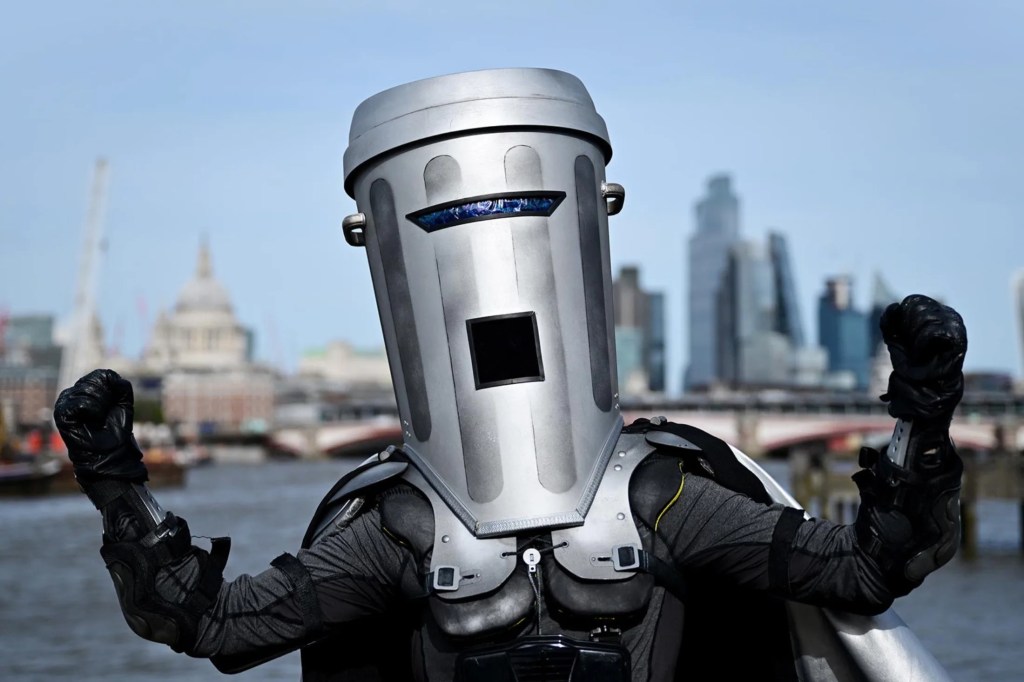
This essay asks why that keeps happening, across every era that’s tried to use comedy as a weapon, and whether it’s ever actually worked. Not “was the joke good.” Whether the joke did anything. Spoiler: there’s a by-election happening in Clacton in the UK in under two weeks where the leading opposition to a sitting populist MP is a man in a bin costume — and nobody yet knows if that’s satire finally landing a punch, or satire’s containment problem playing out live, in the media, for the whole country to watch.
Scene II: Those Greeks Had Cojones
Aristophanes didn’t just mock Cleon. He got prosecuted for it. The Babylonians, performed in 426 BC at the City Dionysia — a festival with foreign dignitaries in the audience — attacked Cleon’s conduct of the war so directly that Cleon had Aristophanes hauled before the Council on a charge of slandering the city in front of outsiders. He kept writing. He kept naming Cleon, relentlessly, for years — The Knights the following year casts him almost undisguised as a scheming slave fighting to control a foolish master called Demos, literally “The People.” Aristophanes may not have been alone. He is our only extant example. Those Greeks had cojones.
Athens had good reason to feel entitled to this freedom. The city had lived under real tyranny and violently thrown it off — the Peisistratid dynasty fell in 510 BC, and Harmodius and Aristogeiton, who struck the first blow against it, were turned into a civic cult almost immediately: statues in the agora, a drinking song sung at symposia for generations, tyrannicide treated as democracy’s own founding act. Mocking a man reaching for Cleon-sized power wasn’t just permitted mischief in that context. It was continuous with the city’s own origin myth. The freedom wasn’t permanent, though — Athens later passed decrees restricting named mockery of individuals in comedy, so even the boldest tradition in this essay’s sweep had its own containment mechanism eventually catch up with it.
The Middle Ages solved the same problem by licensing it instead of risking it — and gave power something Aristophanes never offered his targets: a way to change its mind without losing face. The court fool could say the unsayable to a king’s face — mock his vanity, name his failures, needle his advisors — precisely because everyone in the room understood the mockery came with the king’s own permission attached and could be withdrawn the instant it stopped being funny. But the arrangement cut both ways. If the king heard something true in the joke and quietly acted on it, he never had to be seen conceding a courtier’s argument — the correction arrived disguised as nonsense, and he could absorb it without anyone watching him lose. Which makes the phrase “save face” a satisfying, if not strictly honest, fit here: the idiom almost certainly has nothing to do with medieval fools — it enters English later, via nineteenth-century contact with Chinese usage — but the function it names is exactly what the fool was for. The freedom was real, and it was also, by construction, a leash — on the fool, and quietly, usefully, on the king’s own dignity too.
Gillray and Punch did something neither Aristophanes nor the licensed fool managed: they actually crossed class lines. James Gillray’s caricatures of the Prince Regent, fat and dissolute, or Pitt and Napoleon literally carving up the globe, sold as cheap prints, pasted in shop windows, seen by people who never set foot in a theatre and couldn’t have afforded to if they’d wanted to. Punch, from 1841, put political cartooning into a magazine a clerk could buy on a Friday. Neither one required the reader to already be the sort of person who reads reviews or knows what an alienation effect is. This is the genuine counter-example to “satire always preaches to the converted” — for about a century, English caricature reached an audience wider than the target’s own class, and it left a mark: politicians of the period wrote, with real irritation, about dreading the print shops.
So the pattern isn’t “satire never lands.” It’s “satire lands exactly when it stops needing the audience to already agree with it and reaches people who wouldn’t otherwise see the target at all” — and that’s rarer than the tradition likes to admit. Aristophanes risked prosecution to do it. The fool traded real freedom for a permission slip. Gillray and Punch needed a print market and a literate clerk class that simply didn’t exist before the nineteenth century. Every genuine crossover in this section required either real personal risk or a specific, historically narrow set of conditions. Worth remembering going into the contemporary material, where neither risk nor those conditions obviously still apply.
Scene III: Top of the Range Products
Adorno had a name for the trap the Wyndham’s audience walked straight into: the culture industry doesn’t just tolerate its own critique, it profits from providing one. Writing with Horkheimer in the 1940s, Adorno argued that capitalism had learned to sell opposition back to itself as entertainment — that the system’s cleverest move wasn’t silencing dissent but packaging it, ticketing it, letting you feel appropriately critical for two hours and then sending you home unchanged. Satire, on this account, isn’t outside the machine looking in. It’s one of the machine’s top of the range products.
Serious Money is the perfect test case because Caryl Churchill built it to be un-absorbable and it got absorbed anyway. The play stages the City in 1987 as loud, coked-up, grasping, morally derelict — verse dialogue that mimics trading-floor patter, a plot about insider dealing that indicts the whole culture rather than one bad actor. It comes directly out of City Comedy, the Jacobean tradition of Jonson and Middleton that satirised merchants and speculators for a London audience that half-recognised itself in the joke. Churchill inherited that lineage and sharpened it. And then actual traders came to Wyndham’s, in actual numbers, and did exactly what Sutcliffe watched them do: enjoyed it. Not despite the satire. Some of them, by several accounts, because of it — the play confirmed they were dangerous, glamorous, larger than the moral categories meant to contain them, and that confirmation felt better coming from serious theatre than it would have from a tabloid.
Which is Adorno’s mechanism working exactly as described, not a one-off fluke of one unusually confident audience. The critique didn’t fail to land. It landed, was recognised, was enjoyed, and changed nothing about the thing it targeted — which is a more efficient outcome for the system than the critique simply missing. A missed joke can be sharpened and tried again. An absorbed one has already done its job for the other side: it proved the culture could survive being seen clearly, which is a stronger position than not being seen at all.
The punchline, and it’s not really a punchline, is what’s happened to the theatre that staged it. The Royal Court — which developed Serious Money and has been the reliable home of exactly this kind of state-of-the-nation political theatre for decades — now operates under funding pressure severe enough to threaten the pipeline that produces work like Churchill’s in the first place, propped up in part by donors whose own careers sit far closer to the play’s targets than to its politics. Hedge fund founders and City grandees appear on its own published supporters list, funding work that, more often than not, has nothing to do with their own worldview — a form of patronage considerably more generous than anything the traders in Serious Money were satirised for extending. The industry that makes serious political satire doesn’t get rewarded for successfully skewering its subject. It gets squeezed regardless, and says thank you, sincerely, to whoever’s left willing to fund it.
Scene IV: He Stopped
By the twentieth century, satire had a proper industry, and the industry had a proper problem: it kept getting read by exactly the people it was aimed at, who kept enjoying it. Private Eye, since 1961, has broken more real corruption stories than most of Fleet Street — and has also spent six decades as required reading in the Westminster and Whitehall offices it’s supposedly terrorising. MPs read it to find out what’s being said about them before their aides do. That’s not satire failing to reach its target. That’s satire becoming part of the target’s morning routine.
Spitting Image made the same trade at a bigger scale. Fifteen million viewers a week at its peak, latex puppets of Thatcher and Reagan grotesque enough to leave real marks — and politicians queued up to buy their own puppets afterward, framed them, put them in the office. Being savaged became a status symbol, provided the savaging was famous enough. The show that was meant to diminish power ended up handing power a trophy.
Television found the sharpest version of the same trap and gave it the best writing the genre’s ever had. Yes Minister through The Thick of It through Veep — each one funnier, more forensic, more quotably savage than the last about how government actually works, and each one, by most accounts, popular with the actual civil servants and politicians who recognised themselves in it. The Daily Show built a whole American institution on nightly ridicule of the powerful and, by its own later reckoning, changed remarkably little about how the powerful behaved once the cameras stopped rolling.
Which brings you to Armando Iannucci, the contemporary presiding genius of the whole period, and the essay’s sharpest data point: he stopped. The Thick of It, In the Loop, Veep — a run of political satire good enough to be called the best of its generation, and then he walked away from the genre almost entirely, deliberately, and said so. Not cancelled. Not run out of ideas. A choice. When the man who did this better than anyone alive decides the form isn’t worth doing anymore, that’s not a data point you can wave off as one artist’s fatigue. That’s the most qualified person in the field filing a verdict.
And the verdict got confirmed live, in London, in 2024, by his own hand. Iannucci and Sean Foley staged Dr Strangelove — Coogan in Sellers’s old roles, every resource a West End production can muster — and reviewers walked out calling it toothless. The failure wasn’t just Trump-era reality outrunning the fiction; it was closer to anachronism, Cold War brinkmanship material grafted onto a resonance it never quite fit, the two eras’ stakes never actually lining up. The stagecraft, heavy and expensive, felt like an attempt to paper over that gap rather than close it. The man who defined a generation of political comedy tried to satirise the current moment through a sixty-year-old vehicle and found the vehicle wasn’t built for the road it was being driven on. That’s not a failure of craft. That’s the essay’s whole thesis, delivered by its own best practitioner, on a commercial stage, for money, in real time.
Scene V: Voted For
Somewhere between mockery and legislation, satire occasionally stops being a genre and starts being a candidacy.The pattern is global and it’s bigger than any one country’s political moment: Beppe Grillo built Italy’s Five Star Movement out of a stand-up act. Jón Gnarr’s Best Party took Reykjavík’s mayoralty in 2010 on a manifesto that promised free towels at the pool and, as a joke, a polar bear for the zoo. Tiririca, a clown, was elected to Brazil’s Congress in 2010 on a campaign slogan that just said it plainly: “It can’t get any worse, vote Tiririca.” Luka Maksimović ran Serbian local politics as “Ljubiša Preletačević Beli,” a parody strongman in a Ray-Ban-and-tracksuit costume, and had to decide, once actual votes started coming in, whether to stay in character or drop it. None of this is one anomaly. It’s a recognisable route into office now, documented enough to have its own academic literature.
Two cases carry the whole argument, though, and they pull in opposite directions. Marjan Šarec, a working stand-up impressionist, was elected mayor of Kamnik in 2010 and Prime Minister of Slovenia in 2018 — comedy as a direct, undisguised route to the top job, no fictional intermediary required. Volodymyr Zelensky took the stranger path: he played a fictional Ukrainian president in a satirical sitcom, a schoolteacher whose viral rant against corruption accidentally makes him head of state, and then actually became president in 2019 running on the show’s own title as his party’s name. He is now genuinely at war with Putin, increasingly fought remotely through drones, a symbol of freedom in most European capitals and an increasingly adept Trump whisperer. Nobody wrote that as a plan. Satire’s fantasy of accidental competence walked off the screen and had to become real, under fire, with nothing funny left in the job description.
Boris Johnson took the containment route instead, and it’s the one that should worry this essay most. Years as the beloved, self-deprecating regular guest on Have I Got News For You, mocked weekly and rehabilitated weekly in the same half hour, built the persona that outlasted scandal after scandal once he reached Number 10. That’s not satire failing to land. That’s satire landing perfectly and manufacturing exactly the wrong outcome — affection, familiarity, the sense of a “character” everyone already half-forgives before he does anything requiring forgiveness. Or hard work.
Trump sits outside the whole mechanism, and the gap is instructive. He doesn’t come from satire. He comes from reality television — The Apprentice — mass entertainment format with the same audience-recruiting power as a knowing wink to camera, but with the critical distance stripped out at the source. No joke ever needed absorbing, because no joke was ever made. That’s the boundary case: satire needs some sliver of critical distance built in, however easily that distance gets neutralised afterward. Reality television doesn’t even pretend to have any distance to lose.
Which is where Adorno’s diagnosis finally cashes out, sharper than “satire fails” and sharper than the Wyndham’s audience alone could show it. The culture industry doesn’t just survive its own critique. It promotes from within it. Šarec and Grillo didn’t defeat the containment mechanism Scene III described — they demonstrated its next stage. The joke doesn’t just get watched, enjoyed, and forgiven anymore. It gets voted for. That’s not satire’s revenge on power. It’s absorption completing itself, one election at a time.
Coda: Put Your Vote In The Bin
There’s a by-election happening in Clacton as this essay goes up, and nobody knows how it ends. Nigel Farage resigned his seat on the 7th of July, mid-investigation into an undeclared £5 million gift, specifically to force this contest and re-win it himself. Labour, the Conservatives, the Liberal Democrats, the Greens, and Reform’s own rival Restore Britain all declined to stand against him. That left the most visible opposition to a sitting populist MP, officially, unavoidably, to a man in a bin costume. Count Binface. Thirty-four candidates on the ballot in total, a record. Polling this month found more Britons would rather see Binface win than Farage. At his final Prime Minister’s Questions, Keir Starmer told the country to put its vote in the bin, and the papers weren’t wrong to read that as half an endorsement.
On the 13th of August we’ll find out whether the joke wins, and either answer proves this essay’s point rather than settling it. If Binface wins, satire has finally done the one thing this whole essay has doubted it can do — actually taken the seat, not just occupied the moral high ground next to it — and the honest response is to note that it took thirty-two other candidates, a funding scandal, and a boycott by every serious party to create the conditions for that particular joke to land. If Farage wins anyway, despite all of it, the essay’s argument holds in the other direction: mockery, however popular in a poll, however funny at a safe distance, still isn’t the same thing as a vote cast by the people who actually have to live with the result. You couldn’t make it up.
And that’s the line worth sitting with longest, and it isn’t really a joke about London laughing at Clacton. It plays differently depending on where you’re standing, but the damage doesn’t sort itself neatly by postcode or by how someone voted last time. The Reform voter in Frinton, the Labour voter in Thorpe-le-Soken, the Green voter in Tendring, the Conservative voter in Great Bentley — different politics entirely, and probably the same slow erosion once the joke wears off and the actual investigation, the actual funding scandal, the actual absence of every serious party from their own ballot paper, is still sitting there unresolved on the 14th of August whoever’s won. A constituency asked to choose between a man under investigation and a man in a bin isn’t being handed a genuine democratic choice. It’s being handed the appearance of one, and it’s the people who live there — across the whole political range, not one stock type of disaffected voter — who are left carrying what that does to their faith in the next vote, and the one after that.


Leave a Reply