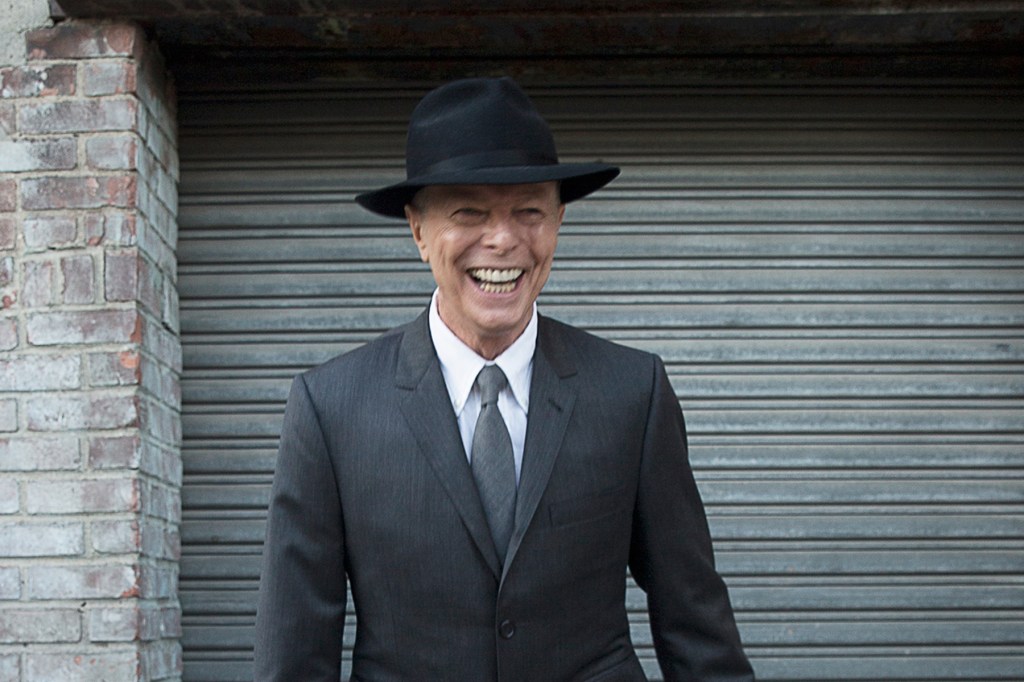
Essay Seven: Black Hole — David Bowie and the Gravity of the Invented Self
This essay is part of Chameleons or Charlatans: The Art of Reinvention — a series examining artistic reinvention across the twentieth century through six figures, the cultural theory that illuminates them, and the question of whether what they did is still possible. Each essay stands alone. The series opens with The Invitation.
Part One: The Laughing Gnome and the Question the Exhibition Didn’t Ask
In 1967 David Jones — not yet David Bowie, not yet anyone in particular — released a novelty record called The Laughing Gnome. It features a small man with a sped-up comic voice making puns. It is cheerfully, enthusiastically terrible. It is also the most revealing document in the entire Bowie catalogue, because it shows the man before the armour was built. No persona. No theory of the constructed self. No philosophical apparatus for the inauthenticity of identity. Just a twenty-year-old south London boy who liked music and wanted to be in showbusiness, making a silly record because he thought it might be funny and he needed a hit.
The armour arrived within five years. And it was extraordinary.
In 2013 the Victoria and Albert Museum mounted David Bowie Is — the most comprehensive account of the career ever assembled, five floors of costumes, lyrics, photographs, recordings, the complete archive of a life spent constructing and deconstructing the self. The exhibition title is a grammatical fragment. David Bowie Is. The verb to be, left hanging without a predicate. Is what? The curators posed existence without interrogating it. Five floors of evidence for the proposition and no sustained attempt to ask the question the proposition demands.
Is what?
Is performing. Is constructing. Is hiding. Is David Jones. Is the black hole. Is the thing the exhibition’s own evidence kept pointing toward and the framing kept declining to name.
This essay asks the question. It does not answer it. Nobody can answer it. But the asking is more interesting than the five floors of archive, and more in keeping with what the work actually does — which is to refuse resolution while generating the impression of revelation.
Part Two: The List of Selves
Here is a list. Not a discography. Not a timeline. A list of selves.
David Jones — Brixton, 1947. The original. A mod, a saxophone player, a boy from south London who liked Little Richard and wanted to be in showbusiness. Changed his name at seventeen to avoid confusion with Davy Jones of the Monkees. The first reinvention, the most fundamental, performed before anyone was watching. And — as we will argue — perhaps the only one that was entirely his own.
Major Tom — 1969. The astronaut of Space Oddity, drifting beyond rescue in his tin can. Not quite a persona, more a thought experiment — what does it feel like to be completely untethered? Returns eleven years later in Ashes to Ashes, now explicitly a junkie. The same character, a different decade, the romanticism curdled into something darker and more sincere.
Ziggy Stardust — 1972. The alien rock messiah. Kabuki theatre, Lindsay Kemp’s mime, New York street energy filtered through a British art school sensibility and a Bromley boy’s hunger for transformation. Bowie described him as the paradigm of the rock star — not a rock star but the archetype of one, the idea of one. Killed off deliberately, on stage, at the Hammersmith Odeon on 3 July 1973. Bowie announced the retirement mid-concert. The audience wept. The band found out at the same time as the crowd.
Aladdin Sane — 1973. Ziggy goes to America. A lad insane. The lightning bolt across the face — the most reproduced image in the catalogue, the one that ended up on a million bedroom walls and eventually on a million Halloween costumes, which is either the culture industry’s greatest achievement or its most complete act of recuperation, depending on your theoretical position.
Halloween Jack — 1974. Diamond Dogs. Ziggy in a dystopian future lifted from Orwell’s 1984, which Orwell’s estate refused to licence, so Bowie built his own dystopia instead. The glam trilogy’s endpoint — Ziggy’s world destroyed, Aladdin’s world at war, Jack’s world the rubble that remains.
The Thin White Duke — 1976. Station to Station. The most disturbing persona on the list. Cold, aristocratic, emotionally null — Bowie described him as a very Aryan, fascist type. Made during the Los Angeles cocaine years, the period of the Hitler salute at Victoria Station, the interviews about the benevolent dictatorship. The extraordinary music produced in conditions of near-complete psychological dissolution. The gap between the artistic output and the human wreckage is at its widest here. Neither fact cancels the other.
The Berliner — 1977 to 1979. Not a named persona. That is the point. Low, Heroes, Lodger — the Berlin trilogy made with Brian Eno and Tony Visconti in Hansa Studios by the Wall. No costume. No character. No mythology being constructed in parallel with the music. The armour briefly set aside. More of this later, because it matters more than any of the others.
The Entertainer — 1983. Let’s Dance. Nile Rodgers. MTV. The biggest selling album of his career. Bowie himself said he had made a very successful album of bad songs. The manifesto of constant reinvention — turn and face the strange, he had sung — deployed in service of the most commercially conventional period of the career. The Changes self-contradiction made explicit. He knew it. He said so. He moved on.
The Collaborator — Tin Machine, 1989. The desperate attempt to escape the Bowie machinery by hiding inside a band, becoming a member rather than the auteur. It did not work. He was too famous for the anonymity to hold. But the impulse was real — the same impulse that produces the Laughing Gnome, the slightly baffled interviews about painting and cricket, the David Jones surfacing in the gaps.
Nathan Adler — 1995. Outside. The art detective in a future world where murder has become performance art. One of the strangest commercial decisions in the history of popular music — a concept album about transgressive art, made with Eno, released into the post-Nirvana landscape with the confidence of a man who had stopped caring whether the market followed.
The Blind Prophet — 2016. Blackstar. The final persona. The videos filmed while he was dying. The last act of deliberate self-construction, performed in secret, released two days before the collapse. The armour on one more time, and then off, permanently, and then nothing.
And then simply — silence.
Part Three: The Theory and the Defence
Eleven named or nameable selves across fifty years. The question the list makes unavoidable: what was at the centre? What was the gravity that held it together? Was there anything there at all?
The philosopher Simon Critchley argues that the personas do not conceal an authentic self — they demonstrate that there is not one. That Bowie’s work provides not an opportunity to confront one’s authentic subjectivity but rather to confront the very lack of it. The inauthenticity is not a failure of the project. It is the project.
Bowie encouraged this reading. He said so explicitly: I had to be very exaggerated in the beginning to defy people to put me in a category so that would leave me room to work in. Not — I am this character. But — this character creates the space. The persona as strategic deployment of inauthenticity, the costume as the condition of freedom rather than its concealment.
Debord’s argument, turned inside out. Where Debord mourns the replacement of authentic life with its representation, Bowie says: there was never an authentic life to represent. The spectacle is the condition we all inhabit. My personas are a way of making that visible rather than concealing it. Look at all these selves I have been. Now look at all the selves you have been. The difference is I named mine.
It is a sophisticated position. It is also, we now think, at least partly a defence mechanism.
Consider the evidence. In 1972, at the height of Ziggy Stardust, Bowie told an interviewer: sometimes I don’t feel as if I’m a person at all. The alien rock messiah admitting he didn’t feel human. Which is either the most complete artistic commitment to the persona or the most unguarded thing he said in a decade of interviews. Probably both. But the context matters — this is a young man from Brixton who has reinvented himself as an extraterrestrial being, who is performing that reinvention eight nights a week, who is watching the gap between David Jones and David Bowie widen daily, and who is frightened in ways the persona was partly designed to contain.
The fear had a specific shape. His half-brother Terry suffered from schizophrenia — committed to Cane Hill psychiatric hospital, eventually dying by suicide in 1985. Bowie spoke about Terry throughout his life with love and guilt and fear. The fear was partly the fear of inheritance. He said to the BBC in 1993: I felt that I was the lucky one because I was an artist and it would never happen to me. As long as I could put those psychological excesses into my music and into my work, I could always be throwing it off. The personas were not only artistic strategy. They were a way of throwing it off. The armour was built, at least in part, to keep something out.
The method confirms this reading. The cut-up technique borrowed from Burroughs — words cut apart and recombined by chance. The oblique strategies devised with Eno — cards drawn at random to interrupt habitual thinking. The compositional approach described in his own words: I’ll write out five or six chords, then discipline myself to write something only with those chords. To allow the accidental to take place is often very good. So I trick myself into things. The methodology protects the maker. If the material is generated through procedures that include chance and accident, the fiction can be maintained that there is no David Jones making choices. The trickery is directed inward as much as outward.
And then Iman. Who knew him for twenty-three years and said with complete clarity: we both understand the difference between the person and the persona. I fell in love with David Jones. I did not fall in love with David Bowie. Bowie is just a persona. He is a singer, an entertainer. David Jones is the man I met. And Bowie himself, in 2005: the Bowie character, for me, is strictly to be used on stage. With my family, I am David Jones, very much.
The man who built the most elaborate theoretical apparatus for the non-existence of David Jones confirmed, to his wife and eventually in public, that David Jones was precisely what he was at home. The theory of inauthenticity was the most sophisticated piece of armour in the collection. The self-contradiction is not a failure of intellectual consistency. It is the most sincere thing in the catalogue — the acknowledgment that the armour was always armour, that something was always inside it, that the black hole had a centre that couldn’t be observed directly but was there nonetheless.
Part Four: The Music
Before the theory. Before the personas. Before the defence mechanism reading. There is a reason any of this matters, and the reason is this: when the opening chord of Ziggy Stardust hits, something happens in the body that precedes thought. When the bass pulse of Heroes begins, when the synth washes build, when the vocal enters and the layers accumulate toward that climactic declaration — we can be heroes, just for one day — something happens that cannot be fully accounted for by cultural theory, however useful cultural theory subsequently proves.
The music is extraordinary. We say this plainly before we say anything else.
The technical reasons are specific. Bowie described his compositional method: I’ll write out five or six chords, then discipline myself to write something only with those chords. To allow the accidental to take place is often very good. So I trick myself into things. The cut-up technique borrowed from Burroughs applied to harmony. The strangeness is procedurally generated, which means it never sounds calculated. It sounds discovered.
The result is what musicologists call the absent tonic — a harmonic approach in which the home key is deliberately obscured, the musical ground pulled away, the listener placed in a state of productive uncertainty. Five Years builds on a repeated chord progression that only resolves at its moment of culmination — the world is ending, the music accelerates toward that ending, the form enacts the feeling. Life on Mars moves through harmonies that should not work together and arrives at moments of resolution that feel simultaneously inevitable and impossible. Changes shifts key centres with a restlessness that sounds like the subject matter — the exhortation to turn and face the strange embodied in the music’s own refusal to stay still.
Heroes is built on a drone and a repeated figure over which the layers accumulate — Robert Fripp’s guitar processed through Eno’s treatments into something that sounds like a signal arriving from a very great distance. The vocal builds through three distinct dynamic levels — conversational, declaratory, transcendent — each one feeling like the last until the next arrives.
Blackstar reaches back to the earliest musical love — the free jazz, the saxophone, the Ornette Coleman lineage — and finds a way to use it that nobody had previously managed within a pop context. The seven minutes of the title track move through time signatures and tonal centres with the freedom of jazz and the precision of someone who has spent fifty years learning how to make strangeness feel necessary.
This is why the black hole still pulls. Not the mythology. Not the personas. Not the cultural theory. The music. The specific, technically accomplished, harmonically adventurous, emotionally precise music that Bowie and his collaborators produced when everything aligned.
Part Five: The Collaborators the Mythology Erased
The black hole absorbed everything. Including the people who made the music possible.
Mick Ronson. The sound of Ziggy Stardust is as much Ronson as Bowie — the guitar arrangements, the orchestrations on Hunky Dory, the sonic identity of the early 1970s work. A working class musician from Hull who gave the alien rock messiah his musical spine. When Bowie moved to the soul period and dropped Ronson, the collaborator spent years in relative obscurity. The mythology did not follow him.
Brian Eno. The Berlin trilogy without Eno is literally unimaginable — not just the synthesiser textures but the compositional philosophy, the oblique strategies, the whole approach to working with accident and constraint that makes Low and Heroes something other than pop records. Heroes is a co-creation in the deepest sense. The mythology calls it a Bowie album.
Carlos Alomar. The guitarist and musical director through the soul, funk and later periods — present on more Bowie albums than almost any other musician, across a relationship spanning three decades. The Young Americans sound is Alomar’s sound as much as Bowie’s — a Black musician from New York whose musical intelligence gave Bowie access to a tradition he could not have reached alone, who provided the rhythmic foundation for some of the most commercially successful work of the career, and whose contribution the standard Bowie narrative consistently underweights. The dispossession is not dramatic. It is structural — the gravitational pull of the black hole mythology reassigning credit to the centre. Alomar is present in the records. He is largely absent from the legend.
Nile Rodgers. Let’s Dance. The commercial peak. Rodgers brought the precision, the funk, the radio-ready sonic architecture that made Bowie’s biggest selling album. Bowie then immediately distanced himself from the result — called it too commercial, moved away from what it had produced. Used the genius and retreated from its consequences.
Tony Visconti. The producer across the most important phases, returning for Blackstar. The most consistent creative relationship of the career, and the one most consistently underweighted in the accounts that prefer the singular genius narrative.
And the Spiders from Mars. Trevor Bolder and Woody Woodmansey found out they were being disbanded on stage at Hammersmith, mid-concert, when Bowie announced the retirement to the audience. They learned it at the same time as the crowd.
The auteur myth requires the erasure of the collaborators. This is how the star system works. Harvey’s dispossession operating at the level of creative credit rather than economic return. The black hole pulls everything in and emits it as Bowie. That is both the description of his genius and the description of something more uncomfortable. The two are not separable.
Part Six: The Gaps
The output was variable. Significantly, sometimes embarrassingly variable. And the variable output is not an aberration in the Bowie story. It is the most revealing part.
Pin Ups — 1973, a covers album of songs Bowie loved as a teenager — is not a reinvention. It is a contractual obligation fulfilled by a man who had run out of ideas for the moment and fell back on affection. It is charming precisely because it is not trying to be anything. The persona slips and David Jones appears — the Brixton boy who loved those songs and wanted to play them.
Tonight — 1984. Hours — 1999. The Reality tour. The acting roles of varying quality and conviction. Labyrinth, which is a man in tight trousers doing a children’s fantasy film and clearly enjoying himself. The interviews where he talks about his painting or his reading with the slightly baffled enthusiasm of someone who has never quite got used to being asked and never quite learned to perform the intellectual.
Tin Machine most of all — the desperate attempt to be ordinary, to hide inside a band, to escape the machinery. It failed. But the failure is more revealing than most of the successes.
These are the gaps where David Jones lived. Critchley’s argument — the no authentic self argument — is both true and slightly too clever. Because there clearly was a David Jones underneath all of it. The same partner for twenty-three years. The children taken to school. The voracious reading. The painting. The consistency of private testimony from people who knew him — that he was decent, curious, genuinely funny, sometimes baffled by his own fame. Iman said she fell in love with David Jones. He said he was David Jones at home. The man who built the most elaborate theoretical apparatus for the non-existence of the authentic self had one.
The black hole has something at its centre. We cannot observe it directly. We can only measure its effects.
Part Seven: Berlin — When the Armour Came Off
Of all the phases, the Berlin trilogy is the one that earns its place on this list most completely. Because it is the only phase where the reinvention was genuinely costly — commercially, reputationally, in terms of the audience’s willingness to follow — and simultaneously the only phase where the defence mechanism was deliberately dismantled.
Bowie moved to West Berlin in 1976. Away from Los Angeles and the cocaine and the psychological dissolution and the Thin White Duke and the Hitler salute. To a divided city, on the front line of capitalism versus communism, a city whose geography enacted the political argument that was also a personal argument — the wall between the constructed self and whatever was on the other side of it.
He said later that he dared to be himself during the Berlin period — whatever that was. The whatever is doing all the work. He did not know what it was. That is the point. The Berlin trilogy is made by someone who has taken the armour off and is not yet sure what is underneath and is making music in that uncertainty rather than from behind a persona. Low sold poorly. Heroes sold better but not well. Lodger confused almost everyone.
Heroes, the song, is simultaneously a love song, a political statement, and a philosophical argument about the possibility of transcendence in a world that has made transcendence structurally unavailable. The two lovers kissing by the Wall with the guns and the shame on the other side. We can be heroes, just for one day. Not we are heroes. Not we will be heroes. Just for one day. The mortality built into the defiance. The gravity named and momentarily defeated.
It is the greatest three minutes of his career. It is the moment where the persona machinery stops and something genuinely felt comes through. David Jones, briefly, without the armour.
Part Eight: Blackstar — The Return
In 2015 Bowie was diagnosed with liver cancer. He told almost nobody. He kept making the record. He assembled a group of New York jazz musicians — Donny McCaslin’s band — who did not know who he was in the way his previous collaborators had known, who brought a freshness and a strangeness to the sessions that the Bowie mythology could not domesticate. He made Blackstar in secret, in eighteen months, while he was dying.
He released it on 8 January 2016 — his sixty-ninth birthday. Two days later he was dead.
The videos he made for Lazarus and Blackstar were filmed knowing they would be received as posthumous communications — the Blind Prophet, the final persona, in a hospital bed, bandaged, rising and returning to darkness. He did not announce he was dying. He did not make the death part of the marketing. He made the work and left it. The last persona deployed in service of the last artistic statement, with one difference — this time the persona and the person were the same. The man behind the bandages was actually dying. The hospital bed was not a prop.
The Laughing Gnome is at one end of the career. Blackstar is at the other. The same person made both. The theory says that is impossible — the theory of inauthenticity, the no authentic self, the black hole with nothing at the centre. The biography says otherwise. What connects the Laughing Gnome to Blackstar is not a persona or a theory or a methodology. It is a person. David Jones, who liked music, who was frightened of going mad, who built the most extraordinary armour the pop world has ever seen, and who at the end set it aside and left the work at the door on his way out.
No announcement. No farewell. Just the work, thrown outward at the last possible moment before the collapse.
The black hole’s final emission. The thing at the centre, briefly visible.
Key Works
Space Oddity (1969) — Major Tom adrift: the first thought experiment, the first glimpse of the untethered self, before the armour was fully built.
The Rise and Fall of Ziggy Stardust (1972) — the archetype: the alien rock messiah and the persona as artistic philosophy made flesh.
Station to Station (1976) — the Duke and the cocaine: the most disturbing and the most formally extraordinary simultaneously.
Heroes (1977) — the armour off: David Jones briefly visible, just for one day, with the guns and the shame on the other side.
Scary Monsters (1980) — the summation: every previous persona present and interrogated, the most complete self-examination before the commercial turn.
Blackstar (2016) — the return: the Laughing Gnome at the beginning, this at the end, the same person, the armour finally set aside.
Postscript: The Bond
In February 1997 David Bowie issued $55 million worth of asset-backed securities — the Bowie Bonds — backed by the future royalties of 287 songs from 25 albums recorded before 1990. The Prudential Insurance Company bought the entire issue at 7.9% interest. Bowie took the $55 million upfront and used it to buy back his masters from his former manager, reclaiming ownership of the prior self the culture industry had been profiting from for twenty years.
The academic literature on Bowie — the identity construction, the performativity, the inauthenticity thesis — does not engage with the bond. It is not a cultural studies object. It is a Moody’s A3 rated security. Which is precisely why it matters more than most of the cultural studies.
Harvey’s accumulation by dispossession, documented in a bond prospectus. The black hole securitised. The gravity of cultural attraction converted into yield at 7.9% per annum.
Then Napster arrived. Music piracy exploded. The revenue stream deteriorated. Moody’s downgraded the bonds to one notch above junk. The greatest back catalogue in rock history was briefly, technically, nearly junk.
The bonds matured in 2007 without default. The rights reverted to Bowie. He owned his masters free and clear until his death. In 2022 his estate sold the publishing catalogue to Warner Chappell for $250 million. The catalogue that was briefly one notch above junk now belongs to one of the three major labels. The masters came back via the bond. They went back to the industry six years after his death.
The collaborators whose contributions were embedded in those 287 songs — Ronson, Alomar, Eno, Visconti, the Spiders from Mars — had no royalty stake in the securitised catalogue. The bond prospectus confirmed what the mythology had always implied. The black hole had absorbed their contributions so completely they did not appear in the small print.
David Bowie Is.
The verb to be, converted into a financial instrument, rated, sold, nearly junked, and then reclaimed.
He got it back.


Leave a Reply