A humanist’s rough guide to physics, philosophy, and the question of what reality actually is
We spend a great deal of time on this blog asking what a good human life looks like — politically, economically, culturally. But before we can ask what is good for us, it helps to have some working idea of what we are. This essay approaches that question from an unexpected direction: the frontier of physics. Not because physics has the answers, but because the questions physicists are currently failing to answer turn out to be surprisingly close to questions the rest of us should be asking too.
There is no detail here that would satisfy a physicist. We cannot always find the metaphor to describe these ideas. In some philosophical moods, those ideas might not exist in any conventional sense — which is, as it happens, part of the argument. But this departure is worth the effort because it frames what we are grappling towards elsewhere on this blog. And we completely understand if it does your head in.
(It did mine. Claude doesn’t have a head to be done in — yet.)
The question I thought needed asking
I asked a stupid question in a recent introductory physics class. Nonetheless I thought it obviously needed asking. Turns out it was not quite so stupid, or obvious. The tutor acknowledged it, made a few cursory remarks, but was clearly as keen as mustard to get back to the equations.
The question was something like: if we cannot see these subatomic particles directly — if we only know they exist because the mathematics demands them — then in what sense are they real? Are they things, or are they just the maths?
It felt, at the time, like the question of a muddled amateur who had not yet grasped the basics. It is not. It is one of the most contested questions in the philosophy of physics, it occupied Bohr and Einstein for the better part of three decades without resolution, and it remains genuinely open today. The tutor went back to the equations because that is the physicist’s happy place. The question, it turns out, is the interesting and uncomfortable ground.
This essay is an attempt to take that question seriously. It is written by a non-scientist for other non-scientists — people who think carefully about politics, culture, and economics, and who suspect, correctly, that the big picture of what physics is currently discovering about reality is relevant to those concerns. Not as a metaphor. As a genuine frame. It is basic, but fit for our purpose.
The zoo problem, and why it matters
Start with the particles. When physicists first began smashing atoms in the mid-twentieth century, they expected to find a tidy — and tiny — handful of fundamental building blocks. What they found instead was a proliferating menagerie — dozens, then hundreds, of particles, many existing for only a fraction of a second before decaying into something else. The physicist Murray Gell-Mann called it, with audible frustration, the particle zoo.
The reason for the proliferation is not that nature is extravagant. It is that energy and matter are interchangeable. When you collide particles at sufficient speed, the energy of the collision can spontaneously become new particles. The harder you smash, the more exotic the particles you can create. This is Einstein’s E=mc² made literal and slightly worrying.
Order was eventually brought to the zoo. The Standard Model of particle physics, completed in the 1970s, showed that the apparent chaos resolved into a relatively small number of truly fundamental entities. There are two basic kinds: fermions, which are the matter particles — the quarks and electrons that make up everything you can touch — and bosons, which are force-carrying particles that govern how the fermions interact. The fermions are the Lego bricks. The bosons are the instructions for assembly.
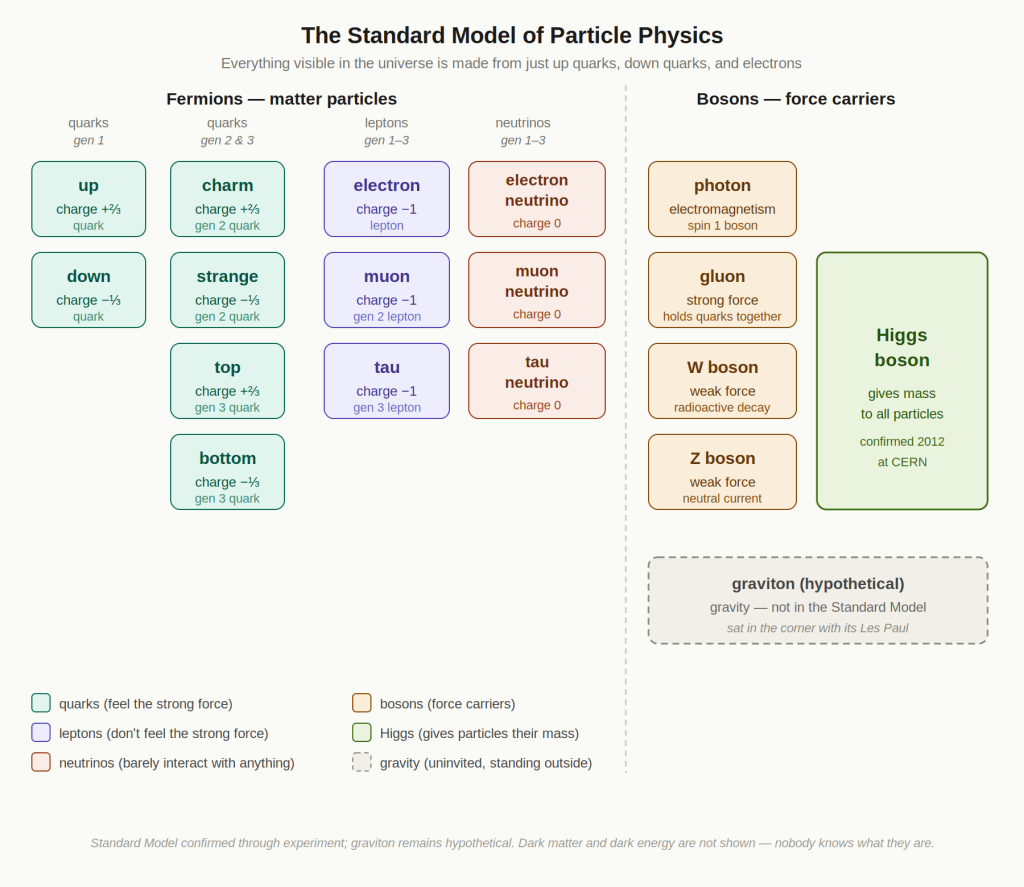
But here is the thing the textbooks tend to skip past: none of these particles has ever been directly observed. What we observe are the traces they leave — statistical patterns in collision data, bumps in graphs, behaviours that match what the equations predict with extraordinary precision. The Higgs boson, confirmed in 2012 at CERN after decades of searching, was not spotted so much as inferred: the mathematics said something had to be there, and when the right kind of evidence accumulated, the physics community declared it found.
This matters, because it means that our most complete description of the fundamental constituents of reality is a description of things whose existence we know only through mathematics. Which is either perfectly fine — the equations work, the predictions match, what more do you want — or it is a profound puzzle about the relationship between mathematical structure and physical reality. Depending on your philosophical temperament, you will find one of those responses more satisfying than the other. Both are defensible.
Two rule books, one universe
The deeper problem — the one that has driven theoretical physics for the past century and remains unsolved — is that we have two supremely successful frameworks for describing reality, and they are mutually incompatible.
The first is quantum field theory, which describes the behaviour of particles at subatomic scales. It is inherently probabilistic — particles do not have definite properties until they interact with something else — and it is written in the language of flat, fixed space. The second is general relativity, Einstein’s theory of gravity, which describes how mass curves spacetime itself, producing the gravitational effects we experience at planetary scales and above. It is smooth, deterministic, and geometrical in a way that quantum theory is not.
Each framework is astonishingly accurate in its own domain. The GPS system in your phone works because engineers account for the relativistic distortion of time caused by the satellites’ velocity and altitude. The semiconductor in that same phone works because of quantum mechanics. Both theories are embedded, invisibly, in the devices most of us carry around without thinking about them. The trouble is that when you try to apply both frameworks simultaneously — in the places where matter is dense enough and small enough for both to be relevant — the mathematics produces nonsense. Infinities appear where finite answers are required. The equations break.
This breakdown is not a minor technical inconvenience. The places where both frameworks should apply simultaneously are the places where our description of reality is most urgently needed: the centre of black holes, and the first instants after the Big Bang. In both cases, physics as currently constituted simply throws up its hands. We have no coherent description of what happens there.
A useful way to hold the distinction: the three forces described by quantum field theory — electromagnetism, the strong nuclear force, and the weak nuclear force — all speak the same mathematical language. They are all described by the exchange of force-carrying particles, the bosons. Electromagnetism has the photon. The strong force has gluons. The weak force has W and Z bosons. Gravity has no equivalent. In Einstein’s framework, gravity is not a force in that sense at all. It is the curvature of spacetime itself.
A parenthesis is justified here, because “the curvature of spacetime” is one of those phrases that sounds explanatory but mostly produces the sensation of understanding without the reality of it. Every attempt to illustrate it — the rubber sheet, the trampoline, the bowling ball making a dent — cheats by using gravity to explain gravity. The honest answer is that spacetime curvature is something the mathematics describes with complete precision, and that our intuition simply cannot picture it at all, because our intuitions were built for navigating a world of medium-sized objects at low speeds. This is not a failure of intelligence. It is a genuine feature of the material: we are trying to grasp, with cognitive equipment evolved for the African savanna, a description of reality that operates at scales and in regimes our ancestors never encountered. The fact that we cannot visualise it does not make it less real. It may, in a way that will become clearer as the essay proceeds, make it more interesting.
There is no exchange of particles in gravity. It is geometrical rather than mechanical, and it refuses, with considerable stubbornness, to be translated into the other language.
The analogy that comes to mind is musical. The three quantum forces are playing in the same genre — same rhythm, same structure, same rules about how you exchange a track. You can mix them on the same dancefloor. Gravity in the form of Jimmy Page walks in with a Les Paul and a Marshall stack and does not recognise the format. The music is not bad — general relativity is, by widespread agreement, the most beautiful theory in physics. The problem is that nobody has found a way to get the two to play at the same time without the mathematics collapsing into feedback. (Jimmy Page, incidentally, was not exclusively a Les Paul man — the full arsenal ran to Telecasters, double-necks, a bow across the strings, and a theremin. Perhaps there is hope.)
If it is all maths, does it matter?
Back to the question: if we cannot see these things, if they exist only because the equations demand them, in what sense are they real? And if they are not real in any ordinary sense — if the maths is just a very effective description — then does the incompatibility between quantum mechanics and general relativity matter in any way beyond the technical?
This is where the philosophy of physics becomes, unexpectedly, relevant to everyone else.
There are, broadly, two philosophical positions on what physics is actually doing. The first — instrumentalism — says that scientific theories are tools. They predict outcomes. They work or they do not. The question of what is ‘really’ there, underneath the equations, is either meaningless or unanswerable, and either way we should not worry about it. Shut up and calculate, as the physicist David Mermin put it, with only partial irony.
The second position — realism in various forms — says that if the equations work this well, they are probably tracking something genuinely real about the structure of the universe, even if we cannot see it directly. The most rigorous version of this, structural realism, goes further: physics never tells us what things are in themselves. It only ever tells us about the relationships between things — the patterns, the structure. And the radical version, ontic structural realism, takes one more step and says there are no things with intrinsic natures underneath. There are only the relationships. The structure is the reality.
This is not as arcane as it sounds. Notice that physics never actually tells you what an electron is. It tells you its mass, its charge, how it responds to fields, how it relates to other particles. It is, all the way down, a bundle of relationships and dispositions. Ask what it is underneath all that, and physics goes quiet. The philosopher Bertrand Russell observed this early in the twentieth century. Science gives us the structure of reality — the pattern of relationships — but not the intrinsic nature of the things related. We have the map, in extraordinary detail. What the territory is made of remains, in some sense, unknown.
The physicist Carlo Rovelli has built an entire interpretation of quantum mechanics on a related insight. His relational quantum mechanics holds that quantum states are never absolute — they exist only relative to other systems. There is no view from nowhere. Reality, at its most fundamental level, is a web of interactions with no fixed anchor point. The physicist Max Tegmark takes the argument further still, proposing that the universe does not merely happen to be describable by mathematics — it is a mathematical structure. There is no distinction, in his account, between the map and the territory.
One is not required to accept any of these positions. But they are not the fringe speculation of people who have lost the plot. They are serious responses to the genuine peculiarity of what modern physics has revealed: that the deeper you look into the structure of matter, the less it resembles anything we would call a thing, and the more it resembles a pattern of relationships described by equations.
Where the 5% came from
Set aside, for a moment, the philosophical questions about what reality is made of, and ask the more basic one: what is the universe actually made of, in the accounting sense?
The answer is borderline baffling. Everything we have ever observed directly — every star, galaxy, planet, person, and particle — constitutes approximately 5% of the universe’s total energy content. The remaining 95% consists of dark matter (roughly 27%) and dark energy (roughly 68%), neither of which we have ever directly detected, and neither of which is well understood.
Dark matter is inferred from its gravitational effects. Galaxies rotate at speeds that their visible mass alone cannot account for — they should, by rights, fly apart. Something invisible is providing the additional gravitational mass. That something is dark matter. Nobody knows what it is. It does not interact with light. We cannot see it, measure it directly, or catch it in a detector. We know it is there because the maths of gravity demands it.
Dark energy is stranger. Not only is the universe expanding — a fact established in the 1920s — but the expansion is accelerating. Something is pushing galaxies apart with increasing force. That something appears to be a property of space itself: the vacuum is not empty but has energy, and that energy has a repulsive gravitational effect. The more space expands, the more of this energy there is, driving further expansion. Recent observations from the Dark Energy Spectroscopic Instrument (DESI) suggest this energy may not be constant but dynamic — changing over time — which would have significant implications for the long-term fate of the universe.
The 5% that we do understand arrived in stages. The Big Bang was not an explosion into pre-existing space — it was the expansion of space itself from an extraordinarily hot, dense state. In the first second, the temperature was roughly ten billion degrees, and the universe was a plasma of elementary particles. As it cooled over the next few minutes, protons and neutrons fused to form atomic nuclei — mostly hydrogen and helium. After hundreds of thousands of years, electrons settled into orbits, and atoms formed for the first time. Gravity then did its slow, enormous work: gathering gas clouds into stars, and stars into galaxies.
The heavier elements — carbon, oxygen, iron, everything beyond helium — did not exist until stars made them. The nuclear furnaces inside stars fused lighter elements into heavier ones. When those stars exploded as supernovae, they scattered those elements into space, seeding the next generation of stars and, eventually, planets. Every atom of carbon in your body, every atom of calcium in your bones, every atom of iron in your blood was forged in a stellar explosion before our sun was born. This is not poetry. It is nuclear physics.
The unresolved dialectic, and why it is the right place to stand
Physics in 2026 is in an unusual position. Its two great frameworks are both extraordinarily successful and mutually inconsistent. Its most complete model of matter — the Standard Model — leaves 95% of the universe’s content unexplained. Its best candidates for a unified theory, string theory and loop quantum gravity, make predictions that may be untestable for generations, if ever. And the philosophical questions about what the maths is actually describing remain, after a century of argument, genuinely open.
There is a position, advanced by serious philosophers of science, that this irresolution is not a failure but a clue. The philosopher Nancy Cartwright has argued that nature is fundamentally dappled — that there is no single correct complete description of reality, and that the dream of a Theory of Everything is a metaphysical prejudice physicists inherited from monotheism more than from evidence. Multiple incompatible frameworks can each be irreducibly true within their domain, not as temporary approximations awaiting a better theory, but as genuinely the right description at that level. We can run with that.
One might go further and note that the tension between the quantum world and the relativistic world has been extraordinarily productive — that it has generated most of the interesting physics of the last century precisely because it has not resolved. A premature unification might close down more than it opens. The unresolved dialectic, held carefully rather than collapsed in either direction, turns out to be a generative condition.
This will resonate with anyone who has spent time with the Western Marxist tradition, which has its own long experience of productive irresolution — the tension between structure and agency, between the determinations of capital and the possibilities of human freedom, between what is and what might be. Physics does not resolve those tensions. But it does something useful: it establishes the material conditions within which they operate. It tells us something — not everything, but something — about what kind of thing we are, and therefore what kinds of things might be possible for us.
Apply humility, not certainty, to these questions. Like the physicists.
What this frame opens up
This essay is an opening, not a conclusion. The frame it proposes for the rest of the blog’s concerns is this: that we are relational beings in a relational universe. That the distinction between things and the relationships between things may be less clear than it appears. That reality at its most fundamental level is constituted by interactions rather than by fixed, intrinsically propertied substances. And that the mathematics which describes those interactions is, in some sense not yet fully understood, part of the reality it describes rather than merely a tool we have developed to track it from the outside.
This does not resolve anything about politics or economics or how to live. But it does push back against one version of the conservative instinct — the one that appeals to fixed natures, to the given, to the way things are as opposed to the way they might be arranged. If the universe is, all the way down, a pattern of relationships rather than a collection of fixed things, then the relationships are not merely incidental to what things are. They are partly constitutive of it. How we organise ourselves, how we structure our interactions, how we arrange the conditions of our collective life — these are not merely adjustments to a fixed underlying reality. They are, in some meaningful sense, participation in its ongoing construction.
The other boundary of the human — the brain, consciousness, why we obey, what desire and agency actually consist of at the level of neuroscience and social psychology — will come in another essay. That is, in some ways, the more intimate and perhaps more directly relevant question for the project of this blog. But this one, the question of the physical frame within which any human life takes place, seemed worth establishing first.
We are made of star-stuff, as Carl Sagan had it. We are also, it turns out, made of relationships all the way down. The physics does not tell us what to do with that. But it is, at minimum, a more interesting starting point than the alternatives.
A few books worth your time
These are not sources or citations. They are what to read next if the essay left you wanting more. Roughly in order of accessibility. I won’t pretend I have read all of them.
Carlo Rovelli, Seven Brief Lessons on Physics The place to start. Slim enough to read in an afternoon, written for people who think carefully but have no physics background. Rovelli writes about science the way a good essayist writes about anything — with wonder and without condescension.
Carlo Rovelli, Helgoland Rovelli’s account of the relational interpretation of quantum mechanics — the argument that quantum states only exist relative to other systems, that there is no view from nowhere. Directly relevant to this essay’s philosophical thread. Slightly harder than the Seven Brief Lessons but not by much.
Max Tegmark, Our Mathematical Universe The full case for the proposition that the universe does not merely happen to be describable by mathematics — it is a mathematical structure. Readable, provocative, and usefully infuriating in places. You will want to argue with it, which is the point.
Lee Smolin, The Trouble With Physics The best account of where theoretical physics may have gone wrong — written by an insider with a sceptical temperament. Particularly good on string theory’s decades of untestable promise. Satisfying for anyone who has ever felt that the emperor’s new clothes deserved a second look.
Nancy Cartwright, The Dappled World The philosophical case for pluralism — the argument that nature has no single correct complete description and that the dream of a Theory of Everything tells us more about physicists than about physics. Harder going than the others but the argument is worth the effort.
Bertrand Russell, The Analysis of Matter Where structural realism begins. Russell’s argument that science gives us the structure of reality but not the intrinsic nature of the things related. Not easy, but short enough to attempt, and the payoff for the patient reader is considerable.
A note on method
This essay was developed through an extended conversation with Claude (Anthropic’s AI assistant), in which the physics was explored, questioned, and challenged from a humanist rather than a technical starting point. The instincts, provocations, and editorial judgements are mine. Claude provides the scaffold and much of the prose; the thinking that shaped it, and the philosophical position — that the unresolved dialectic is the right place to stand — are entirely mine.
 At Home He Feels Like A Tourist
Leave a comment