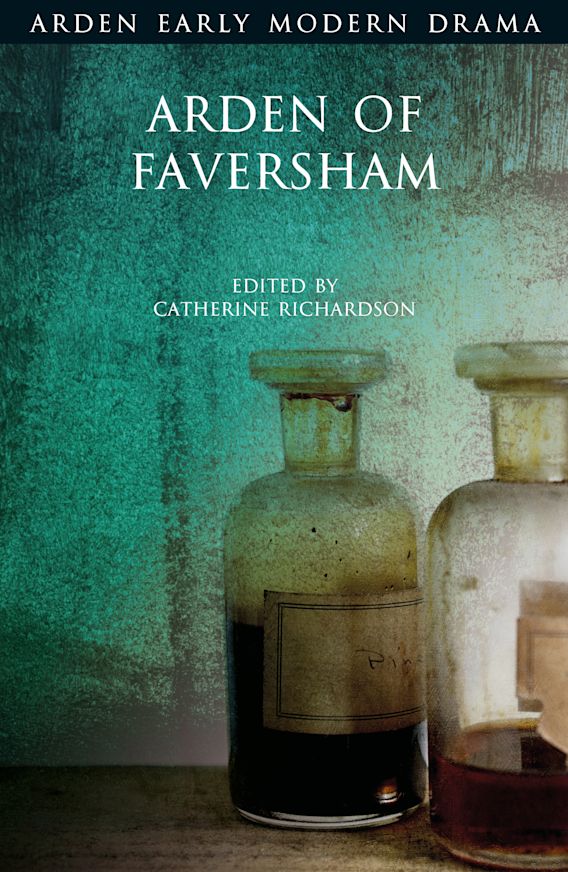
Arden of Faversham, Domestic Tragedy, and the World the Enclosures Made
I. Begin with the Murder
On the night of 15 February 1551, Alice Arden and her lover Thomas Mosby, together with a small retinue of hired hands, killed Thomas Arden in his own parlour in Faversham, Kent. The method was straightforward enough: Mosby struck Arden with a pressing iron, Alice produced a knife, and their hired men — a pair of wonderfully named thugs called Black Will and Shakebag — lent their muscles to the business. The body was dragged out and left in a field. The snow, however, had been falling. When it stopped and the footprints remained, the game was more or less up. Alice was burned at the stake at Canterbury. Mosby was hanged at Smithfield. The hired men met similar ends, mostly.
Forty years later, give or take, somebody wrote a play about it.
That somebody remains, tantalisingly, unknown. Arden of Faversham was first printed in 1592, attributed to nobody. It has been variously assigned, with varying confidence, to Thomas Kyd, Christopher Marlowe, George Peele, and — in a scholarly controversy that has gathered serious momentum over the past two decades — to William Shakespeare, at least in part. The authorship question matters, and we will return to it. But let us first sit with the strangeness of the object itself: an anonymous play about a real murder committed forty years previously, written at the birth of English professional theatre, that turns out to be one of the most formally and psychologically sophisticated dramas of the entire Elizabethan period. It has been neglected. It should not be.
There is something else worth noting before we proceed, and it concerns the play’s relationship to what we now call true crime. The murder of Thomas Arden was, by any measure, a sensation. It was reported in Holinshed’s Chronicles, the great compendium of English history that Shakespeare mined for his history plays. It circulated in ballads and pamphlets. It was, in the terms available to the 1550s, a media event — the kind of story that spread through alehouses and market days and created a shared public narrative. The play arrives forty years later into an audience that almost certainly knew the outline already. This is not a whodunit. It is something more interesting: a reconstruction, a re-examination, an attempt to understand not just what happened but what kind of world makes this kind of thing happen. The fascination with real murder — the way it opens a window onto the social structures and pressures that surround it — is not a modern invention. It is, if anything, older than fiction. You are still gripped by this today.
* * *
II. The World the Play Walks Into
To understand what Arden of Faversham is doing, you need to understand what kind of England it is doing it in. And that requires a short detour through one of the most consequential economic upheavals in English history — one that was still living memory for the play’s first audiences, and that is written, obliquely but unmistakably, into every scene.
The dissolution of the monasteries, carried out by Henry VIII between 1536 and 1541, was not merely a religious event. It was a land grab of staggering scale. Something in the region of a quarter of all English land changed hands in less than a decade, passing from ecclesiastical ownership to the crown and then, rapidly, into the hands of a new mercantile and gentry class. These new owners had none of the customary obligations that had governed monastic land management. They enclosed. They converted arable to pasture. They evicted tenants. They introduced rack-rents.
The Pilgrimage of Grace — the great northern uprising of 1536 — was among other things a direct response to this transformation. Its grievances were religious, yes, but they were also economic: the destruction of common rights, the disappearance of customary tenure, the replacement of a (theoretically, imperfectly, but genuinely) obligation-bound feudalism with something much colder and more purely transactional. The rebels failed. The executions that followed were exemplary. But the fury that produced the Pilgrimage did not simply evaporate.
Thomas Arden, the man whose murder would one day make theatrical history, was himself a beneficiary of precisely this system. He had acquired substantial property in and around Faversham from the dissolved abbey of Faversham. He was an aggressive encloser. The historical record shows him in repeated disputes with tenants and neighbours over land rights. He held the title of Esquire — a designation that in this period sat precisely at the contested boundary between gentleman and not-quite-gentleman, the kind of title that new men acquired along with their new property, and that older families regarded with barely concealed contempt. He was, in the terms available to his contemporaries, a new man: risen through royal patronage, enriched by the dissolution, his prosperity built on the rubble of older, more communal arrangements. But still not a real gentleman.
The play knows this. It does not make a polemic of it — this is not a drama with a thesis — but it makes the land question structurally central. In the very first scene, a local man named Greene confronts Arden over the seizure of his lands. “Arden,” he says, with a directness that tells us everything about the rawness of the grievance, “thou hast prayed upon me and mine, and got my living by the sweat of my brows.” Arden’s response is complacent: the land is his by royal grant, end of discussion. Greene departs full of murderous rage and promptly joins the conspiracy against Arden’s life. Land, in Arden, is not background. It is motive. It is the condition of possibility for everything that follows.
And land, in the England of 1551 — and equally of 1592, when the play was written — was not a simple matter of ownership in the modern sense. The law governing it was a tangle of overlapping jurisdictions, contested precedents, and rival claims. Common law courts, equity courts, ecclesiastical courts, manorial courts, borough courts: these did not agree with each other, did not defer to a settled hierarchy, and were all simultaneously in play for any dispute of substance. The dissolution had created a massive backlog of uncertain title — conveyances of dubious validity, copyhold rights of unclear status, common land whose enclosure had no firm legal foundation. When the play uses precise legal vocabulary around Arden’s property — and it does, with a specificity that suggests either a legally trained author or a deliberate compositional choice — it is not showing off. It is speaking to an audience that lived this. The average Elizabethan of the middling sort had almost certainly been involved in a property dispute, or known someone who had, or sat on a jury in one. The legal texture of the play is part of its recognisability, its documentary immediacy. This is not a remote tale of kings and dukes. This is the stuff of daily life rendered in dramatic form.
Whether this constitutes veiled social criticism is a question worth sitting with. The play is not a pamphlet. It does not tell us that Arden deserved his fate because he was an encloser. But it does tell us, with considerable precision, that the world in which the murder becomes possible is a world shaped by exactly the kinds of property relations Arden represents. The social criticism, such as it is, is structural rather than explicit — which was probably not merely a matter of prudence. The theatre was a permissible space for the representation of social tensions in ways that more direct forms of address were not, partly because those in power were inclined to dismiss it as low entertainment. The groundlings could watch an encloser get knifed in his parlour and the Privy Council did not convene an emergency session. The medium was its own alibi.
* * *
III. What Kind of Play Is This?
Domestic tragedy is, by early modern standards, a new form, and Arden of Faversham is one of its founding documents. The genre is defined, broadly, by its subject matter (private rather than public life, the household rather than the court), its social register (the middling sort rather than kings and dukes), and its source material (often, as here, actual events — the genre has a strong documentary impulse from the beginning). It is a form born of print culture and a newly literate urban public, audiences who had read about this murder in pamphlets and ballads and now wanted to see it on stage.
Catherine Richardson, in her introduction to one of the standard scholarly editions, is characteristically precise on this point. Domestic tragedy, she argues, is as much interested in the household as an economic unit as it is in the household as an emotional space. The home in these plays is not merely a theatre of love and betrayal; it is a site of production, investment, inheritance, and social reproduction. Its dramas are inseparable from the property relations that structure it. When Alice Arden murders her husband, she is doing something to a legal and economic structure, not just to a marriage. The body in the parlour is also a title deed.
We know, from various sources, that Arden was not alone in this. Contemporary records suggest that by the early seventeenth century there were upwards of thirty domestic tragedies in circulation, most of them now lost. Arden is the great survivor — the one that has come down to us in recoverable form — but the existence of thirty others tells us something important: there was a market. Audiences wanted this. The form answered something in the experience of urban, middling-sort Elizabethans that the court tragedies and the chronicle histories did not. What we have lost in those thirty vanished plays is genuinely melancholy to contemplate — a whole parallel tradition of social drama, grounded in real events, exploring the pressure points of ordinary life, gone. Arden is not an anomaly. It is the visible tip of an iceberg of which the rest has melted.
This matters for how we think about the genre, but also for how we think about who was writing it. The professional theatre of the 1580s and 1590s was a workshop culture. Plays were written quickly, often collaboratively, by men — and perhaps occasionally women, the historical record is not airtight — who had educated themselves into a literary tradition but were economically positioned outside the structures of patronage and preferment that tradition was supposed to serve. Marlowe was a cobbler’s son. Shakespeare was a glover’s son. The university wits were mostly impoverished graduates with expensive educations and no obvious place in the world. They were, in a very precise sense, the human surplus of exactly the same social and economic processes that produced Black Will and Shakebag: displaced, mobile, with something urgent to say about displacement. The anonymous author of Arden — whoever they were — belongs to this world. The thirty lost plays were written by people like them.
* * *
IV. The Story
The plot of Arden of Faversham is, on its surface, not complicated. Thomas Arden suspects his wife Alice of conducting an affair with the social-climbing Mosby — tailor’s son by birth, aspiring gentleman by self-promotion. He is correct: she is. Alice, frustrated in her love and quite possibly in the general imprisonment of a marriage she did not choose, decides that Arden must be killed. She recruits Mosby. Mosby recruits Black Will — a professional ruffian of magnificent incompetence — and his associate Shakebag. The play’s fourteen scenes consist largely of the repeated failure of this conspiracy to achieve its objective, before finally succeeding.
What is remarkable is the texture of those fourteen scenes. This is not a play in which the murder is merely the end-point of a smooth tragic trajectory. The assassination attempts are farcical: Black Will fails to kill Arden in a crowd in London because a stall’s board falls on his head. He and Shakebag get lost in the fog on Rainham Down and end up stabbing each other by accident. A painter is recruited to poison Arden’s portrait and the wrong person is affected. There is a scene — genuinely comic in its staging, genuinely disturbing in its implications — in which Arden sits playing backgammon with Mosby while Alice positions the killers behind him, and Arden keeps winning. “Now I can take you,” Arden says, moving his piece. He means the game. The audience knows he doesn’t mean the game.
The delay, the prevarication, the conspiracy that repeatedly fails to become action — there is something here that invites comparison with Hamlet, written within a decade of Arden and similarly structured around a revenge that keeps not happening. But where Hamlet’s delay is internalised, agonised, the subject of five acts of metaphysical soliloquy, Arden’s prevarication is distributed across multiple agents and played largely for comedy. The existential burden that Shakespeare will concentrate in a single brooding consciousness is here dispersed among a cast of incompetents — which is, in its way, an equally radical formal choice, and a funnier one. The delay is not tragic paralysis. It is institutional failure. Which may be the more accurate account of how human plans generally go wrong.
The murder, when it finally comes, is domestic in the most literal sense: Arden is killed in his own parlour, by his own wife and her lover, with household implements. The body is carried out and left in the field behind the house. The snow is falling.
The ending is strange, and deliberately so. The discovery, arrest, and punishment of the conspirators is handled with unusual speed and compression — almost as if the play is impatient with its own juridical closure. The punishments are announced rather than dramatised. The epilogue notes that Arden’s land, the land at the centre of the whole dispute, reverted on his death to its original owner. As if the land itself had worked the outcome. As if the whole bloody comedy of errors was, in the end, a property transaction. The play refuses to supply the satisfying moral accounting that genre convention might lead us to expect. It closes the trap, yes. But it does so with a cold efficiency that leaves the audience, if they are paying attention, not reassured but unsettled.
* * *
V. Nobody Gets Off Lightly: Dialogue, Motive, and the Unromantic Heart
One of the play’s most striking qualities, and one that becomes apparent only through sustained reading rather than plot summary, is the refusal of its dialogue to spare any of its characters. This is not a drama of heroes and villains, sympathetic lovers and obstructive patriarchs. Everyone in Arden of Faversham is compromised, and the play knows it and shows it, with an unflinching directness that feels startlingly modern.
Mosby is the most obviously unromanticised figure. He loves Alice — or performs love, and perhaps cannot tell the difference — but his attachment to her is inseparable from his social ambitions. He is using her, and she knows he is using her, and he knows she knows, and this mutual knowledge generates some of the most electrically uncomfortable exchanges in the play. When they fall out — which they do, repeatedly, with increasing violence — the accusations they level at each other strip away every pretence of romantic motivation. Love, in these scenes, is revealed as social positioning, as mutual instrumentalisation, as a means to ends that neither party will fully name. Mosby turns on Alice savagely: “Thou art a woman, and thou art too weak / To rid thyself of thy unhappy knot.” She comes back at him with a ferocity that suggests both absolute dependence and absolute lucidity: “And yet I will not send thee hence unpaid.” They make up. Nobody is fooled, least of all themselves.
Greene, the dispossessed landowner who recruits the killers, is similarly unsparing in his presentation. His grievance is legitimate — Arden really did seize his land — but his response to it is not heroic. He is vengeful and calculating and perfectly willing to hire incompetent criminals to do his dirty work. The legitimate grievance and the squalid response coexist without resolving into either straightforward victim or straightforward villain. This is, in fact, the play’s default mode: the legitimate grievance lodged inside the indefensible action, the understandable motive attached to the squalid means.
Even Arden himself — the victim, the man whose death the play is ostensibly building toward — is not granted uncomplicated sympathy. He is an encloser and a bully. He is also, in his scenes with his friend Franklin, a more recognisably human figure: anxious, occasionally tender, aware on some level that something is wrong in his household without being able to quite bring himself to act on that awareness. The play does not want us to mourn him simply. It wants us to hold the complication.
* * *
VI. Alice Arden: The Problem the Play Refuses to Solve
Alice Arden is, by any measure, the most compelling figure in the play, and one of the most challenging female protagonists in the Elizabethan canon. The received tradition — present in Holinshed’s Chronicles and in the popular ballads that preceded the play — is of Alice as the archetypal unfaithful wife: lustful, treacherous, a domestic Clytemnestra. Murder by a wife was in Tudor law not simply murder but petty treason — a crime against the natural order of the household, which mirrored the natural order of the state. The punishment (burning at the stake) was accordingly exemplary.
The play knows this framing. It does not exactly reject it. But it does something far more interesting: it shows Alice’s interiority in ways that the chronicle source does not, and in doing so opens up the question of what, exactly, is being punished and why.
Alice’s desire for Mosby is not presented as straightforwardly corrupt. It is passionate, articulate, and in places remarkably tender. Her soliloquies — and she gets genuine soliloquies, the instrument of interiority that Shakespeare will develop into perhaps the most powerful tool in the theatrical arsenal — reveal a woman who knows exactly what she is doing, feels the full weight of it, and does it anyway. This is not the psychology of vice. It is the psychology of someone who has decided that the life available to her is insufficient and who is willing to pay whatever the cost of exceeding it.
Katherine Eisaman Maus, in her essential Inwardness and Theater in the English Renaissance, argues that the Elizabethan theatre is the crucial site where a new concept of the interior self gets worked out in public: a self that is self-aware, strategically self-concealing, and systematically different from its public presentation. This is not, Maus insists, a mere theatrical convention. It reflects a genuine historical shift — the emergence of a more mobile, anonymous social world in which you cannot read a person’s inner life from their outer signs, in which the gap between performance and reality has become both a social fact and a source of profound anxiety. Alice Arden is a laboratory case for this argument. She is perpetually performing: performing wifely submission before Arden, performing passion before Mosby, performing normalcy before the world. The gap between performance and interiority is the engine of the play’s psychological tension.
And Alice is not alone in this. The play is saturated with the problem of social performance — of knowing your place, displaying your place, and navigating the gaps between where you are and where you want to be. Mosby performs gentility he has not inherited. Arden performs the authority of a settled man while privately anxious. Black Will and Shakebag perform professional competence they conspicuously lack. In the early modern world, the performance of social position was not merely metaphorical. It was legally and materially consequential: what you wore, who you walked with, how you addressed your superiors, whether you carried a sword — these were claims, legible to everyone, contestable and contested. The play’s interest in performance is not incidental to its historical moment. It is one of its central subjects.
There is a further dimension to do with the hierarchy of social structures — household, community, commonwealth, crown — that the play keeps brushing against. The household in early modern political theory is the basic unit of the social order, and the authority of the husband within it is both analogous to and constitutive of the authority of the king within the state. Alice’s murder of Arden is, in this framework, not just a domestic crime but a political one — petty treason, the overturning of legitimate authority at its most fundamental level. The play knows this framing too, deploys it, and simultaneously complicates it by showing us a household whose authority structure was already compromised before the murder, already maintained by performance and suppression rather than any natural or consensual rightness.
What is worth pausing on, finally, is the sheer density of critical insight that Arden has generated and continues to generate. Gender and desire, domestic power, class and aspiration, performance and identity, the hierarchy of social order, the legal construction of marriage and property — all of it is here, posed with extraordinary precision, in a play written four hundred and thirty-five years ago. Two centuries of literary and cultural theory — from Marx to Foucault, from second-wave feminism to queer theory, from new historicism to law-and-literature — have found their problems already articulated in Arden of Faversham. The theorists did not invent these questions. They found them waiting, in a two-hour play by someone whose name we do not know.
* * *
VII. Franklin, Friendship, and What Else Might Be Going On
Franklin is Arden’s closest friend and near-constant companion in the play, and he has attracted increasing critical attention for reasons that go beyond his dramatic function as confidant and helper. He is devoted to Arden with an intensity that several scholars have read as exceeding the conventions of early modern male friendship — conventions which were, it should be said, considerably more physically and emotionally expressive than modern equivalents, so the bar for “exceeding” is already high.
Mario DiGangi, in The Homoerotics of Early Modern Drama, argues that the period’s theatre routinely presents intense male bonds that sit at the unmarked boundary between friendship and desire — and that this unmarked quality is itself meaningful, part of a culture that did not organise sexuality into the binary categories we now take for granted. The critical case for a homoerotic subtext between Arden and Franklin rests on the texture of their scenes together: the tenderness, the anxiety, the way Franklin positions himself as Arden’s protector, interpreter, and — crucially — the person most devastated by his death. Where Alice and Mosby perform their emotions strategically, Franklin’s feeling for Arden reads as the one unperformed thing in the play.
What makes this dramatically interesting, if we accept it, is the way it reframes the play’s central conflict. Alice and Franklin are rivals for Arden’s primary emotional attachment. The murder is not just a wife killing a husband. It is, on this reading, the violent resolution of a triangulated desire in which marriage, friendship, and erotic investment are all simultaneously in play. Whether the play consciously constructs this or merely makes it available is one of those questions criticism cannot finally resolve. The text supports the reading. That is enough.
* * *
VIII. Masterless Men and the Problem of Black Will
Black Will and Shakebag are, on the surface, the play’s comic relief: endlessly planning, endlessly failing, bickering with each other and their employers, constitutionally unable to accomplish the task for which they are being paid. They are also something more specific and more historically grounded: what contemporaries called masterless men.
The masterless man is one of the great anxieties of Elizabethan social policy. The feudal order had — in theory if not always in practice — assigned every man a place: a lord, a master, a household, a community within which his labour and behaviour were located and supervised. The dissolution of the monasteries, the enclosures, the collapse of the old service networks of the aristocracy: all of these processes produced men who had been removed from or ejected from those structures and who now circulated without fixed attachment. They were soldiers discharged without pension, tenants evicted from enclosed land, servants released from dissolved households. From the perspective of the Tudor state, they were a source of chronic anxiety — potential criminals, potential rebels, men whose loyalty and labour were available to whoever would pay.
Black Will is explicitly located within this world. He has been a soldier. He has no household, no fixed abode, no master. His violence is a professional service offered to the market. Shakebag is similarly unmoored. Their presence in the play is not merely comic. It is a social diagnostic: these are the men that the new economic order has produced and then discarded, circulating at the bottom of a society that has no structure to contain them. Their incompetence is funny. The conditions that produced them are a direct consequence of the same processes — the dissolution, the enclosures, the commodification of land and labour — that made Thomas Arden rich. The play does not make this connection explicit. It does not need to. It simply puts them all on stage together and lets us do the arithmetic.
* * *
IX. Tone: Or, Why This Play Keeps Almost Being a Comedy
Let us come now to the thing that most distinguishes Arden of Faversham from other tragedies of the period, and that has most perplexed its critics: its tone. Specifically, the way it keeps sliding into something that is not quite farce but is not quite not-farce either.
The critical tradition has often treated this as a problem — evidence of an uneven hand, the marks of multiple authorship, the amateur quality of a form not yet fully mastered. This seems to me exactly wrong. The tonal instability of Arden is its deepest meaning.
In a conventional revenge tragedy — say, The Spanish Tragedy, staged around the same time — the movement toward the violent climax is inexorable and escalating. The delays intensify the pressure. In Arden, by contrast, the delays are bathetic: they deflate the very genre conventions they invoke. Black Will and Shakebag are not the instruments of a terrible fate. They are a pair of bunglers who cannot manage even their criminal profession. The conspiracy is not a dark force gathering toward inevitable catastrophe. It is a cock-up in progress.
And yet the murder does eventually happen. The play does not let us fully relax into comedy. Every time we have laughed at the incompetence, we are reminded that the object of all this incompetent scheming is a man who will end up stabbed with a kitchen knife on his own floor. The comedy and the tragedy are not alternating. They are simultaneous.
Mikhail Bakhtin’s work on carnival — developed for the novel but applicable here — is useful on this point. The carnivalesque, in Bakhtin’s account, is not simply the suspension of hierarchy in festive licence. It is the revelation, through laughter and bodily excess, of the contingency of the official order — its dependence on performance and repetition for its maintenance, its fragility when the performance fails. Arden’s comedy functions something like this. The repeated failures of the murder plot reveal the fragility of the household order it is trying to destroy. And the household order — Arden’s authority, his property rights, the marriage structure — is shown throughout to be maintained by performance and suppression, not by any natural rightness.
Lorna Hutson, in The Usurer’s Daughter, traces the way that early modern comic and tragicomic forms are bound up with new kinds of social anxiety about trust, credit, and the readability of persons — anxieties produced precisely by the breakdown of the older, face-to-face communities of the feudal order and the emergence of a more mobile, transactional social world. Her argument, in essence, is that the mixed-tone play is not a genre anomaly but a genre response: a formal answer to a world in which you genuinely cannot tell who people are or what they want, in which social presentation has become systematically unreliable. Mosby wears a gentleman’s sword. Alice performs a wife’s submission. Black Will presents himself as a competent professional. Everyone is selling themselves. And the market, it turns out, is not a reliable mechanism for producing truth.
What is also worth saying is that we should be wary of projecting modern generic expectations backward when thinking about how contemporary audiences received all this. The amphitheatre audiences of the 1580s and 1590s were socially mixed — apprentices, merchants, gentlemen, occasionally aristocrats — in ways that no other contemporary cultural institution matched. They were, by all accounts, vocally responsive, emotionally volatile, perfectly capable of laughing and weeping in quick succession. The moralist Stephen Gosson, who despised the theatre, nonetheless gives us an inadvertent portrait of this mixed responsiveness in his outraged complaints about it. An audience that knew the Arden murder from ballads and pamphlets, that recognised the social types on stage from daily life, that lived the property disputes and the aspiration and the constraint that the play dramatises — this audience did not need protecting from tonal complexity. It was better equipped to receive it than we are. The sophistication was in them already. The play met them where they were.
* * *
X. Weather, Landscape, and How the Stage Made Fog
One of the most striking things about Arden of Faversham, for a play set largely indoors, is how much the outside world presses in — and specifically how much it presses in through weather. The Rainham Down scenes, in which Black Will and Shakebag attempt to intercept Arden on his journey between Faversham and London, are built almost entirely around fog.
This is not incidental. The fog on Rainham Down is among the first sustained uses of landscape as psychological environment in English drama. The two murderers cannot see where they are going. They cannot find their quarry. They end up in a ditch, having stabbed each other by accident. The scene is comic, but the comedy is of a specifically estranging kind: a landscape that will not cooperate, that refuses to be the backdrop for human intention, that has its own thick, indifferent presence.
The question of how this was staged is genuinely fascinating, because the Elizabethan stage had essentially no scenery. The fog on Rainham Down does not arrive through a lighting rig or a smoke machine. It exists entirely in the language and in the actors’ behaviour — their disorientation, their inability to see each other, their stumbling and cursing in the dark. The playwright knew they were writing atmosphere rather than describing it, and trusted the words to do the phenomenological work. “The fog is very thick” is a stage direction in the mind, not a cue for the technical crew. This is, in its way, a remarkable compositional confidence: the conviction that the spoken word can conjure weather, can fill the amphitheatre’s open-air stage with something as physically elusive as mist.
Tim Stretton and others working at the intersection of early modern legal history and literary studies have drawn attention to the way Arden uses landscape — particularly the transitional, unenclosed spaces between settlements — as a figure for legal and social ambiguity. Rainham Down is not London and not Faversham. It is the space between jurisdictions, where the normal rules are suspended and anything might happen. That nothing does happen there — that the murder consistently fails in this no-man’s land and only succeeds in the parlour — suggests the play has a complicated relationship with the idea that transgression is possible beyond social order. Transgression, it turns out, is most potent at home.
The snow at the end is the other great meteorological moment. Alice and the conspirators carry Arden’s body out into the field. They do not notice the snow falling. When morning comes and the footprints are visible, the world has written their guilt on the ground. There is something almost providential about this — the hand of God making the crime legible — but there is also something that exceeds the providential: a sense that nature persists with a cold indifference that human wickedness cannot ultimately escape or bend.
The play was printed in 1592 in a quarto that clearly served as a reading text as well as a performance script — advertising itself as such on its title page, which was common practice. But the texture of the drama, its comedy, its timing, its tonal volatility, feels deeply performative in ways that resist the page. The backgammon scene needs bodies; the fog scenes need voices; the Alice and Mosby confrontations need the physical presence of two people in a room who cannot quite bring themselves to stop. Arden was written to be watched, and to be watched by people standing in the cold and the noise of an Elizabethan amphitheatre, close enough to the stage to read the actors’ faces. That proximity — between the audience and the characters, between the play-world and the audience’s own daily world — is part of what makes it work. The creatives who stage it today are not decorating a text. They are completing one.
* * *
XI. The Anonymous Text and the Shakespeare Question
We cannot talk about Arden of Faversham without talking about who wrote it, even if we cannot ultimately answer the question.
The play was published anonymously in 1592. For centuries this was the end of the matter: an interesting anonymous play from the early Elizabethan period, worth reading for its genre-historical significance, occasionally revived, mostly left in the scholarly shadows. In the late twentieth century, a growing body of attribution scholars began to argue for multiple authorship, with various candidates proposed for different sections. The Shakespeare hypothesis — first advanced seriously in the 1990s and given its most rigorous defence in the New Oxford Shakespeare project, which in 2016 included Arden as a Shakespeare co-authored text — is now a matter of genuine scholarly debate rather than fringe speculation.
The case rests on computational stylometry: the statistical analysis of linguistic features — rare word choices, collocations, syntactic patterns — that tend to be authorial fingerprints. Craig and Kinney’s work, and subsequently the broader Oxford team’s analysis, identifies scenes — particularly the Alice scenes — as sharing these features with early Shakespeare at a level above the threshold of chance. The counterarguments are real: the corpus of possible authors is large, the texts from this period are damaged and variable, and stylometry has known failure modes. But the case is not dismissible.
If Shakespeare wrote, or co-wrote, the Alice scenes, then Arden sits at the root of a line that runs through Othello, Macbeth, The Winter’s Tale, and Cymbeline: plays obsessed with marital anxiety, domestic transgression, and the epistemological problem of knowing a wife’s interior life. The domestic tragedy, on this reading, is not a minor genre that Shakespeare transcended. It is one of his formative obsessions.
But there is a still more interesting possibility, worth entertaining even if it ultimately resists proof. What if the author was none of the usual candidates? What if it was one of the many writers we know were producing drama in this period and of whom we have recovered no other work? What if — and this is genuinely not as outlandish as it sounds — it was a woman? We know women wrote in this period. We know theatrical culture involved workshop collaboration and forms of authorship that our post-Romantic attachment to the solitary genius makes hard to conceptualise. The anonymous plays of the Elizabethan period are not just texts of unknown attribution. They are evidence of a literary culture considerably broader and more various than the canonical tradition has preserved.
Even if the attribution is wrong in any direction, the anonymity itself has critical purchase. There is something fitting — not accidental but meaningful — about the fact that this play, which is so much about the dissolution of stable identity and the unreliability of social presentation, should itself be authorially unstable. We cannot be sure who made it any more than Arden can be sure what is happening in his own house.
* * *
XII. The Birth of English Tragedy and Where Arden Sits
The course I took in which Arden appeared — alongside Marlowe’s Tamburlaine and Kyd’s Spanish Tragedy — was a cannily constructed syllabus. These three texts represent three different answers to the same question: what do you do with the new form of sustained, secular, vernacular tragedy that the professional theatre is making possible for the first time?
Marlowe’s answer in Tamburlaine is vertical: make the protagonist godlike, fill the stage with processional aspiration, rhetoric and blood, let the language itself be the spectacle. Kyd’s answer in The Spanish Tragedy is structural: build an elaborate mechanism of revenge and counter-revenge, frame it with a supernatural spectator, let the audience become complicit in its own manipulation. The anonymous author’s answer in Arden is horizontal: bring the whole apparatus down to ground level, into the actual world of actual people in actual houses, and see what tragedy looks like when it is not wearing its ceremonial robes.
What is remarkable is how these three approaches end up feeding into the subsequent tradition in complementary ways. The Marlovian vertical sublime runs through the great Jacobean tragedies — Webster’s Duchess of Malfi, Middleton’s Revenger’s Tragedy — and eventually into Milton. The Kyddian structural machine runs through Hamlet and, by a longer route, into nineteenth-century melodrama and the twentieth-century thriller. But the Arden line — domestic, proximate, tonally unstable, interested in the household as an economic as well as emotional space — runs through a tradition that has been less visible in the canon: A Yorkshire Tragedy, A Woman Killed with Kindness, The Witch of Edmonton, and then, much later, the naturalism of Ibsen, the kitchen-sink drama of Osborne and Wesker, and the whole terrain of British television drama in which murder and the middle-class household are apparently inseparable.
The reason this line is less visible in the canon is partly a matter of cultural prestige — domestic space has been systematically undervalued as dramatic territory, in ways that have everything to do with gender and class — and partly because the tonal complexity of the best domestic tragedies resists the kind of formal analysis that canon-formation typically rewards. It is easier to write about the structure of The Spanish Tragedy than about the tonal strangeness of Arden. The strangeness is, nevertheless, where the meaning lives.
It is worth noting, as a brief coda, that those who have adapted Arden for other forms have invariably been tempted to resolve what the play keeps unresolved. Alexander Goehr’s opera Arden Must Die, with a libretto by Erich Fried, first performed in Hamburg in 1967, is a Brechtian reworking that foregrounds the class conflict and turns Arden explicitly into a figure of bourgeois property relations. The reading is legitimate — all the economic elements we have been discussing are genuinely in the play. But the opera knows what it thinks. The play keeps not quite knowing. And that not-quite-knowing is, in the end, what keeps it alive.
* * *
XIII. The Bottled Revolution
Let me end where we began, with the history, because Arden of Faversham is, among other things, a document of an England that is accumulating the pressures that will eventually, a century later, explode.
The play is set in 1551 and written in approximately 1590. In between: the Pilgrimage of Grace, suppressed; the Protestant settlement, contested and bloody; the Elizabethan enclosures, continuing and accelerating; the price revolution of the sixteenth century, eroding real wages and destabilising the middling sort; the new commercial culture of London, producing new forms of aspiration and new forms of exclusion. England in 1590 is a society under pressure, and it knows it, without knowing quite what to do with the knowledge.
The Marxist geographer David Harvey has a concept — the spatial fix — that describes the way that capitalism resolves its crises temporarily by geographical expansion, opening new territories to accumulation and thereby deferring rather than resolving its internal tensions. Something analogous was happening in Elizabethan England: the expansion of trade, the New World, the opening of new markets. But the spatial fix is always temporary. The contradictions accumulate.
What Arden of Faversham dramatises is the texture of a society in which those contradictions are lived, daily, at the level of the household. Thomas Arden’s property has been acquired by exactly the mechanisms of dispossession that are producing the broader crisis. His murder is committed by exactly the kinds of people — the aspiring, the dispossessed, the frustrated, the woman whose labour and desire are both commodified and denied — that those mechanisms produce. The murder is not a political act. But the conditions that make it possible are political conditions.
The revolution that will eventually come — in 1642, in 1649, in the regicide that Elizabethan ideology can barely think but that is already, in plays like this one, being imaginatively rehearsed — is not yet available as a form. The Pilgrimage of Grace failed. The enclosures continued. The law protected Arden’s property right up to the moment it burned his wife. The discontent has nowhere to go.
And so it goes sideways, into the household, into the marriage, into the backgammon game. Into a pressing iron and a kitchen knife.
The snow falls. The footprints show. The trap closes.
We have been watching a murder. We have also been watching England.
* * *
A Note on Further Reading
The scholarly foundation for this essay rests on several key works. Catherine Richardson’s edition of the play and her broader work on domestic space in early modern drama are essential starting points. Katherine Eisaman Maus, Inwardness and Theater in the English Renaissance (1995), is the standard account of early modern theatrical selfhood and the strategic interior. Lorna Hutson, The Usurer’s Daughter (1994), provides the economic-cultural context for the comedy-tragedy mixture and the problem of social trust. For the Shakespeare attribution debate, Craig and Kinney’s Shakespeare, Computers, and the Mystery of Authorship (2009) and the editorial materials in the New Oxford Shakespeare (2016) are the key references. Mario DiGangi, The Homoerotics of Early Modern Drama (1997), informs the reading of the Franklin and Arden relationship. Tim Stretton’s work on early modern law and property is essential background for the legal texture of the play. Martin White’s performance history is thorough and generously readable for those who want to pursue the staging questions further.


Leave a Reply