Part 5 of 7
A canter through the history of luxury, consumption, and desire
The Experience Economy Eats Itself
Debord, overtourism, the commodification of presence, and why genuine experience is more resilient than the system that tries to sell it.
In 1967, a French Marxist situationist named Guy Debord published a short book of numbered theses that reads, half a century later, less like a theoretical text and more like a description of your Instagram feed. The Society of the Spectacle argued that in advanced capitalism, lived experience had been replaced by its representation — that things which were once directly lived were now lived by proxy, through image and performance and the mediated display of a life rather than its actual inhabitation. The spectacle, Debord wrote, is not a collection of images but a social relation between people mediated by images.
He was writing before the internet, before the smartphone, before the selfie, before the influencer and the content creator and the algorithmic feed. He was writing about television and advertising and the managed image of political life. And yet the argument fits the present so precisely that reading him now produces the particular discomfort of recognition — the sense that the diagnosis was made before the disease reached its terminal stage, and that we are living in that stage.
This essay is about what happens when the logic Debord identified — the replacement of experience by the image of experience — collides with the last category of value that seemed immune to it: the genuine, unrepeatable, present-tense encounter with something real. The landscape. The city. The work of art. The live performance. The things we travel to, queue for, pay for, and photograph. And what happens, specifically, when capital decides to monetise that immunity.
— — —
Debord and the spectacle — the missing piece
The intellectual lineage of this series runs through Benjamin and Marx. Debord belongs in that lineage as the bridge between the theoretical and the immediately contemporary. Benjamin saw the aura withering under mechanical reproduction — the original’s quality of presence dissolving as copies proliferated. Debord saw what filled the vacuum aura left: not direct experience but the image of experience, passively consumed and actively performed.
His core move is to extend Marx’s commodity fetishism from objects to experiences and to social life itself. Under capitalism, a commodity conceals the social relations of its production. Under spectacular capitalism, Debord argues, experience itself becomes a commodity — and the social relations it should constitute are replaced by their representation. You do not live the moment. You produce content from it. You do not have the conversation. You perform the having of it.
His most compressed formulation has the quality of a dialectical image in the Benjamin sense — the kind of statement that flashes between historical moments and illuminates both: The spectacle is capital accumulated to the point where it becomes image. Which is to say: when capital has nowhere left to go — when every physical object has been commodified, every resource extracted, every labour process optimised — it turns itself into pure image, pure desire, pure performance of value rather than value itself. The LVMH brand at its peak was not selling bags. It was selling the image of a life in which one owned such bags. The distinction matters, because the image can be manufactured without limit while the bag is merely very expensive.
Debord also gave us the concept of recuperation — the process by which the spectacle intercepts radical critique and absorbs it back into the system as content. The anti-consumerism documentary becomes a Netflix series. The protest against tourism becomes a media event that generates more tourism. The authenticity movement becomes a marketing category. Every attempt to step outside the spectacle becomes, with sufficient speed and sufficient capital, another product within it. This is not a conspiracy. It is a structural feature of the system, as automatic and as impersonal as compound interest.
The experience economy — capital’s smartest move
In 1998, the consultants B. Joseph Pine II and James H. Gilmore published an essay in the Harvard Business Review announcing what they called the experience economy. The argument was elegant and, as it turned out, prescient. Economic value, they observed, had evolved through stages: from commodities (raw materials, undifferentiated) to goods (manufactured, differentiated) to services (personalised, intangible) to experiences (memorable, transformative). Each stage extracted more value from the same underlying activity. You didn’t sell the coffee bean. You sold the Starbucks experience. You didn’t sell the holiday. You sold the transformation.
Pine and Gilmore were describing a genuine economic phenomenon. They were not, for the most part, describing its contradictions. The contradiction is this: the experience economy promises the one thing that mechanical reproduction cannot destroy — genuine presence, the quality of being actually, irreducibly, unrepeataably there. The Mona Lisa in the Louvre has aura that no reproduction captures. The play performed tonight by these actors in this theatre is happening once and will never happen again in precisely this form. The sunrise over this particular mountain on this particular morning is not available as a download.
Capital has found a way to monetise this irreducibility. Charge for presence. Sell access to the unrepeatable. Create markets for the authentic. And in doing so, it has encountered a problem that it has not yet solved and may not be able to solve: the monetisation of authentic experience tends to destroy the authenticity that made the experience valuable. This is not a policy failure. It is a structural contradiction at the heart of the experience economy.
The experience economy produces value by promising the real and then systematically consuming it. The influencer says: go here, it is unspoiled. The followers go. It becomes spoiled. The influencer moves on. Capital does not need the destination to survive. It needs the desire for authentic experience to survive. And desire, unlike a destination, is inexhaustible.
Barcelona, Venice, and the infrastructure of desire
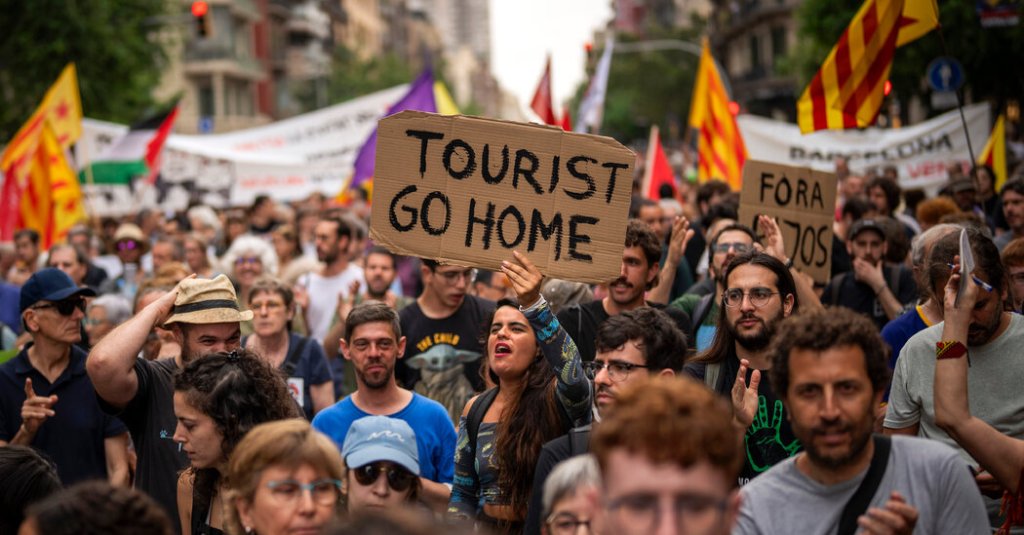
Barcelona received 26 million tourists in 2024. Its resident population is approximately 1.7 million. The ratio — fifteen tourists for every resident, sustained across the year — has produced consequences that the city’s government is now trying to manage with a combination of entry restrictions, licensing freezes, and appeals to the better nature of the travel industry, which has no better nature to appeal to.
The walls of the Gothic Quarter carry graffiti that reads Tourist Go Home. Residents of the Barceloneta neighbourhood, the old fishing district now colonised by short-term rental apartments, have organised. Their signs say: Your Holiday, My Misery. In Mallorca, residents wrote an open letter to potential visitors with the directness that only genuine desperation produces: Do Not Come. The infrastructure cannot bear it. The character of the place — the specific, local, historically produced quality of life that made it worth visiting — is being destroyed by the volume of people arriving to experience it.

The protesters understand, correctly, that this is not primarily a problem of individual tourist behaviour. It is a structural problem. The experience economy has identified the quality of place — the accumulated history, architecture, social texture, and human scale of a city like Barcelona or Venice or Dubrovnik — as an asset to be monetised. It has done so with extraordinary efficiency. And the monetisation process is consuming the asset.
Venice is the terminal case and the perfect symbol. A city that has been a luxury destination, in one form or another, for a thousand years — the Grand Tour, the Romantic pilgrimage, the contemporary cruise ship — is now experimenting with entry fees, group size restrictions, and audio guide bans in an attempt to manage a flow of visitors that its physical infrastructure, built for a population of 120,000 and now serving 30 million annual tourists while housing fewer than 50,000 permanent residents, cannot accommodate. The city is sinking, literally and figuratively, under the weight of the desire to experience it.
Canaletto painted Venice in the eighteenth century for exactly the same market: wealthy visitors who wanted to take home a record of having been there. He was, as has been observed, the original Instagram. His paintings are souvenirs, technically magnificent, produced for a market of tourists who could not take photographs and so commissioned oil on canvas instead. The desire is not new. The scale is new. And the scale is what the infrastructure cannot bear.

Debord’s recuperation, live
Here is where Debord’s concept of recuperation becomes empirically verifiable rather than merely theoretical. In the summer of 2024, protests against overtourism spread across Spain, Greece, Portugal, and Italy. The images of residents confronting tourists with water pistols in Barcelona, of marchers in Mallorca carrying signs about housing costs and destroyed communities, circulated globally. They were covered extensively by the travel press, the lifestyle press, and the general news media.
Tourist arrivals in the affected destinations increased by 4.1% in the first seven months of 2025 compared to the same period the previous year.
The protests became content. The content generated interest. The interest generated visits. The spectacle absorbed the critique and converted it into advertising. This is not cynicism about the protesters, who were entirely sincere and entirely right about their situation. It is an observation about the structural capacity of the experience economy to metabolise resistance. The system does not need to defeat the argument. It only needs to turn it into an image. And images, in the experience economy, sell destinations.
The anti-tourism protest is, from the perspective of the experience economy, free marketing. It signals that the place is contested, alive, real — all qualities that the tourist is paying to encounter. The protest makes the destination more desirable. Debord would not have been surprised.
The theatre and the question of genuine experience
Which brings us to the theatre. And to a distinction that matters more than it might initially appear.
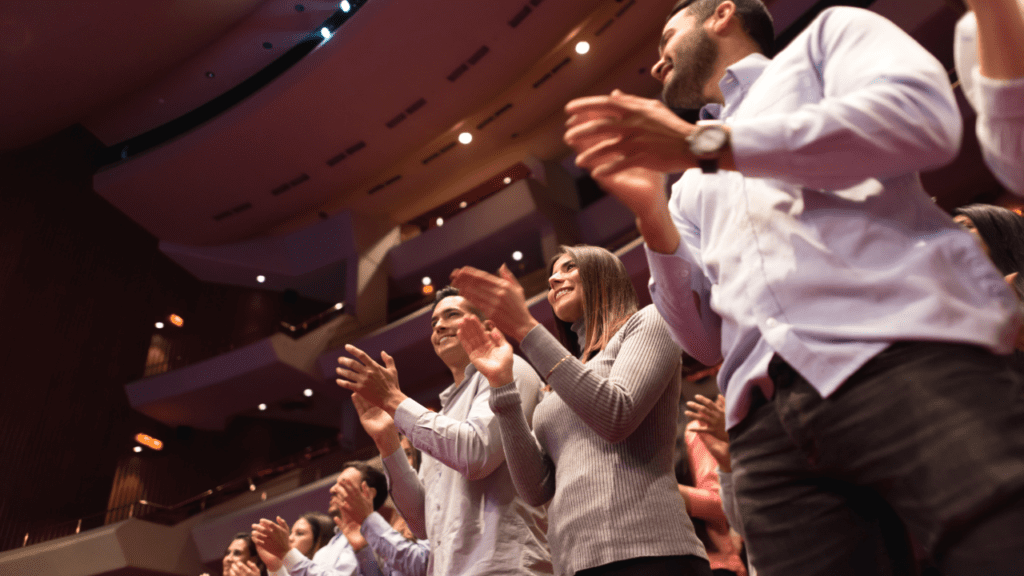
The standing ovation has become, in the British theatre of the past two decades, something close to a reflexive response. The house lights dim. The performance ends. The curtain call begins. A section of the audience rises — often quickly, often led by those nearest the exits, occasionally before the final bow is complete — and the rest follow, because nobody wants to be the person still sitting while others stand. The ovation that was once reserved for the extraordinary has become the standard acknowledgment of the competent. Its currency has inflated to the point of meaninglessness.
This is a genuine observation about a genuine cultural tic. But it is worth being careful about what it actually shows — and what it doesn’t.
What it doesn’t show is that the audience was not genuinely moved. The inflation of the standing ovation is a problem of ritual form, not of experience. The people rising to their feet were, in the two hours before the curtain call, sitting in a room where something unrepeatable was happening in front of them — made of human bodies and voices and the contingency of the live moment, any of which could go wrong at any point, none of which can be rewound. That is the opposite of the spectacular. That is Benjamin’s aura fully alive. The form of appreciation at the end does not retroactively diminish the quality of attention in the middle.
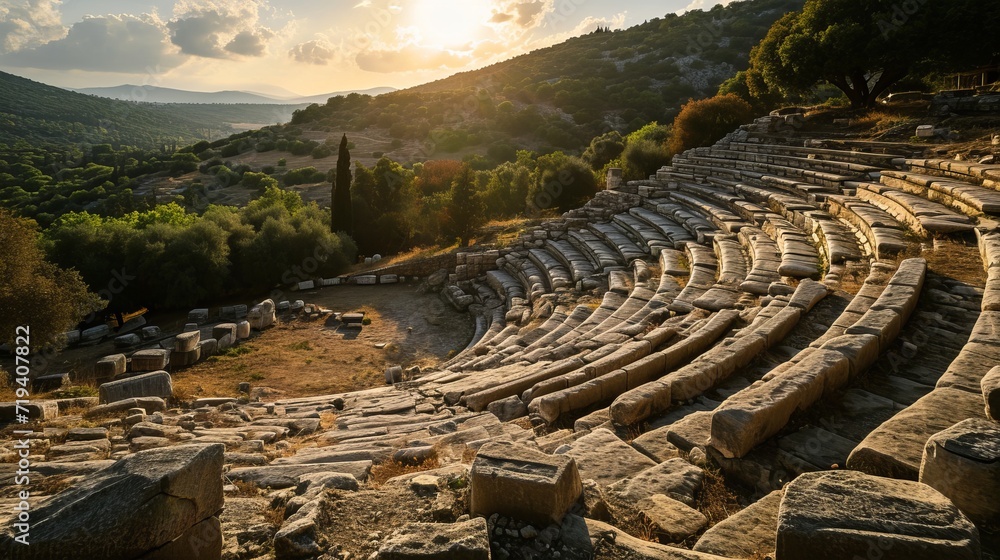
And there is something else. The instinct to reach for the metaphor of ancient Athens — the blokes in the Theatre of Dionysus, sitting on stone seats for six hours watching the Oresteia — as a contrast to the modern audience bouncing up at the curtain call is an instinct that deserves interrogation. The Athenian theatre audience was not composed of aesthetically sophisticated connoisseurs maintaining a reverent silence. It was a noisy, engaged, sometimes rowdy civic gathering that shouted, threw food at bad performances, and expressed its pleasure in ways that would alarm a contemporary theatre manager. The emotional directness of the contemporary standing ovation is not so far from that tradition. What has been lost is not the enthusiasm. It is the civic and collective dimension — the sense that what is happening in the theatre is happening to a community, not to an aggregation of individual consumers who have each purchased a personal experience.
This is the real experience economy problem in the theatre, and it is worth naming precisely. When the theatre ticket becomes primarily a transaction — a luxury experience purchased, like the hotel suite or the tasting menu, for personal consumption and social display — something in the relationship between the work and the audience changes. The work becomes a product to be evaluated rather than an event to be shared. The review posted that evening, the Instagram story from the foyer, the conversation at dinner about whether it was worth the money — these are the spectacular version of theatrical engagement. They are not the same as the two hours of shared attention in the dark.
But — and this matters — the two hours still happen. The story still gets the audience. The live encounter still does what it has always done, which is to place a group of strangers in the presence of something that is happening to them collectively, in real time, without the option to pause or rewind or consume at their own pace. This is the experience that the experience economy cannot fully commodify without destroying. And it persists, in theatres across the country, night after night, regardless of what happens at the curtain call.
What genuine experience looks like — and why it survives
There is a distinction worth drawing, carefully, between two kinds of experience that the experience economy tends to conflate.
The first is the spectacular experience: the Instagram-optimised destination, the heritage site engineered for visitor flow, the restaurant that has adjusted its menu for the algorithm, the concert designed primarily as a content opportunity. These are experiences whose value is located substantially in their image — in the photograph, the story, the social proof of having been there. They are not worthless. They can be genuinely pleasurable. But their relationship to presence is instrumental: the point is to have been there, to have the evidence of having been there, to convert the experience into a form that can be shared and accumulated and displayed.
The second is what we might call, for want of a better term, the genuine experience: the thing that cannot be adequately photographed. The moment in a theatre when the story arrives somewhere unexpected and you feel the person sitting beside you shift in their seat because they felt it too. The walk through a city that goes somewhere unintended because you followed a sound or a smell. The conversation that extends four hours beyond its scheduled end because something real is happening in it. The meal where nobody reaches for their phone because the food and the company have made that gesture unthinkable.
The distinction is not between high culture and popular culture. It is not between expensive and cheap, educated and uneducated, old and young. It is between experience that is constituted by presence and experience that is constituted by the image of presence. And the crucial point is this: the second category is not produced by the experience economy. It is produced by paying attention. And attention — genuine, embodied, present attention — is the one thing the spectacle cannot commodify without destroying.
The moment you monetise the attention, you redirect it from the thing to the transaction. The meditation app makes you watch the progress bar. The mindfulness retreat makes you wonder whether you are being mindful enough to justify the cost. The authentic travel company makes you anxious about whether your experience is sufficiently authentic. The machinery of the experience economy, applied to genuine presence, generates the very distraction that genuine presence requires you to overcome.
This is why the experience economy eats itself. It identifies the value of genuine presence, builds a market for it, monetises it at scale, and in doing so creates the conditions that make genuine presence harder to achieve. The solution it offers to the problem it has created is more product: better noise-cancelling headphones, more exclusive access, higher price points that signal seriousness of intent. None of which produces the thing it promises.
What remains
Pull back from the specific instances — the Barcelona protesters, the inflated curtain call, the Venice entry fee — and a pattern is visible that is, on balance, less pessimistic than the spectacle theory at its most totalising tends to suggest.
The experience economy has not captured everything. It has not captured the conversation that goes on longer than expected. It has not captured the walk that goes somewhere unintended. It has not captured the two hours of shared attention in the dark before the curtain call. It has not captured the quality of presence that is produced when a group of strangers agrees, implicitly and without negotiation, to pay attention to the same thing at the same time.
These things are not niche or residual or the preserve of a cultural elite. They are available to anyone with the time and the inclination to stop producing content from their experience long enough to have the experience. The theatre that charges £15 for a ticket produces the same quality of live encounter as the one that charges £150. The city walk that follows no itinerary produces the same quality of presence as the guided tour. The meal cooked at home with genuine attention can be more genuinely experienced than the restaurant meal photographed for documentation.
The market cannot sell this. Which is, from the perspective of the market, its only flaw. From the perspective of the people who might actually want to live their lives rather than document them, it is its primary recommendation.
Debord ended the Society of the Spectacle with a call to the construction of situations — the deliberate creation of moments of genuine, unmediated experience that broke through the spectacular surface. He was thinking of political intervention, of radical disruption. But the construction of situations is available at a much more modest level: the decision to put the phone away, to follow the unexpected turning, to sit still in the theatre until the feeling of what just happened has had time to settle.
The blokes in Athens were doing that. On stone seats, for six hours, in the open air, with no interval and no programme notes. The story got them then. It gets people now. That continuity — the persistence of genuine experience through every economic system that has tried to package and sell it — is the most encouraging thing this series has encountered. It is also, in its quiet way, a form of resistance.
— — —
Parts Six and Seven of this series move from the theoretical to the particular. Part Six examines the appropriation of Black music by a white industry — not as a story about cultural ownership but as a story about economic extraction and power. Part Seven turns to Venice: empire, trade, ecological nightmare, democratic experiment, sublime landscape, and the most beautiful terminal case of the experience economy in the world. Both, in their different ways, are about what survives when the system tries to consume it.
— — —
A NOTE ON METHOD
This essay draws on conversations with Claude (Anthropic’s AI) as the research and synthesis engine, and on: Guy Debord, The Society of the Spectacle (1967); B. Joseph Pine II and James H. Gilmore, The Experience Economy (1999); Walter Benjamin, The Arcades Project; tourism data from Barcelona City Council and the World Tourism Organisation (2024-2025); and the author’s own experience of theatres in which curtain calls have occurred. The thinking is collaborative; the voice, selection, and responsibility are the author’s own.
Next: Part Six — The Co-option: Black music, the white industry, and forty years of economic extraction dressed as cultural appreciation.


Leave a Reply